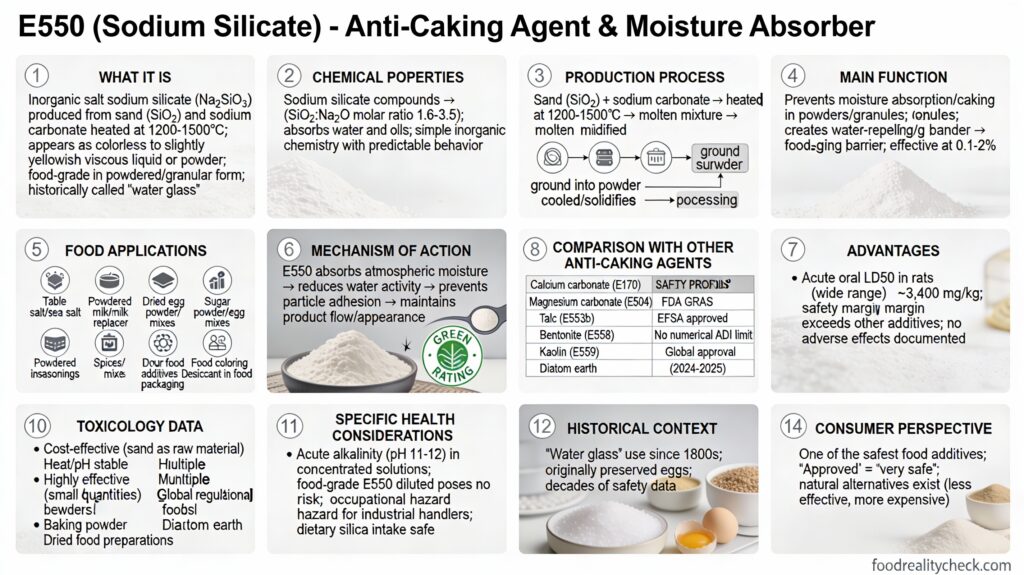
What is E550?
Complete guide to understanding E550 (Sodium Silicate) in your food
The Quick Answer
E550 is a synthetic inorganic anti-caking agent (sodium silicate or “water glass”) that prevents powders and granules from clumping.
It’s used in table salt, powdered foods, dried milk, and other powdered products to maintain free-flowing consistency.
It is one of the safest food additives with minimal documented health concerns at approved food use levels.
📌 Quick Facts
- Category: Inorganic anti-caking agent and moisture absorber
- Chemical Name: Sodium silicate(s) or sodium metasilicate
- Chemical Formula: Na₂SiO₃ or similar (varies; hydrated form is most common in food)
- Also Known As: Water glass, soluble silica, sodium metasilicate, liquid glass
- Source: Entirely synthetic, produced from sand (SiO₂) and sodium carbonate
- Found in: Table salt, powdered milk, dried eggs, sugar products, baking powder, spices, powdered foods
- Safety Status: FDA GRAS (Generally Recognized as Safe); EU approved; ADI not defined (very low toxicological concern)
- Health Risk Assessment: GREEN – SAFE; minimal documented health concerns at food use levels
What Exactly Is It?
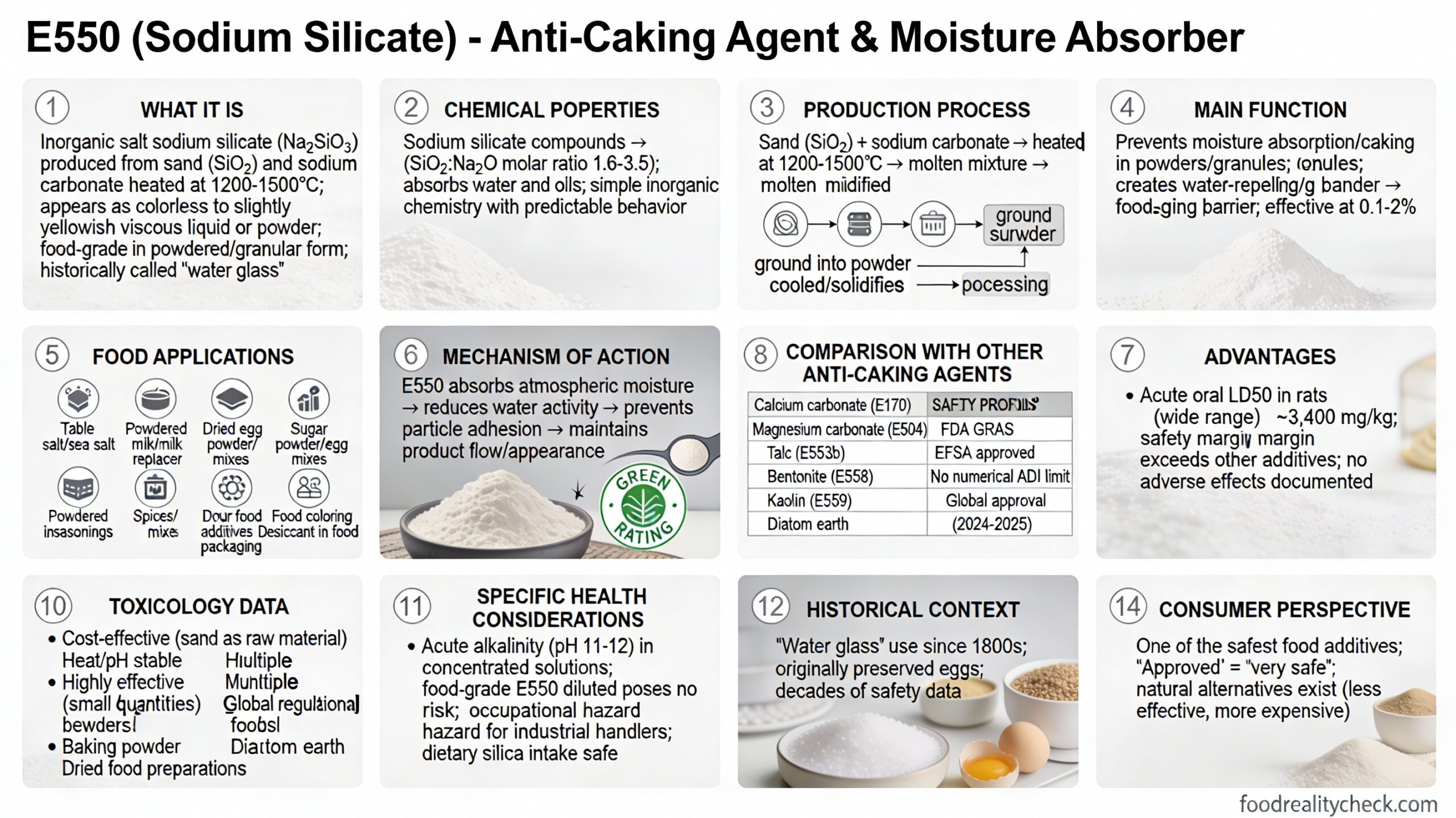
E550 is a simple inorganic salt produced by heating sand (silicon dioxide, SiO₂) with sodium carbonate (Na₂CO₃) at high temperature.
The primary chemical compound is sodium silicate (Na₂SiO₃), though the term “sodium silicates” encompasses a range of related compounds with different SiO₂:Na₂O molar ratios (typically 1.6–3.5).
E550 appears as a colorless to slightly yellowish viscous liquid or solid (depending on form). Food-grade E550 is typically in powdered or granular form for anti-caking applications.
The mechanism: E550 absorbs excess moisture in powders and granules, preventing crystal aggregation and clump formation. It can absorb both water and oils, making it effective across diverse food environments.
E550 is entirely synthetically manufactured—there is no natural form, though it is derived from abundant natural materials (sand and soda ash).
Historically called “water glass,” sodium silicate was used in the 19th century to preserve eggs by coating them with a protective silicate layer.
Where You’ll Find It
E550 appears in many powdered and granulated foods:
• Table salt and sea salt
• Powdered milk and milk replacer
• Dried egg powder and egg mixes
• Sugar products (icing sugar, powdered sugar)
• Baking powder
• Spices and seasonings
• Instant soup powders and broths
• Powdered instant foods (coffee, cocoa, drinking chocolate)
• Flour and cake mixes
• Dried food preparations
• Food coloring and additives
• Desiccant in food packaging (preventing moisture absorption)
E550 is extremely common in powdered food products globally.
Why Do Food Companies Use It?
E550 serves one critical preservation function:
Prevents moisture absorption and caking: Powders and granules naturally absorb atmospheric moisture, causing particles to clump and aggregate. E550 absorbs both water and oils, maintaining free-flowing consistency. This is critical for salt, powdered milk, baking powder, and other products requiring consistent dispensing.
Highly effective: Small quantities (0.1–2% depending on application) provide significant anti-caking benefit.
Cost-effective: Inexpensive raw material (sand) and simple manufacturing process make it economical.
Heat and pH stable: E550 remains stable across wide temperature and pH ranges used in food processing and storage.
Multiple functional benefits: Besides anti-caking, E550 can serve as desiccant (removes moisture from packages), preservative agent (though E535/E536 are more common for this), and egg preservative (historical use).
Regulatory approval: Widely approved with minimal restrictions, reducing manufacturer liability concerns.
Is It Safe?
Yes—E550 is one of the safest food additives with minimal documented health concerns at approved food use levels.
The FDA classifies sodium silicate as GRAS (Generally Recognized as Safe).
The EFSA approved E550 with no numerical ADI (Acceptable Daily Intake) limit specified—a designation reserved for substances with exceptionally low toxicological concern.
Acute oral LD50 (lethal dose in 50% of test animals) in rats is approximately 3,400 mg/kg body weight for food-grade sodium silicate—extraordinarily high, indicating very low acute toxicity.
✓ GREEN SAFETY RATING – SAFE: E550 has:
• No documented genotoxicity (DNA damage)
• No carcinogenicity at food use levels
• No reproductive or developmental toxicity
• No chronic systemic health effects at approved food doses
• Minimal absorption from gastrointestinal tract
• No accumulation in body tissues
• Simple inorganic chemistry with predictable biological behavior
Safety data demonstrates E550 is one of the least concerning food additives in regulatory systems globally.
What Are The Health Concerns?
E550 has essentially no documented health concerns at approved food use levels. However, some technical considerations exist:
Acute alkalinity (concentrated solutions only): Pure sodium silicate solutions are highly alkaline (pH 11–12) and can cause irritation or burns if ingested in concentrated form or contact eyes/skin. However, food-grade E550 is properly diluted and contains minimal amounts, posing no such risk for consumers. This is an occupational hazard for handlers of industrial sodium silicate, not a consumer food safety concern.
Silica intake from food sources: E550 contributes soluble silica to diet. While soluble silica is generally considered safe and may have beneficial effects (silica is essential for bone and connective tissue health), extremely high chronic silica exposure from non-food sources (occupational inhalation) can cause silicosis (lung disease). Food use poses no such risk—dietary silica intake is far below dangerous levels.
Mineral bioavailability (theoretical concern): Some studies suggest anti-caking agents may slightly reduce vitamin C stability in fortified foods. However, this is a general anti-caking agent concern, not specific to E550, and is minimal in practical food applications.
No absorption or accumulation: Ingested E550 is minimally absorbed through the gastrointestinal tract and does not accumulate in body tissues. Most is excreted unchanged.
No genotoxicity or carcinogenicity: Extensive testing shows no genetic damage or cancer potential at any tested dose levels.
Natural vs Synthetic Version
E550 is entirely synthetic—there is no natural form.
It’s produced through heating sand (silicon dioxide) with sodium carbonate at high temperature (1200–1500°C).
However, the raw materials (silicon dioxide from sand, sodium carbonate from mineral deposits or Solvay process) are derived from abundant natural sources.
Natural Alternatives
Want to avoid E550?
Natural anti-caking agents include:
• Calcium carbonate (E170) – natural mineral
• Magnesium carbonate (E504) – natural mineral
• Talc (E553b) – natural mineral (though controversial in cosmetics)
• Bentonite (E558) – natural clay from volcanic origin
• Kaolin (E559) – natural clay mineral
• Diatom earth – natural silica-based powder
• No anti-caking agent – accept potential clumping (requires better storage/handling)
Natural alternatives are less effective and more expensive, which is why synthetic E550 remains widely used. However, they are available for consumers seeking to avoid all synthetic additives.
The Bottom Line
E550 (Sodium Silicate) is a simple inorganic anti-caking agent with an exceptional safety profile—one of the safest food additives available, with no documented health concerns at approved food use levels and no evidence of genotoxicity, carcinogenicity, reproductive toxicity, or chronic systemic effects.
Safety Confidence: EFSA’s decision to set no numerical ADI (a designation reserved for the safest additives) reflects the exceptionally low toxicological concern. Acute LD50 in rats is extraordinarily high (~3,400 mg/kg), far exceeding other food additives.
Why It’s Safe at Food Levels: E550 is a simple inorganic salt with well-understood chemistry and minimal absorption from the gastrointestinal tract. It does not accumulate in body tissues and is rapidly excreted.
Occupational vs. Consumer Risk: The only documented health concerns relate to occupational exposure to industrial sodium silicate solutions (concentrated alkaline liquid), not consumer food use. Food-grade E550 poses no such risk.
Silicosis Concern (Not Relevant for Food): While chronic inhalation of silica dust can cause silicosis (occupational lung disease), dietary intake of silica from food sources poses no such risk—food amounts are negligible and are ingested (not inhaled).
Regulatory Consensus: FDA GRAS approval, EFSA approval with no ADI limit, and global regulatory approval without restrictions reflect scientific consensus on safety.
Recommendation: E550 is one of the few food additives where “approved” genuinely means “very safe.” It is not an additive you should try to avoid based on health concerns. If you have concerns about synthetic additives generally (regardless of safety data), natural alternatives exist but are less effective and more expensive.