What is E560?
Complete guide to understanding E560 — the most critical discovery: E560 is NOT a food additive, it’s a feed additive. Not approved for human food in the EU.
The Quick Answer
E560 is NOT a food additive — it’s a feed additive for animal nutrition. Despite the E-number designation, E560 is not approved for human food consumption in the EU; it’s approved only for animal feed under separate regulations.
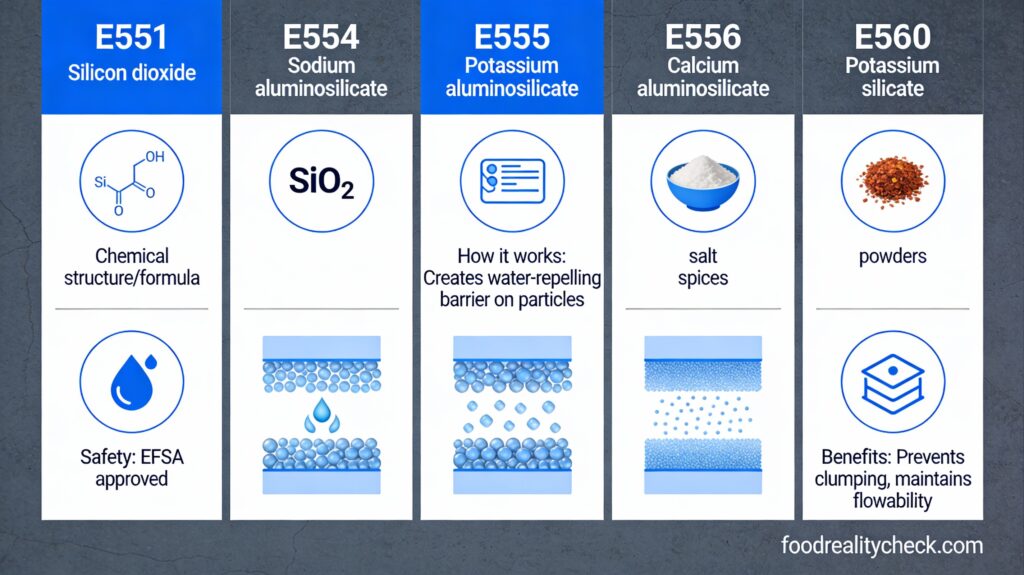
What makes E560 uniquely important: This is the first additive in this entire research collection that revealed a critical consumer misconception: not all E-numbers are food additives. E560 is a perfect example. The E-number designation suggests it’s approved for food use like E551, E554, E555, etc. But E560 is completely different — it’s a feed additive authorized under different regulations for use in animal nutrition. E560 (natural mixtures of talc and chlorite) is approved by EFSA as a hygiene condition enhancer for livestock feed. But it’s NOT in any human food products in the EU because it’s not authorized as a food additive. This distinction matters enormously for consumers because it means: (1) You will NOT find E560 in EU human food, (2) E560 may indirectly reach you through meat/dairy from treated animals (but EFSA found no safety concern), (3) The E-number system can be confusing because not all E-numbers mean food additives.
E560 is unique: an E-number for a feed additive, not a food additive.
📌 Quick Facts
- What It Is: Natural mixtures of talc (steatite) and chlorite (NTMC)
- Type: FEED ADDITIVE (not food additive)
- Regulatory Home: EC 1831/2003 (feed regulations), NOT EC 1333/2008 (food regulations)
- Function: Hygiene condition enhancer; pathogenic control in animal feed
- EU Food Approval: NOT APPROVED (not on food additives list)
- EU Feed Approval: APPROVED (authorized for animal feed)
- Found in Human Food (EU): NO (not authorized)
- Found in Animal Feed (EU): YES (approved for livestock, poultry)
- EFSA Assessment: 2018 re-evaluation; confirmed safe for animal feed
- Consumer Impact: Not directly in food; indirect exposure through treated animals
The Critical Distinction: Feed Additive vs. Food Additive
Most important concept: E560 is NOT a food additive despite the E-number designation.
| Characteristic | Food Additive (E551-E559, E561+) | Feed Additive (E560) |
|---|---|---|
| Regulatory base | EC Regulation 1333/2008 (food additives) | EC Regulation 1831/2003 (feed additives) |
| Approval list | Annex II to Regulation 1333/2008 | Separate feed additives register |
| Direct human consumption | YES – in food products | NO – only in animal feed |
| Intended use | Human food (salt, spices, supplements, etc.) | Animal nutrition (livestock, poultry feed) |
| Safety assessment | Based on human dietary exposure | Based on animal feed use + indirect human exposure |
| Labeling in food | YES – must be listed on food label | NO – not on food labels (not in food) |
| E560 examples | N/A – E560 not a food additive | Talc/chlorite mixture for poultry feed |
What Exactly Is E560?
E560 is a natural mineral mixture of talc and chlorite used only in animal feed — NOT in human food.
Official designation: Natural mixtures of talc (steatite) and chlorite (NTMC)
Composition: At least 75% talc and chlorite as main components; may include other mineral components
Appearance: Fine gray-white powder; mineral origin
Origin: Natural mineral mined from geological deposits; not synthesized
Primary function in animal feed:
– Hygiene condition enhancer
– Reduces pathogenic bacteria in feed
– Improves animal health outcomes
– Maintains feed quality during storage
Key properties:
– Natural mineral composition
– Adsorbent properties (binds pathogens)
– Fine powder form (disperses in feed)
– Chemically stable in animal digestive system
– Not absorbed in significant amounts
– Harmless passage through animal GI tract
Where E560 Is (and Isn’t) Found
E560 distribution: strictly separated between animal feed and human food.
| Product Category | Contains E560? | Regulatory Basis | Notes |
|---|---|---|---|
| EU Human Food | NO | Not authorized (1333/2008) | E560 cannot legally be added to human food |
| Table salt | NO | Not approved for salt | Uses E551, E554, E555, E556, E558 instead |
| Spices and seasonings | NO | Not approved additive | Uses other anti-caking agents |
| Food supplements | NO | Not authorized | Different anti-caking agents used |
| EU Animal Feed | YES | Authorized (1831/2003) | Approved for livestock, poultry feed |
| Livestock feed | YES | EFSA approved (2018) | Hygiene condition enhancer |
| Poultry feed | YES | Approved use | Pathogenic control in feed |
| Pet food (varies) | Varies | Country-specific regulations | May be included in some pet feeds |
Critical distinction: E560 is in animal feed, NOT in human food, in the EU.
EFSA 2018 Assessment of E560
Most recent regulatory evaluation: EFSA 2018 re-evaluation of talc/chlorite mixture for animal feed.
EFSA Opinion (2018): “Safety and efficacy of natural mixtures of talc (steatite) and chlorite (E 560) as a feed additive for all animal species”
Key findings:
– Safety for animals: E560 confirmed safe for livestock and poultry when used in feed
– Function efficacy: Hygiene condition enhancer confirmed effective
– Indirect human exposure: Assessed carry-over risk to meat/dairy from treated animals
– Consumer safety: “No concerns identified for consumers from carry-over to food products from animals fed E560”
– Approval: Recommended for continued authorization as animal feed additive
Why re-evaluation occurred: Talc has historical concerns about potential asbestos contamination in older sources. EFSA needed to confirm that modern talc sourcing is properly controlled to prevent asbestos-like fiber contamination.
Outcome: Modern talc/chlorite products meet specifications; no asbestos concerns identified; safe for animal feed use.
Potential Indirect Human Exposure
How E560 could theoretically reach humans: indirect route through treated animals.
Exposure pathway:
1. E560 (talc/chlorite) added to livestock or poultry feed
2. Animals consume feed containing E560
3. E560 passes through animal digestive system
4. Talc/chlorite NOT absorbed (remains in GI tract)
5. Excreted in waste or minimal residue remains
6. Minimal to no carry-over to meat/dairy
7. Any theoretical residue would be negligible
EFSA assessment of this pathway: “No safety concerns identified for indirect human consumers.”
Bottom line on indirect exposure: Even if E560 were used in animal feed, the amount that could theoretically carry over to meat or dairy is negligible, and EFSA found no safety concern for this route.
The Bottom Line
E560 is a feed additive (not food additive) — not found in EU human food, approved only for animal feed use.
Key facts about E560:
– Not a food additive: E560 is not on the EU approved food additives list (1333/2008)
– Is a feed additive: E560 is authorized under animal feed regulations (1831/2003)
– Not in your food: E560 cannot legally be added to any human food in the EU
– In animal feed: E560 is approved for livestock and poultry feed
– EFSA assessment: 2018 re-evaluation confirmed safety for animal feed use
– Indirect exposure: No safety concern identified from potential carry-over to meat/dairy
– Consumer impact: Minimal; E560 is not a food additive concern because it’s not in food