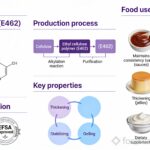
What is E463?
Complete guide to understanding hydroxypropyl cellulose in your food
The Quick Answer
E463 is hydroxypropyl cellulose (HPC), a plant-based thickener and stabilizer derived from cellulose.
It’s used to improve texture, prevent separation, and extend shelf life in ice cream, dairy products, baked goods, and numerous processed foods.
Most people who eat ice cream, dairy products, or processed baked goods regularly consume trace amounts of it.
📌 Quick Facts
- Category: Thickener, Stabilizer & Emulsifier
- Found in: Ice cream, cheese, dairy, baked goods, sauces, desserts
- Safety: FDA-approved (GRAS), EFSA-approved, no ADI needed
- Approved by: FDA, EFSA, JECFA
- Key Fact: Plant-based cellulose derivative with water solubility
What Exactly Is E463?
E463 is hydroxypropyl cellulose (HPC or hydroxypropylcellulose), a plant-derived thickener and stabilizer created from cellulose—the main structural component of plant cell walls.
More specifically, cellulose is partially modified by attaching hydroxypropyl groups through chemical etherification. This semisynthetic process creates a compound with unique properties useful in food production.
E463 appears as a white to cream-colored powder that is odorless and tasteless. Unlike some other cellulose derivatives, E463 is soluble in water, giving it broader applications in food systems.
In technical terms, it’s a nonionic polymer that thickens liquids, stabilizes emulsions, forms films, and prevents separation in complex food systems. It belongs to the broader cellulose family of additives (E460-E469), all sharing similar plant-based origins.
Where You’ll Find E463
E463 appears in numerous processed foods requiring thickening or stabilization:
– Ice cream and frozen desserts
– Cheese and cheese products
– Milk and dairy products
– Sauces and gravies
– Soups and broths
– Jams, jellies, marmalades, gels
– Desserts and puddings
– Cakes, pastries, biscuits
– Icings and fillings
– Baked goods and ready-made mixes
– Salad dressings and mayonnaise
– Meat and fish products
– Whipped toppings and creams
– Toppings and coatings
– Vegetable protein products
– Nutritional supplements
– Mustard
– Table-top sweeteners (tablets and powders)
– Non-alcoholic beverages
If you eat ice cream, dairy products, baked goods, or processed sauces, you’ve almost certainly consumed E463. It’s one of the most common food additives in processed foods.
💡 Pro Tip: Look for “Hydroxypropyl cellulose,” “HPC,” “Hydroxypropylcellulose,” or “E463” on ingredient lists. It’s especially common in dairy products and frozen desserts where its thickening and stabilizing properties are essential for desired texture.
How E463 Works in Food
E463 serves multiple critical functions in food production.
As a thickener: E463 increases the viscosity of liquids, giving them desired texture and mouthfeel. In sauces, dressings, and soups, it creates the appropriate consistency without adding bulk. Because it’s water-soluble (unlike some other cellulose derivatives), it disperses easily in aqueous systems.
As a stabilizer: E463 prevents separation of oil and water phases in complex emulsions. In ice cream, for example, it prevents ice crystal formation and maintains smooth texture. In dairy products, it prevents separation during storage.
As an emulsifier: E463 helps oils and water remain mixed together, creating stable emulsions in products like mayonnaise and creamy dressings.
In whipped products: E463 acts as a foaming aid and stabilizer in whipped toppings and creams, maintaining desired foam structure.
As a film former: E463 creates protective coatings on foods, acting as an oil and oxygen barrier to maintain freshness.
Why Do Food Companies Use E463?
E463 solves specific technical problems that manufacturers cannot solve without it.
Without proper stabilizers, ice cream would separate and develop ice crystals. Without thickeners, sauces would be too thin. Without emulsifiers, oil and water would separate. E463 addresses all these issues simultaneously in many applications.
Its water solubility makes it particularly useful compared to some other cellulose derivatives—it disperses easily in aqueous food systems without special processing.
Is It Safe?
Regulatory authorities confirm E463 is safe for food use.
The FDA classifies E463 as “Generally Recognized As Safe” (GRAS). The EFSA conducted a comprehensive re-evaluation in 2017-2018 and concluded that there is “no need for a numerical ADI” (no numerical daily intake limit needed) and “no safety concern at the reported uses and use levels.”
JECFA specified that no ADI needs to be set—indicating exceptionally high safety margins.
✓ Safety Confirmed: The EFSA’s 2017-2018 re-evaluation confirmed no safety concern for E463. No numerical ADI is needed, indicating exceptional safety. Actual exposure at approved use levels is far below any threshold for concern.
The EFSA’s 2017-2018 Comprehensive Safety Re-evaluation
The European Food Safety Authority’s thorough 2017-2018 re-evaluation of all cellulose derivatives (E460-E469) provides authoritative reassurance.
Key findings:
– No numerical ADI needed for E463—indicating exceptional safety
– No safety concern at reported uses and use levels
– No systemic toxicity observed in animal studies
– No mutagenic effects (genetic damage)
– No carcinogenic effects (cancer risk)
– No reproductive toxicity or developmental effects at doses greater than 1,000 mg/kg
– NOAEL (No Observed Adverse Effect Level): up to 9,000 mg/kg bw per day
– Combined cellulose exposure at 95th percentile: 506 mg/kg bw per day (far below concerning levels)
The 2017-2018 EFSA Panel concluded that safety is assured at all approved use levels.
Absorption and Metabolism
E463 is not absorbed from the gastrointestinal tract.
Studies in rats fed labeled E463 demonstrated that the additive passes through the digestive system intact and is quantitatively excreted in feces without absorption. This means it cannot accumulate in the body.
Important Note: E463 vs E463a
E463 comes in two related forms:
– E463: Hydroxypropyl cellulose (HPC) – water-soluble, established 1989
– E463a: Low-substituted hydroxypropyl cellulose (L-HPC) – water-insoluble, approved 2018
L-HPC (E463a) is a newer addition approved in 2018 for use in dietary supplements in solid form (tablets). The EFSA concluded “no safety concern” for L-HPC as well. Both forms share similar safety profiles due to their close chemical relationship.
Pharmaceutical History
E463 has been safely used in medications for decades.
Hydroxypropyl cellulose is used as an eye drop lubricant for treating dry eye conditions (keratoconjunctivitis sicca) and as a lubricant for artificial eyes. It’s also used as an excipient (inactive ingredient) in tablets and capsules. This extensive pharmaceutical use demonstrates exceptional safety—millions of people have consumed it in medications without documented adverse effects.
Plant-Based and Dietary Attributes
E463 is entirely plant-based with excellent dietary compatibility:
– Vegan ✓
– Vegetarian ✓
– Gluten-free ✓
– Plant-based ✓
– All religious groups ✓
E463 is derived from cellulose sourced from plant materials (wood pulp, cotton linter), making it suitable for all dietary preferences.
Manufacturing and Purity Standards
E463 is manufactured through controlled chemical synthesis using plant-derived cellulose.
Cellulose is extracted from plant materials (wood pulp or cotton linter) and then chemically modified using propylene oxide to attach hydroxypropyl groups. The process is semisynthetic—it requires chemical synthesis but starts from a natural plant material.
Food-grade E463 meets strict purity and specification standards.
Potential Side Effects—Generally Well-Tolerated
At food additive levels, E463 causes no adverse effects in most people.
Because E463 is water-soluble, it can be fermented in the large intestine. However, this only causes problems at unusually large concentrations beyond normal food use. At food additive levels, no adverse effects occur.
Comparison with Other Celluloses
E463 is part of the cellulose family:
– E460: Microcrystalline cellulose (i) and powdered cellulose (ii)
– E461: Methyl cellulose
– E462: Ethyl cellulose
– E463: Hydroxypropyl cellulose (this product)
– E464: Hydroxypropyl methyl cellulose
– E465: Ethyl methyl cellulose
– E466: Sodium carboxymethyl cellulose (has more restrictions)
– E468: Cross-linked sodium carboxymethyl cellulose
– E469: Enzymatically hydrolysed carboxymethyl cellulose
All were evaluated together in 2017-2018; E463 specifically cleared with no safety concerns.
Feed Additive Status
E463 is approved as a feed additive for all animal species.
It’s considered safe for animals and safe for the environment, indicating confidence in its overall safety profile.
The Bottom Line
E463 (hydroxypropyl cellulose) is a plant-based thickener and stabilizer used in ice cream, dairy products, baked goods, and numerous processed foods.
Regulatory authorities worldwide classify it as safe, with the FDA rating it GRAS and the EFSA confirming “no safety concern at reported uses and use levels.”
The EFSA’s 2017-2018 re-evaluation found no numerical ADI is needed—indicating exceptional safety.
At normal food use levels, actual exposure is far below any threshold for concern.
E463 is not absorbed from the gastrointestinal tract—it passes through the body intact and is excreted in feces.
E463 is entirely plant-based and suitable for all dietary preferences including vegan, vegetarian, and gluten-free diets.
It has been safely used in medications for decades with millions of people consuming it daily.
Most people eating ice cream, dairy products, or baked goods consume E463 regularly without documented health concerns.
As always, food labels must declare E463 when used, enabling informed consumer choice.