What is E476?
Complete guide to understanding polyglycerol polyricinoleate (PGPR) in your food
The Quick Answer
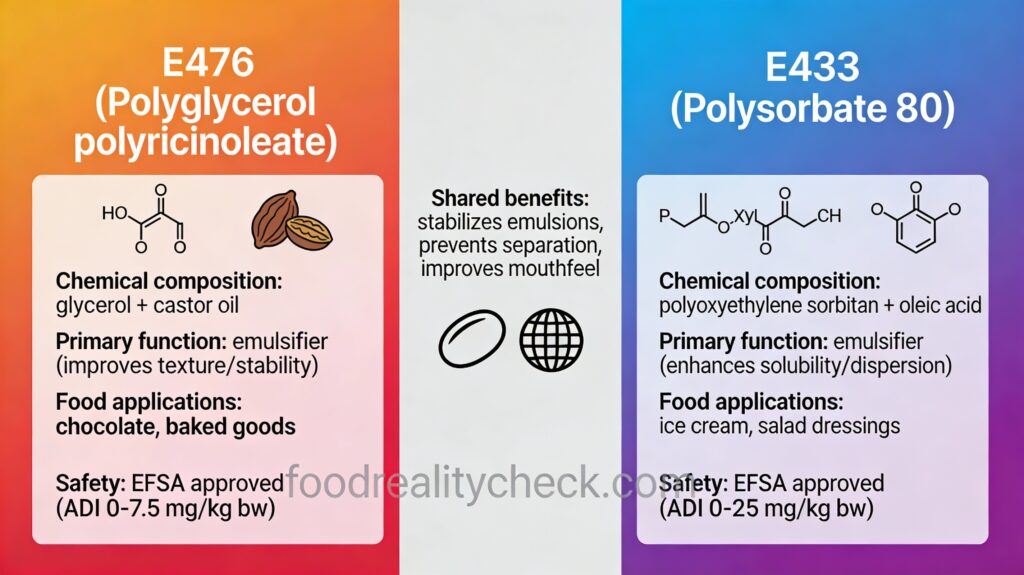
E476 is polyglycerol polyricinoleate (PGPR), an emulsifier made from glycerol and castor oil fatty acids, used primarily in chocolate to reduce viscosity and improve processing efficiency.
It allows chocolate with low cocoa butter content to flow as smoothly as high-fat chocolate, enabling manufacturers to reduce costs while maintaining quality. It’s also used in spreads, dressings, and baked goods.
Most people eating chocolate regularly consume small amounts of E476.
📌 Quick Facts
- Category: Emulsifier & Stabilizer
- Found in: Chocolate, spreads, dressings, baked goods, margarine
- Safety: FDA-approved (GRAS), EFSA-approved with ADI increased to 25 mg/kg (2017)
- Approved by: FDA, EFSA, JECFA
- Key Fact: Reduces chocolate viscosity; allows lower cocoa butter content without quality loss
What Exactly Is E476?
E476 is polyglycerol polyricinoleate (PGPR), a semisynthetic emulsifier made from glycerol and ricinoleic fatty acids (primarily from castor oil).
More specifically, E476 consists of a short chain of glycerol molecules connected by ether bonds, with ricinoleic acid side chains connected by ester bonds. It’s a yellowish, viscous, oily liquid that is strongly lipophilic—soluble in fats and oils but insoluble in water and ethanol.
E476 is classified as a water-in-oil (W/O) nonionic emulsifier, meaning it’s particularly effective at keeping water droplets dispersed within an oil-based matrix.
In technical terms, E476 works as a surfactant with both oil-attracting and water-attracting properties, though its strong affinity for oils makes it particularly suited for chocolate and fat-based applications.
Where You’ll Find E476
E476 appears in numerous chocolate, confectionery, and spread products:
– Chocolate and chocolate-type products
– Compound chocolate coatings
– Cocoa-based candies and confectionery
– Margarine and spreads
– Salad dressings
– Emulsified sauces
– Baked goods (cakes, pastries)
– Ice cream and edible ices (via chocolate coatings)
– Fat-reduced food products
– Dairy product spreads
If you eat chocolate, spreads, dressings, or baked goods, you’ve likely consumed E476. According to industry data, it’s declared in more than 8,200 food products.
💡 Pro Tip: Look for “Polyglycerol polyricinoleate,” “PGPR,” or “E476” on ingredient lists. It’s most commonly found in chocolate products and chocolate-based confectionery.
How E476 Works in Food
E476’s primary function is reducing viscosity (thickness) in chocolate, enabling more efficient processing and cost savings.
As a viscosity reducer in chocolate: E476 decreases the friction between solid particles (cacao, sugar, milk) in molten chocolate. This reduces the yield stress so that chocolate flows more easily, approaching the behavior of a Newtonian fluid (flows smoothly at different shear rates). This improvement in flow characteristics is especially noticeable near the melting point.
Processing improvements: Better chocolate flow improves the efficiency of coating processes—chocolate coatings flow better around shapes of products being enrobed or dipped. In molded products, chocolate flows more easily into molds, surrounds inclusions more effectively, and releases trapped air more readily.
Cost reduction through cocoa butter replacement: By reducing the viscosity of chocolate, E476 allows manufacturers to reduce the amount of cocoa butter needed. Cocoa butter is expensive; this reduction can significantly lower production costs. The result is that chocolate with lower cocoa butter content (and thus lower cost) flows and feels as smooth as higher-fat chocolate.
Bubble elimination: E476 helps release small bubbles generated during the molding process, avoiding bubbles and holes in the finished chocolate product.
Synergy with lecithin: E476 works synergistically with lecithin (E322), another emulsifier. Combined use enhances emulsification beyond what either substance achieves alone.
In spreads and dressings: E476 functions as an emulsifier to keep water and oil phases mixed, maintaining smooth, uniform texture without separation.
Why Do Food Companies Use E476?
E476 provides multiple benefits that manufacturers value: cost reduction, processing efficiency, product consistency, and thermal stability.
The primary driver is cost savings. By allowing reduction in cocoa butter content without compromising flow characteristics or sensory qualities, E476 enables manufacturers to produce chocolate that consumers perceive as premium while reducing production costs. Without E476, achieving smooth flow with less cocoa butter would be impossible.
Secondary benefits include processing efficiency (faster molding, better equipment performance) and consistent product quality across batches.
Is It Safe?
Regulatory authorities worldwide confirm E476 is safe for food use at approved levels.
The FDA approved polyglycerol polyricinoleate as Generally Recognized as Safe (GRAS) for use in chocolate-type products. The EFSA conducted a comprehensive safety re-evaluation in 2017 and concluded it poses no safety concern at permitted uses and levels. JECFA (the international FAO/WHO expert committee) also approved it.
In fact, the 2017 EFSA re-evaluation found E476 to be “even more harmless than previously assumed,” leading to an increase in the Acceptable Daily Intake (ADI) from 7.5 mg/kg to 25 mg/kg body weight per day.
✓ Safety Confirmed: The EFSA’s 2017 comprehensive safety re-evaluation established an ADI of 25 mg/kg body weight per day for E476—a 3-fold increase from the previous ADI. Regulatory authorities concluded E476 is safe at permitted uses and levels. The compound has been extensively studied since the 1950s with no safety concerns identified.
The EFSA’s 2017 Comprehensive Safety Re-evaluation
The European Food Safety Authority’s thorough 2017 re-evaluation provides authoritative reassurance about E476’s safety.
Key findings:
– Safe at permitted uses and levels – No safety concern identified
– ADI increased to 25 mg/kg body weight per day (from previous 7.5 mg/kg)
– NOAEL: 2,500 mg/kg body weight per day – No observed adverse effect level from animal studies
– No carcinogenic effects – Animal studies found no carcinogenicity
– Metabolism: E476 metabolizes to free polyglycerols and ricinoleic acid, which are safe
– Ricinoleic acid: Safe as an edible oil; not of toxicological concern
– No metabolic interference: No evidence of interference with normal fat metabolism
– Digestion: Approximately 98% digested by animals, utilized as energy source
Safety Studies and Toxicity Data
E476 has been extensively studied since the 1950s with consistently reassuring results.
Acute toxicity: Low acute oral toxicity. Animal studies show E476 is tolerated at high doses without adverse effects.
Long-term toxicity: A 1998 comprehensive review of studies from the late 1950s and early 1960s concluded that “PGPR does not constitute a human health hazard.”
Carcinogenicity: A 1998 study found no carcinogenic effects when 120 rats were fed for 2 years and 50 mice for 80 weeks with diets containing 5% E476—an extremely high dose.
Organ weight changes: At very high doses, increased kidney and liver weights were observed in animal studies. However, EFSA determined these were adaptations to increased consumption levels, not toxic effects.
How E476 Is Made
E476 is synthesized through a multi-step chemical process combining glycerol and castor oil components.
Manufacturing process:
1. Polyglycerol production: Glycerol is heated to above 200°C in a reactor in the presence of an alkaline catalyst to create polyglycerol
2. Fatty acid preparation: Castor oil fatty acids are separately heated to above 200°C to create interesterified ricinoleic fatty acids
3. Combination: The polyglycerol and interesterified ricinoleic fatty acids are mixed to create PGPR
4. Result: A semisynthetic emulsifier combining glycerol (from plant sources or animal sources) with castor oil components
Potential Side Effects
At approved food use levels, no adverse effects are documented.
E476 is safe for consumption. Regulatory agencies have identified no toxic endpoints at food-use levels. The compound is well-digested (98% in animal studies) and utilized as an energy source.
Rare allergic reactions have been theoretically possible but are extremely rare in practice. General population consumption occurs without documented health concerns.
Important note: The EFSA noted that studies on other emulsifiers have observed potential issues such as changes in gut bacterial communities and increased intestinal inflammation risk. However, these specific findings have not been confirmed for E476 itself and are areas of ongoing research for the broader emulsifier class.
Vegan, Vegetarian, and Dietary Status
E476 status depends on its source of glycerol:
– Vegan-friendly: Usually yes, when derived from plant-based glycerol and castor oil (no animal products in manufacturing)
– Vegetarian: Usually yes, when sourced from plants
– Exception: Glycerol can alternatively be sourced from animal fats/oils; vegetarians should verify source
– Gluten-free: Yes, complies with FDA gluten-free definition
– Halal: Yes, complies with Muslim dietary policy
– Kosher: Yes, certified as kosher pareve
– Natural: No, semisynthetic; made from chemical combination of glycerol and fatty acids
Approved Use Levels
E476 is approved at specific maximum levels depending on food category:
– Chocolate and cocoa products: 0.5% (5,000 mg/kg)
– Chocolate coatings: 0.5% (5,000 mg/kg)
– Cocoa-based confectionery: 5,000 mg/kg
– Spreads and margarine: 4,000 mg/kg
– Salad dressings: 4,000 mg/kg
– Emulsified sauces: 4,000 mg/kg
– Baked goods: Varies by category
– Ice cream (via chocolate coating): ~750 mg/kg assumed level
These levels are carefully controlled to ensure both efficacy and safety.
Where You Might Find It (Not Always Labeled)
An important note: E476 is sometimes used in food production in ways not always visible on labels.
According to regulatory sources, E476 is used as an adjuvant in the food industry to protect chocolate and cakes from mold during production. In these cases, the emulsifier may not need to be declared on the label, depending on regulatory jurisdiction.
Additionally, E476 serves as an ingredient in other food additives, particularly in food colorings like curcumin (E100), cochineal (E120), and anthocyanins (E163).
Regulatory Approval Across Regions
E476 is approved for use virtually worldwide:
– United States (FDA): Generally Recognized as Safe (GRAS) at ≤0.3% in chocolate products
– European Union (EFSA): Authorized food additive per Commission Regulation (EU) No 231/2012
– International (JECFA): FAO/WHO approved as emulsifier
– Australia/New Zealand: Approved with code number 476
– United Kingdom (FSA): Categorized as emulsifier, stabilizer, thickener, and gelling agent
This near-universal approval reflects confidence in its safety and efficacy.
Recent Regulatory Updates
In 2022, the EFSA issued a follow-up assessment addressing additional data gaps identified in the 2017 re-evaluation.
The Panel on Food Additives and Flavouring concluded that:
– Proposed extension of use in edible ices would not give rise to safety concern
– Revision of maximum levels in emulsified sauces is acceptable
– Impurity limits for toxic elements (arsenic, lead, mercury, cadmium) should be lowered based on actual commercial levels
– New specification requirements for purity to prevent glycidyl esters and 3-monochloropropanediol contamination
Overall, the regulatory trend is toward confirmed safety at current and proposed use levels.
Comparison with Similar Emulsifiers
E476 is part of a family of polyglycerol ester emulsifiers:
– E475: Polyglycerol esters of fatty acids (PGE)
– E476: Polyglycerol polyricinoleate (PGPR) ← This product
– E477: Propane-1,2-diol esters of fatty acids
All three are approved by EFSA and FDA when used within regulated limits. E476 is distinguished by its specific use of ricinoleic acid from castor oil.
The Bottom Line
E476 (polyglycerol polyricinoleate or PGPR) is a semisynthetic emulsifier made from glycerol and castor oil fatty acids, used primarily in chocolate to improve flow and reduce cocoa butter requirements.
It allows chocolate manufacturers to maintain quality while reducing costs, making it economically valuable for the industry.
Regulatory authorities worldwide (FDA, EFSA, JECFA) classify E476 as safe for food use at approved levels.
The EFSA’s 2017 comprehensive safety re-evaluation found it “even more harmless than previously assumed,” leading to a 3-fold increase in the Acceptable Daily Intake (ADI) from 7.5 to 25 mg/kg body weight per day.
Extensive toxicological studies dating back to the 1950s have identified no safety concerns. The compound is well-digested and utilized as an energy source by the body.
At food-use levels, no adverse effects are documented.
E476 is typically plant-derived and vegan-friendly (when sourced from plant-based glycerol), and is gluten-free, halal, and kosher.
Most people eating chocolate and confectionery products regularly consume E476 without any documented health concerns.
As always, food labels must declare E476 when used as a direct food additive, enabling informed consumer choice.