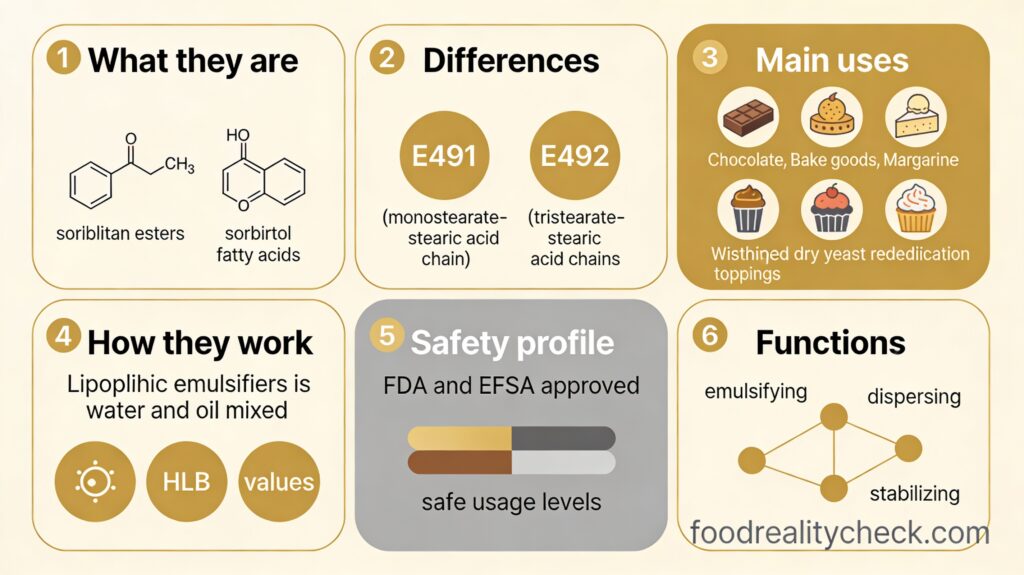
What is E491?
Complete guide to understanding sorbitan monostearate in your food
The Quick Answer
E491 is sorbitan monostearate (Span 60), an emulsifier used primarily to improve active dry yeast, stabilize margarine, and enhance texture in baked goods and confectionery.
It’s one of the most common food additives in processed foods, approved as safe by the FDA and EFSA with a well-established safety track record.
Most people who eat bread, baked goods, margarine, or confectionery regularly consume trace amounts of it.
📌 Quick Facts
- Category: Emulsifier, Stabilizer & Texture Improver
- Found in: Yeast, margarine, ice cream, baked goods, confectionery, dairy products
- Safety: FDA-approved (GRAS), EFSA-approved with established ADI
- Approved by: FDA, EFSA, JECFA
- Key Fact: Part of sorbitan ester family (E491-E495) with group ADI of 10 mg/kg bw/day
What Exactly Is E491?
E491 is sorbitan monostearate (SMS or Span 60), a nonionic surfactant created by esterifying sorbitol with stearic acid.
More specifically, one stearic acid molecule is chemically bonded to a sorbitol molecule, creating a waxy solid that ranges in color from cream to tan. It’s insoluble in water but disperses well in oils, making it ideal for oil-based food applications.
E491 is a semisynthetic compound—meaning it’s created through chemical synthesis rather than occurring naturally. It belongs to the sorbitan ester family (E491-E495), all sharing similar safety profiles and approved uses.
In technical terms, it’s an emulsifier and stabilizer that prevents water and oil from separating and improves the texture and shelf life of numerous processed foods.
Where You’ll Find E491
E491 appears in numerous processed foods, most prominently baked goods and margarine:
– Active dry yeast (primary use)
– Margarine and low-fat spreads
– Ice cream and frozen desserts
– Baked goods and breads
– Cakes and cake mixes, icings and fillings
– Confectionery and chocolate
– Desserts and puddings
– Food supplements
– Coffee whiteners and creamers
– Whipped toppings
– Dairy products
If you eat bread, use margarine, enjoy ice cream, or consume baked goods, you’ve almost certainly consumed E491. It’s particularly common in yeast products, where it serves a critical function in maintaining moisture and extending shelf life.
💡 Pro Tip: Look for “Sorbitan monostearate,” “E491,” or “Span 60” on ingredient lists. It’s especially common in active dry yeast packages and margarine where its emulsifying properties are essential for product quality.
How E491 Works in Food
E491 serves multiple critical functions in food production.
In active dry yeast—the primary application: E491 helps maintain moisture content, dramatically extending shelf life. When yeast is rehydrated before use, E491 aids in the rehydration process, improving yeast cell viability and fermentation performance. Most commercial active dry yeast products use E491 for this essential function.
In margarine and spreads: E491 improves emulsion stability and reduces the “sandy” grittiness that develops from fat crystal formation. It keeps fat crystals organized and small, maintaining smooth texture throughout storage.
In ice cream: E491 promotes emulsification of dairy fat and prevents ice crystal formation. Combined with other ingredients, it creates smooth ice cream with improved mouthfeel.
In baked goods: E491 increases loaf volume and improves crumb structure, making bread and cake lighter and more desirable.
In confectionery: E491 stabilizes emulsions of oils and fats, maintaining consistent texture and appearance.
Overall emulsifying function: E491 is a water-in-oil emulsifier that prevents separation of water and oil phases, creating stable food mixtures.
Why Do Food Companies Use E491?
E491 solves specific technical problems that manufacturers cannot solve without it.
For bakers, E491 improves dough handling and increases bread volume—directly affecting consumer satisfaction. For yeast manufacturers, it extends shelf life dramatically, making commercial yeast practical for retail sale. For margarine producers, it prevents the undesirable gritty texture that develops over time.
E491 also improves product stability across temperature ranges and storage conditions, reducing waste and improving profitability. Without emulsifiers like E491, many processed foods would separate, become gritty, or lose quality.
Is It Safe?
Regulatory authorities confirm E491 is safe for food use.
The FDA classifies sorbitan esters (including E491) as “Generally Recognized As Safe” (GRAS). The EFSA established a group Acceptable Daily Intake (ADI) of 10 mg/kg body weight per day for all sorbitan esters (E491-E495) in 2017, concluding that there is “no safety concern for the use of sorbitan esters as food additives at the reported uses and use levels.”
This approval is based on comprehensive toxicological review spanning decades.
✓ Safety Confirmed: The EFSA’s 2017 re-evaluation confirmed no safety concern for E491 and related sorbitan esters. Actual exposure at approved use levels remains well below the established ADI. E491 was NOT identified in recent observational studies linking certain emulsifiers to health risks.
The EFSA’s 2017 Comprehensive Safety Re-evaluation
The European Food Safety Authority’s thorough 2017 re-evaluation of all sorbitan esters provides authoritative reassurance.
Key findings:
– Mean exposure and 95th percentile exposure did not exceed the ADI in any population group
– No safety concern identified for E491 and related sorbitan esters at approved uses and levels
– Group ADI established: 10 mg/kg bw/day for sorbitan esters E491-E495 (singly or in combination)
– Individual ADI for E491 specifically: 26 mg/kg bw/day (higher than the group limit)
– Comprehensive toxicological data reviewed and determined acceptable
The safety margin is significant—actual exposure is well below the established ADI.
Recent Scientific Studies—Important Finding
E491 has NOT been identified in recent observational studies linking certain emulsifiers to health risks.
In 2023, a large BMJ study examined emulsifier intake and cardiovascular disease risk. The study identified associations with five specific emulsifiers (E460, E466, E471, E472b, E472c) and trisodium phosphate (E339). Notably, E491 was NOT among the emulsifiers identified with increased CVD risk.
Similarly, in 2024, a PLOS Medicine study on emulsifiers and cancer risk identified associations for other emulsifiers (E407, E450, E471, E440, E500) but NOT for E491. The study listed E491 among additives “not studied individually”—meaning consumption was too low for statistical analysis in the study population, not that safety was questioned.
Critical point: E491 does NOT appear in any of the identified risk associations from these recent large observational studies.
Comparison with Other Emulsifiers
E491 is part of the sorbitan ester family:
– E491: Sorbitan monostearate (this product)
– E492: Sorbitan tristearate
– E493: Sorbitan monolaurate
– E494: Sorbitan monooleate
– E495: Sorbitan monopalmitate
All five share similar safety profiles and are evaluated as a group with a combined ADI of 10 mg/kg bw/day. However, E491 has an individual ADI of 26 mg/kg bw/day—higher than the group limit.
Toxicological Data
E491 has been thoroughly tested for safety.
– No adverse effects at approved food use levels
– Long-term and chronic toxicity studies completed and reviewed
– No evidence of carcinogenicity (cancer risk)
– No evidence of mutagenicity (genetic damage)
– Safety margin substantial between food use levels and any observed adverse effects
Manufacturing and Raw Materials
E491 is synthetically manufactured through controlled chemical synthesis.
The process involves esterification of sorbitol (derived from glucose, typically from maize or tapioca) with stearic acid (a fatty acid). Stearic acid can be sourced from both vegetable oils (palm, coconut, canola, soy) and animal fats (beef tallow).
The final product meets strict specifications for purity before approval for food use.
Historical Context
E491 has a well-established safety history spanning decades.
The original ADI of 25 mg/kg bw/day was established in 1974. The 2017 EFSA re-evaluation reduced the group ADI to 10 mg/kg bw/day for all sorbitan esters (E491-E495 combined), though E491 individually maintains an ADI of 26 mg/kg bw/day. This reflects confidence in its safety—manufacturers have decades of experience with its use.
Vegan and Allergen Status
E491 can be vegan-friendly depending on source materials:
– Most food-grade E491 uses vegetable-sourced stearic acid (making it vegan-compatible)
– Some products may use animal-derived stearic acid (beef tallow sourced)
– Always check product labels for specific sourcing information
– Can be halal and kosher when vegetable-sourced
– Gluten-free: Yes ✓
Why It’s Called a “Semisynthetic” Additive
E491 is semisynthetic because it combines natural ingredients through chemical synthesis.
Sorbitol is derived from natural glucose (from corn or other sources), and stearic acid is a naturally occurring fatty acid. However, the esterification process that bonds them together is synthetic—it doesn’t occur naturally. The result is a new compound that must be manufactured in a lab.
The Bottom Line
E491 (sorbitan monostearate) is an emulsifier and stabilizer used primarily in active dry yeast, margarine, baked goods, and confectionery.
Regulatory authorities worldwide classify it as safe, with the FDA rating it GRAS and the EFSA establishing an ADI of 26 mg/kg bw/day for E491 specifically (and 10 mg/kg bw/day as a group limit for all sorbitan esters).
The 2017 EFSA re-evaluation confirmed “no safety concern for the use of sorbitan esters as food additives at the reported uses and use levels.”
At normal food use levels, actual exposure remains well below the established ADI.
E491 was NOT identified in recent large observational studies that found associations between certain emulsifiers and health risks. It does not appear in any of the reported risk associations with cardiovascular disease, cancer, or type 2 diabetes.
Most people eating bread, baked goods, margarine, or confectionery consume E491 regularly without documented health concerns.
As always, food labels must declare E491 when used, enabling informed consumer choice.