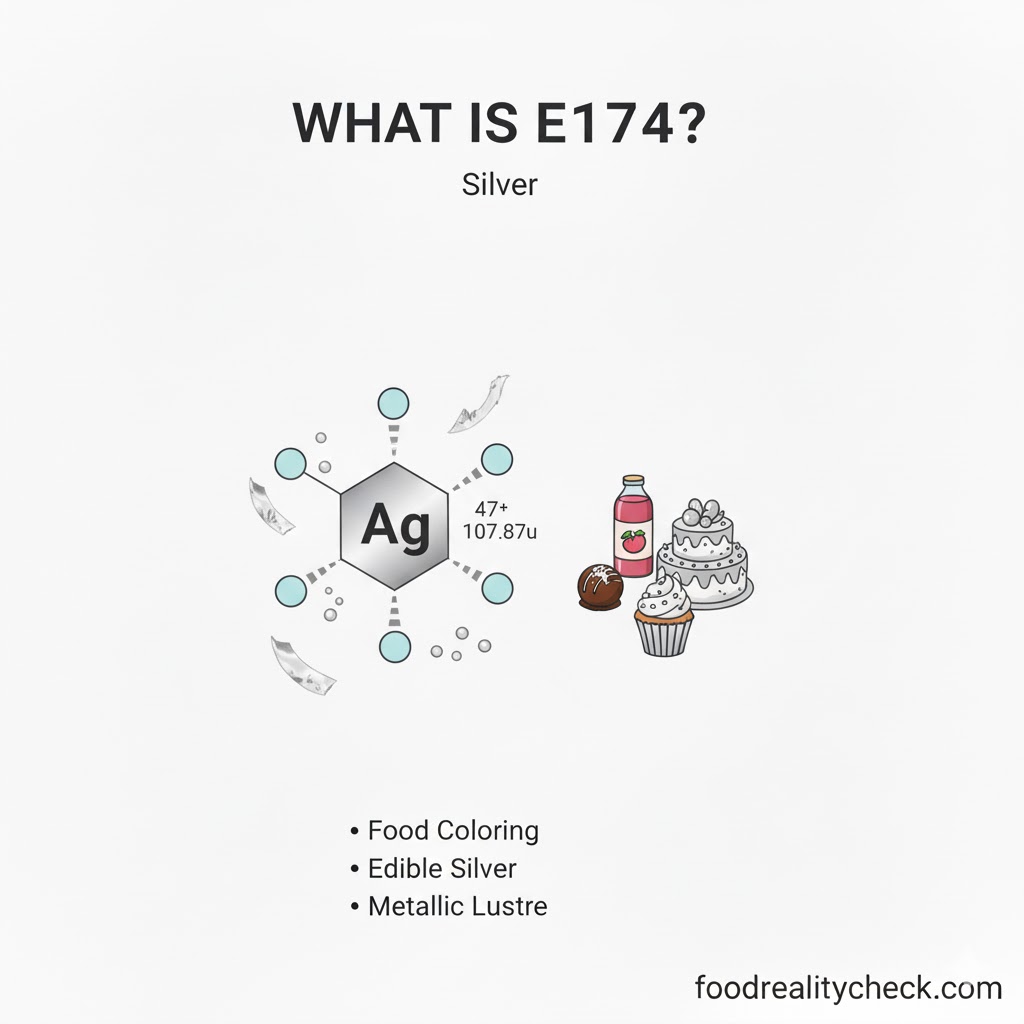
What is E174?
Complete guide to understanding E174 (Silver) – the nanosilver food colorant facing potential ban
The Quick Answer
E174 is elemental silver in powder or flake form—a precious metal used as a metallic food colorant to provide a decorative, shimmering silver-grey appearance to foods. It is applied exclusively to food surfaces (confectionery, cakes, dragées, liqueurs) for decoration. However, recent EFSA analysis reveals that E174 as commercially sold contains predominantly nanosilver particles (approximately 97% nanoparticles in independent studies), raising serious safety concerns.
E174 is currently approved in the EU but faces potential ban following EFSA’s April 2025 updated safety assessment, which concluded that insufficient data exists to confirm safety. The primary concerns include: (1) Undisclosed nanoparticle content (manufacturers did not adequately characterize particle sizes), (2) Release of potentially toxic silver ions, (3) Inadequate toxicity and genotoxicity testing, (4) Potential neurotoxic and reproductive effects per ECHA classification, (5) Bioaccumulation in body tissues.
This is one of the most concerning and controversial food additives currently under regulatory scrutiny, with potential for EU-wide ban in the near future.
📌 Quick Facts
- Chemical: Elemental silver (Ag); precious metal, element 47 on periodic table
- Also known as: Silver, edible silver, silver dust, silver foil, silver leaf, nanosilver (when particles below 100 nm)
- Atomic number: 47
- Atomic weight: 107.87 g/mol
- CAS number: 7440-22-4
- EC number: 231-131-3
- Physical form: Fine metallic powder, flakes, or leaf; silvery-white color
- Source: Naturally occurring metal; mined and processed/purified for food use
- Food use: Surface decoration/coating ONLY; NOT for interior food coloring
- Color provided: Silver-grey, metallic, shimmering appearance
- Key properties: Metallic colorant, bactericidal (kills bacteria), insoluble in water
- Approved uses: Confectionery, dragées, cakes, decorations, spirit drinks
- Safety status: Currently EU-approved; FACING POTENTIAL BAN following EFSA April 2025 assessment
- CRITICAL ISSUE: E174 as sold contains ~97% nanoparticles (independent studies); manufacturers failed to disclose particle size distribution
- Nanoparticle percentage: Independent analysis shows 97% nanoparticles (median 11 nm) vs. manufacturer claims of minimal nanoparticles
- Safety assessment status (EFSA April 2025): INSUFFICIENT DATA to confirm safety; unable to conclude
- Data deficiencies identified: Inadequate toxicity studies, genotoxicity data of “low relevance,” silver ion release unknown, particle size distribution unknown
- ECHA classification: Silver classified as potentially damaging to nervous system and suspected of impairing fertility
- Health concerns documented: Neurotoxicity potential, reproductive hazards, bioaccumulation, argyria (blue-grey skin discoloration) at high exposure
- Regulatory trajectory: May be banned; EU Commission to discuss fate at Working Party of Governmental Experts meeting
- Dietary restrictions: Suitable for vegan, vegetarian, kosher, halal (as mineral)
What Exactly Is It?
E174 is elemental silver (Ag)—the 47th element on the periodic table, a precious metal mined from ore and processed into fine powder or flakes for use as a food colorant. It is not a chemical compound but a pure element. When used as a food additive, it imparts a metallic, shimmering appearance to food surfaces.
Think of E174 as finely ground precious metal—the same material used in jewelry, coins, and silverware, but in food-grade powder form. The critical distinction is that recent independent analysis reveals E174 products contain predominantly NANOSILVER particles (97% in independent study), despite manufacturer claims of minimal nanoparticle content.
CRITICAL ISSUE: The undisclosed presence of vast quantities of nanosilver particles (below 100 nm) is the central safety concern. Nanoparticles behave differently than bulk metal due to their small size—they have different toxicological properties, greater bioavailability, and potential for systemic absorption.
Chemical identity:
• Element: Silver (Ag); atomic number 47
• Atomic weight: 107.87 g/mol
• Electron configuration: [Kr] 4d¹⁰ 5s¹
• Crystal structure: Face-centered cubic (FCC) metallic lattice
• Naturally occurring: Element; found in nature; third most precious metal
• Physical properties: Highest optical reflectivity of all metals; white color; excellent conductor
• Reactivity: Relatively unreactive; forms silver oxide (Ag₂O) with oxygen exposure
The Nanoparticle Problem:
• Manufacturer claims: E174 suppliers reported minimal nanoparticle content (maximum 10% by number with one dimension <100 nm)
• Independent research (NanoAg@ project): Tested ten E174 samples from Belgium, UK, Germany; found 97% were nanoparticles with median size 11 nm
• Release of nanoparticles: When E174-containing confectionery introduced to water, nanoparticles release from product surface
• Regulatory significance: EFSA unable to assess safety because actual nanoparticle content unknown/misrepresented
• Risk assessment impossibility: Without accurate particle size distribution, risk assessment cannot be conducted properly
Where You’ll Find It
E174 appears exclusively in foods for decoration/surface coating:
Primary Food Applications (Limited to Decoration):
• Confectionery and dragées (PRIMARY USE) – sugar-coated nuts, decorative candies, decorative chocolates
• Cake decorations (PRIMARY USE) – cake toppers, icing decorations, premium cake finishes
• Spirit drinks and liqueurs – decorative floating silver particles in luxury spirits
• Specialty baked goods – gourmet pastries, wedding/anniversary cakes requiring metallic decoration
• Confectionery coatings – chocolate dragées, dragée decorations
Regulatory scope (severely restricted/under review): EU Authorization—Currently approved for surface coating of foods at “quantum satis”; however, EFSA April 2025 assessment states safety cannot be confirmed and potential ban is being considered. FDA (USA)—Silver approved as exempt colorant for cosmetics; NOT approved as direct food additive.
⚠️ CRITICAL SAFETY UPDATE (APRIL 2025):
The EFSA published an updated safety assessment of E174 in April 2025 (nine years after initial 2016 evaluation). Key findings:
1. INSUFFICIENT DATA FOR SAFETY CONCLUSION: EFSA unable to conclude on E174 safety due to multiple data gaps
2. NANOPARTICLE DECEPTION: E174 contains ~97% nanoparticles (independent studies) vs. manufacturer claims of minimal nanoparticles; manufacturers failed to provide adequate particle characterization
3. INADEQUATE TOXICITY TESTING: Genotoxicity and sub-chronic toxicity studies submitted were of “low relevance” and “not sufficient”; did not use proper nanoscale assessment methods
4. UNKNOWN SILVER ION RELEASE: Extent of toxic silver ion release from E174 in foods unknown
5. ECHA HAZARD CLASSIFICATION: Silver classified (2022) as potentially causing nervous system damage and suspected of impairing fertility
6. POTENTIAL BAN: European Commission will discuss E174’s fate at next Working Party of Governmental Experts meeting; ban is likely given “no data, no market” REACH principle
RECOMMENDATION: Avoid E174-containing products; potential ban expected imminently.
Why Did E174 Get This Unusual Approval?
E174 was approved historically for decorative use in premium foods, but the approval was based on incomplete safety data and manufacturers’ misrepresentation of nanoparticle content.
E174 was originally approved because:
• Traditional use: Silver decoration used historically in cuisines (Indian vark, dragées in European traditions)
• Limited application: Surface coating only; minimal ingestion
• Regulatory assumptions: Regulators assumed bulk silver with negligible nanoparticle content
• Historical data gaps: Pre-modern toxicological standards; inadequate testing before approval
• Incomplete characterization: Manufacturers did not properly characterize or disclose nanoparticle content
CRITICAL POINT: The 2016 EFSA re-evaluation identified data gaps. A call for additional data was issued. Only ONE manufacturer responded—and their data was INSUFFICIENT, failed to address key concerns, and later independent analysis revealed massive nanoparticle content not disclosed. Nine years later (April 2025), EFSA concluded safety STILL cannot be confirmed.
Is It Safe?
⚠️ EFSA APRIL 2025 VERDICT: SAFETY CANNOT BE CONFIRMED
EFSA explicitly states the available information is insufficient to assess E174 safety. This is effectively a regulatory “red flag” that typically precedes bans.
Regulatory approval status (as of January 2026):
• EU: Currently approved for surface decoration; however, EFSA April 2025 assessment recommends data collection and potential regulatory action
• FDA (USA): NOT approved as direct food additive (approved only for cosmetics)
• JECFA: Limited evaluation; concerns noted
• EFSA 2025 position: Cannot conclude on safety; insufficient data; potential ban under discussion
Health concerns identified by scientific authorities:
• Neurotoxicity: ECHA classified silver as potentially causing nervous system damage
• Reproductive hazards: ECHA classified silver as suspected of impairing fertility
• Silver ion release: Elemental silver can release toxic silver ions; extent unknown in food context
• Nanoparticle bioavailability: Nanosilver more bioavailable than bulk silver; may penetrate tissues
• Bioaccumulation: Silver accumulates in body tissues over time; eliminated slowly
• Argyria: Chronic silver exposure causes blue-grey skin discoloration; benign but permanent cosmetic effect
• Oxidative stress: Research indicates nanosilver causes oxidative stress in cells
• Microbiota effects: Silver has antimicrobial properties; potential to harm beneficial gut bacteria
• Inadequate testing: Toxicity and genotoxicity studies on E174 are insufficient and use improper methodologies for nanoscale assessment
MAJOR RED FLAGS FOR E174:
1. Regulatory failure: Manufacturers misrepresented nanoparticle content; regulators failed to verify claims
2. Undisclosed nanosilver: E174 products contain ~97% nanoparticles, completely different from assumed composition
3. Hazard classification: ECHA classified silver as neurotoxic and reproductive hazard (2022)
4. Safety assessment impossible: Without accurate characterization, proper risk assessment cannot be conducted
5. Nine-year assessment failure: After 9 years and call for data, EFSA still cannot conclude safety; manufacturers failed to provide needed data
6. Likely ban imminent: Regulatory discussions suggest potential EU-wide ban following “no data, no market” principle
CONSUMER RECOMMENDATION: AVOID E174 products; potential ban expected imminently and safety cannot be confirmed.
The Bottom Line
E174 (silver) is a metallic food colorant currently approved in the EU for surface decoration of premium foods, but its safety cannot be confirmed and a potential EU-wide ban is imminent following EFSA’s April 2025 assessment.
CRITICAL ISSUES:
• E174 contains ~97% nanosilver particles (independent studies) vs. manufacturer claims of minimal nanoparticles
• EFSA April 2025 assessment: Insufficient data; safety cannot be confirmed
• ECHA classified silver as neurotoxic and reproductive hazard
• Manufacturers failed to provide adequate safety data despite regulatory calls
• Potential ban likely under “no data, no market” REACH principle
• European Commission to discuss E174’s fate at upcoming regulatory meeting
For consumers: E174 is among the most problematic currently-approved food additives. Avoid products containing E174, particularly for children. A ban is likely imminent given EFSA’s April 2025 verdict that safety cannot be confirmed and regulatory discussions already underway.
Regulatory trajectory: E174 exemplifies regulatory failure—manufacturers misrepresented product composition, regulators failed to verify claims, and nine years of reassessment still cannot confirm safety. The REACH principle “no data, no market” strongly suggests a ban is forthcoming.
Bottom recommendation: E174 is effectively in regulatory limbo with a probable ban imminent. Do not purchase or consume products containing E174. This additive demonstrates why precautionary approaches to novel food additives—especially nanoparticulate materials—are critical.