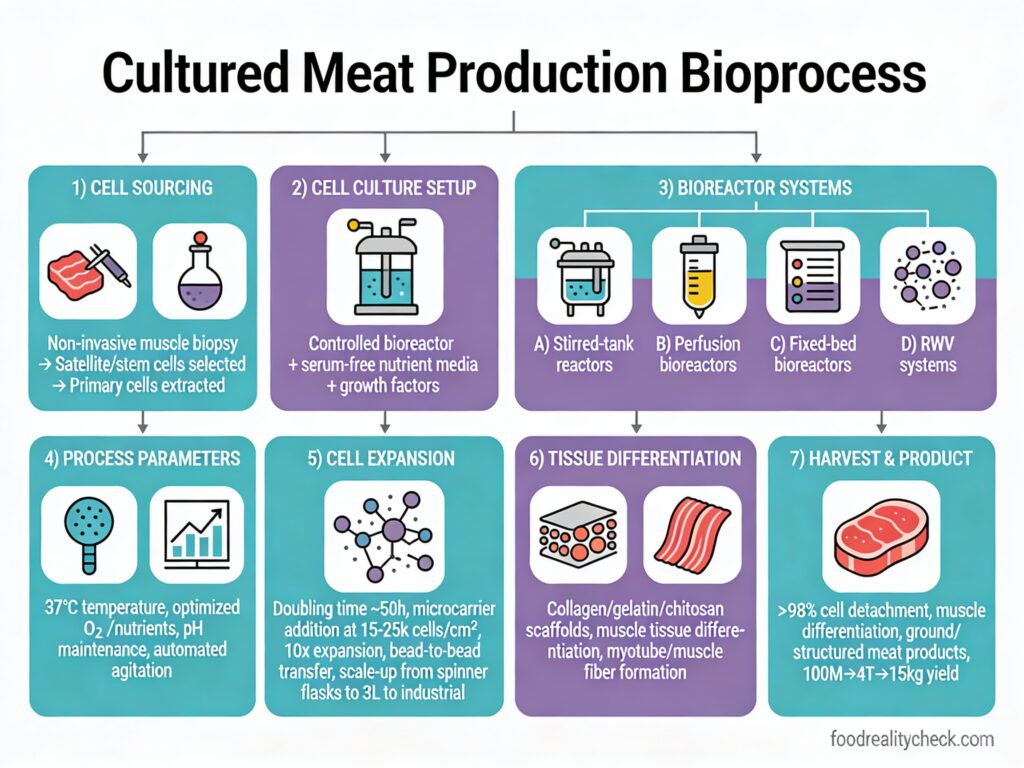
Cultivated meat production uses bioreactors—large tanks that provide controlled temperature, pH, oxygen, and growth medium allowing animal cells to multiply exponentially. Understanding the bioreactor process reveals that meat culturing is biological engineering, scaling tissue culture from laboratory to commercial volume.
Bioreactor Basics
Bioreactor is a controlled tank system containing: (1) Growth medium: Nutrient-rich liquid (amino acids, glucose, vitamins, minerals). (2) Animal cells: Muscle cells suspended in medium. (3) Temperature control: Maintaining 37°C (98.6°F—body temperature). (4) pH control: Maintaining neutral pH (~7.4). (5) Oxygen supply: Aerating medium to prevent hypoxia. (6) Agitation: Gentle stirring/mixing preventing cell settling/clumping.
A bioreactor is essentially an artificial body environment—providing conditions that isolated cells require to survive and multiply.
Temperature Control
Animal cells are temperature-sensitive: (1) Optimal range: 36-38°C (mammalian body temperature). (2) Below 32°C: Cell metabolism slows dramatically, growth halts. (3) Above 42°C: Protein denaturation begins, cells die. Bioreactor system: Jacketed vessel with heating/cooling circulation maintains precise temperature 24/7. Temperature stability is critical—fluctuation kills cells.
Temperature control is the first requirement—without precise temperature, all other conditions become irrelevant.
Oxygen & Aeration
Mammalian cells require oxygen for respiration: (1) Oxygen dissolved in medium: Must reach minimum threshold (~2-5mg/L dissolved oxygen). (2) Aeration methods: Sparging (bubbling oxygen), stirring (increasing surface area for diffusion), or microcarrier rotation. (3) Oxygen gradient: Cells at edges get more oxygen than center—agitation homogenizes oxygen distribution. (4) Hypoxia risk: Insufficient oxygen causes cell death/metabolic dysfunction.
Oxygen supply must be carefully balanced—too little causes hypoxia, too much creates unwanted oxidative stress.
pH Management
Cell metabolism produces acids (lactate from glucose fermentation, CO₂): (1) pH naturally drifts downward during culture. (2) Buffer system: Growth medium contains buffers (bicarbonate) to resist pH change. (3) Automated pH control: Carbon dioxide injection to lower pH, sodium hydroxide to raise. (4) Optimal range: 7.0-7.4 for most mammalian cells. (5) Consequences of drift: pH <6.5 or >7.8 causes metabolic dysfunction, cell death.
pH stability requires active monitoring and adjustment—bioreactors have sensors and automatic chemical injection systems.
Cell Expansion Timeline
Cell growth trajectory: (1) Initial inoculation: Millions of starter cells in bioreactor. (2) Lag phase (hours 0-24): Cells adjust to bioreactor environment, minimal division. (3) Exponential phase (days 1-7): Cells divide rapidly—doubling every 24-48 hours. (4) Stationary phase (days 7-14): Cell division slows, nutrients become limiting, cell density plateaus. Practical scale: From 10^6 starter cells → 10^12 cells in 2 weeks represents 10^6-fold expansion.
The exponential growth phase is the value—cells multiply exponentially without any additional input beyond medium and oxygen.
Tissue Organization
Simple cell suspension isn’t meat—tissue organization required: (1) Scaffolds: Biocompatible matrices (alginate, collagen-based) cells attach to, creating 3D structure. (2) Mechanical stimulation: Bioreactors provide stretching/contracting mimicking muscle function—stimulates myogenic differentiation. (3) Cell differentiation: Mature muscle fibers form from myoblasts. (4) Tissue maturation: Weeks of culture in scaffold with stimulation creates muscle tissue structure.
Tissue formation is the rate-limiting step—pure cell expansion is fast, but organizing cells into functional tissue takes time/complexity.
Scalability Challenges
Challenges: (1) Bioreactor cost: Large industrial bioreactors ($1-5 million+). (2) Growth medium cost: Most expensive input—specialized serums, growth factors expensive. (3) Scaling physics: Oxygen diffusion limits cell density—larger bioreactors have diffusion gradients (center is hypoxic). (4) Energy intensity: Maintaining temperature, aeration, pH control requires significant energy.
Commercialization success depends on reducing growth medium cost and improving oxygen delivery in large-scale bioreactors—technical challenges that are solvable but expensive.