How Is Cheesecake Made?
From cream cheese to the perfect dessert slice.
The Overview
Cheesecake is a multi-layered dessert combining a buttery crust, a rich cream cheese filling, and precise baking control.
The process requires careful temperature management to achieve a smooth, creamy interior without cracks while maintaining a golden crust.
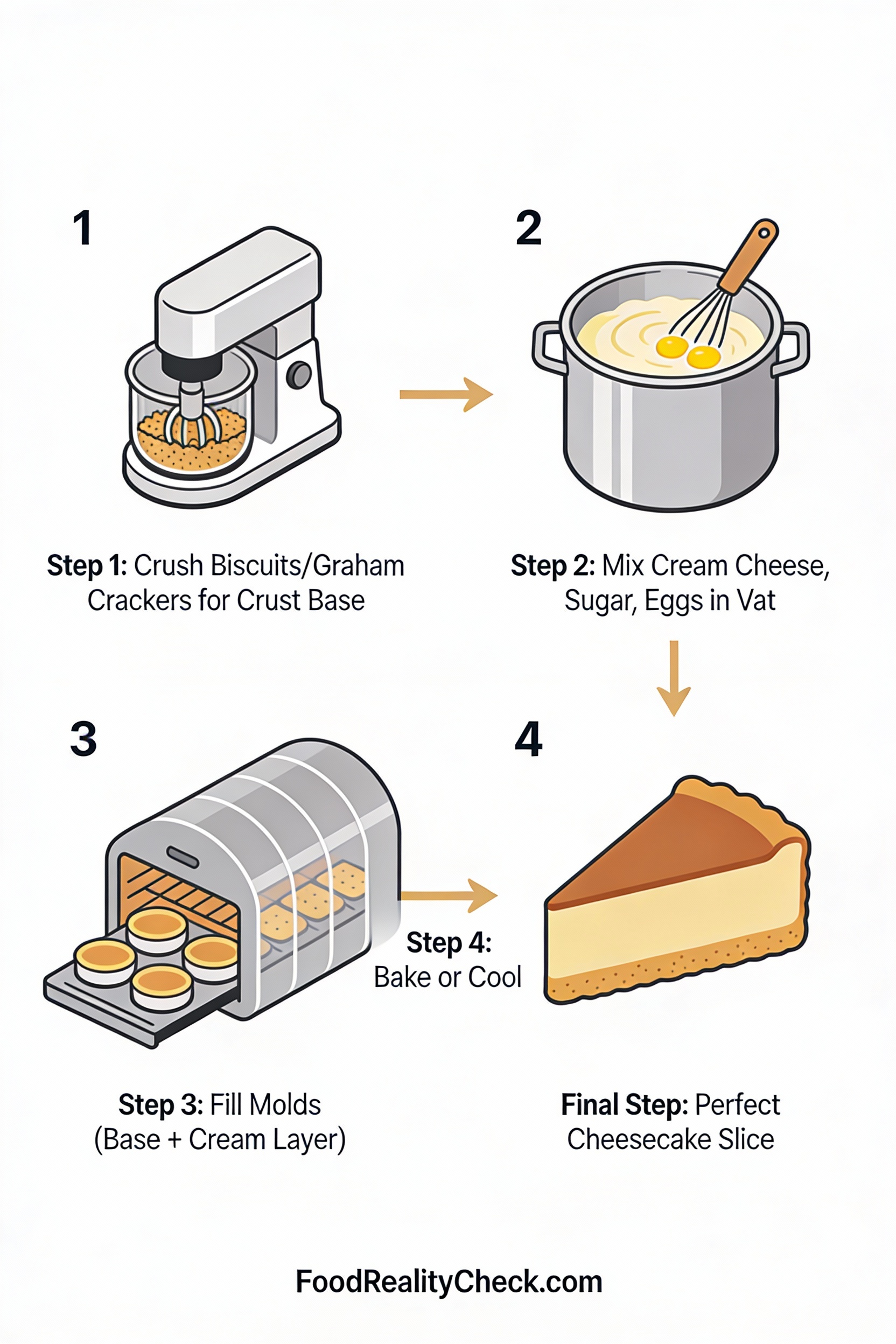
Here’s exactly what happens at each stage from ingredients to finished dessert.
🥘 Main Ingredients
• Cream cheese (softened)
• Sugar
• Eggs
• Heavy cream or sour cream
• Vanilla extract
• Graham crackers (for crust)
• Butter (for crust)
Step 1: Ingredient Preparation & Room Temperature
All ingredients are brought to room temperature (70-75°F / 21-24°C) before mixing begins.
This is critical—cold cream cheese won’t blend smoothly with sugar, creating a lumpy, grainy filling.
Eggs and cream must also be at room temperature to fully incorporate and create a uniform, creamy batter.
Step 2: Crust Preparation
Graham crackers are crushed into fine crumbs (typically in a food processor) and combined with melted butter and a pinch of sugar.
The mixture is pressed firmly and evenly into the bottom of a springform pan using the bottom of a measuring cup or glass.
The crust is pre-baked at 350°F (175°C) for 7-10 minutes to toast and set, then cooled before the filling is added.
Step 3: Cream Cheese Creaming
Softened cream cheese is added to a mixing bowl and beaten at medium speed for 2-3 minutes until smooth and creamy.
This breaks down the curds in the cheese and incorporates air, creating a lighter texture.
The goal is a homogeneous, lump-free base before sugar is added.
Step 4: Sugar Integration
Granulated sugar is gradually added to the creamed cheese while mixing continues at medium speed for 2-3 minutes.
Sugar dissolves into the cheese, sweetening the filling and helping it set properly during baking.
The mixture should look pale yellow and feel smooth—no gritty sugar crystals when rubbed between fingers.
Step 5: Egg Incorporation (Low & Slow)
Eggs are beaten lightly in a separate bowl, then added very slowly to the cheese mixture while beating at low speed.
This critical step must be done carefully—overmixing eggs incorporates too much air, creating a spongy, soufflé-like texture instead of dense and creamy.
Each egg is added gradually and fully incorporated before the next one is introduced.
Step 6: Cream & Flavorings
Heavy cream or sour cream and vanilla extract are added at low speed, just until combined.
These ingredients add richness and subtle tang, balancing the sweetness of the cream cheese.
The batter is scraped down and mixed briefly—any additional overmixing at this stage will create a light, fluffy texture instead of the desired dense, creamy interior.
Baking: The Temperature Dance
Step 7: Pan Preparation & Water Bath
The springform pan is wrapped tightly in aluminum foil on the outside (preventing water from seeping in).
The pan is placed inside a larger roasting pan, and boiling water is added to the roasting pan until it reaches 1-2 inches up the sides of the springform.
This water bath ensures gentle, even heating and prevents the cheesecake from cracking—one of the biggest challenges in cheesecake baking.
Step 8: Filling the Crust
The cheesecake batter is poured carefully into the cooled graham cracker crust.
The filled pan is gently tapped on the counter several times to release air bubbles that would create holes or cracks in the finished cake.
The pan is then carefully placed in the water bath inside the preheated oven.
Step 9: Low & Slow Baking
The cheesecake is baked at a low temperature (250-325°F / 121-163°C) for 1 hour to 1 hour and 20 minutes, depending on pan size and oven.
The low temperature is crucial—high heat (350°F+) causes the edges to cook and crack while the center remains undercooked.
The cheesecake is done when an instant-read thermometer inserted in the center reads 145°F (63°C)—the center may still jiggle slightly, but carryover cooking will firm it up.
Step 10: Oven Cooling Phase
Once the cheesecake reaches the target internal temperature, the oven is turned off and the door is propped open with a wooden spoon.
The cheesecake stays in the partially open oven for 1 hour, gradually cooling and adjusting to ambient temperature.
This slow cooling prevents thermal shock that would cause the surface to crack or sink.
Step 11: De-panning & Counter Cooling
The cheesecake is removed from the oven and water bath, then cooled on the counter until it reaches room temperature (about 1-2 hours).
A knife is run around the edges to loosen the cake from the pan sides without releasing the springform.
This prevents the cake from shrinking unevenly and pulling away from the crust during refrigeration.
Refrigeration & Serving
Step 12: Refrigeration & Setting
The cooled cheesecake is transferred to the refrigerator and chilled for at least 4 hours, preferably overnight.
Cold temperature firms up the filling completely, making slicing clean and easy.
The flavor also develops during refrigeration—cream cheese flavor becomes richer and more complex after 24 hours.
Step 13: Topping & Finishing
Before serving, the cheesecake may be topped with fruit preserves, fresh berries, chocolate ganache, fruit sauce, or other toppings.
The springform pan is carefully released by unlatching the sides, revealing the finished cake.
Slices are served cold, often with a warm sauce or whipped cream on the side.
Why This Process?
Room temperature ingredients ensure smooth, lump-free batter and uniform texture throughout the finished cake.
Low baking temperature and a water bath allow the entire cake to set gently and evenly without thermal stress that causes cracking.
Slow cooling prevents thermal shock and allows the structure to set gradually, ensuring a creamy center with clean, straight sides.
What About Variations?
Cheesecake can be made in many styles:
• New York style – rich, dense, creamy filling
• Chicago style – lighter, fluffier filling (sometimes with sour cream topping)
• No-bake – uses gelatin to set without oven heat
• Flavored – chocolate, pumpkin, strawberry, or other add-ins swirled into the filling
Some recipes include cornstarch (1-3 tablespoons per batch) to absorb water and prevent cracking.
Commercial producers may use stabilizers or thickening agents to ensure consistency across millions of cakes.
The Bottom Line
Cheesecake production requires patience, precise temperature control, and careful ingredient handling.
The multi-step process—from creaming cheese to low-temperature baking to slow cooling—ensures a smooth, creamy, crack-free result.
Now you understand exactly how cream cheese transforms into the perfect dessert through careful thermal management and technique.