How Is Cola Zero Made?
From secret syrup formula to perfectly carbonated beverage in your bottle.
The Overview
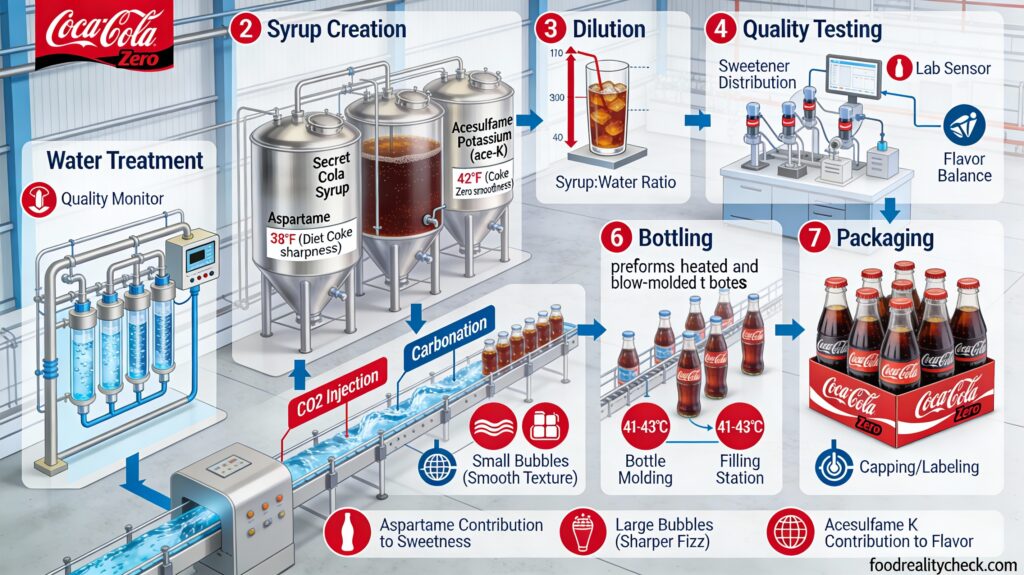
Cola Zero is a zero-sugar, zero-calorie carbonated soft drink created through precise blending of a proprietary concentrate (syrup) with purified water, artificial sweeteners, and carbon dioxide gas.
The manufacturing process combines strict water purification, secret syrup formulation, exact proportioning, careful carbonation, and high-speed bottling to produce billions of identical bottles annually.
Here’s exactly how Cola transforms raw ingredients into the finished product you drink.
🥘 Main Ingredients
• Carbonated water
• Cola syrup concentrate (proprietary recipe)
• Sweeteners (aspartame, acesulfame potassium)
• Caramel color (E150d)
• Phosphoric acid
• Natural flavors
• Caffeine
• Potassium benzoate (preservative)
Step 1: Water Purification & Treatment
Municipal or well water arrives at the bottling plant and undergoes rigorous multi-stage purification including activated carbon filtration, sand filtration, and advanced membrane technologies.
Water passes through multi-stage reverse osmosis (RO) membranes that remove dissolved minerals, microorganisms, and contaminants at the molecular level.
Ultraviolet (UV) sterilization, ozone treatment, and final polishing filters ensure the water meets pharmaceutical-grade purity standards—critical since water is the primary ingredient (85-90% of the final drink).
Step 2: Syrup Concentrate Formulation
The legendary Cola syrup formula—one of the world’s best-kept trade secrets—is precisely measured and blended in controlled tanks.
The concentrate contains dozens of ingredients including caramel color, natural and artificial flavors, phosphoric acid, caffeine, and preservatives blended to exact specifications.
For Cola Zero, artificial sweeteners (aspartame and acesulfame potassium) replace sugar entirely, keeping the drink at zero calories while matching the taste of regular Cola as closely as possible.
Step 3: Concentrate Quality Control
Every batch of syrup concentrate is analyzed for color density (measured in degrees), flavor intensity, acidity, and viscosity using automated spectrophotometers and chemical analyzers.
Any batch failing to meet strict specifications is diverted from production—consistency across all Cola bottles worldwide depends on syrup quality being identical.
Syrup is stored in stainless steel tanks under nitrogen atmosphere to prevent oxidation and flavor degradation.
Step 4: Syrup Dilution & Blending
The concentrated syrup is mixed with purified water in precise ratios—typically 1 part concentrate to 5-6 parts water (roughly 15-20% concentrate by volume).
This mixture is blended in large batch tanks using powerful agitation to ensure complete homogeneity, then transferred to buffer tanks where it’s held at exact temperature (7-10°C) before carbonation.
Throughout this process, the syrup-water mixture is protected from oxygen exposure using nitrogen blankets and closed-loop piping.
Step 5: Cooling to Optimal Temperature
The blended syrup-water mixture is chilled to 0-4°C (32-39°F) in sophisticated heat exchangers.
Cold temperature is critical—CO₂ dissolves approximately 2 times better in cold liquid than in warm liquid, and cold beverages taste more refreshing to consumers.
The chilled liquid flows directly to carbonation chambers where it remains under positive pressure to prevent any degassing.
Carbonation: The Heart of the Fizz
Step 6: CO₂ Gas Preparation & Pressurization
Liquid CO₂ is stored in massive cryogenic tanks maintained at -40°C (-40°F) and extremely high pressure (up to 250 PSI).
When needed, the liquid CO₂ is vaporized and filtered through multiple stages to remove any contaminants that could affect taste or shelf stability.
The vaporized CO₂ is then pressurized and injected into the carbonation chamber where it meets the chilled beverage mixture.
Step 7: Injection & Saturation
Pressurized CO₂ gas is injected into the chilled syrup-water mixture through fine diffusers in a sealed carbonation chamber operating at 60-80 PSI.
The mixture is continuously agitated under pressure using impellers or paddle mixers to maximize CO₂ absorption and ensure uniform carbonation throughout the batch.
The final carbonation level in Cola is typically 2.5-3.5 volumes of CO₂ per volume of liquid—meaning 1 liter of Coke contains 2.5-3.5 liters of CO₂ gas at standard atmospheric pressure.
Step 8: Buffer Tanks & Pressure Maintenance
Freshly carbonated Cola flows into buffer tanks where it’s gently agitated (with minimal movement to prevent foam) at constant temperature.
These tanks are maintained under positive pressure (10-15 PSI) to prevent any CO₂ loss or oxygen infiltration, which would cause degassing (losing carbonation) or oxidation (off-flavors).
Real-time sensors continuously monitor CO₂ saturation levels, and any variance triggers automated corrective measures.
Bottling: The High-Speed Precision Phase
Step 9: Bottle Formation (PET Only)
For plastic bottles, pre-forms (small plastic test tubes) arrive at the filling plant and are heated in rotating ovens with infrared heaters to 105-110°C to make them pliable.
Hot pre-forms are fed into injection molding machines where compressed air (up to 80 PSI) blows them into fully formed bottles in milliseconds.
The newly formed bottles are cooled immediately by water spray, then conveyed to the filling line.
Step 10: Bottle & Can Inspection & Rinsing
Every empty bottle or can passes through automated vision inspection systems that scan for cracks, dents, label defects, and seal integrity—bottles with any defect are automatically rejected and recycled.
Accepted containers pass through pressurized rinsing systems using deionized water at 80-100°C to remove dust, manufacturing residues, and any potential contaminants.
Rinse water is continuously monitored for cleanliness, and the rinsing system won’t allow filling to begin until cleanliness thresholds are met.
Step 11: Pre-Pressurization & Oxygen Removal
Before the carbonated beverage enters the bottle, each container is pre-pressurized with CO₂ gas or nitrogen to create an internal pressure balance.
This step prevents explosive foaming when the cold, pressurized beverage enters the container—without pre-pressurization, violent CO₂ release would cause excessive foam and spillage.
A brief CO₂ purge also displaces any residual oxygen inside the bottle, protecting the beverage from oxidation during storage.
Step 12: Counter-Pressure Filling
The chilled, carbonated beverage enters pre-pressurized bottles through a counter-pressure filling system where a precision valve descends into the bottle mouth.
The system creates an airtight seal and initiates the filling sequence—a brief CO₂ burst eliminates any remaining oxygen, then the pressurized beverage flows into the bottle at controlled rate.
Fill volume is measured to the milliliter—20oz (567ml) or 33oz (975ml)—using electronic scales or optical sensors that adjust fill rate in real-time.
Step 13: Capping & Sealing
Immediately after filling, the bottle moves to an automated capping machine that applies a cap or seal at exact torque (tightness).
Caps are applied at 50-80 foot-pounds of torque—tight enough to maintain carbonation but not so tight that consumers can’t remove it.
Every capped bottle passes through a vision inspection system that verifies the cap is properly seated and the bottle is upright.
Step 14: Rapid Cooling & Stabilization
Hot-filled bottles (temperature raised slightly during filling) are conveyed through cooling tunnels or water spray systems, rapidly cooling to 5-10°C.
This rapid cooling stabilizes the carbonation level and prevents pressure buildup inside the bottle that could cause cap displacement.
Cooled bottles are held in buffer conveyor systems for 30-60 minutes to fully stabilize before labeling.
Step 15: Labeling & Coding
Stabilized bottles move to labeling machines that apply nutrition facts labels, ingredient lists, and product identification at high speed.
Batch codes and expiration dates are printed on labels or directly on the bottle using laser marking systems.
Each bottle is visually inspected to ensure proper label placement, legibility, and alignment before packing.
Step 16: Packaging & Palletization
Labeled bottles are robotically packed into cardboard cases (typically 12-24 bottles per case) using robotic case packing systems.
Cases are organized into layers on plastic pallets and wrapped with plastic film for stability during shipping.
Pallets are stacked in climate-controlled warehouses or loaded directly onto refrigerated trucks for distribution to retailers.
Why This Process?
Multi-stage water purification ensures consistent taste—impurities or minerals in water would vary by location, making Cola taste different in different regions.
Precise syrup-to-water ratios ensure every bottle contains identical flavor and sweetness, regardless of which bottling plant produced it.
Cold temperature during carbonation maximizes CO₂ absorption while improving taste perception and refresh sensation to consumers.
Counter-pressure filling prevents foam and maintains carbonation—the difference between a perfect fizzy drink and a flat, disappointing beverage.
What About the Sweeteners?
Cola Zero specifically uses:
• Aspartame – 180x sweeter than sugar, approved by FDA and regulatory agencies worldwide
• Acesulfame potassium (Ace-K) – 200x sweeter than sugar, provides more rounded sweetness
• In some markets: Stevia (natural sweetener from stevia plant leaves)
The combination of two sweeteners creates a flavor profile closer to regular Cola with sugar than either sweetener alone—consumers typically prefer the taste of two artificial sweeteners blended together over a single sweetener.
Potassium benzoate preserves the beverage and extends shelf-life to 12+ months at room temperature.
The Bottom Line
Cola Zero manufacturing is a highly automated, precision-controlled process that combines advanced water purification, secret syrup formulation, exact proportioning, careful carbonation, and high-speed bottling.
It’s designed to produce billions of identical bottles annually, each containing perfectly balanced flavor, carbonation, and sweetness regardless of which bottling plant produced it.
Now you understand exactly how water, syrup, sweeteners, and CO₂ gas transform into the iconic beverage through industrial precision and proprietary chemistry.