The Quick Answer
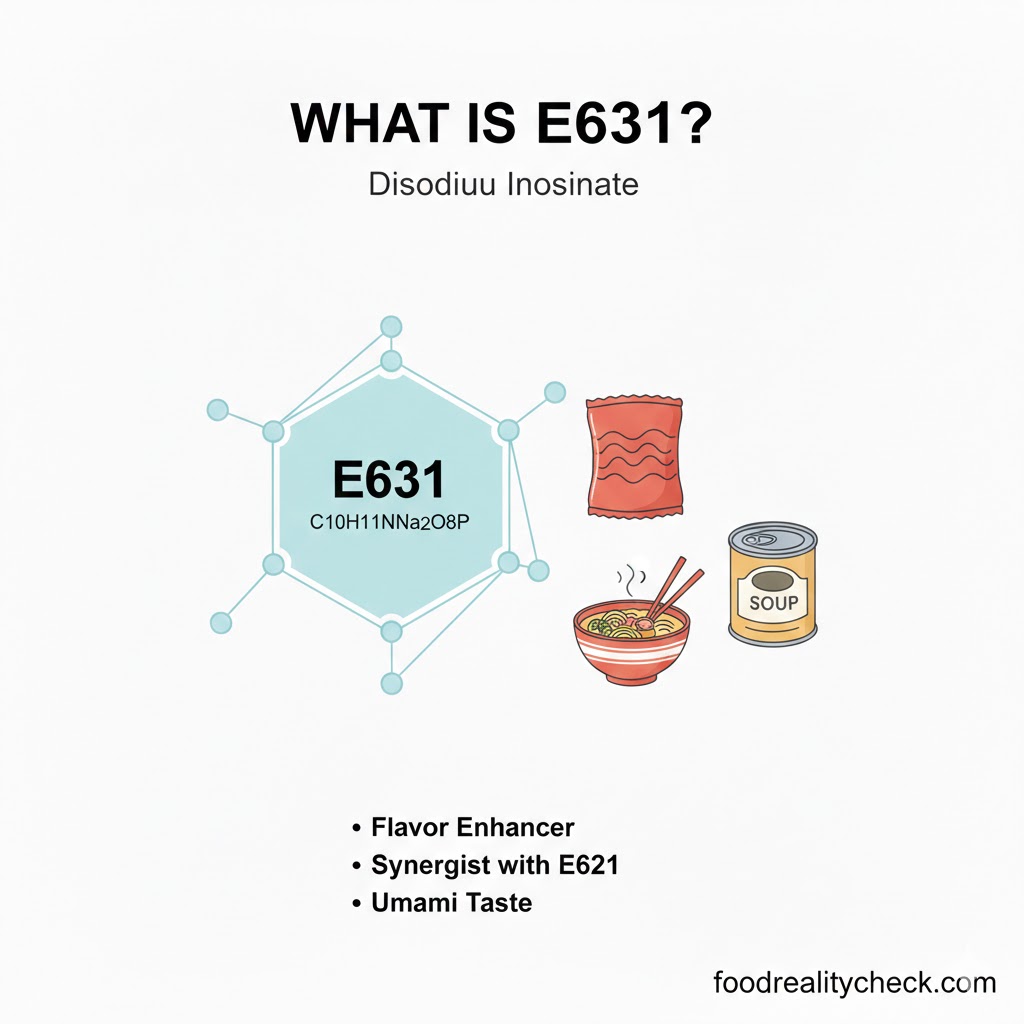
E631 is disodium inosinate—a flavor enhancer derived from inosinic acid (inosine 5′-monophosphate or IMP), a naturally occurring nucleotide found in meat and fish. It’s primarily used in instant noodles, potato chips, seasonings, and processed snacks to enhance umami (savory) taste, often in synergy with monosodium glutamate (MSG).
While regulatory authorities approve E631 as safe at food levels, it’s a purine compound that metabolizes to uric acid—a critical concern for people with gout, kidney stones, or kidney disease who must strictly limit purine intake.
Unlike truly neutral additives, E631 is categorized as having “some concerns” by independent food safety evaluators, specifically because regular consumption in highly processed foods can be a marker of an ultra-processed diet, and because vulnerable populations must avoid it.
📌 Quick Facts
- Category: Flavor enhancer, nucleotide, umami taste booster
- Source: Naturally found in meat/fish; commercially produced by bacterial fermentation or animal product extraction
- Found in: Instant noodles, potato chips, snack seasonings, stock cubes, processed soups, sauces
- Safety Status: FDA approved, EFSA approved, but with cautions for vulnerable populations
- Chemical Name: Disodium inosinate; C₁₀H₁₁N₄Na₂O₈P (disodium salt of inosinic acid)
- Metabolism: Converts to uric acid through purine metabolism
- Controversy Level: MODERATE—safe for healthy people but risky for gout/kidney patients
- Dietary Status: Often non-vegetarian (from meat/fish), though fermented versions may be vegan
What Exactly Is Disodium Inosinate?
Disodium inosinate is the disodium salt of inosinic acid (IMP—inosine 5′-monophosphate), a nucleotide that occurs naturally in living cells. It’s a purine nucleotide—meaning your body metabolizes it into uric acid.
Chemical composition: Inosinic acid consists of the purine base adenine ring bonded to a ribose sugar and a phosphate group. The disodium salt form allows it to dissolve and function in food.
In simple terms: It’s a chemical messenger found in meat and fish that makes food taste savory and meaty. When extracted and added to processed foods, it amplifies umami taste—the same flavor-enhancing quality in aged cheese, tomato sauce, or mushroom soup.
Key properties:
• Purine nucleotide: Metabolizes to uric acid—critical for gout/kidney disease sufferers
• Synergistic with MSG: Works 5-6 times more effectively when combined with glutamate sources
• Powerful umami booster: Approximately 50% as potent as disodium guanylate (E627)
• Natural origin: Found abundantly in meat (80-800 mg/100g), fish, and yeast
• Often combined: Used as part of “disodium 5′-ribonucleotides” blends with disodium guanylate (E627)
• Low-dose usage: Effective at very small concentrations (0.5-2g/kg food)
Where You’ll Find E631
Disodium inosinate appears primarily in processed savory foods:
• Instant ramen and noodle products
• Potato chips and savory snacks
• Snack seasonings and flavoring powders
• Stock cubes and bouillon
• Instant soups and dried soups
• Processed meat products
• Sauces and condiments
• Cheese-flavored snacks
• Asian noodle seasonings
• Frozen dinner meals
• Canned broths
• Umami-boosted seasonings
Important pattern: E631 is almost always found in highly processed, inexpensive convenience foods. If you see E631 on an ingredient list, it’s a reliable marker that the product is ultra-processed and should be consumed infrequently.
How Is Disodium Inosinate Produced?
Disodium inosinate is produced through two main methods:
Method 1: Bacterial Fermentation (Modern, potentially vegetarian):
Microorganisms are cultivated on carbohydrate feedstocks (tapioca starch, glucose). The bacteria produce nucleotide-rich biomass containing inosinic acid. The inosinic acid is then extracted, purified, and neutralized with sodium to create disodium inosinate.
Method 2: Animal Product Extraction (Traditional, non-vegetarian):
Inosinic acid is extracted from animal meat, fish, or their byproducts. The extracted inosinic acid is then neutralized with sodium to create the food-grade disodium inosinate salt.
Note on vegetarian status: While manufacturers increasingly claim to use fermentation (potentially vegetarian), the industry historically relied on animal extraction, which remains common. Check labels—products labeled “suitable for vegetarians” use fermented versions, while unlabeled products likely derive from animal products.
Functions of E631 in Food
Disodium inosinate serves one primary function:
As a flavor enhancer (umami booster): Amplifies the savory, meaty taste perception. Most effective when used in combination with MSG or other glutamate sources (yeast extract, tomato), where the two compounds create a synergistic effect—multiplying the flavor impact while keeping individual additive levels lower.
Why manufacturers use it: It allows them to create “meaty” or “savory” taste in cheap processed foods without using expensive meat ingredients. Combined with MSG, a small amount of E631 + E621 can make instant noodles taste like real meat broth.
Is E631 Safe?
For healthy people, E631 is approved as safe. However, for vulnerable populations, it poses real health risks.
Regulatory Approvals (for general population):
• FDA: Approved as a direct food additive flavoring adjuvant
• EFSA: Approved as E631 within the ribonucleotides group (E626-E635) with maximum use level of 500 mg/kg in certain products
• JECFA (WHO/FAO): Assigned a Group ADI for nucleotide flavor enhancers (inosinate salts) of “Not Specified”—indicating low toxicity at normal use levels
⚠️ Critical Safety Issue: Purine Metabolism & Gout Risk
E631 is a PURINE nucleotide that metabolizes to uric acid. This is the most important health consideration for this additive.
For most people without gout or kidney disease, regular consumption poses minimal acute risk because dietary purine intake from E631 (average 4 mg/day from additives vs. 2,000+ mg/day from natural foods) is modest.
However, for vulnerable populations, E631 should be strictly avoided:
• People with active gout
• Those with hyperuricemia (elevated uric acid levels)
• People with recurrent kidney stones
• Those with chronic kidney disease or reduced kidney function
• Pregnant women (emerging research suggests potential fetal effects from high purine intake)
Health Effects & Side Effects
For Healthy People (No Gout/Kidney Disease):
Minimal documented acute toxicity: At normal food levels, E631 shows no significant toxic effects. Animal studies found no concerning toxicity even at high doses, though some kidney changes were noted in high-dose studies (8% disodium inosinate in diet).
Reported sensitivities (individual variation):
• Headaches or migraines (in some individuals, similar to MSG sensitivity)
• Skin rashes or hives (rare allergic-type reactions)
• Gastrointestinal discomfort (rare)
• Asthma exacerbation (in sensitive individuals)
These effects are similar to MSG sensitivity and likely affect a small subset of the population.
For Gout Sufferers:
Direct uric acid elevation: E631 metabolizes to uric acid. Even small amounts can trigger gout attacks in susceptible individuals. People with gout need to minimize ALL purine sources, including E631-containing foods.
For Kidney Disease Patients:
Impaired uric acid clearance: Kidneys with reduced function struggle to eliminate excess uric acid. E631 consumption can elevate blood uric acid levels, worsening kidney function and potentially triggering kidney stone formation.
Dietary Marker Concern:
Ultra-processed diet indicator: E631 appears almost exclusively in highly processed convenience foods. Regular consumption of E631-containing foods indicates a diet pattern associated with obesity, metabolic syndrome, type 2 diabetes, and cardiovascular disease—not from E631 itself, but from the overall ultra-processed nature of the diet.
E631 vs Related Flavor Enhancers: Comparison
| Additive | Type | Purine/Uric Acid? | Health Concerns | Vegetarian Status |
|---|---|---|---|---|
| E631 Disodium Inosinate | Purine nucleotide | ✗ YES—metabolizes to uric acid | Gout/kidney disease risk; ultra-processed foods marker | Often non-vegetarian; fermented versions may be vegan |
| E627 Disodium Guanylate | Purine nucleotide | ✗ YES—metabolizes to uric acid | Similar to E631; even more potent flavor booster | Usually non-vegetarian |
| E635 Disodium 5′-Ribonucleotides | Blend of E627 + E631 | ✗ YES—mixture of purines | Combined purine risk; synergistic flavor boost | Usually non-vegetarian |
| E621 MSG (Monosodium Glutamate) | Amino acid salt | ✓ NO—not a purine | Controversy about neurotoxicity; MSG sensitivity in some | Usually vegan (fermented from plants) |
| E630 Inosinic Acid | Purine nucleotide (acid form) | ✗ YES—metabolizes to uric acid | Same as E631; purine risk | Depends on source |
Who Should Avoid E631?
Definitely avoid E631 if you have:
• Active gout: ANY exposure can trigger attacks
• Recurrent gout attacks: Strict purine avoidance is part of management
• Hyperuricemia: Elevated uric acid levels indicate need for purine restriction
• Chronic kidney disease (CKD): Reduced kidney function impairs uric acid clearance
• History of kidney stones: Purine restriction reduces stone recurrence risk
• Pregnancy (if history of complications): Limited data; precautionary avoidance recommended
• Infants under 12 months: Food additives generally avoided for developing systems
Consider limiting if:
• You’re overweight or obese (E631 marker of ultra-processed foods)
• You have metabolic syndrome or type 2 diabetes
• You have cardiovascular disease
The Bottom Line
E631 (disodium inosinate) is approved as safe by major food authorities, but with critical caveats: It’s a purine nucleotide that metabolizes to uric acid, making it dangerous for gout and kidney disease patients. For healthy people, it’s likely safe at food levels, but its presence signals ultra-processed food consumption.
Key takeaways:
• Safe for most healthy people: Approved by FDA, EFSA, JECFA; minimal acute toxicity at food levels
• DANGEROUS for gout/kidney patients: Purine metabolism creates uric acid—direct health risk
• Moderate controversy: Classified as “orange—some concerns” by independent food evaluators
• Ultra-processed marker: E631 appears almost exclusively in cheap convenience foods; signals an ultra-processed diet pattern
• Synergistic with MSG: Usually combined with monosodium glutamate for amplified effect
• Often non-vegetarian: Historically and currently derived from meat/fish; fermented versions may be vegan
• Minimal individual sensitivity: Some people report migraine/headache reactions similar to MSG sensitivity
Practical recommendation: If you have gout, kidney disease, or elevated uric acid levels, strictly avoid foods containing E631, E627, or E635. For healthy people, occasional consumption is likely safe, but the real issue is that E631-containing foods are typically ultra-processed and nutritionally poor. The healthier approach is reducing consumption of instant noodles, cheap snacks, and processed seasonings in general—not just for E631, but for the overall diet quality they represent.