The Quick Answer
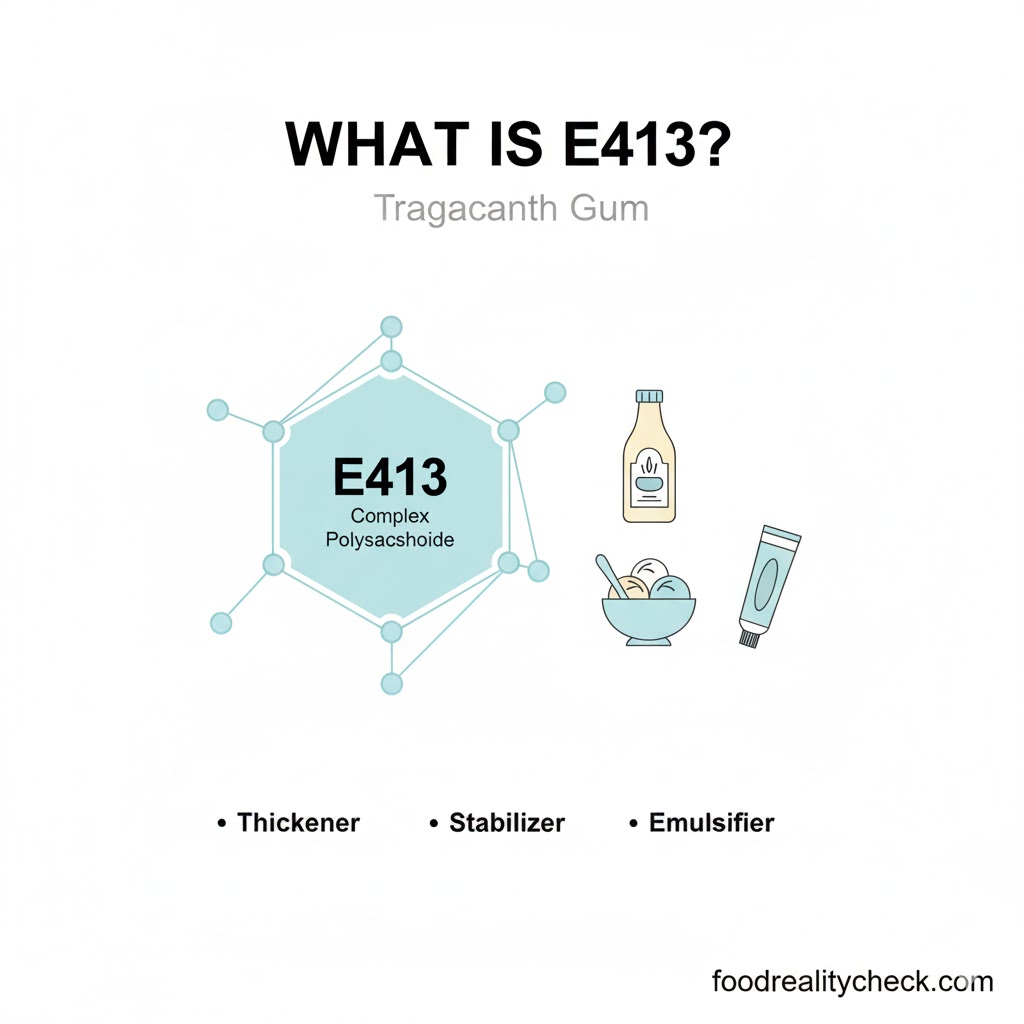
E413 is tragacanth gum—also known as “gum dragon”—a natural thickener and stabilizer extracted from the sap of Astragalus shrubs native to the Middle East (primarily Iran, Iraq, Syria, and Turkey). It’s one of the most viscous natural gums available, with exceptional heat and acid stability.
Unlike many food additives, tragacanth is a genuinely safe, plant-based ingredient that may provide digestive health benefits through its prebiotic fiber content and traditional use in herbal medicine spanning centuries.
It’s less common than guar gum or locust bean gum in processed foods due to supply chain constraints, but where it’s used, it’s highly valued for its superior stability in extreme conditions and excellent emulsifying properties.
📌 Quick Facts
- Category: Thickener, stabilizer, gelling agent, emulsifier, soluble dietary fiber
- Source: Sap exudation from Astragalus shrub roots (Middle Eastern regions)
- Found in: Salad dressings, sauces, syrups, ice cream, cake decorations, processed cheeses, beverages
- Safety Status: FDA approved, EFSA approved, no specified ADI (highest safety rating)
- Dietary Status: 100% vegan, vegetarian, gluten-free, kosher
- Chemical Name: Complex mixture of acidic polysaccharides (galacturonic acid, galactose, xylose, arabinose, fucose)
- Controversy Level: NONE—universally considered safe
- Rarity: Less common than other gums due to limited geographical production
What Exactly Is Tragacanth Gum?
Tragacanth gum is a complex mixture of acidic polysaccharides (complex carbohydrates) secreted from the roots of Astragalus shrub species. It consists of two main fractions: a water-soluble component called tragacanthin and a water-swelling component called bassorin.
Chemical composition: The primary components include galacturonic acid, D-galactose, D-xylose, L-fructose, D-mannose, and L-arabinose. The exact composition varies depending on the plant species and growing conditions.
Physical form: In nature, tragacanth exudes from the plant roots as twisted white or grayish strips or flakes that are hard and brittle when dry. The name “gum dragon” comes from the Greek words “tragos” (goat) and “akantha” (thorn), referencing the plant’s thorny appearance.
In simple terms: It’s a thick, gummy substance that plants produce as a protective barrier. When extracted and processed, it creates one of the most viscous natural gums available—approximately 5-8 times more viscous than guar gum at equivalent concentrations.
Key properties:
• Extremely viscous: Creates thick gels at very low concentrations (0.1-0.4%)
• Heat stable: Maintains viscosity at high temperatures without breaking down
• Acid stable: Doesn’t degrade in acidic environments, perfect for sauces and citrus products
• Dual-action: Both swells and dissolves in water, creating unique texture properties
• Excellent emulsifier: Superior to many synthetic emulsifiers in certain applications
• Long shelf life: Doesn’t degrade during extended storage
Where You’ll Find E413
Tragacanth appears in select processed foods:
• Salad dressings and vinaigrettes
• Sauces and condiments (particularly acidic ones like mustard)
• Syrups and glazes
• Ice cream and frozen desserts
• Confectionery (fondant fillings, sugar syrups)
• Cake decorations and icings
• Processed cheeses
• Some beverages (particularly acidic or citrus-based)
• Mayonnaise
• Soups and broths
• Meat products and sausages
• Cosmetics and personal care products
• Pharmaceutical preparations
Availability note: Tragacanth is less common in everyday processed foods than guar gum or locust bean gum. Its use is typically reserved for products that require exceptional stability under extreme pH or temperature conditions, where cheaper alternatives would fail.
How Is Tragacanth Gum Produced?
Tragacanth gum production is one of the most ancient and traditional food extraction methods:
Step 1: Harvesting & Tapping
Astragalus shrubs grow wild in arid mountainous regions of the Middle East. When plants reach maturity (typically 5-6 years), the root and lower stem are tapped or cut. The gum exudes naturally as a protective response from the plant.
Step 2: Collection & Drying
The gum exudation is collected and dried in the sun. This is a manual, labor-intensive process. The dried gum appears as white, twisted strips or flakes.
Step 3: Cleaning & Sorting
The crude gum is cleaned to remove debris and sorted by quality and color. Lighter-colored gum is typically considered higher quality.
Step 4: Grinding
The cleaned gum is finely ground into a powder or microparticles. No chemicals or solvents are used in this mechanical process.
Step 5: Optional Purification
For food-grade applications, the gum may be further purified to remove impurities and standardize viscosity. This typically involves water extraction and sedimentation.
Step 6: Quality Control & Standardization
The final product is tested for viscosity (measured in centipoise), purity, microbiological safety, and contaminants before packaging.
Note: The entire production process uses only mechanical and water-based methods. No synthetic chemicals are involved. Iran is the world’s largest producer, though production has been affected by geopolitical tensions, making supply limited and prices higher than other gums.
Functions of E413 in Food
Tragacanth serves multiple practical functions, particularly in challenging applications:
As a thickener: Creates extremely thick, stable emulsions at very low concentrations. One of the most efficient thickeners on a gram-for-gram basis.
As a stabilizer: Prevents separation of oil and water in emulsified foods. Particularly valuable in products that must remain stable at high temperatures or in acidic environments (dressings, citrus sauces).
As a gel former: Creates firm, stable gels that hold their shape without refrigeration. Used in confectionery fillings and decorative applications.
As an emulsifier: Binds fat and water phases more effectively than some synthetic emulsifiers. Superior emulsifying power compared to guar gum or locust bean gum.
As a binder: In icing and cake decorations, tragacanth creates moldable pastes with excellent workability.
As a protective colloid: In beverages, it suspends particles and prevents settling or separation during storage.
As dietary fiber: Like other plant-based gums, it contributes to soluble dietary fiber intake and provides prebiotic benefits.
Is E413 Safe?
Yes. Tragacanth gum is safe and approved by major food authorities worldwide.
Regulatory Approvals:
• FDA: Approved as a food additive. Listed as “Generally Recognized As Safe” for use as a stabilizer, thickener, and emulsifier.
• EFSA (European Food Safety Authority): Approved as E413. Although no specific re-evaluation has been conducted recently (unlike other gums), it remains approved for use with no numerical ADI set.
• Usage tradition: Used in food for centuries, particularly in Middle Eastern and Asian cuisines.
Why is the safety so strong?
1. Natural plant source: Tragacanth is a plant secretion, not a synthetic chemical. Humans have consumed it safely for centuries in traditional foods and medicines.
2. Indigestible: Like other gums, tragacanth passes through the digestive system largely unchanged, being fermented by beneficial gut bacteria.
3. No toxicity: Extensive research shows no toxic effects at any reasonable consumption level.
4. Traditional use: Historically used in traditional medicine for respiratory health, digestive issues, and wound healing—with no reports of harm.
5. Limited exposure: Because tragacanth is less commonly used than other gums, total dietary exposure is naturally lower.
Health Benefits of Tragacanth Gum
🌟 Traditional & Emerging Health Benefits
- Prebiotic fiber: Fermented by gut bacteria to produce short-chain fatty acids (SCFAs) that support colon health and beneficial bacterial growth
- Respiratory support: Traditionally used as an expectorant and demulcent for cough, sore throat, and respiratory complaints
- Digestive health: High soluble fiber content supports regular bowel movements and digestive comfort
- Anti-inflammatory: Traditional use suggests anti-inflammatory effects; some modern research supports reduced intestinal inflammation
- Wound healing: Topically applied, may support skin healing and have antimicrobial properties
- Bulk-forming laxative: Historically used as a gentle, natural laxative for constipation management
- Blood sugar stabilization: As soluble fiber, may slow carbohydrate absorption and moderate blood glucose spikes
Research note: Tragacanth has received less modern scientific study compared to guar gum or gum arabic. Most current knowledge comes from traditional use and extrapolation from other plant gums. Additional research would further clarify its specific health benefits.
Side Effects & Digestive Considerations
Tragacanth gum is generally very well tolerated with minimal side effects:
Mild digestive effects (rare, from excessive intake):
• Slight bloating or gas (much less common than with guar gum)
• Loose stools or diarrhea (due to laxative fiber effect)
• Mild abdominal discomfort
• Rare nausea
Why fewer side effects than other gums? Tragacanth is used at much lower concentrations (0.1-0.4%) compared to guar gum or locust bean gum (1-5%), so total fiber intake from tragacanth in foods is typically minimal. Side effects are unlikely at food-use levels.
Important note about water intake:
Like all gums, tragacanth can swell in the digestive system. While the risk is lower due to lower food concentrations, consuming adequate water (at least 8 oz with meals containing the additive) is still prudent.
Rare allergic reactions:
Occupational exposure to tragacanth dust has occasionally triggered respiratory symptoms in workers (asthma, rhinitis). Food consumption poses no such risk. True allergies to tragacanth in foods are extremely rare.
No significant interactions:
Unlike some plant gums, tragacanth has no known significant interactions with medications.
E413 Tragacanth vs Other Gums: Comparison
| Gum | Source | Viscosity | Heat Stability | Acid Stability | Best Use |
|---|---|---|---|---|---|
| E413 Tragacanth | Astragalus shrub roots | ✓ Highest (5-8x guar) | ✓ Excellent | ✓ Excellent | High-heat or acidic products where stability is critical |
| E412 Guar Gum | Guar plant seeds | ~ Medium-High | ~ Good | ~ Good | General thickening; most versatile option |
| E410 Locust Bean Gum | Carob tree seeds | ~ Medium | ~ Good | ~ Good | General thickening; better delayed gastric emptying effects |
| E407 Carrageenan | Red seaweed | ~ Medium | ✓ Excellent | ✓ Excellent | Controversial; emerging health risks despite heat/acid stability |
| Xanthan Gum | Bacterial fermentation | ~ Medium | ~ Good | ~ Fair | Gluten-free baking; general thickening; less effective in acidic products |
Who Should Avoid or Limit Tragacanth?
Tragacanth is safe for most people. Consider avoiding if you have:
• History of intestinal obstruction: While risk is lower due to low food concentrations, consult your doctor
• Severe esophageal strictures: Avoid gums that swell, unless approved by healthcare provider
• Difficulty swallowing: Though risk is minimal at food levels
• Occupational exposure sensitivity: Rare, but avoid if known airway sensitivity to the dust
General recommendation: Tragacanth is one of the safest gums for most people, with minimal side effects even compared to guar gum. Its lower food concentrations make it exceptionally safe.
The Bottom Line
E413 (tragacanth gum) is a safe, natural, plant-based thickener with a long history of use and approval from major food authorities. It’s particularly valuable in applications where exceptional heat or acid stability is required.
Key takeaways:
• Universally safe: Approved by FDA and EFSA with no numerical ADI limits
• Natural plant source: Extracted from Astragalus shrub roots using mechanical methods only
• No controversy: Zero scientific debate about its safety
• Superior performance: Most viscous natural gum; exceptional heat and acid stability
• Minimal side effects: Lower food concentrations mean fewer digestive effects than other gums
• Potential benefits: Prebiotic fiber, traditional respiratory and digestive support
• Vegan and clean: Plant-based, no synthetic chemicals in production
• Limited availability: Less common due to geographical constraints and supply chain issues
Practical recommendation: Tragacanth gum is one of the safest and most effective food additives available. Where it’s used (primarily in specialty sauces, dressings, and confectionery), it’s justified by its superior performance in challenging applications. If you encounter it in ingredient lists, it’s an excellent additive with no health concerns.