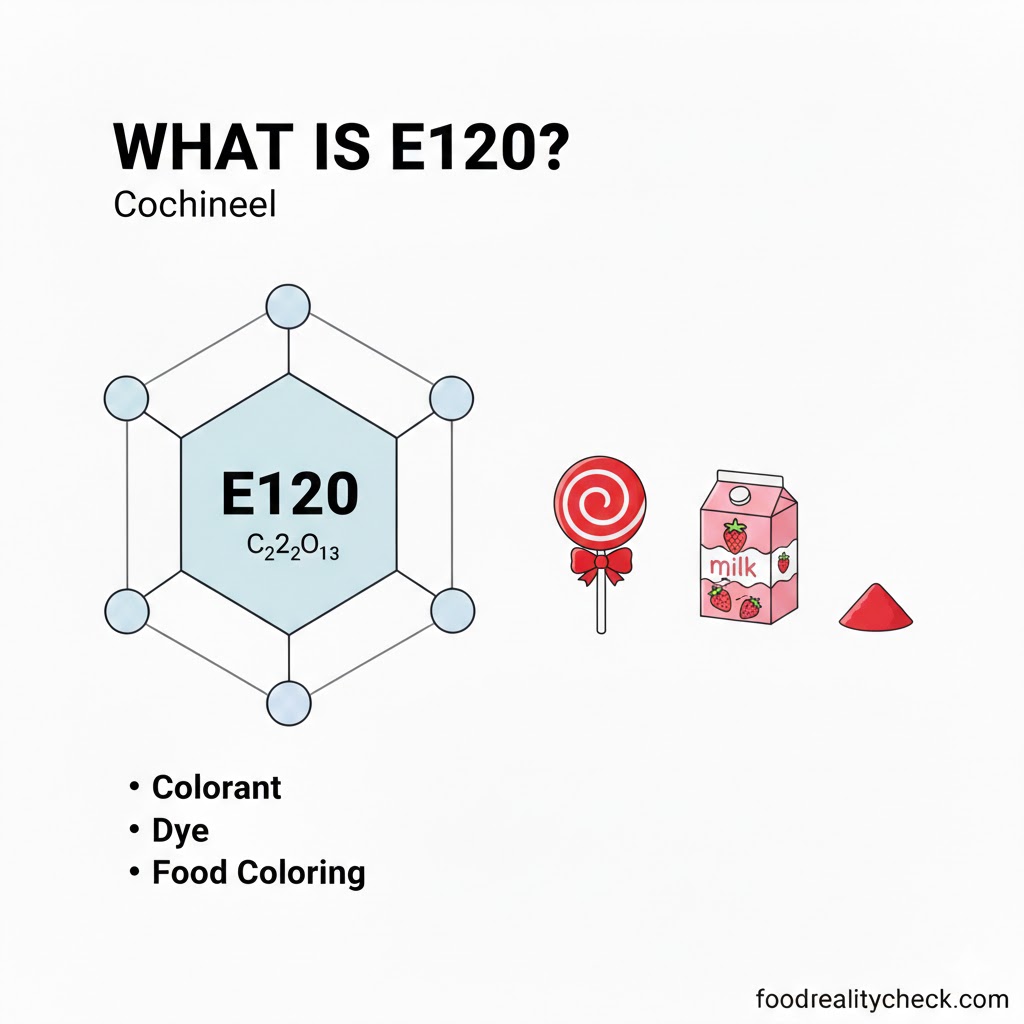
What is E120?
Complete guide to understanding E120 (Carmine/Cochineal) in your food
The Quick Answer
E120 is a natural deep red colorant extracted from female cochineal insects.
It’s used in candies, yogurts, jams, beverages, and cosmetics to provide vibrant red color.
It’s one of the oldest natural dyes, historically used by Aztec and Mayan civilizations, but it poses unique challenges: rare but serious allergic reactions (including anaphylaxis), dietary restrictions for vegans/vegetarians, and religious/cultural concerns.
📌 Quick Facts
- Category: Natural food colorant (derived from insects)
- Source: Dried bodies of female cochineal insects (Dactylopius coccus)
- Also Known As: Carmine, Cochineal extract, Carminic acid, Natural Red 4, CI 75470
- Found in: Candies, yogurts, jams, juices, beverages, cosmetics, medications
- Safety: Generally approved; rare but documented allergic reactions including anaphylaxis
- Production: ~70,000-155,000 insects required per kg of dye
- Ethical Concerns: Not suitable for vegans, vegetarians, or certain religious diets
What Exactly Is It?
E120 is a natural red pigment extracted from the dried bodies of female cochineal insects.
The cochineal insect (Dactylopius coccus Costa) is a small scale insect native to Central and South America that lives on prickly pear cacti.
The active coloring compound is carminic acid, which comprises 17–24% of the dried insect’s weight. This acid evolved naturally in the insect as a defense mechanism against predators.
Production involves harvesting insects from cacti, drying them, crushing them, and extracting carminic acid using water or alcohol. The extracted acid is then purified and combined with aluminum or calcium salts to create the stable carmine dye.
Historically, cochineal was one of the most valuable exports from the Americas to Europe during the colonial period—literally worth its weight in gold at times.
Where You’ll Find It
E120 appears in many common foods and cosmetics:
• Candies and sweets (particularly red candies)
• Yogurts and yogurt drinks
• Jams, jellies, and marmalades
• Fruit juices and beverages
• Alcoholic beverages (liqueurs, wine, cocktail mixers)
• Processed and cured meats (sausages, ham)
• Cakes and pastries
• Chocolate and confectionery
• Ice cream and frozen desserts
• Medications (particularly pediatric syrups)
• Lipsticks and cosmetics
• Blushes and eye shadows
• Some textile dyes
Global production centers are primarily in Peru and the Canary Islands, where prickly pear cacti are cultivated specifically for cochineal harvesting.
Why Do Food Companies Use It?
E120 serves one purpose: provide vibrant, stable deep red color to products.
Manufacturers prefer it for several reasons:
Natural origin: Unlike synthetic dyes (Red 40), E120 is genuinely natural, appealing to health-conscious consumers and “clean label” products.
Exceptional color stability: E120 resists degradation from heat, light, acid, and time far better than plant-based alternatives—ideal for long shelf-life products.
Historical precedent: Cochineal has been used for 500+ years, providing consumer confidence in safety.
Superior vibrancy: Produces deep, rich reds that plant-based colorants (like beetroot) cannot match.
Regulatory approval: Approved globally as safe, unlike some synthetic alternatives facing elimination (e.g., Yellow 5, Yellow 6).
Is It Safe?
E120 is generally approved as safe by regulatory bodies, but it poses rare but serious allergic risks that should not be overlooked.
The FDA approves E120 (cochineal and carmine) for food use with no numerical ADI (Acceptable Daily Intake) specified.
The EFSA also approved E120 and considers it safe for the general population at approved use levels.
However, despite being “generally safe,” E120 causes genuine IgE-mediated allergic reactions in a subset of the population, including rare anaphylaxis cases.
⚠️ Important Allergic Reaction Concern: While E120 is approved as safe, documented cases show it can cause serious IgE-mediated allergic reactions including:
• Urticaria (hives) and skin rashes
• Angioedema (swelling of face/throat)
• Asthma exacerbation and bronchial constriction
• Anaphylaxis (life-threatening allergic shock)
• Vomiting and diarrhea
• Occupational asthma in factory workers
These reactions are caused by insect-derived proteins in the carmine, not the carminic acid itself. Allergies are IgE-mediated (true food allergies), not food intolerances.
What Are The Health Concerns?
E120 has minimal chemical toxicity but poses specific allergic and ethical concerns:
IgE-mediated allergic reactions (PRIMARY CONCERN): Well-documented cases of serious allergic reactions to carmine proteins, including urticaria, angioedema, asthma, occupational asthma in workers, and rare anaphylaxis. These are true allergies (protein-based), not chemical sensitivities. Studies show carmine retains insect-derived proteins (23-88 kDa) that trigger reactions in sensitive individuals.
Anaphylaxis cases: Medical literature documents multiple cases of anaphylactic shock after carmine ingestion—requiring epinephrine and emergency care. Cases reported after consuming popsicles, beverages, and foods colored with E120.
Occupational asthma: 18+ documented cases of occupational asthma in workers exposed to carmine dust or aerosols in food manufacturing facilities.
No chemical toxicity: Unlike synthetic dyes, E120 shows no genotoxicity, carcinogenicity, or reproductive toxicity concerns at approved use levels.
Dietary restrictions: Not suitable for vegans, vegetarians, or those following Kosher/Halal diets—ethical/religious concern rather than health risk.
Natural vs Synthetic Version
E120 is completely natural—there is no synthetic version.
It’s extracted directly from dried cochineal insects; all E120 comes from the same biological source.
What varies is processing: cochineal extract (less processed) vs. carmine (more refined, salt-treated), but both come from insects.
Natural Alternatives
Want to avoid E120?
Food companies use plant-based red colorants:
• Beetroot extract/Betanin (E162) – natural red/purple from beets (most popular alternative)
• Red cabbage extract – natural red-purple from cabbage
• Anthocyanins (E163) – natural dyes from berries and grapes
• Allura Red/Red 40 – synthetic alternative (though being phased out in some regions)
• No coloring – accept naturally colored products
Plant-based alternatives are vegan-friendly and more stable than many assume, though some (like beetroot) may be less vibrant or more pH-sensitive than carmine.
The Bottom Line
E120 (Carmine/Cochineal) is a natural deep red colorant derived from insects that is generally approved as safe but poses rare but serious allergic risks (including anaphylaxis) and is unsuitable for vegans, vegetarians, and certain religious diets.
Safety Profile: No chemical toxicity (genotoxicity, carcinogenicity) concerns. However, documented allergic reactions—including anaphylaxis—occur in susceptible individuals due to insect-derived proteins, not the carminic acid pigment itself.
Allergy Prevalence: Allergies are rare in the general population but serious when they occur. Workers in carmine manufacturing face occupational asthma risks. Individuals with shellfish or insect allergies may have higher risk.
Ethical Considerations: Unsuitable for vegans, vegetarians (often), and Kosher/Halal diets. Requires 70,000-155,000 insects per kg of dye, raising animal welfare and sustainability questions.
Regulatory Action: Unlike synthetic dyes facing elimination (Yellow 5, Yellow 6), E120 remains approved and even preferred by manufacturers as a “natural” alternative.
If You Have Known Allergies: Check all ingredient labels, particularly for products that are red-colored or labeled “natural colors.” If you have shellfish, insect, or food allergies, consult with an allergist about carmine risk. People with asthma should be particularly cautious.
For Most People: E120 is safe. However, the existence of documented anaphylaxis cases means it should not be casually dismissed—allergies are real, even if rare.