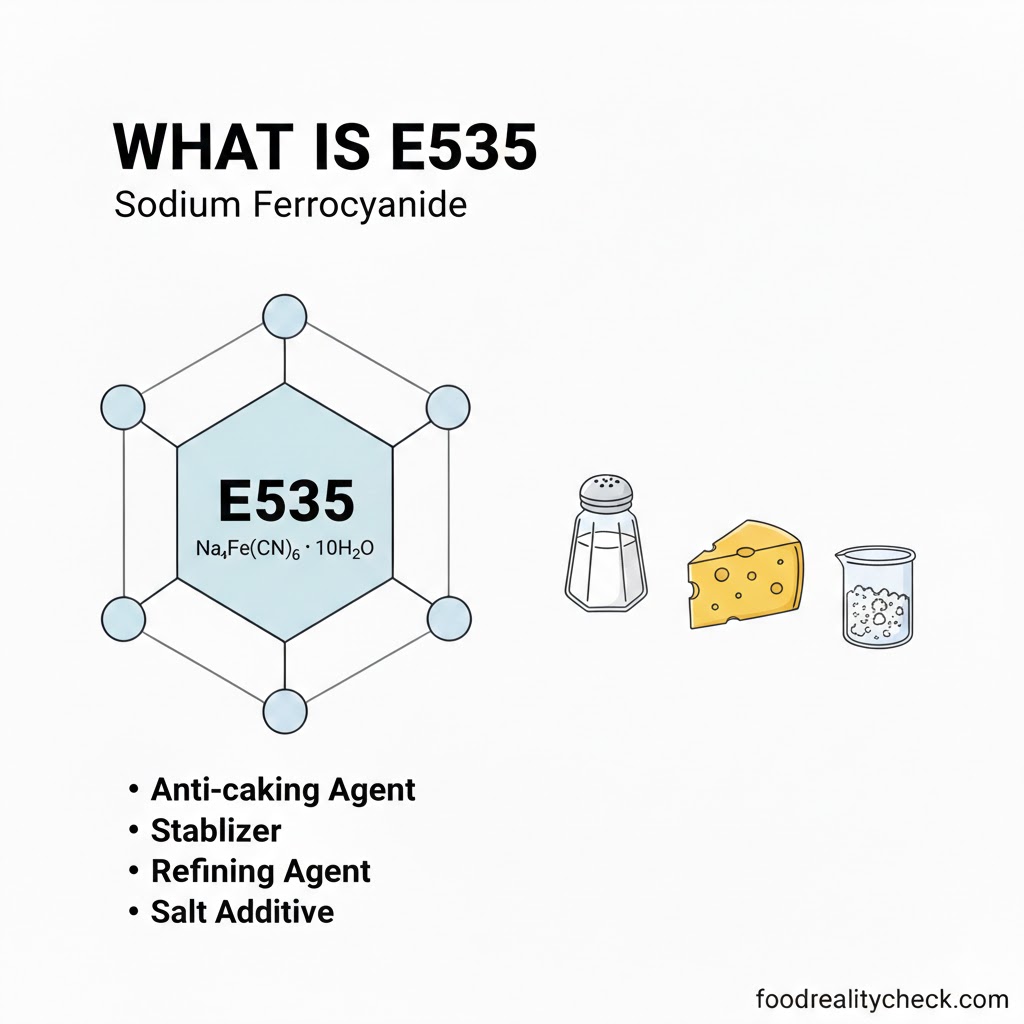
What is E535?
Complete guide to understanding E535 (Sodium Ferrocyanide) in your food
The Quick Answer
E535 is a synthetic anti-caking agent containing cyanide but chemically bound so it cannot release toxic cyanide.
It’s used in table salt to prevent clumping and keep salt free-flowing.
Despite its alarming chemical name, E535 is considered safe by regulatory authorities and poses essentially no health risk at approved use levels.
📌 Quick Facts
- Category: Anti-caking agent (inorganic compound)
- Chemical Name: Sodium ferrocyanide, also called “Yellow Prussiate of Soda”
- Chemical Formula: Na₄[Fe(CN)₆]·10H₂O
- Contains: Cyanide ions chemically bound to iron (cannot release free cyanide)
- Found in: Table salt, sea salt, iodized salt, salt substitutes
- Safety: FDA and EFSA approved; considered safe with no known adverse effects at approved levels
- ADI (EFSA): 0.03 mg/kg body weight per day (expressed as ferrocyanide ion)
- Maximum Permitted Level: 20 mg/kg (parts per million) in salt
What Exactly Is It?
E535 is a synthetic compound containing sodium, iron, and cyanide ions chemically bound together as a complex salt.
Its chemical formula is Na₄[Fe(CN)₆]·10H₂O.
The critical safety feature: the cyanide ions are tightly bound to the iron atom through extremely strong chemical bonds. This bonding is so strong that free cyanide ions cannot be released under normal conditions—not in water, not in stomach acid, and not in the human body.
E535 is synthesized in laboratories by reacting sodium cyanide with iron sulfate or iron chloride.
It appears as a yellow powder (hence the alternative name “Yellow Prussiate of Soda”) and is highly stable.
Where You’ll Find It
E535 appears only in salt and salt products:
• Table salt (kitchen salt)
• Sea salt
• Iodized salt
• Salt substitutes
• Dendritic salt (specially shaped crystal salt)
E535 is NOT used in any other foods—regulatory approval is restricted solely to salt and salt substitutes.
Why Do Food Companies Use It?
E535 serves one essential purpose: prevent salt from clumping and forming lumps when exposed to humidity.
Salt naturally absorbs moisture from humid air, causing the crystals to partially dissolve and recrystallize as large lumps. E535 works by:
Crystal modification: E535 changes the crystal structure of salt at the molecular level, reducing the likelihood of moisture absorption and recrystallization.
Minimal dosage needed: Only 20 mg per kg (0.002%) is required, making it extremely economical.
Invisibility: At these tiny doses, E535 doesn’t affect salt taste, appearance (beyond yellow tinge), or properties.
Long shelf-life: Keeps salt free-flowing for years, even in humid climates, without refrigeration.
Is It Safe?
Yes, E535 is considered safe and poses no health risk at approved use levels.
The FDA approves E535 with a maximum of 0.0013% in salt.
The EFSA re-evaluated E535 in 2018 and concluded it is “of no safety concern” at current authorized use levels.
JECFA (WHO Expert Committee) also approves E535.
✓ Why It’s Safe Despite Containing Cyanide:
The critical safety principle: chemical bonds matter. Cyanide (CN⁻) as a free ion IS extremely toxic. However, in sodium ferrocyanide, cyanide ions are bound to iron through extraordinarily strong coordination bonds. These bonds cannot be broken by:
• Stomach acid (stomach acid is too weak to break Fe-CN bonds)
• Heat (ferrocyanide resists heating up to decomposition)
• Water (ferrocyanide remains bound in aqueous solution)
• The human body’s chemistry
Result: Free cyanide ions are never released. Ferrocyanide passes through the body largely unabsorbed and is excreted unchanged.
What Are The Health Concerns?
E535 has virtually no documented health concerns at approved use levels.
Absorption: Human absorption is very low (0.25–0.42%). Most E535 passes through the digestive system unchanged and is excreted in urine and feces.
No accumulation: E535 does not accumulate in the body. Long-term exposure studies show no buildup over time.
No genotoxicity or carcinogenicity: Extensive testing shows no genetic damage or cancer risk.
No reproductive or developmental toxicity: Animal studies at extremely high doses (1,000 mg/kg body weight—far beyond any possible food exposure) found no adverse reproductive effects.
Target organ: Kidneys: The only organ of concern in toxicology studies is the kidney, which is the target organ for ferrocyanide toxicity. However, at approved use levels (ADI 0.03 mg/kg), there is no safety concern even for kidneys. An adult would need to consume approximately 15 teaspoons of salt daily just to approach the safe limit—an impossible consumption level.
Free cyanide release concern (theoretical only): Under extreme conditions (strong acids, prolonged UV light exposure), ferrocyanide could theoretically release small amounts of hydrogen cyanide gas. However, none of these conditions occur in food or the human body. Stomach acid is too weak, and UV light doesn’t penetrate food in normal storage.
Safety Comparison: Why Ferrocyanide Is Safe While Cyanide Is Lethal
The Toxicity of Free Cyanide vs. Bound Ferrocyanide:
Free cyanide (CN⁻) is lethal because it binds to the iron-containing cytochrome c oxidase enzyme in the mitochondrial electron transport chain, blocking cellular respiration. Cells cannot produce ATP, and organs fail rapidly. A tiny amount of free cyanide (10 mg) can be fatal to humans.
In sodium ferrocyanide, cyanide is bound to iron in a chelate complex (Fe-CN bonds). When ingested, the entire ferrocyanide complex is too large and polar to be absorbed through the intestinal wall. Any ferrocyanide that IS absorbed remains bound and cannot interact with cellular enzymes because the iron keeps cyanide tightly locked up. Free cyanide is never released.
Natural vs Synthetic Version
E535 is entirely synthetically manufactured—there is no natural form.
It’s produced in laboratories through the reaction of sodium cyanide with iron sulfate or iron chloride.
Natural Alternatives
Want to avoid E535?
Salt alternatives include:
• Additive-free salt or rock salt – unrefined salt with no anti-caking agents (will clump in humidity)
• Potassium ferrocyanide (E536) – similar compound, equally safe
• Calcium ferrocyanide (E538) – similar compound, equally safe
• Silicon dioxide (E551) – alternative anti-caking agent
• Salt stored in dry conditions – no anti-caking agent needed if salt is kept dry
Most alternative anti-caking agents (like silicon dioxide) are equally safe or have slightly different safety profiles. Some consumers prefer ferrocyanide salts because ferrocyanides provide more complete caking prevention at lower doses.
The Bottom Line
E535 (Sodium Ferrocyanide) is a synthetic anti-caking agent containing chemically-bound cyanide that cannot release free cyanide under normal food or physiological conditions, making it safe for human consumption at approved use levels.
Why the scary name matters: The chemical name “sodium ferrocyanide” understandably alarms consumers because cyanide is a notorious poison. However, the bonding of cyanide to iron creates an entirely different chemical with no cyanide toxicity. This is analogous to how table salt (sodium chloride) is safe despite being made from chlorine (a poisonous gas) and sodium (a reactive metal)—the combination creates something completely different and safe.
Regulatory Consensus: The FDA, EFSA, and WHO all approve E535 without reservations. It has been used in salt for decades with an excellent safety record and no documented adverse effects in humans.
Actual Health Risk: Zero. At approved use levels, E535 poses essentially no risk. An adult would need to consume 15+ teaspoons of salt daily to approach the safe intake limit—a biochemically impossible consumption level.
Why It’s a Good Choice: E535 is one of the safest food additives available. Its effectiveness at tiny doses (20 mg/kg) means minimal chemical exposure. If you’re concerned about additives, E535 is one where your concern can be rationally set aside in favor of practical salt preservation.