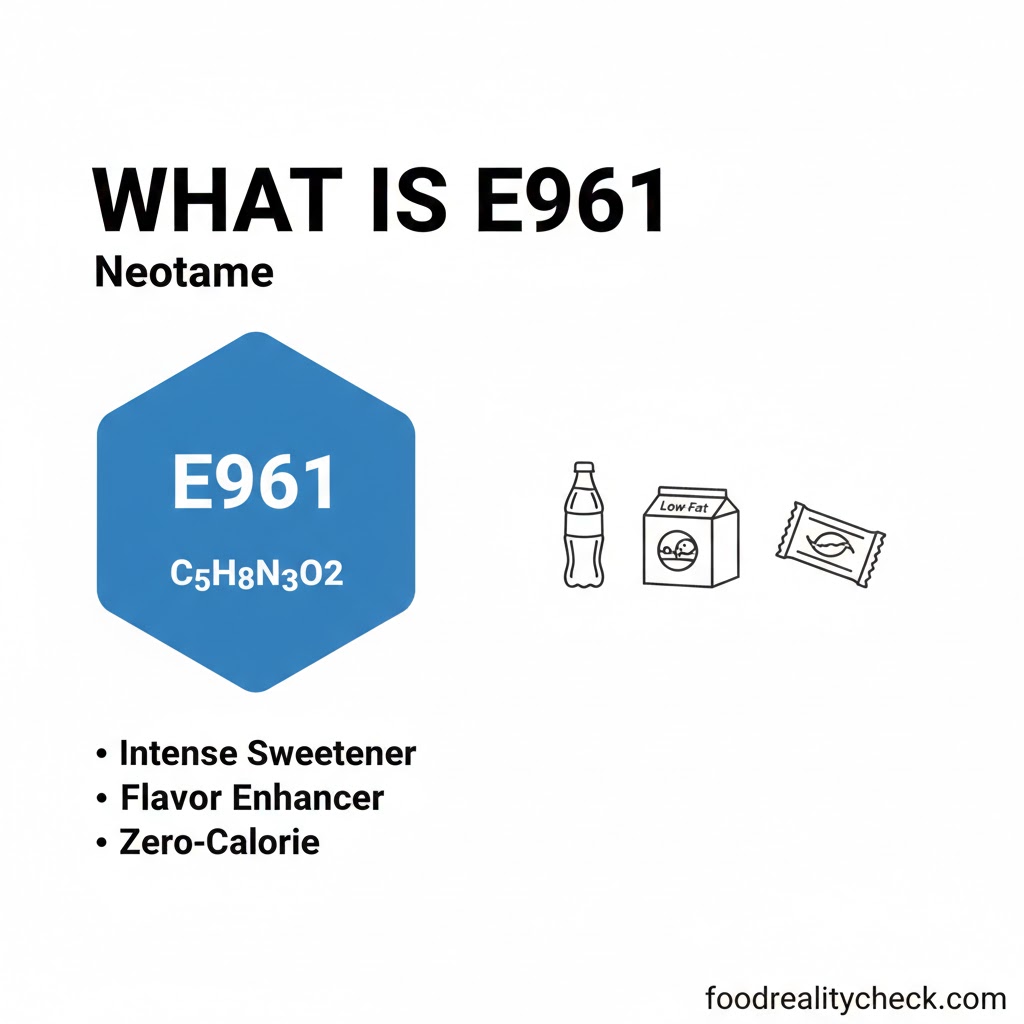
What is E961?
Complete guide to understanding E961 (Neotame) in your food
The Quick Answer
E961 is a synthetic ultra-high-potency aspartame-derived sweetener that is 7,000–13,000 times sweeter than sugar with zero calories.
It’s used in soft drinks, confectionery, baked goods, and sugar-free products as a replacement for sugar.
In July 2025, EFSA completed a comprehensive re-evaluation and concluded it is safe with no safety concerns, increasing the ADI from 2 to 10 mg/kg body weight per day—notably higher than original assessment, reflecting increased confidence in safety compared to aspartame.
📌 Quick Facts
- Category: Synthetic aspartame-derived amino acid-based high-intensity sweetener
- Full Name: N-[N-(3,3-Dimethylbutyl)-L-aspartyl]-L-phenylalanine 1-methyl ester
- Chemical Formula: C₂₀H₃₀N₂O₅
- Sweetness: 7,000–13,000 times sweeter than sugar; ~35 times sweeter than aspartame
- Found in: Diet soft drinks, confectionery, chewing gum, baked goods, frozen desserts, tabletop sweeteners
- Safety Status: FDA approved; EU approved; EFSA July 2025 re-evaluation: NO SAFETY CONCERNS; ADI increased from 2 to 10 mg/kg
- Key Advantage Over Aspartame: Heat-stable up to 100°C (vs. aspartame ~120°C); generates minimal phenylalanine (safe for PKU patients)
What Exactly Is It?
E961 is a synthetic ultra-high-potency sweetener created by attaching a 3,3-dimethylbutyl group (6-carbon chain) to the amino nitrogen of aspartame.
Its full chemical name is N-[N-(3,3-Dimethylbutyl)-L-aspartyl]-L-phenylalanine 1-methyl ester (C₂₀H₃₀N₂O₅).
Production involves the reaction of aspartame with 3,3-dimethylbutyraldehyde under hydrogen pressure with palladium/carbon catalyst, producing a white crystalline powder with a clean, sweet taste and no bitter or metallic aftertaste.
The neohexyl (3,3-dimethylbutyl) group attached to aspartame is the defining structural feature—the “neo” in neotame refers to this new hexyl-like group.
Neotame is approximately 35 times sweeter than aspartame due to the bulky neohexyl group, which enhances binding to sweet taste receptors.
Upon ingestion, neotame is rapidly absorbed and de-esterified (metabolized) to NC-00751 (the aspartame analog with the neohexyl group), which is further metabolized to 3-dimethylbutyric acid and other metabolites.
Where You’ll Find It
E961 appears in sugar-free and low-calorie products:
• Carbonated soft drinks and diet beverages
• Sugar-free confectionery and candies
• Chewing gum (particularly sugar-free)
• Baked goods (cookies, cakes, muffins)
• Frozen desserts and yogurt
• Preserved fruits
• Salad dressings
• Tabletop sweeteners
• Flavor enhancer in various foods
• Powdered drinks and juice drinks
E961 is less commonly found than aspartame (E951) alone due to its much higher potency enabling use in tiny quantities.
Why Do Food Companies Use It?
E961 serves critical functional advantages:
Extreme potency: At 7,000–13,000× sweeter than sugar, neotame enables use in minuscule quantities, reducing off-flavors and aftertastes.
Heat stability: Stable up to 100°C, enabling use in hot processes and baked goods where aspartame cannot be used (aspartame is labile above ~120°C).
Clean taste profile: Minimal bitter or metallic aftertaste compared to aspartame, saccharin, or acesulfame-K.
Safe for PKU patients: Generates minimal phenylalanine (unlike aspartame which is 50% phenylalanine), making it suitable for phenylketonuria sufferers.
Regulatory approval (global): FDA approved (2002), EU approved (2010), JECFA approved (2003), and approved in Australia, New Zealand, and many other countries.
Flavor enhancement capability: Can mask bitter tastes (e.g., caffeine, medicines) at low use levels.
Is It Safe?
Yes—EFSA’s July 2025 comprehensive re-evaluation concluded that E961 is safe with no safety concerns at currently permitted use levels, increasing the ADI from 2 to 10 mg/kg body weight per day, reflecting increased confidence compared to earlier assessment.
The FDA approves E961 as a non-nutritive sweetener and flavor enhancer (except in meat/poultry) with an ADI of 0.3 mg/kg body weight per day.
The JECFA (WHO Expert Committee) set an ADI of 0–2 mg/kg per day in 2003.
EFSA July 2025 Re-Evaluation (Most Recent, Comprehensive Assessment): EFSA published a full re-evaluation concluding neotame is safe with no adverse effects at the NOAEL (No Observed Adverse Effect Level) of 1,000 mg/kg body weight per day (in 52-week chronic and 104-week carcinogenicity rat studies). EFSA established a new ADI of 10 mg/kg body weight per day—a 5-fold increase from the previous 2 mg/kg ADI, reflecting increased regulatory confidence in safety.
✓ EFSA JULY 2025 SAFETY CONCLUSION: “The Panel concluded that there is no safety concern for neotame (E 961) at the currently permitted and reported uses and use levels.” EFSA found:
• No genotoxicity (DNA damage) concerns at permitted levels
• No carcinogenicity concerns
• No reproductive or developmental toxicity
• No adverse effects on immune, nervous, or reproductive systems
• Methanol and formaldehyde metabolites do not raise safety concerns
• Dietary exposure in all population groups remains well below new ADI of 10 mg/kg
This represents a significant positive safety reassessment, with ADI increased 5-fold and no safety concerns identified.
What Are The Health Concerns?
E961 has minimal documented health concerns based on EFSA’s July 2025 comprehensive re-evaluation and extensive safety testing:
Minimal phenylalanine generation (MAJOR ADVANTAGE): Unlike aspartame (50% phenylalanine), neotame generates very minimal phenylalanine during metabolism. EFSA confirms this is safe even for PKU patients. This is a major functional advantage over aspartame.
Metabolite safety (EFSA CONFIRMED): Primary metabolite NC-00751 and degradation products show no toxicity in safety studies. EFSA assessed metabolite compounds and found no safety concerns.
Methanol and formaldehyde metabolites (EFSA CONFIRMED SAFE): Neotame does generate methanol and formaldehyde metabolites (aspartame-derived). However, EFSA’s 2025 assessment confirms that “the resulting exposure to methanol and its metabolite formaldehyde from the use of neotame at the ADI of 10 mg/kg bw per day does not raise a concern.”
Aspartame-like neurotoxicity concerns (RESEARCH ONGOING BUT EFSA CONCLUSION IS NO CONCERN): Some independent research on aspartame’s breakdown products raises neurotoxicity concerns (excitotoxicity from aspartic acid, effects on neurotransmitters from phenylalanine, formaldehyde). However, neotame generates far less phenylalanine than aspartame, and EFSA’s 2025 assessment found no neurological safety concerns based on available data.
Long-term human safety data: Like most synthetic sweeteners, true long-term (20+ year) observational data in humans is limited, though neotame has been approved since 2002 (FDA) and 2010 (EU), providing ~10–15 years of real-world use history.
No carcinogenicity or mutagenicity: EFSA 2025 confirmed no concerns; FDA also concluded no cancer risk; extensive animal testing (110+ studies) found no evidence.
Natural vs Synthetic Version
E961 is entirely synthetic—there is no natural form.
It’s produced through chemical synthesis of aspartame with 3,3-dimethylbutyraldehyde via hydrogenation under catalyst.
Natural Alternatives
Want to avoid E961?
Natural sweeteners include:
• Stevia (E960) – natural extract, 300–500× sweeter than sugar
• Monk fruit – natural, 150–200× sweeter than sugar
• Xylitol (E967) – sugar alcohol, lower calorie (under cardiovascular re-evaluation)
• Erythritol – sugar alcohol, lower calorie
• Regular sugar – accept calories and glycemic impact
• Honey/maple syrup – natural alternatives with trace nutrients
The Bottom Line
E961 (Neotame) is a synthetic ultra-high-potency aspartame-derived sweetener that EFSA’s July 2025 comprehensive re-evaluation concluded is safe with no safety concerns, increasing the ADI from 2 to 10 mg/kg body weight per day—reflecting strong confidence in safety and representing one of the cleanest sweetener safety assessments by EFSA in recent years.
Key Differentiators from Aspartame: Neotame generates far less phenylalanine (safe for PKU patients), is heat-stable, and has superior taste profile with minimal aftertaste. EFSA explicitly found no safety concerns where earlier assessments might have questioned aspartame.
Regulatory Confidence: The 5-fold increase in ADI (from 2 to 10 mg/kg) in EFSA’s 2025 re-evaluation reflects genuinely increased confidence in safety compared to the 2007 original assessment. This is unusual—most additives face restrictions over time; neotame’s ADI was increased based on comprehensive re-review of all available data.
Safety of Metabolites: EFSA explicitly confirmed that methanol and formaldehyde metabolites from neotame do not raise safety concerns at permitted use levels—directly addressing a concern some consumers have about aspartame metabolites.
Phenylalanine Advantage: The minimal phenylalanine generation is a genuine advantage over aspartame and a key reason neotame is suitable for PKU patients.
For Most People: EFSA’s 2025 re-evaluation provides strong regulatory reassurance of safety. Neotame is among the safer approved sweeteners based on latest evidence.
Long-Term Data Limitation: Like all synthetic sweeteners, true 20+ year observational studies in humans do not exist. However, 10–15 years of market use combined with extensive animal testing (110+ studies) provides reasonable confidence.
Recommendation: For consumers concerned about artificial sweeteners generally, natural alternatives (stevia, monk fruit) remain options. For those accepting synthetic sweeteners, neotame represents a well-studied, recently re-evaluated option with strong regulatory safety clearance from EFSA as of July 2025.