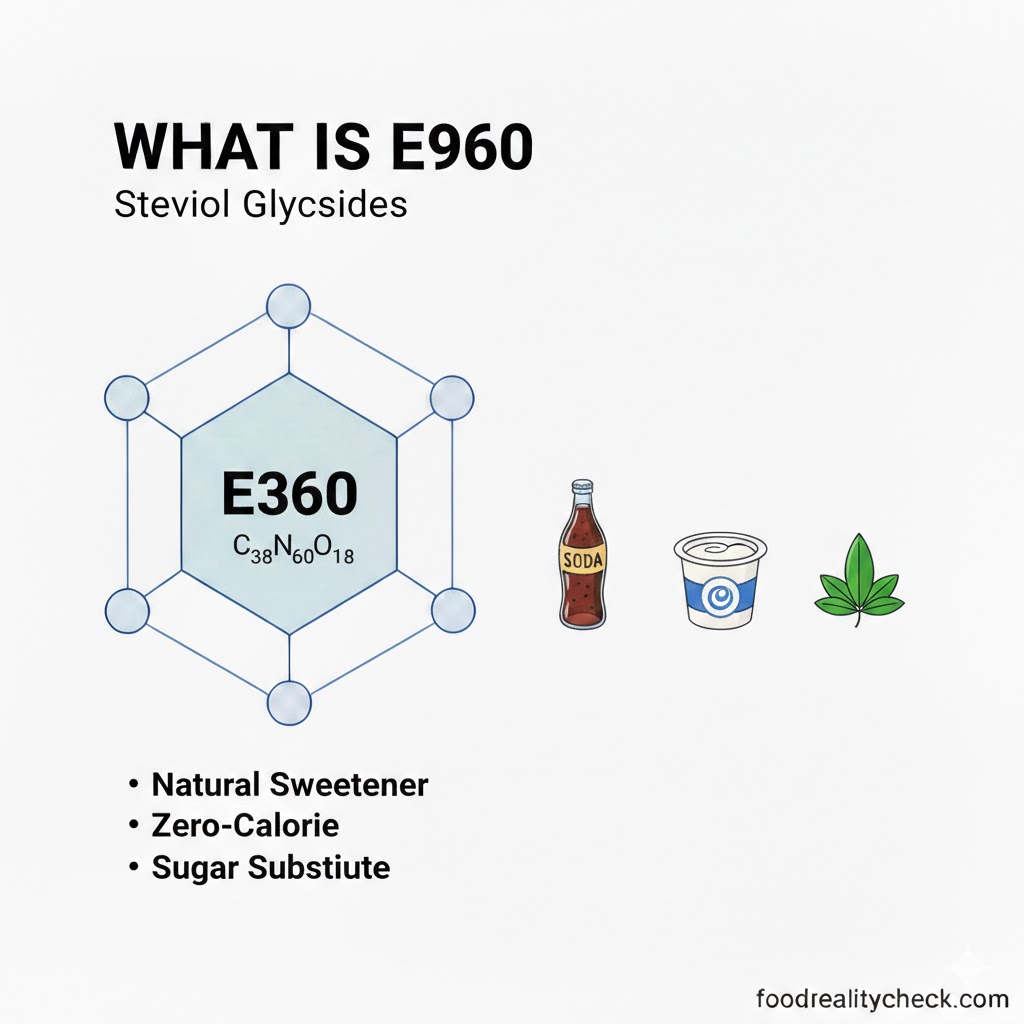
What is E960?
Complete guide to understanding E960 (Stevia/Steviol Glycosides) in your food
The Quick Answer
E960 is a natural high-intensity sweetener extracted from stevia leaves (Stevia rebaudiana) that is 200–300 times sweeter than sugar with zero calories.
It’s used in beverages, confectionery, baked goods, and other sugar-free products as a zero-calorie replacement for sugar.
It is one of the safest and most comprehensively tested food sweeteners available, with no documented adverse health effects at approved use levels and approval from all major regulatory agencies globally (FDA, EFSA, JECFA, UK FSA, FSANZ).
📌 Quick Facts
- Category: Natural high-intensity sweetener (steviol glycosides)
- Source: Extracted from leaves of Stevia rebaudiana Bertoni plant (native to Paraguay/Brazil)
- Active Compounds: Stevioside and rebaudiosides (A, C, D, M, etc.) – steviol glycosides
- Sweetness: 200–300 times sweeter than sucrose; Stevioside ~250×; Rebaudioside A ~150–200×
- Calories: Zero calories; not metabolized by humans
- Glycemic Index: 0 (does not raise blood sugar)
- Found in: Beverages, confectionery, baked goods, yogurts, tabletop sweeteners, flavoring in foods
- Safety Status: FDA GRAS; EFSA approved (E960); JECFA approved; Globally approved with NO documented safety concerns at permitted use levels
- ADI (Acceptable Daily Intake): 4 mg/kg body weight per day (EFSA, JECFA, FDA)
What Exactly Is It?
E960 is a purified extract of steviol glycosides obtained from the leaves of the stevia plant (Stevia rebaudiana), a natural plant native to South America that has been used for centuries by indigenous peoples.
The stevia plant produces multiple steviol glycosides with sweetening properties. The primary compounds are:
• Stevioside: ~250× sweeter than sucrose; most abundant; can have bitter aftertaste
• Rebaudioside A: ~150–200× sweeter; cleaner taste than stevioside; most commonly used in food industry
• Rebaudioside M: ~200× sweeter; very clean, sugar-like taste; increasingly used in premium products
• Rebaudioside D: ~250× sweeter; improved taste profile; used in newer formulations
E960 is produced by steeping dried stevia leaves in water and/or organic solvents, then purifying the extracted glycosides to >95% purity. The final product is a white to off-white crystalline or powdered sweetener.
E960-approved products must meet strict EU Regulation (EU) No 231/2012 specifications regarding purity, composition, and identity—ensuring only approved steviol glycosides meeting defined ratios are present.
Historically, the Guaraní peoples of Paraguay called stevia “ka’a he’ê” (sweet herb) and used it for centuries in teas and traditional medicines. Swiss botanist Moisés Santiago Bertoni first scientifically described it in 1899. Stevia has been widely used in Japan for decades and was formally approved in the EU in 2011.
Where You’ll Find It
E960 appears in many sugar-free and reduced-calorie products:
• Soft drinks and beverages (diet sodas, flavored waters)
• Confectionery and candies (chocolate, gummies, hard candies)
• Baked goods (cookies, cakes, bread)
• Yogurts and dairy products
• Ice cream and frozen desserts
• Jams and preserves (reduced-sugar)
• Tabletop sweeteners and sugar substitutes
• Breakfast cereals (low-sugar varieties)
• Chewing gum
• Nutritional supplements and drinks
• Flavored beverages
• Condiments and sauces (low-sugar versions)
E960 is increasingly common globally as consumer demand for natural sweeteners grows and regulatory approvals expand.
Why Do Food Companies Use It?
E960 serves critical functional and market advantages:
Natural origin: Derived from a plant with centuries of traditional use, appealing to health-conscious consumers seeking “natural” alternatives to synthetic sweeteners.
Zero calories: Humans cannot metabolize steviol glycosides; complete zero-calorie sweetener ideal for diet and weight-management products.
Zero glycemic impact: Does not raise blood sugar; safe for diabetics; glycemic index of 0.
Heat and pH stability: Stable at high temperatures and across pH ranges, enabling use in baking, cooking, hot beverages, and shelf-stable products.
No aftertaste (improved formulations): Newer rebaudiosides (M, D) have clean, sugar-like taste with minimal licorice/bitter aftertaste compared to older stevioside-based products.
Regulatory approval and consumer confidence: Approved by FDA, EFSA, JECFA, and major authorities globally, reducing manufacturer liability and supporting marketing as “safe and approved.”
Clean label advantage: “Stevia” sounds natural and organic compared to “aspartame” or “sucralose”—significant marketing advantage for health-conscious segments.
Is It Safe?
Yes—E960 is one of the safest and most comprehensively tested food sweeteners available, with no documented adverse health effects at approved use levels and unanimous approval from all major regulatory agencies globally (FDA, EFSA, JECFA, UK FSA, FSANZ).
The FDA classifies high-purity steviol glycosides as GRAS (Generally Recognized as Safe).
The EFSA approved E960 in 2011 with an ADI of 4 mg/kg body weight per day, based on comprehensive safety assessment.
The JECFA (WHO Expert Committee) set an identical ADI of 4 mg/kg per day.
All other major authorities (UK FSA, FSANZ, Health Canada) also approve E960 as safe.
✓ SAFETY PROFILE – GREEN: E960 has:
• No documented genotoxicity (DNA damage) at permitted use levels
• No carcinogenicity at permitted use levels
• No reproductive or developmental toxicity
• No organ toxicity at food use levels
• No adverse effects on blood pressure, glucose metabolism, or lipid profiles in humans
• Minimal systemic absorption (glycosides poorly absorbed; excreted mostly unchanged)
• Natural origin with centuries of safe traditional use
• Comprehensive regulatory approval by all major food safety authorities globally
This combination of natural origin, comprehensive testing, and unanimous regulatory approval makes E960 one of the safest sweeteners available.
What Are The Health Concerns?
E960 has no documented health concerns at approved food use levels. Research shows only minor, non-safety considerations:
Aftertaste (formulation-dependent, not a safety concern): Crude stevioside extracts can have bitter, licorice-like, or astringent aftertaste. Newer purified rebaudioside A, M, and D formulations have much cleaner taste profiles. This is a taste preference, not a safety issue.
Gastrointestinal effects (minimal): Some people report mild gastrointestinal symptoms (bloating, nausea) at very high doses. However, normal consumption in foods poses no such risk.
Potential glucose and insulin effects (not proven harmful): Some in vitro studies suggest steviol glycosides might affect insulin secretion. However, human clinical studies show no adverse effects on glucose control; some studies suggest potential beneficial effects for diabetics. No safety concern identified.
Microbiome effects (research ongoing): Like all non-metabolizable sweeteners, E960 may affect gut bacterial composition, though E960-specific research is limited. No safety concern currently identified; this applies to the entire sweetener class.
Toxicological uncertainty in animal studies (not confirmed in humans): Some high-dose animal studies reported organ changes (kidney, spleen weight increases). However, these occurred at doses far exceeding human dietary exposure; human studies show no such effects at relevant doses.
Impurities (regulated): E960 specifications require limits on contaminants (lead, mercury, arsenic, cadmium). Food-grade E960 meeting specifications poses no safety concern from impurities.
Natural vs Synthetic Version
E960 is entirely natural—it is extracted directly from stevia plant leaves.
No synthetic version exists; all E960 comes from the Stevia rebaudiana plant. What varies is processing (extraction method, purification level) and composition (which steviol glycosides are concentrated), but the source and primary compounds are always natural plant-derived.
Natural Alternatives
E960 IS already the natural alternative to synthetic sweeteners.
Other natural/reduced-calorie sweeteners include:
• Monk fruit (Luo Han Guo) – natural sweetener from monk fruit (150–200× sweeter than sugar)
• Xylitol (E967) – sugar alcohol from birch or corn (equal sweetness to sugar; 40% fewer calories; under cardiovascular re-evaluation)
• Erythritol – sugar alcohol (70% sweetness of sugar; 2 calories/gram vs. sugar’s 4)
• Allulose – rare sugar (70% sweetness; similar calories but low glycemic impact)
• Honey or maple syrup – natural alternatives with trace nutrients and full calories
• Regular sugar – accept full calories and glycemic impact
The Bottom Line
E960 (Stevia/Steviol Glycosides) is a natural high-intensity sweetener extracted from stevia plant leaves that is one of the safest and most comprehensively tested sweeteners available, with no documented adverse health effects at approved use levels and unanimous approval from all major regulatory agencies globally (FDA, EFSA, JECFA, UK FSA, FSANZ).
Natural Origin: E960 is genuinely natural—extracted from a plant used safely by indigenous peoples for centuries. Not a synthetic chemical created in laboratories.
Safety Profile: Comprehensive testing shows no genotoxicity, carcinogenicity, reproductive toxicity, or organ toxicity at food use levels. Human clinical studies support safety. Regulatory consensus is strong and unanimous.
ADI Confidence: The 4 mg/kg ADI is based on comprehensive safety assessment. At typical dietary exposure, consumption remains well below this limit.
Zero-Calorie, Zero-Glycemic Benefits: Humans cannot metabolize steviol glycosides, providing genuine zero-calorie and zero-blood-sugar-impact benefits—advantages no other sweetener combines with natural origin.
Taste Profile Advantage: Newer formulations (rebaudioside A, M, D) provide clean, sugar-like taste without the bitter aftertaste of older stevioside products. Taste quality has improved substantially.
Natural vs. Synthetic: For consumers who prefer natural sweeteners, E960 is the best-studied natural option with excellent regulatory approval and comprehensive safety data supporting long-term use.
Recommendation: E960 is an excellent sweetener choice for sugar-free or reduced-calorie products. It combines natural origin, zero calories, zero glycemic impact, and comprehensive safety approval. For individuals sensitive to other synthetic sweeteners or preferring natural alternatives, E960 is a well-supported choice.