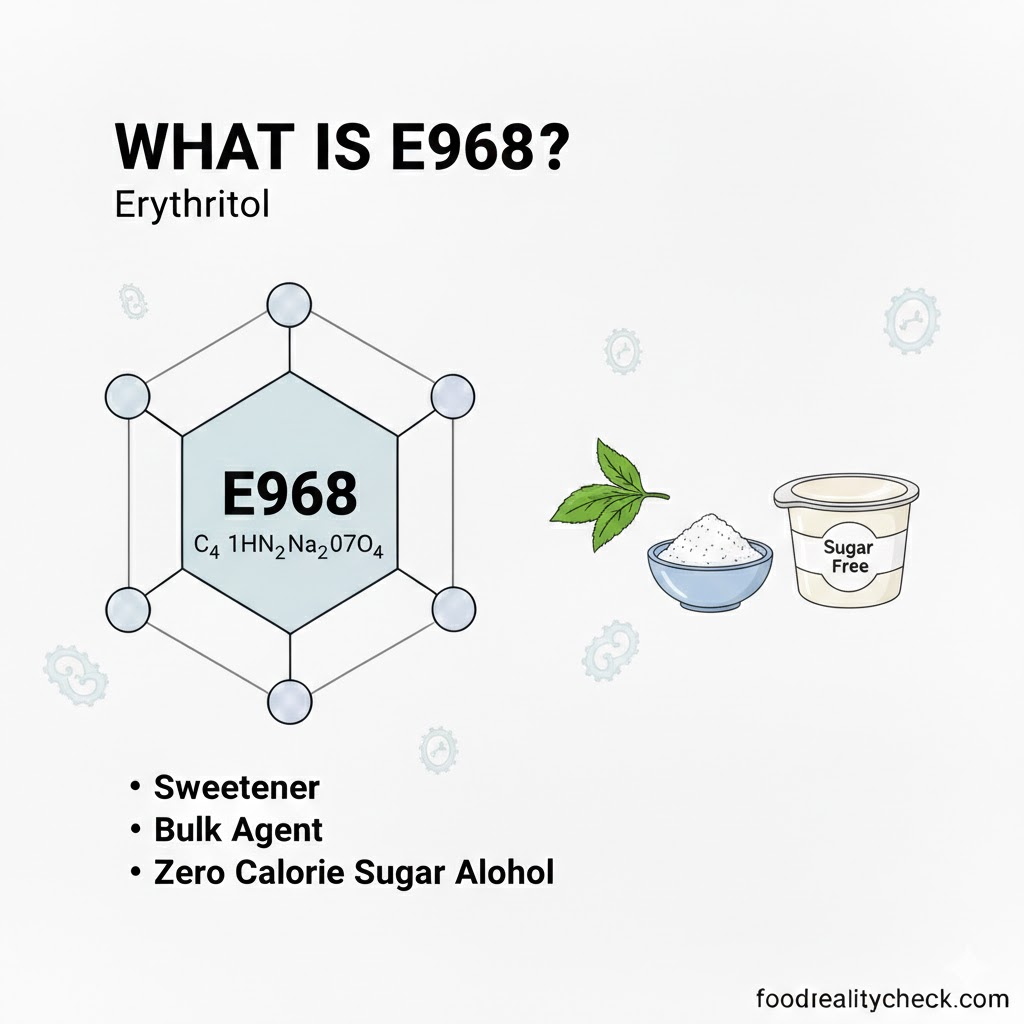
What is E968?
Complete guide to understanding E968 (Erythritol) in your food
The Quick Answer
E968 is a natural sugar alcohol (polyol) derived from fruit fermentation that is 70% as sweet as sugar with virtually zero calories.
It’s used in sugar-free beverages, confectionery, baked goods, and other low-calorie products.
It is generally recognized as safe by regulatory agencies, but emerging 2023 cardiovascular research has raised concerns about increased heart attack and stroke risk at high blood levels, leading EFSA to establish an ADI and recommend caution—making it a sweetener requiring careful moderation, particularly for those with cardiovascular risk factors.
📌 Quick Facts
- Category: Natural sugar alcohol (polyol) sweetener
- Chemical Name: Erythritol (meso-1,2,3,4-butanetetrol)
- Chemical Formula: C₄H₁₀O₄
- Source: Derived from natural fermentation of glucose using osmophilic yeasts (Moniliella pollinis, M. megachiliensis); also occurs naturally in fruits, mushrooms, fermented foods
- Sweetness: 60–80% as sweet as sucrose; minimal aftertaste
- Found in: Diet soft drinks, sugar-free confectionery, baked goods, yogurts, chewing gum, tabletop sweeteners
- Safety Status: FDA GRAS (with caveats); EU approved; EFSA December 2023 re-evaluation: ADI set at 0.5 g/kg body weight/day; cardiovascular risk flagged as emerging concern
- Critical Concern: 2023 cardiovascular research shows associations with increased heart attack/stroke risk and thrombosis (blood clot formation) at high blood levels
What Exactly Is It?
E968 is a natural sugar alcohol (polyol) produced by fermenting glucose with safe yeast strains, or extracted from naturally-occurring sources like fruits and fermented foods.
Its chemical name is meso-1,2,3,4-butanetetrol (C₄H₁₀O₄)—a four-carbon sugar alcohol.
Food-grade E968 is produced primarily through fermentation by osmophilic yeasts (Moniliella pollinis or M. megachiliensis) followed by purification and crystallization. The result is a white, odorless, non-hygroscopic (moisture-resistant) crystalline powder with minimal sweetness aftertaste.
Erythritol occurs naturally in small amounts in fruits (grapes, pears, watermelon), mushrooms, fermented foods (wine, beer, soy sauce), and some vegetables. However, the high-purity food-grade E968 is industrially manufactured through fermentation.
Mechanism: Erythritol is poorly absorbed in the small intestine and is mostly excreted unchanged through urine (approximately 60% of consumed amount). The small amount that does get absorbed may contribute to physiological effects at high blood concentrations.
E968 is one of the best-tolerated sugar alcohols—it causes far fewer gastrointestinal side effects than maltitol, sorbitol, or xylitol because most passes through the GI tract unchanged rather than fermenting in the colon.
Where You’ll Find It
E968 appears in many sugar-free and reduced-calorie products:
• Diet soft drinks and beverages
• Sugar-free confectionery and candies
• Chewing gum (particularly sugar-free)
• Baked goods (cakes, cookies, bread)
• Yogurts and dairy desserts
• Ice cream and frozen yogurt
• Jams and preserves (sugar-free)
• Tabletop sweeteners and sugar substitutes
• Chocolate (reduced-sugar varieties)
• Breakfast cereals (low-sugar)
• Nutritional supplements and drinks
• Flavor enhancer in various foods
E968 is increasingly common as demand for natural sweeteners with minimal digestive side effects grows.
Why Do Food Companies Use It?
E968 serves critical functional advantages:
Natural origin: Derived from fermentation, not synthetic chemical synthesis, appealing to “natural” product marketing.
Zero calories: Humans cannot metabolize most erythritol; essentially calorie-free (technically 0.2 kcal/gram vs. sugar’s 4 kcal/gram).
Zero glycemic impact: Does not raise blood glucose or insulin levels; safe for diabetics.
Minimal digestive side effects: Unlike maltitol or sorbitol, erythritol is well-tolerated—most people do not experience bloating or diarrhea even at higher doses.
Clean taste: Minimal aftertaste compared to other sweeteners; some detect faint cooling sensation.
Heat and pH stability: Suitable for baking, cooking, and shelf-stable products.
Regulatory approval: FDA GRAS, EFSA approved, globally approved with long history of safe use.
Is It Safe?
E968 is officially approved by major regulatory agencies but is currently under scrutiny due to 2023 cardiovascular research showing associations with increased heart attack, stroke, and thrombosis risk at high blood levels—requiring moderation, particularly for cardiovascular-risk populations.
The FDA classifies erythritol as GRAS (Generally Recognized as Safe), though with noted caveats about high-dose consumption.
The EFSA approved E968 historically, but in December 2023 completed a comprehensive re-evaluation and established an ADI of 0.5 g/kg body weight per day based on diarrhea as limiting factor, NOT cardiovascular risk.
However, the EFSA explicitly noted that epidemiological evidence of cardiovascular associations exists but concluded “a causal relationship…has not been established.”
⚠️ CRITICAL 2023 CARDIOVASCULAR RESEARCH – Emerging Concern:
2023 Witkowski et al. Study (Cell Metabolism): Published February 2023, this major study found:
• Cardiovascular Risk Association: Higher plasma erythritol levels associated with 2.64–4.48× increased risk of major adverse cardiovascular events (MACE: heart attack, stroke, cardiovascular death) in independent US and European patient cohorts (n=4,982 total)
• Independent of Traditional Risk Factors: Association remained significant even after adjusting for conventional CVD risk factors (diabetes, hypertension, cholesterol)
• Thrombosis Mechanism: Erythritol enhanced platelet reactivity (blood clot formation) in human blood and animal models at physiologically achievable levels
• Dose-Response: For each 1 µM increase in plasma erythritol, 21% increase in adjusted heart attack/stroke risk (US cohort)
• Intervention Study: Healthy volunteers ingesting erythritol showed sustained plasma level elevations (>2 days) at thresholds associated with thrombosis potential
EFSA Response (December 2023 Re-evaluation): EFSA acknowledged the cardiovascular epidemiological evidence but concluded “a causal relationship…has not been established” and declined to set a separate ADI for cardiovascular effects. However, EFSA established ADI of 0.5 g/kg based on diarrhea laxation effects—essentially side-stepping the cardiovascular concern while recommending caution.
What Are The Health Concerns?
E968 has minimal safety concerns at moderate intake levels, but emerging cardiovascular research and GI tolerance issues warrant caution:
Cardiovascular risk (EMERGING 2023 CONCERN): 2023 Witkowski study found associations between high plasma erythritol and increased heart attack/stroke/cardiovascular death risk. Mechanism appears to involve enhanced blood clot formation (thrombosis). However, EFSA noted causality not definitively established; observational data susceptible to confounding. This remains an active area of research requiring long-term safety follow-up.
Diarrhea/laxative effect (established): EFSA established ADI of 0.5 g/kg bw/day based on diarrhea as adverse effect. However, erythritol is well-tolerated compared to other sugar alcohols; many people do not experience GI symptoms even at higher doses. Sensitivity varies widely.
Electrolyte/water imbalance (theoretical with diarrhea): If diarrhea occurs with high consumption, electrolyte and fluid balance could be affected, particularly in vulnerable populations (elderly, those on diuretics).
No genotoxicity or carcinogenicity: Comprehensive testing shows no genetic damage or cancer potential at tested doses.
No reproductive/developmental toxicity: Animal and human studies show no adverse effects on reproduction or fetal development at approved use levels.
Microbiome effects (minimal): Unlike other sugar alcohols, erythritol is poorly fermented in colon; minimal microbiome disruption compared to other polyols.
Impurity concerns (addressed): EFSA recommends lowering maximum lead impurity limits to reduce consumer exposure, indicating quality oversight.
Natural vs Synthetic Version
E968 is naturally-derived—produced through fermentation of glucose with natural yeast, or extracted from natural sources.
It is not a synthetic chemical created in a laboratory, though food-grade E968 undergoes industrial processing and purification for consistency and safety.
Natural Alternatives
Want to avoid E968?
Other sweeteners include:
• Stevia (E960) – natural plant extract, 200–300× sweeter than sugar
• Monk fruit – natural sweetener, 150–200× sweeter than sugar
• Xylitol (E967) – sugar alcohol from birch/corn, equal sweetness to sugar but with GI side effects
• Maltitol (E965) – sugar alcohol, ~90% sweetness but higher GI side effects than erythritol
• Regular sugar – accept full calories and glycemic impact
• Honey/maple syrup – natural alternatives with trace nutrients and calories
The Bottom Line
E968 (Erythritol) is a natural sugar alcohol derived from fermentation that is officially approved by major regulatory agencies but is currently under scrutiny due to 2023 cardiovascular research showing associations with increased heart attack, stroke, and blood clot formation at high blood levels—requiring moderation and caution, particularly for those with cardiovascular risk factors.
Natural Origin: E968 is genuinely natural—produced through yeast fermentation, not synthetic chemical synthesis. This is an advantage over many other sweeteners.
Regulatory Status Paradox: EFSA approved erythritol but established an ADI based on GI effects (diarrhea), NOT the more concerning cardiovascular findings. This reflects a regulatory gap where emerging epidemiological evidence was noted but not fully integrated into safety determinations.
Cardiovascular Concern Is Serious: The 2023 Witkowski study found 2.6–4.5× increased cardiovascular event risk with high erythritol blood levels. The mechanism (enhanced thrombosis) is plausible and reproducible in animal/mechanistic studies. However, causality not yet definitively proven—observational data can reflect confounding.
GI Tolerance Advantage: Erythritol is the best-tolerated sugar alcohol—far fewer people experience bloating or diarrhea compared to maltitol or sorbitol. This is a genuine advantage for digestive comfort.
Exposure Levels: Average dietary exposure in Western populations is estimated at 1–2 g/day, well below the EFSA ADI of 0.5 g/kg (roughly 35 g for a 70 kg adult). However, regular consumption of multiple sugar-free products (diet sodas, confectionery, baked goods) can accumulate to higher levels.
At-Risk Populations: Those with cardiovascular disease, prior heart attack/stroke, diabetes, obesity, or other CVD risk factors should exercise caution with high erythritol consumption pending further safety research.
If You Want to Minimize Exposure: Limit consumption of erythritol-sweetened products, particularly diet beverages, to occasional use rather than daily consumption. Choose natural sweeteners (stevia, monk fruit) or regular sugar in moderation as alternatives.
Future Outlook: Erythritol faces potential regulatory restrictions as cardiovascular research accumulates. Long-term safety studies in humans are warranted. The FDA may eventually revisit its GRAS classification if cardiovascular evidence strengthens.
Current Recommendation: Erythritol is safe at moderate intake levels for healthy individuals, but moderation is prudent given emerging cardiovascular concerns. Those with cardiovascular risk should consider alternative sweeteners (stevia, monk fruit) until long-term erythritol safety is conclusively established.