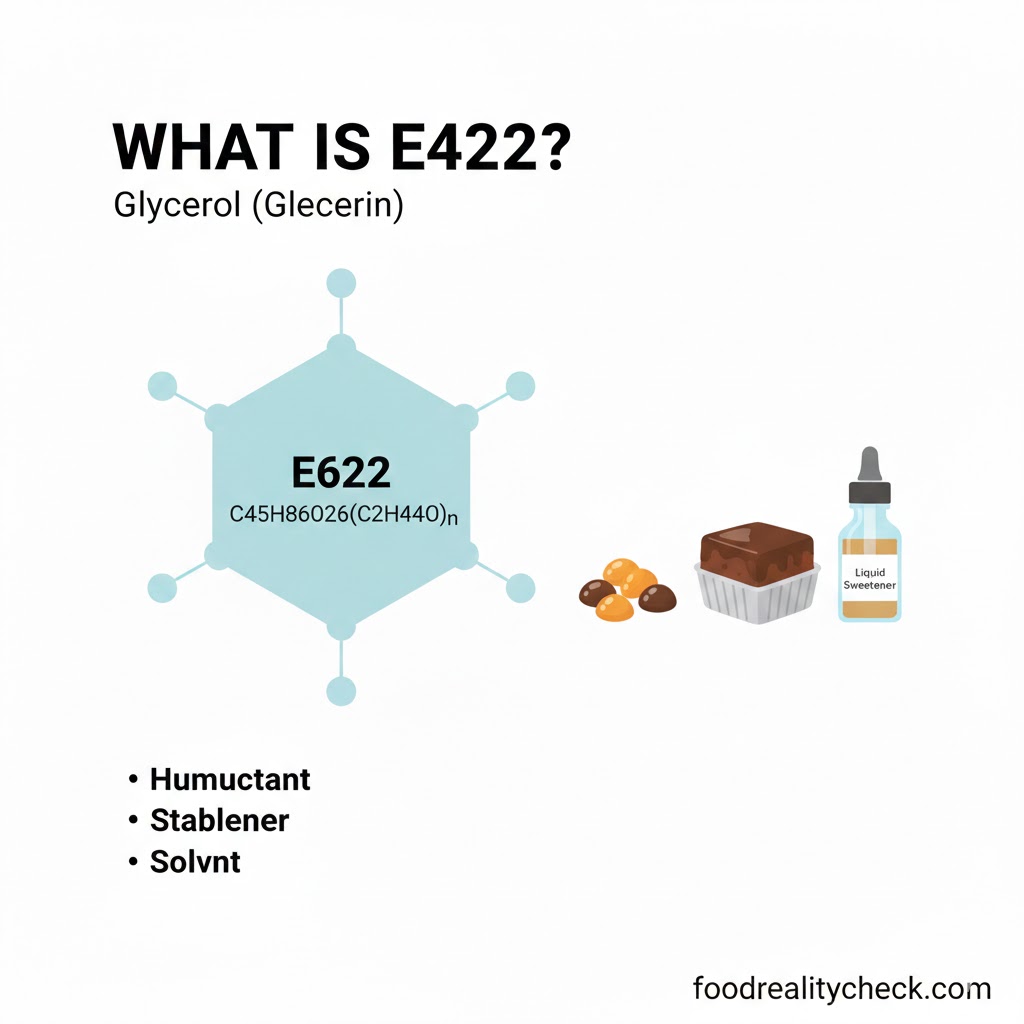
What is E422?
Complete guide to understanding E422 (Glycerol/Glycerin) in your food
The Quick Answer
E422 is glycerol (also called glycerin)—a three-carbon sugar alcohol that functions as a humectant (moisture-retaining agent), emulsifier, sweetener (60% as sweet as sugar), and food preservative in thousands of processed foods.
It’s used in baked goods, confectionery, beverages, sauces, ice cream, and margarine.
It is one of the safest food additives available. EFSA’s 2017 comprehensive re-evaluation and 2022 follow-up concluded there is no need for a numerical ADI, with no documented safety concerns at approved food-use levels. Glycerol is rapidly metabolized, does not bioaccumulate, and has been safely used for decades. Manufacturing quality is the primary consideration—EFSA recommends specifications limiting genotoxic impurities (glycidol, epichlorohydrin, acrolein) that could form during production.
📌 Quick Facts
- Category: Natural polyhydric alcohol; humectant, emulsifier, sweetener, preservative
- Chemical Name: Glycerol or 1,2,3-propanetriol
- Chemical Formula: C₃H₈O₃ or C₃H₅(OH)₃
- Appearance: Colorless, odorless, viscous liquid with sweet taste
- Sweetness: 60% as sweet as sugar; 2.7 kcal/gram
- Natural Source: Found in all fats and oils as triglyceride backbone; modern production primarily from biodiesel refining (byproduct)
- Found in: Baked goods, confectionery, jams, sauces, beverages, ice cream, margarine, cosmetics, pharmaceuticals
- Safety Status: FDA GRAS; EFSA approved; No numerical ADI required (safest rating); JECFA approved globally
- Key Function: Most versatile food additive—simultaneous humectant (retains moisture), emulsifier, sweetener, preservative
What Exactly Is It?
E422 is glycerol—a three-carbon polyhydric alcohol (triol) with three hydroxyl groups (-OH) that functions as a humectant, emulsifier, sweetener, and preservative through its water-absorbing and moisture-retaining properties.
Chemical formula: C₃H₈O₃ or C₃H₅(OH)₃; molecular weight 92.09; also called glycerin or glycerine (commercial term for ≥95% pure glycerol).
E422 appears as a colorless, odorless, viscous liquid with a sweet taste and syrupy consistency. It is fully miscible with water (infinitely soluble) due to its three hydroxyl groups. When exposed to humid air, glycerol is highly hygroscopic, readily absorbing water and some gases.
Natural occurrence: Glycerol is the backbone of all triglycerides (fats and oils in nature). Glycerol does not occur as a free molecule in nature but is bound to fatty acids as triglycerides. When fats/oils are hydrolyzed, saponified, or transesterified, glycerol is released.
Production: Modern food-grade glycerol is primarily produced as a byproduct of biodiesel manufacturing. During biodiesel production, fats/oils are transesterified with methanol/ethanol to produce biodiesel and crude glycerol (10-15% aqueous solution with salts, methanol, and impurities). The crude glycerol is then refined via distillation to produce pharmaceutical-grade (80-85%) or food-grade (>99.5%) glycerol.
Alternative production: Glycerol can also be produced by saponification of fats/oils with sodium hydroxide, or chemically synthesized from propylene (chlorination method), though these routes are less common industrially.
Mechanism: Glycerol’s three hydroxyl groups enable it to absorb and retain water (humectant property), mix oil and water (emulsifier property), and prevent microbial growth by binding water (preservative property). The properties are interconnected—the water-absorbing ability enables all functions.
Where You’ll Find It
E422 appears in thousands of food products worldwide:
• Baked goods (bread, cakes, pastries, cookies)
• Confectionery and candy
• Jams, jellies, and preserves
• Sauces and condiments
• Margarine and spreads
• Ice cream and frozen desserts
• Beverages (flavored drinks, sports drinks)
• Chocolate and cocoa products
• Dried fruits and nuts
• Low-fat foods (as fat replacement)
• Protein bars and nutrition products
• Pet food
• Cosmetics (skin care, shampoo, soaps)
• Pharmaceuticals (syrups, suspensions)
• Nitroglycerin (heart medication)
E422 is one of the most versatile and widely used food additives due to its multiple functions—more foods contain glycerol than any other additive.
Why Do Food Companies Use It?
E422 serves multiple critical functional advantages—no other additive provides such versatile benefits:
Humectant (moisture retention): Absorbs and retains water, preventing baked goods and confectionery from drying out, extending shelf-life.
Preservative (antimicrobial): By binding water, glycerol reduces water availability to microorganisms, inhibiting bacterial and fungal growth without added chemical preservatives.
Emulsifier (mixing oil+water): Enables stable mixing of ingredients that would otherwise separate (oil-based and water-based components).
Sweetener (60% potency): Provides sweetness for reduced-calorie products while contributing to smooth mouthfeel and texture.
Texture improver: Creates smooth, creamy textures in sauces, dressings, ice cream.
Solvent for colors/flavors: Dissolves food colorings and flavoring compounds, enabling uniform distribution.
Fat replacer: In low-fat/fat-free products, mimics fat texture and mouthfeel.
Exceptional safety profile: FDA GRAS; no documented adverse effects; enables use in sensitive populations (infants, children, elderly, pregnant women).
Is It Safe?
Yes—E422 is one of the safest food additives available. EFSA’s 2017 comprehensive re-evaluation and 2022 follow-up both concluded there is no need for a numerical ADI and no safety concerns at approved food-use levels. Glycerol is rapidly metabolized and does not bioaccumulate.
The FDA classifies glycerol as GRAS (Generally Recognized As Safe).
The EFSA in 2017 re-evaluated glycerol and concluded: “there is no need for a numerical ADI and no safety concern regarding the use of glycerol (E 422) as a food additive at the refined exposure assessment for the reported uses.”
The EFSA in 2022 confirmed this conclusion through follow-up assessment, noting that modern manufacturing (from vegetable oils/fats or biodiesel byproducts with refined purification) ensures safety when specifications limiting genotoxic impurities are met.
The JECFA approved glycerol globally with “ADI not specified” designation (same as no ADI needed).
✓ GREEN SAFETY RATING – SAFEST CATEGORY: E422 has:
• No documented genotoxicity (DNA damage) in vivo at food levels
• No documented carcinogenicity at food-use levels
• No documented reproductive or developmental toxicity at food levels
• No documented organ toxicity at food-use levels
• Very low acute toxicity
• Rapidly metabolized; not bioaccumulative
• EFSA “no numerical ADI needed” designation (highest confidence)
• 2022 EFSA follow-up reconfirmed safety when specifications limit impurities
• Medical use as nitroglycerin (heart medication) at high concentrations confirms exceptional safety
• Cosmetic/pharmaceutical use at high concentrations supports safety profile
• Safe for all populations including infants, children, pregnant women, elderly
This is among the highest safety confidence possible—glycerol is one of the safest approved food additives globally.
What Are The Health Concerns?
E422 has no documented health concerns at food-use levels. The primary regulatory considerations are manufacturing quality and specification compliance:
No health concerns at food-use levels: EFSA, FDA, and JECFA all concluded no adverse effects at approved use levels. Decades of safe global use supports this.
Manufacturing impurity concerns (not food safety issue, but regulatory): EFSA’s 2017 and 2022 assessments noted that during glycerol manufacturing, genotoxic impurities (glycidol, epichlorohydrin) and other compounds (acrolein, 3-MCPD) could theoretically form depending on the manufacturing process used. EFSA therefore recommended updated EU specifications including numerical limits for these impurities. Modern production from vegetable oils/fats or biodiesel byproducts with refined distillation-based purification ensures these impurities are minimized, and specifications now enforce limits.
Osmotic/laxative effects (only at extremely high local concentrations): Animal studies showed local GI irritation at very high gavage doses; EFSA concluded this was due to glycerol’s osmotic and hygroscopic properties drawing water into the GI tract, not direct toxicity. At food-use levels and consumption patterns, this is not a concern.
Medical use in high concentrations confirms safety: Nitroglycerin (glycerol trinitrate) and IV glycerol used medically at high doses demonstrate glycerol’s safety profile in pharmaceutical applications.
No concerns for any population: E422 is approved for all consumer groups including infants, children, pregnant women, elderly, immunocompromised—all populations at food-use levels.
Regulatory Quality Monitoring
EFSA’s 2022 follow-up assessment highlights that regulatory oversight focuses on manufacturing quality:
• Genotoxic impurities: Glycidol and epichlorohydrin limits (specifying they should not be present at levels creating margin of exposure <10,000)
• Acrolein: Limits recommended based on provisional tolerable concentration
• 3-MCPD (3-monochloropropanediol): Maximum limit 0.1 mg/kg specified in EU regulations; does not raise health concerns at this level
• Toxic elements: Arsenic, lead, cadmium, mercury limits enforced
• Manufacturing process specification: EFSA recommended that E422 specifications explicitly state it’s manufactured from vegetable oils/fats with refined purification including distillation
Health Benefits
Beyond safety, glycerol has documented health benefits:
• Moisture retention: Extends product freshness without chemical preservatives
• Fat replacement in low-fat foods: Enables healthier reduced-fat product formulations
• Cosmetic/dermatological benefit: Used in skincare to retain moisture and support skin health
• Pharmaceutical delivery: Used in medications to improve absorption and stability
Natural vs Synthetic Version
E422 is naturally derived or semi-synthetic, depending on perspective.
While glycerol is the backbone of all natural fats and oils, it does not occur as a free molecule in nature. Modern food-grade E422 is produced by refining crude glycerol from biodiesel manufacturing (which is itself derived from vegetable oils/fats), or directly from saponification of vegetable/animal fats. Chemical synthesis from propylene exists but is uncommon.
Natural Alternatives
E422 is already a natural ingredient. Other humectants/emulsifiers include:
• Lecithin (E322) – natural emulsifier from egg or soybeans
• Alginic acid (E400) – natural thickener/stabilizer
• Guar gum (E412) – natural thickener
• Xanthan gum (E415) – naturally-derived thickener
• Sorbitol (E420) – sugar alcohol humectant/sweetener
• Accept drier products – products without humectants naturally dry faster
The Bottom Line
E422 (Glycerol) is a naturally-derived polyhydric alcohol that functions as a humectant, emulsifier, sweetener, and preservative. EFSA’s 2017 comprehensive re-evaluation and 2022 follow-up both concluded there is no need for a numerical ADI and no safety concerns at approved food-use levels. Glycerol is one of the safest food additives available globally, with exceptional versatility—serving multiple functions simultaneously in thousands of food products.
Regulatory Safety Conclusion: EFSA explicitly concluded “no numerical ADI needed and no safety concern” at food-use levels. This is the highest possible regulatory confidence designation.
Comprehensive Safety Data: No genotoxicity, carcinogenicity, reproductive toxicity, or organ toxicity documented at food levels. Rapidly metabolized; not bioaccumulative.
Medical Confirmation of Safety: Used medically in nitroglycerin (heart medication) and IV formulations at high concentrations—confirmation of safety profile even at elevated doses.
Manufacturing Quality Oversight: EFSA’s 2022 follow-up emphasized manufacturing specifications ensuring impurities (glycidol, epichlorohydrin, acrolein, 3-MCPD) are controlled. Modern biodiesel-derived production with refined distillation-based purification meets these standards.
Exceptional Versatility: No other additive provides simultaneous humectant, emulsifier, sweetener, and preservative functions. This makes glycerol cost-effective and enables cleaner label formulations with fewer additives.
Safe for All Populations: Approved for infants, children, pregnant women, elderly, immunocompromised—all population groups at food-use levels.
Decades of Safe Use: Extensively used in processed foods, cosmetics, and pharmaceuticals for decades without documented serious adverse events.
Recommendation: E422 is one of the safest and most beneficial food additives available. It is NOT something consumers should avoid. In fact, glycerol enables food preservation, extends freshness, and supports healthier reduced-fat product formulations without requiring additional chemical preservatives or additives. Its use represents modern food science at its best—combining safety, effectiveness, and versatility.