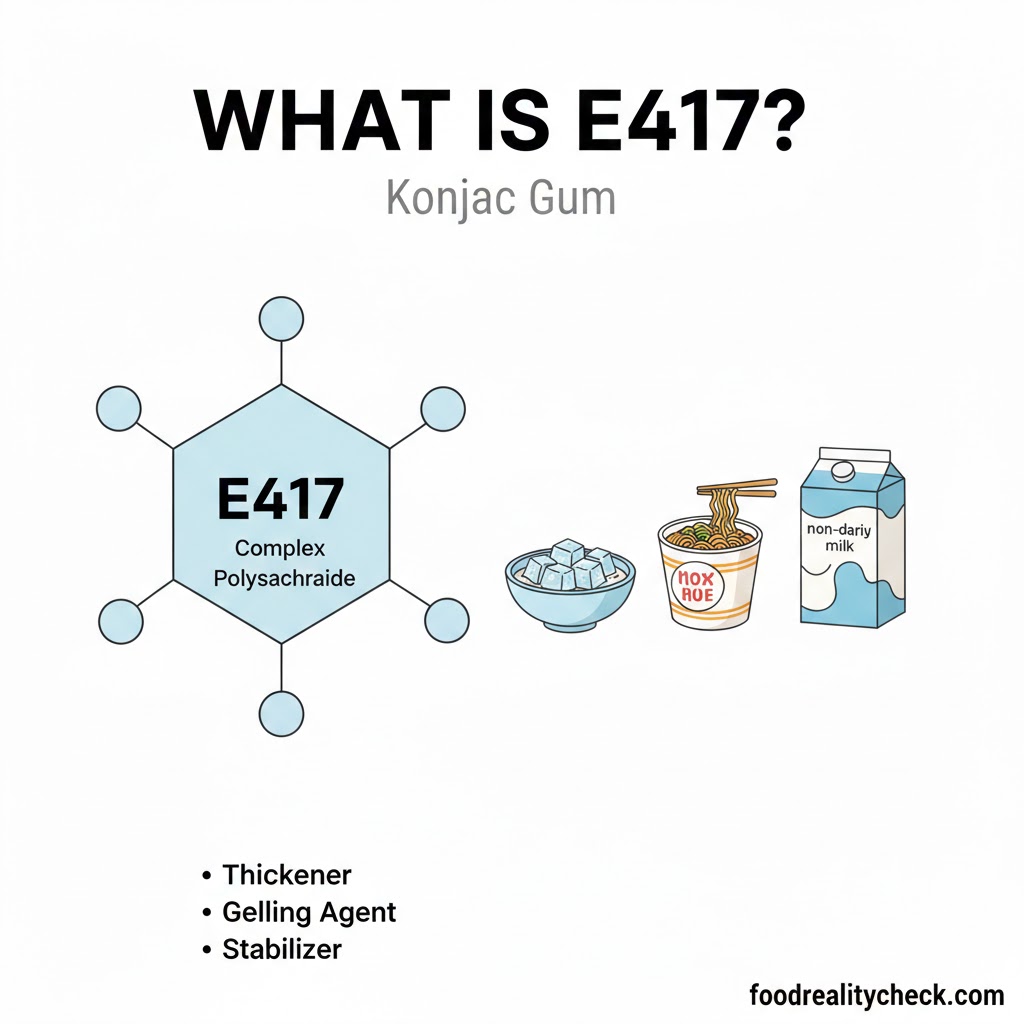
What is E417 (Tara Gum)?
Complete guide to this sustainable South American plant fiber with prebiotic benefits and excellent safety profile
The Quick Answer
E417 is tara gum—also called Peruvian carob—a naturally occurring soluble dietary fiber extracted from the seeds of the tara tree (Caesalpinia spinosa), a legume native to Peru and other South American regions. It’s used as a thickener, stabilizer, emulsifier, and gelling agent in thousands of foods, particularly dairy products, baked goods, and sauces.
One of the newest and most sustainable food thickeners available, tara gum is approved by all major food authorities with an ADI of “Not Specified”—the highest safety rating. It offers genuine health benefits as a prebiotic soluble fiber, supports digestive health, and is environmentally sustainable because it utilizes byproducts of tara pod harvesting for livestock feed.
Unlike controversial additives, tara gum has no documented adverse effects at food levels and is classified as GREEN—SAFE by independent food safety evaluators. It’s an excellent choice for those seeking natural, plant-based alternatives to synthetic thickeners.
📌 Quick Facts
- Category: Thickener, stabilizer, gelling agent, emulsifier, soluble dietary fiber
- Source: Endosperm of tara tree seeds (Caesalpinia spinosa), native to Peru
- Found in: Ice cream, yogurt, cheese, baked goods, sauces, dressings, gluten-free products
- Safety Status: FDA approved, EFSA approved, ADI “Not Specified” (highest safety rating)
- Chemical Type: Galactomannan polysaccharide (75-80% galactomannan content)
- Controversy Level: NONE—universally considered safe and beneficial
- Health Benefits: Prebiotic fiber, digestive support, soluble fiber, low-calorie texturizer
- Sustainability: Harvested from renewable plant; uses sustainable processing with minimal environmental impact
What Exactly Is Tara Gum?
Tara gum is a galactomannan polysaccharide extracted from the endosperm (interior) of seeds of the tara tree (Caesalpinia spinosa). Like guar gum and locust bean gum, it’s a plant-based fiber composed primarily of mannose and galactose sugars linked together.
Chemical composition: Tara gum consists of 75-80% galactomannan (the rest being cellulose and other minor components). The structure is a linear chain of (1-4)-beta-D-mannopyranose units with alpha-D-galactopyranose units attached as side branches. This structure is similar to guar gum but with a different mannose-to-galactose ratio, giving it unique functional properties.
In simple terms: It’s a plant fiber that swells when mixed with water, creating a thick gel. When you consume it, your gut bacteria ferment it to produce short-chain fatty acids that feed beneficial bacteria—the same prebiotic effect as guar gum and locust bean gum.
Key properties:
• Natural plant fiber: Derived from legume seeds, same plant family as peas and beans
• Soluble in hot water: Swells readily in hot water; partially soluble in cold water
• Synergistic with other gums: Works exceptionally well combined with xanthan gum, agar, or carrageenan to create better textures
• Prebiotic potential: Fermented by gut bacteria to produce beneficial short-chain fatty acids
• Acid and temperature stable: Maintains viscosity in acidic foods and at high temperatures
• Neutral taste and odor: Doesn’t affect flavor of foods
• Low molecular weight degradation: Can be partially hydrolyzed by intestinal microbiota, unlike some gums
Where You’ll Find E417
Tara gum appears in a wide variety of foods, particularly where high-quality texture is desired:
• Ice cream and frozen desserts
• Yogurt and cultured dairy products
• Cheese and processed cheese products
• Sauces and gravies
• Salad dressings and vinaigrettes
• Baked goods (bread, cakes, pastries)
• Gluten-free baking mixes and products
• Low-fat and fat-free dairy desserts
• Jams, jellies, and fruit fillings
• Soups and broths
• Beverages and fruit juices
• Canned and jarred vegetables
• Meat products and sausages
• Cosmetics and personal care products
• Pharmaceutical preparations
How Is Tara Gum Produced?
Tara gum extraction is a simple, mechanical process requiring no synthetic chemicals:
Step 1: Harvesting
Mature tara pods are harvested from Caesalpinia spinosa trees, primarily grown in Peru and Chile. The tara tree naturally thrives in arid, mountainous regions.
Step 2: Seed Extraction
The tara pods are mechanically opened or threshed to separate and collect the seeds. The pods themselves are dried and used for tannin extraction or as animal feed (sustainable use of the entire plant).
Step 3: Cleaning & Drying
Seeds are cleaned to remove dirt and pod debris, then dried to a stable moisture content for storage.
Step 4: Mechanical Splitting
The dried seeds are mechanically split or cracked. The seed coat (hull) is separated from the interior endosperm through friction or impact.
Step 5: Endosperm Grinding
The separated endosperm is finely ground into a powder using mechanical mills. This crude tara gum contains the galactomannan and other seed components.
Step 6: Purification (Optional)
For higher-purity products, the powder may be further processed using water extraction, followed by precipitation and drying to create a more refined product with higher galactomannan content (75-80%).
Step 7: Final Milling & Quality Control
The tara gum is milled to the desired particle size and tested for viscosity, purity, and microbiological safety before packaging.
Note: The entire production process uses only mechanical and water-based methods. No synthetic chemicals are used. This is one of the most natural food additive extraction processes available.
Functions of E417 in Food
Tara gum serves multiple critical functions in food manufacturing:
As a thickener: Increases viscosity and creates smooth, creamy mouthfeel at very low concentrations (0.3-0.5%). One of the most efficient thickeners available on a weight basis.
As a stabilizer: Prevents separation of oil and water in emulsified foods. In frozen foods, prevents ice crystal formation and maintains smooth texture during storage. Particularly valuable for freeze-thaw stability.
As a gel former: Combined with calcium or other gelling agents, creates firm gels for jams, jellies, and fruit fillings.
As an emulsifier: Helps blend oil and water phases, creating uniform texture and extending shelf life. More effective than some plant gums due to its unique galactose ratio.
As a texture modifier: In combination with other hydrocolloids (xanthan gum, agar, carrageenan), creates specific textures and improves overall product quality with lower overall additive levels.
As a bulking agent: In low-fat or diet foods, adds volume and creates satiety without calories.
As dietary fiber: Unlike many thickeners, tara gum contributes to dietary soluble fiber intake and provides prebiotic effects.
Is E417 Safe?
Yes. Tara gum is one of the safest food additives available, with universal regulatory approval and no documented adverse effects.
Regulatory Approvals:
• FDA: Approved as a food additive thickener and stabilizer
• EFSA (European Food Safety Authority): Approved as E417. In 2017 re-evaluation, concluded: “There is no need for a numerical ADI for tara gum (E 417) and that there is no safety concern for the general population at the refined exposure assessment of tara gum (E 417) as a food additive at the reported uses and use levels.”
• JECFA (Joint FAO/WHO Committee): Assigned an ADI of “Not Specified”—the highest possible safety rating since 1986
• Canada: Approved as of May 14, 2018
• Australia & New Zealand: Approved ingredient under food additive code 417
Why is the safety so strong?
1. Natural plant fiber: Tara is a legume, same plant family as peas and beans—traditionally consumed safely for centuries
2. Not absorbed intact: Passes through the digestive system largely intact, being fermented by beneficial gut bacteria rather than absorbed
3. No toxicity: Extensive regulatory and independent testing shows zero toxic effects at any reasonable consumption level
4. EFSA comprehensive testing: Evaluated for genotoxicity, carcinogenicity, reproductive toxicity, and developmental toxicity with no concerns identified
5. Decades of safe use: Despite being newly approved (2017), tara gum has a long history of use in South American cuisine without adverse reports
6. No bioaccumulation: Doesn’t accumulate in tissues; completely excreted
Health Benefits of Tara Gum
🌟 Documented Health Benefits
- Prebiotic effects: Like guar and locust bean gum, fermented by gut bacteria to produce short-chain fatty acids (butyrate, propionate, acetate) that feed beneficial bacteria
- Soluble dietary fiber: Contributes to daily fiber intake; important for digestive health and metabolic function
- Digestive health support: Increases stool bulk, promotes regular bowel movements, and alleviates constipation
- Low-calorie texturizer: Fat replacer in low-fat and diet foods, contributing volume without calories
- Blood sugar regulation: As soluble fiber, slows gastric emptying and carbohydrate absorption, reducing post-meal glucose spikes
- Potential weight management: Creates satiety through delayed stomach emptying
- Sustainable production: Unlike some gums, tara gum production uses waste products and doesn’t compete with food crops—environmental health benefit
Research note: While tara gum is newer than guar gum or locust bean gum, it shares the same galactomannan structure and mechanism of action, suggesting similar prebiotic and digestive health benefits. As a legume fiber, it likely provides comparable benefits to other plant-based gums that have been extensively studied.
Side Effects & Digestive Considerations
Tara gum is extremely well tolerated with minimal side effects:
Transient digestive effects (rare, typically from excessive intake):
• Bloating and abdominal distension (less common than with guar gum)
• Gas or flatulence (sign of bacterial fermentation; typically resolves within days)
• Loose stools or mild diarrhea (dose-dependent laxative effect)
• Mild abdominal cramping
• Rare nausea
At typical food levels: Tara gum is unlikely to cause any digestive effects. These effects occur primarily with very high intakes or excessive supplementation, not from food consumption.
Why fewer side effects than guar gum? Tara gum has a different mannose-to-galactose ratio than guar gum, and tara gum’s structure can be partially hydrolyzed by intestinal microbiota more readily. This potentially creates fewer initial digestive disturbances while still providing prebiotic benefits.
Medication interactions:
Like all soluble fibers, tara gum can slow absorption of certain medications. If taking medications, separate tara gum consumption by 1-2 hours from medication dosing.
Safety for pregnancy and breastfeeding:
EFSA testing confirmed no parental, reproductive, or developmental toxicity at high doses (up to 2,500 mg/kg bodyweight per day in animal studies). Food levels are safe for pregnant and breastfeeding women.
No allergic reactions reported:
Despite being a legume seed product, tara gum shows no documented allergic reactions in food consumption. The refining process removes proteins that might trigger legume allergies.
Tara Gum vs Other Plant-Based Gums: Comparison
| Gum | Source | Solubility | Prebiotic Effects | Best Use |
|---|---|---|---|---|
| E417 Tara Gum | Tara tree seeds (legume) | Hot water soluble; partially cold soluble | ✓ Yes; recent addition to gum family | Sustainable alternative; temperature-sensitive applications |
| E412 Guar Gum | Guar plant seeds (legume) | Cold water soluble; most versatile | ✓ Yes; well-documented benefits | Most versatile; broadest applications |
| E410 Locust Bean Gum | Carob tree seeds | Hot water soluble only | ✓ Yes; strong prebiotic effects | High-temperature applications; anti-inflammatory |
| E415 Xanthan Gum | Bacterial fermentation | Cold water soluble; acid stable | ~ Minimal; emerging safety concerns | Gluten-free baking; acidic foods (but with reservations) |
| E407 Carrageenan | Red seaweed | Hot water soluble | ✗ No; may damage gut barrier | Not recommended—health risks documented |
Sustainability & Environmental Benefits
Tara gum stands out among food thickeners for its sustainability:
• Waste utilization: The tara tree’s pods are used for tannin extraction and animal feed; only seeds are used for gum production—nothing is wasted
• Native South American crop: Naturally thrives in Peru and Chile without requiring irrigation or chemical inputs in many regions
• No competition with food crops: The tara tree grows in arid regions where food crops typically can’t be grown
• Sustainable harvest: Perennial tree requiring minimal management once established
• Supporting traditional agriculture: Harvest supports rural South American communities and traditional agricultural practices
Who Should Increase Tara Gum Intake?
Tara gum benefits are similar to guar gum and locust bean gum. Consider increasing intake if you have:
• Constipation or digestive sluggishness
• Poor digestive health or weakened gut microbiota
• Type 2 diabetes or prediabetes (for blood sugar regulation)
• Overweight or obesity (satiety effects)
• Environmental/sustainability concerns (prefer this to guar gum from less-sustainable sources)
The Bottom Line
E417 (tara gum) is one of the safest and most beneficial food additives available, with the added advantage of being a sustainable and newer addition to the market. It offers genuine health benefits comparable to older plant-based gums while being more environmentally responsible.
Key takeaways:
• Universally safe: ADI “Not Specified”—the highest safety rating; no adverse effects documented at food levels
• 100% natural: Extracted from legume seeds using mechanical methods only
• No controversy: Zero scientific debate about its safety or health benefits
• Prebiotic benefits: Fermented by gut bacteria to support digestive and metabolic health
• Sustainable production: One of the most environmentally responsible thickeners available
• Minimal side effects: Unlike guar gum, fewer reports of initial bloating/gas
• Newer but tested: Only approved in 2017 (EU) and 2018 (Canada), but with decades of traditional use and comprehensive regulatory testing
• Excellent synergy: Works particularly well combined with xanthan gum or other hydrocolloids for superior textures
• GREEN—SAFE classification: Rated safe by independent food safety evaluators
Practical recommendation: Tara gum is an excellent choice for those seeking natural, plant-based thickeners with genuine health benefits and minimal environmental impact. It’s particularly valuable as a sustainable alternative to guar gum, which faces supply chain variability, and to xanthan gum, which has emerging health concerns. If you’re choosing between plant-based gums, tara gum offers the best combination of safety, sustainability, and functional benefits. The fact that it’s newer means less long-term data than guar gum, but comprehensive regulatory testing has found no concerns whatsoever.