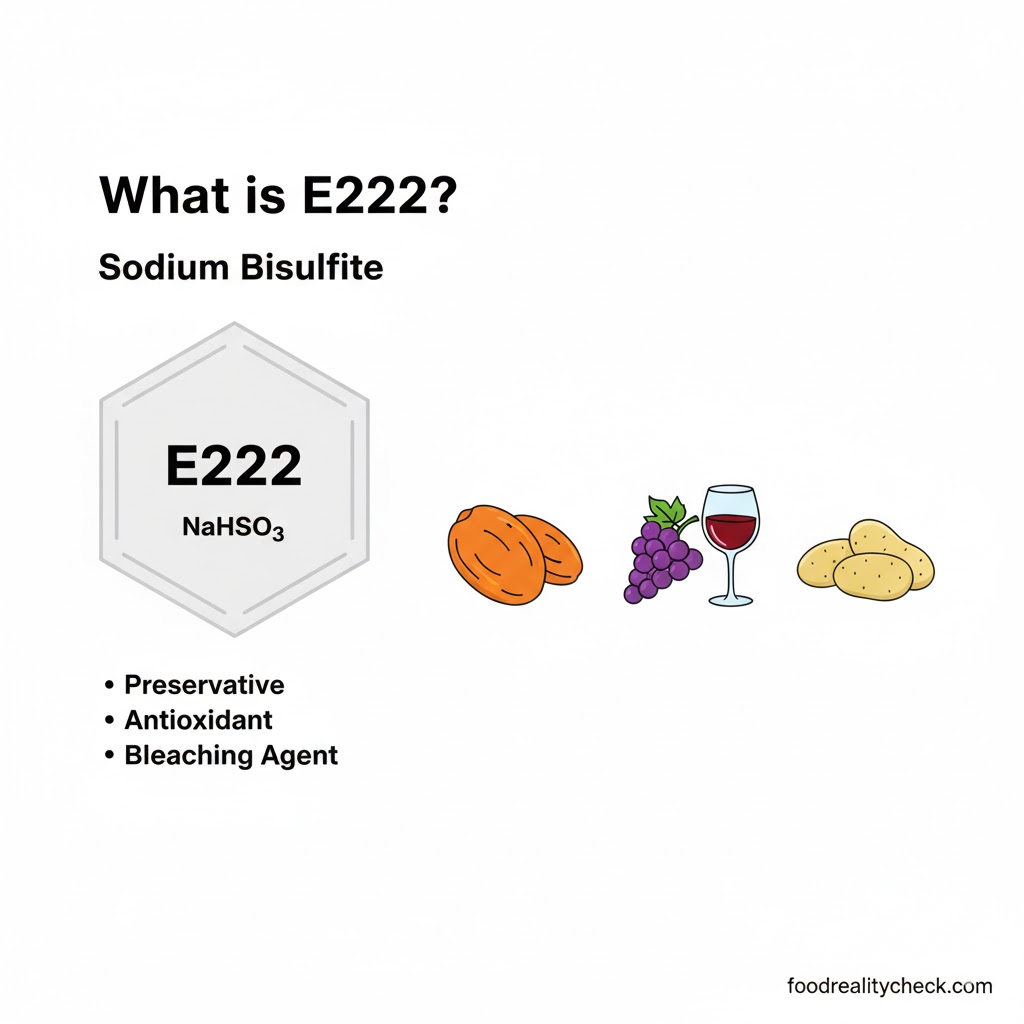
What is E222?
Complete guide to understanding E222 (Sodium Bisulfite) in your food
The Quick Answer
E222 is sodium bisulfite—a sodium salt of sulfurous acid that functions as a preservative, antioxidant, and anti-browning agent to prevent spoilage and discoloration in dried fruits, vegetables, and processed foods.
CRITICAL SAFETY WARNING: E222 is part of the sulfite family (E220-E228) which carries documented health risks, particularly for asthmatics. Like its sibling E221 (sodium sulfite), E222 has serious documented concerns. EFSA’s 2016 re-evaluation found MOE (margin of exposure) below safe thresholds for high consumers. Key documented concerns include: (1) respiratory distress and bronchial constriction in 5-10% of chronic asthmatics; (2) allergic-like reactions (anaphylaxis, urticaria, swelling) in sensitive individuals; (3) central nervous system effects at high intakes (nervous system dysfunction); (4) vitamin B1 destruction; (5) high-consumer exposures potentially exceeding safe ADI by up to 60% for adults and 12.5% for children. E222 should be avoided by asthmatics and those with sulfite sensitivity, and all consumers should be aware of potential safety concerns for high intake.
📌 Quick Facts
- Category: Synthetic preservative, antioxidant, anti-browning agent; sodium salt of sulfurous acid
- Chemical Formula: NaHSO₃ (not a pure compound; mixture including sodium metabisulfite)
- Appearance: White/yellowish-white powder; unstable; reacts with oxygen; odor of sulfur dioxide
- Safety Status: FDA GRAS; EFSA approved (but with safety concerns); JECFA approved
- ADI (Acceptable Daily Intake): 0.7 mg/kg body weight/day (as SO₂ equivalent; high consumers exceed this)
- Found in: Dried fruits, dried vegetables, candied fruits, potato starch, mushrooms, wine, processed meats
- KEY CONCERN: Part of sulfite family with documented respiratory/allergic risks in asthmatics; EFSA safety margin concerns for high consumers
- REGULATORY WARNING: Sulfites are mandatory allergen labeling (one of 14 major allergens in UK)
What Exactly Is It?
E222 is sodium bisulfite—a sodium salt of sulfurous acid, chemically produced by treating sulfur dioxide with sodium hydroxide or sodium bicarbonate, functioning as a preservative and reducing agent through its oxygen-scavenging and antimicrobial properties.
Chemical formula: NaHSO₃ (sodium hydrogen sulfite or sodium hydrosulfite); approximately 144.11 g/mol.
Important distinction: E222 is not a pure compound. It is a mixture of salts—primarily sodium bisulfite (NaHSO₃) and sodium metabisulfite (Na₂S₂O₅). During crystallization, sodium bisulfite converts partially to sodium metabisulfite. Upon dissolution in water, the metabisulfite regenerates bisulfite ions.
E222 appears as white or yellowish-white powder with faint sulfur dioxide odor. It is unstable—slowly oxidized to sulfate on exposure to air.
Production: SO₂ + NaOH → NaHSO₃ or SO₂ + NaHCO₃ → NaHSO₃ + CO₂. Attempts to crystallize yield sodium metabisulfite (E223). Upon water dissolution, metabisulfite regenerates bisulfite.
Mechanism: In acidic conditions, sodium bisulfite releases sulfur dioxide gas and forms sulfurous acid. These disrupt microbial metabolism, inhibit mold/yeast/bacterial growth, and prevent enzymatic browning by binding to polyphenol oxidase. Additionally, it acts as oxygen scavenger—reacting with oxygen before food oxidizes, preventing rancidity and color degradation.
Where You’ll Find It
E222 (and the broader sulfite family E220-E228) are widely used despite safety concerns:
• Dried fruits (apricots, raisins, figs, dates)
• Dried vegetables
• Candied fruits
• Potato starch and potato products
• Glucose and sugar syrups
• Liquid glucose
• Rock candy and caramel
• Jams and preserves
• Mushrooms and mushroom cans
• Vermicelli and noodles
• Bamboo shoots
• Wine and beer (major use; prevents unwanted fermentation)
• Processed meats
• Sauces and condiments
• Shellfish (especially shrimp)
Maximum use levels: 10-2000 mg/kg depending on food category. Residual sulfur dioxide limits strictly regulated.
🛑 RED SAFETY RATING – SERIOUS HEALTH RISK WARNINGS: E222 has:
• EFSA 2022: MOE (margin of exposure) below 80 for high consumers – indicating estimated intakes exceed safe levels
• Adults: high consumers up to 60% over safe ADI levels
• Children (3-10 years): up to 12.5% over safe ADI levels
• Documented respiratory distress in 5-10% of chronic asthmatics (wheezing, chest tightness, coughing)
• Allergic-like reactions documented: anaphylaxis (life-threatening), urticaria, hives, swelling, skin irritation
• Central nervous system effects: delayed nerve cell response; early sign of nervous system dysfunction at high intakes
• Vitamin B1 (thiamine) destruction reducing nutritional value
• Anaphylaxis reported but rare – still represents serious risk for sensitive individuals
• Asthma sufferers at higher risk for sensitivity reactions
• Mandatory allergen labeling required (one of 14 major allergens in UK)
• Sensitivity reactions not prevented by antihistamines – avoidance is primary management
E222, as part of the sulfite family, carries significant documented health risks. EFSA 2022 found safety margin concerns for high consumers.
Is It Safe?
NO—Not for everyone. E222 carries documented health risks and safety margin concerns from EFSA. While approved by regulatory agencies, EFSA’s 2022 re-evaluation explicitly found that high consumers face estimated intakes exceeding safe levels by up to 60% (adults) to 12.5% (children). This is a serious regulatory concern.
EFSA’s 2022 Follow-up Assessment stated:
“The MOEs we calculated were below 80 for high consumers in all population groups except for adolescents. This means that estimated intakes for these consumers potentially exceed what would be considered safe, by up to 12.5% for children (3-10 year olds) and up to 60% for adults.”
This is an extraordinary regulatory statement—MOE below 80 indicates potential safety concerns. EFSA also noted: “Dietary intakes of sulfites could be a safety concern for high consumers of foodstuffs that contain the additives.”
What Are The Health Concerns?
E222 has multiple documented health concerns shared with other sulfites (E220-E228):
1. Respiratory Distress in Asthmatics (PROVEN): 5-10% of chronic asthma patients experience bronchial constriction, wheezing, chest tightness, and coughing when exposed to sulfites. This is a documented clinical phenomenon affecting substantial populations with asthma.
2. Allergic-Like Reactions (PROVEN): Documented reactions include anaphylactic shock (life-threatening), urticaria (hives), angioedema (swelling), skin irritations, and other allergic-type symptoms. Though termed “sensitivity” rather than true allergy (not IgE-mediated), reactions produce allergy-type symptoms including respiratory effects.
3. Respiratory Allergy-Like Symptoms (DOCUMENTED): Common symptoms include wheezing, chest tightness, cough, shortness of breath, throat tightness, and nasal congestion. Symptoms more likely when asthma is poorly controlled.
4. Skin and Gastrointestinal Reactions (DOCUMENTED): Hives, swelling (face, lips, tongue), itching, rash, stomach pain, vomiting, diarrhea, worsening eczema.
5. Central Nervous System Effects (EMERGING CONCERN): EFSA 2022 noted evidence of adverse health effects on the central nervous system, including delayed response of nerve cells to stimuli—an early sign of nervous system dysfunction. This is an emerging concern area.
6. High-Consumer Intake Exceeding Safe Levels (CRITICAL REGULATORY FINDING): EFSA 2022 calculated that high consumers face:
• Adults: estimated intakes up to 60% above safe ADI levels
• Children (3-10 years): up to 12.5% above safe ADI levels
• MOE (margin of exposure) below safe threshold (80) for all populations except adolescents
This means high consumers are not experiencing safe exposure levels.
7. Vitamin B1 Destruction: Sodium bisulfite reduces thiamine (vitamin B1) content in foods, reducing nutritional value.
8. Anaphylaxis Risk (RARE BUT SERIOUS): While very rare, anaphylaxis can occur with sulfite exposure—a potentially fatal reaction. Risk is documented even if uncommon.
9. Asthma-Sulfite Sensitivity Link (DOCUMENTED): Sulfite sensitivity is more common in people with asthma than general population, dramatically increasing risk for this subgroup.
10. Sensitivity Not Preventable with Standard Treatments: Sulfite sensitivity reactions do not respond to antihistamines—avoidance is the primary management strategy.
Comparison to Other Sulfites
E222 (sodium bisulfite) is part of the sulfite family with similar properties and health concerns:
• E220 (Sulfur dioxide) – gaseous form; most restricted
• E221 (Sodium sulfite) – sodium salt; similar respiratory/allergic risks
• E222 (Sodium bisulfite) – sodium hydrogen salt; mixture form; similar risks to E221
• E223 (Sodium metabisulfite) – dimer form; similar risks; converts to E222 in water
• E224 (Potassium metabisulfite) – potassium salt; similar risks
• E226/E227 (Calcium sulfite/bisulfite) – calcium salts; similar risks
• E228 (Potassium bisulfite) – potassium hydrogen salt; similar risks
All release sulfur dioxide and carry respiratory/allergic sensitivity risks. EFSA groups them together with combined ADI of 0.7 mg/kg SO₂ equivalent.
Regulatory Status and Inconsistencies
E222 is approved by multiple agencies, yet EFSA’s 2022 assessment explicitly found high-consumer safety concerns:
• FDA: GRAS (Generally Recognized as Safe)
• EFSA: Approved (E222 within Commission Regulation 231/2012) BUT 2022 follow-up identified safety margins below safe thresholds
• JECFA: Approved; ADI 0-0.7 mg/kg set 1998
• Mandatory labeling: Sulfites are one of only 14 major allergens requiring emphasis in UK, reflecting serious concerns
• High consumer exposure recognized but not monitored: EFSA knows 60% of adults and 12.5% of children exceed safe ADI but monitoring remains limited
Natural Alternatives
Want to avoid E222 and sulfites?
• Sorbic acid (E200) or potassium sorbate (E202) – alternative preservatives without asthma trigger concerns
• Ascorbic acid (E300/Vitamin C) – natural antioxidant
• Rosemary extract – natural antioxidant and preservative
• Salt-based preservation – traditional method
• Refrigeration/Freezing – avoid additives entirely
• Vacuum packing – reduces oxidation without additives
• Fresh products – accept shorter shelf-life without preservatives
The Bottom Line
E222 (Sodium Bisulfite) is an approved preservative and antioxidant that carries documented health risks, particularly for asthmatics and high consumers. EFSA’s 2022 re-evaluation explicitly found that high consumers have estimated intakes exceeding safe levels by up to 60% (adults) and 12.5% (children), with margin of exposure below safe thresholds. Documented respiratory distress in 5-10% of chronic asthmatics, allergic-like reactions including anaphylaxis, and emerging nervous system dysfunction concerns at high intakes warrant caution. Mandatory allergen labeling reflects regulatory acknowledgment of serious concerns. E222 should be avoided by asthmatics and sulfite-sensitive individuals, and all consumers should be aware of potential high-intake risks.
EFSA 2022 Critical Finding: High consumers have estimated intakes exceeding safe ADI by 60% (adults) and 12.5% (children); MOE below safe threshold (80).
Documented Respiratory Risk: 5-10% of chronic asthmatics experience bronchial constriction, wheezing, chest tightness; asthma sufferers at elevated sensitivity risk.
Documented Allergic-Type Reactions: Anaphylaxis (rare but documented), urticaria, hives, swelling, skin reactions, gastrointestinal symptoms.
Central Nervous System Concerns (EMERGING): Evidence of delayed nerve cell response and early nervous system dysfunction at high intakes.
Chemical Nature: Not a pure compound; mixture of sodium bisulfite and sodium metabisulfite; unstable and prone to oxidation.
Mandatory Allergen Labeling: Sulfites are one of only 14 major allergens in UK, requiring prominent label emphasis.
High Population Exposure Problem: EFSA acknowledges 60% of adults consuming high amounts of sulfite-containing foods exceed safe intakes.
Recommendation (STRONG): E222 should be avoided by asthmatics and those with documented sulfite sensitivity. For general consumers, awareness of high-consumption risks and preference for alternative preservatives (sorbic acid, ascorbic acid, natural preservatives) is warranted. The combination of EFSA’s 2022 finding that high consumers exceed safe intake levels AND documented respiratory/allergic risks makes this additive deserving of caution far beyond typical “approved” additives. Unlike many regulatory approvals that indicate general safety, E222’s approval coexists with explicit regulatory warnings about high-consumer safety concerns—a concerning inconsistency that suggests consumers should err on the side of avoidance when possible.