What is E227?
Complete guide to understanding E227 (Calcium Hydrogen Sulfite) in your food
The Quick Answer
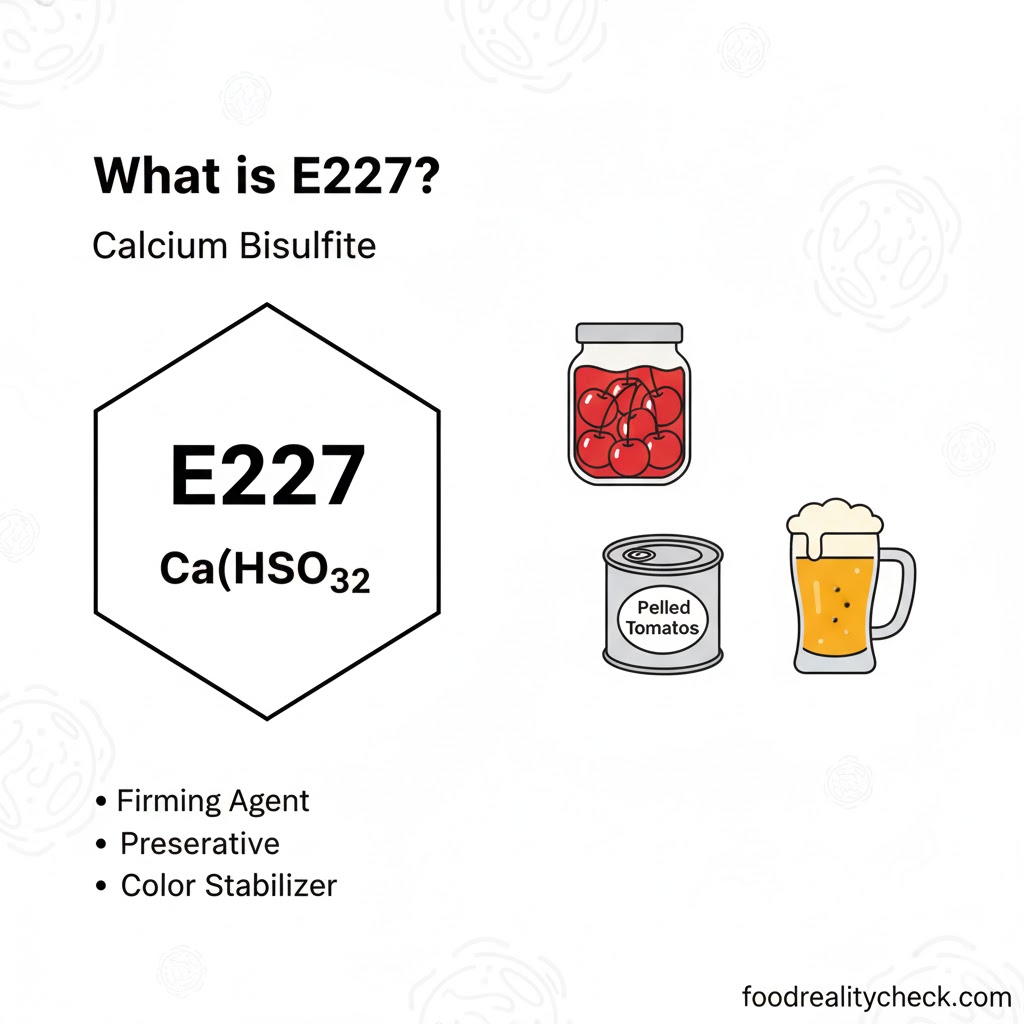
E227 is calcium hydrogen sulfite (also called calcium bisulfite), a preservative and antioxidant additive used in food.
It’s used to prevent spoilage, inhibit bacterial and fungal growth, maintain color and flavor, and extend shelf life.
Most people consume it regularly if they drink beer, eat canned vegetables, or consume dried fruit products.
📌 Quick Facts
- Category: Preservative and Antioxidant
- Found in: Beer, canned vegetables and fruits, pickles, fruit juices, jams, dried fruits
- Safety: Approved by major regulatory agencies with cautious use recommendations
- Approved by: FDA (USA), EFSA (Europe), UK Food Standards Authority, and most major regulatory bodies
What Exactly Is It?
E227 is calcium hydrogen sulfite, also known as calcium bisulfite. It has the chemical formula Ca(HSO₃)₂ or CaH₂O₆S₂.
E227 exists only in solution form – it’s a colorless to yellowish aqueous solution with a distinct sulfur dioxide odor. Unlike many sulfite preservatives that are solids, calcium bisulfite is produced and used as a liquid.
In technical terms, E227 is an acid salt – it’s the calcium salt of sulfurous acid and behaves like an acid when dissolved in water. This acidic nature makes it particularly effective as a preservative in beverages like beer, where it helps control fermentation.
E227 is produced by passing sulfur dioxide gas through a slurry of calcium hydroxide (slaked lime) and water, or by dissolving calcium sulfite in an aqueous SO₂ solution.
Where You’ll Find It
E227 appears in a specific set of beverages and processed foods:
• Beer and other fermented beverages (primary use)
• Canned vegetables and fruit (particularly to maintain firmness and color)
• Pickled vegetables
• Fruit juices and grape juice
• Dried fruits and fruit products
• Jams, jellies, and marmalades
• Canned fish and seafood
• Baked goods (limited use)
If you regularly consume beer or canned vegetables, you’ve likely consumed E227 multiple times this month.
Why Do Food Companies Use It?
E227 performs four critical functions in food:
1. Preservation and fermentation control: In beer production, E227 is especially valuable because it prevents unwanted microbial growth and controls fermentation. It inhibits bacteria, wild yeast, and mold that would otherwise spoil the product or cause off-flavors.
2. Antioxidant protection: E227 acts as an oxygen scavenger, preventing oxidation that causes browning, discoloration, flavor loss, and nutrient degradation in fruits, vegetables, and juices.
3. Color and flavor maintenance: By preventing oxidation and microbial breakdown, E227 preserves the natural appearance and taste of foods, particularly important for canned fruits and pickled vegetables.
4. Firming agent for canned vegetables: Unlike other sulfites, E227 contains calcium, which helps maintain the firmness and texture of canned vegetables, preventing them from becoming mushy during storage.
Without E227, canned vegetables would have shorter shelf lives, beer would be prone to secondary fermentation and sourness, and fruit products would brown and deteriorate more rapidly.
Is It Safe?
E227 is officially approved by major regulatory authorities, though with important safety considerations.
The FDA, EFSA, and UK Food Standards Authority all permit E227 in specific food categories with defined maximum use levels. The accepted daily intake (ADI) for all sulfites (E220-E228 group) is set at 0.7 mg/kg of body weight per day, calculated as SO₂ equivalent.
The regulatory limits vary by product: beer typically allows up to 250 mg/L, canned vegetables up to 100 mg/kg, and canned fruits up to 250 mg/kg.
Who should avoid E227: Anyone with known sulfite sensitivity, asthma, or sulfite allergies should carefully read labels and avoid products containing E227. Approximately 5-10% of people with asthma may experience adverse reactions to sulfites. Some individuals without asthma have also been documented with sulfite sensitivity.
Natural vs Synthetic Version
E227 is produced industrially in one primary way:
Synthetic production: Created by passing sulfur dioxide gas through a slurry of calcium hydroxide (slaked lime) and water. The reaction produces a liquid solution of calcium hydrogen sulfite with a greenish-yellow appearance and sulfur dioxide odor. This is then purified to food-grade specifications.
Unlike some sulfite preservatives, E227 doesn’t have a “natural” source – it’s always produced through controlled synthesis. However, the raw materials (sulfur dioxide, calcium hydroxide) can be derived from natural or synthetic sources.
Once in your digestive system, E227 behaves identically regardless of the origin of its component materials.
Natural Alternatives
Want to avoid E227? Food companies sometimes use these alternatives:
• Ascorbic acid (Vitamin C, E300): A natural antioxidant that slows browning and oxidation in fruits and vegetables
• Sorbic acid and sorbates (E200-E203): Another preservative class with antimicrobial properties, commonly used in beer alternatives
• Benzoic acid (E210): An antimicrobial preservative used in some beverages
• Advanced technologies: Modified atmospheric packaging, pasteurization, or cold storage for beverages and canned goods
These alternatives often work similarly but typically cost more or require additional processing, which is why sulfites like E227 remain widely used in commercial food production, particularly in beer manufacturing.
The Bottom Line
E227 (calcium hydrogen sulfite) is a liquid preservative and antioxidant widely used in beer production and canned goods.
It’s particularly valued for its dual function as both a preservative and firming agent in canned vegetables. Regulatory agencies worldwide have approved its use within specific limits. However, people with asthma, allergies, or sulfite sensitivity must avoid it due to documented risks of serious respiratory and systemic reactions.
If you have asthma, known sulfite sensitivity, or allergies, check product labels carefully and look for products labeled “sulfite-free.” For the general population consuming these foods in normal amounts, E227 is considered safe within approved regulatory limits.