What is E401?
Complete guide to understanding E401 (Sodium Alginate) in your food
The Quick Answer
E401 is sodium alginate, a natural thickener, stabilizer, and gelling agent derived from brown seaweed.
It’s used in food to create smooth textures, prevent ingredients from separating, and maintain consistency without adding calories or artificial ingredients.
Most people consume it multiple times per week in ice cream, yogurt, salad dressings, and other processed foods.
📌 Quick Facts
- Category: Thickener, Stabilizer, Emulsifier, Gelling Agent
- Source: Brown seaweed (Phaeophyta) harvested globally
- Found in: Ice cream, yogurt, desserts, salad dressings, sauces, jams, meat products
- Safety: Approved safe by FDA, EFSA, JECFA with no specific ADI set
- Natural or Synthetic: Natural—extracted directly from seaweed
What Exactly Is It?
E401 is sodium alginate, the sodium salt of alginic acid, a naturally occurring polysaccharide found in brown seaweed.
Alginic acid was first discovered in 1881 by British chemist E. C. C. Stanford. When this natural compound is extracted and treated with sodium compounds, it becomes sodium alginate—a white to yellowish-brown powder or granular solid with no taste or odor.
In technical terms, sodium alginate is a linear copolymer made up of two types of sugar units: α-L-guluronic acid (G units) and β-D-mannuronic acid (M units). These units are connected in various sequences, which affects the additive’s properties like viscosity and gel strength. The ratio of these units depends on the seaweed species and harvest season.
When dissolved in water, sodium alginate creates a thick, viscous solution that mimics the texture and mouthfeel of heavier, fattier foods—allowing manufacturers to make lower-fat versions without sacrificing creaminess.
Where You’ll Find It
E401 appears in a wide range of processed foods:
• Ice cream and frozen desserts
• Yogurt and dairy products
• Salad dressings and mayonnaise
• Sauces, gravies, and condiments
• Desserts, puddings, and mousses
• Jam, jellies, and marmalades
• Meat preparations (sausages, pâtés)
• Canned and processed fruits and vegetables
• Beer and soft drinks
• Whipped cream and mousses
• Prepared foods and ready-to-eat meals
If you eat processed or prepared foods, you’ve consumed E401 multiple times this week.
Why Do Food Companies Use It?
E401 performs four critical functions:
1. Thickening without fat: Sodium alginate creates viscosity and body in foods, allowing manufacturers to create rich-tasting, creamy products with lower fat content. This is why low-fat ice cream can feel smooth rather than icy, and low-fat salad dressings don’t feel watery.
2. Stabilization: It prevents oil and water from separating in emulsified products like mayonnaise and salad dressings. Without E401, these products would separate and look unappetizing on store shelves and in home kitchens.
3. Gel formation: When calcium or other multivalent ions (like copper) are added, sodium alginate forms heat-stable gels. This property is used to create jellies, puddings, and structured desserts.
4. Mouthfeel enhancement: It creates a smooth, pleasant texture that mimics the natural feel of fatty foods, improving consumer satisfaction and product appeal.
Without E401, many processed foods would have inferior textures, thinner consistency, and visible separation of ingredients.
Is It Safe?
E401 is considered very safe by all major regulatory authorities.
The FDA, EFSA, and the Joint FAO/WHO Expert Committee on Food Additives (JECFA) have all approved sodium alginate for food use. Notably, no specific Acceptable Daily Intake (ADI) limit has been established—meaning regulatory agencies found no safety concern even at very high consumption levels.
EFSA’s 2017 safety re-evaluation of alginates concluded “no safety concern and no need to establish an ADI,” reflecting the additive’s excellent safety profile.
Potential considerations: The only noted side effect at food-use concentrations is that very high intakes could theoretically interfere with iron absorption by binding to iron molecules. However, this is not a practical concern in normal dietary consumption. Some individuals may have mild digestive effects from consuming very large amounts, though this would require excessive intake.
Historical Context: Natural Origins
Unlike many food additives that are synthesized in laboratories, sodium alginate has been used for over 140 years as a direct extraction from brown seaweed. The industrial production method has remained consistent since Stanford’s original patent: seaweed is washed, treated with acid and alkaline solutions, and purified to obtain the sodium alginate salt. Today, brown seaweed is harvested from coasts worldwide, including the North Atlantic, South America, and Asia. The natural origin and biodegradability of sodium alginate make it one of the most environmentally friendly food additives available.
Natural vs Synthetic Version
E401 is entirely natural—there is no synthetic version.
Sodium alginate is extracted directly from brown seaweed through a physical and chemical process: seaweed is washed with water and acid, then treated with sodium carbonate to convert the insoluble alginic acid to soluble sodium alginate. The solution is then filtered, concentrated, dried, and ground into a powder.
There is no laboratory-created or synthetic alternative—E401 is harvested and refined from nature, making it one of the few food additives that is genuinely 100% natural in origin.
Environmental and Health Perspectives
Beyond food additive use, sodium alginate has applications in medicine and pharmaceuticals. It’s used in some antacid products to reduce gastric reflux and in pharmaceutical formulations. Its ability to bind to toxic metals has prompted research into its potential use in heavy metal detoxification protocols. In cosmetics and textiles, sodium alginate serves as a thickener and binder. Its biodegradability and natural origin make it attractive for sustainable manufacturing compared to synthetic alternatives.
Natural Alternatives
Want to avoid E401? Food companies sometimes use these alternatives:
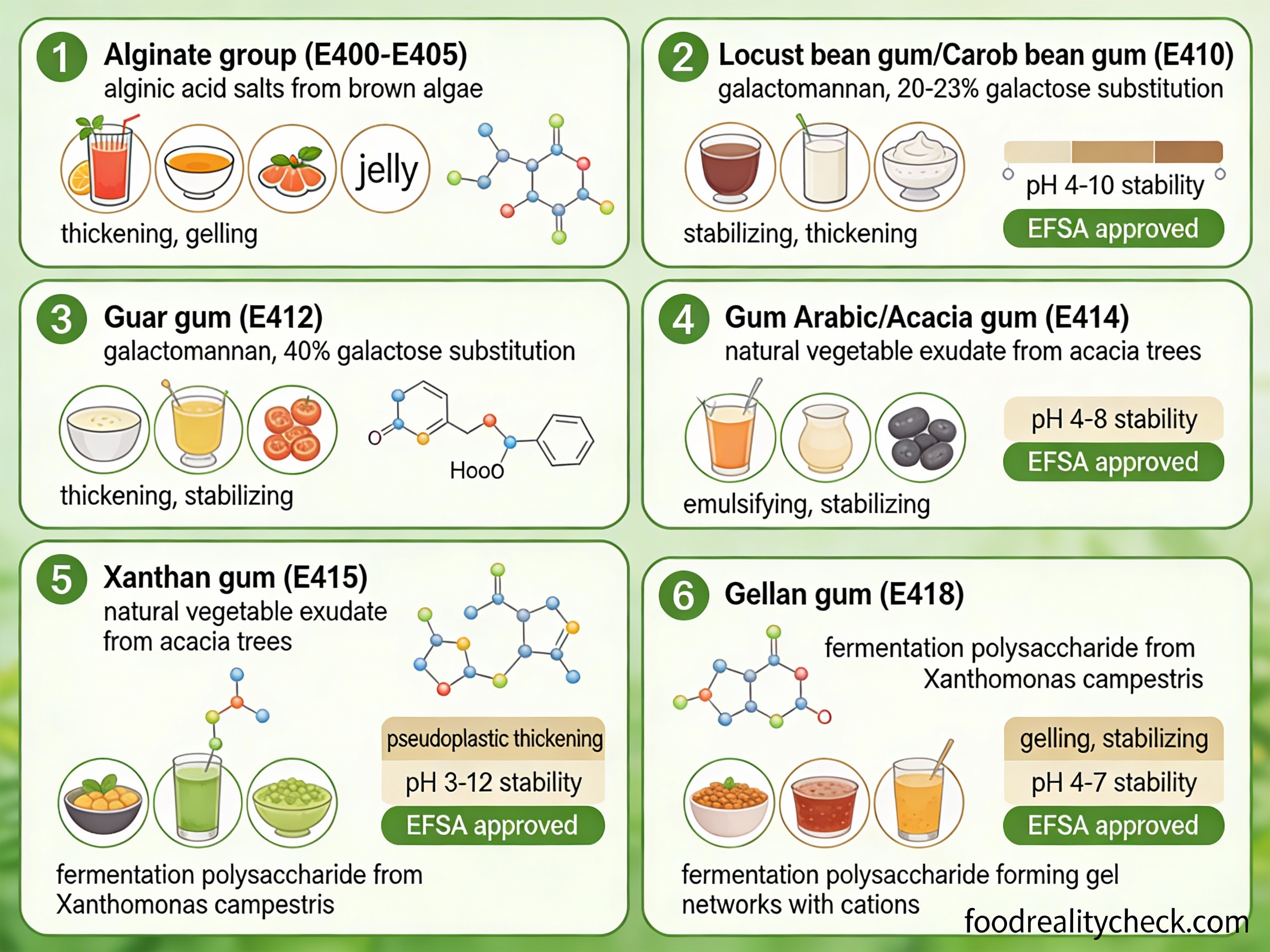
• Xanthan gum (E415): A natural polysaccharide produced by fermentation, similar thickening properties
• Locust bean gum (E410): Extracted from carob seeds, natural thickening agent
• Guar gum (E412): From guar bean seeds, similar stabilizing properties
• Gelatin or pectin: Traditional thickeners from animal or plant sources
• Starch or modified starch: From corn, potato, or tapioca—simple carbohydrates
These alternatives have similar functions but different properties and costs. Sodium alginate’s combination of effectiveness, safety record, natural origin, and cost-efficiency make it the industry standard.
The Bottom Line
E401 (sodium alginate) is a safe, natural food additive derived directly from brown seaweed.
It’s been used for over 140 years and has been extensively studied and approved by all major regulatory agencies worldwide. Unlike many food additives, no safety concerns have been identified, and no ADI limit was deemed necessary. Sodium alginate appears in most processed and prepared foods where it improves texture, prevents separation of ingredients, and maintains quality during storage.
It’s suitable for vegans and vegetarians, and has no known religious dietary restrictions. For the general population, E401 is one of the safest food additives available, with potential additional health benefits in terms of cholesterol and blood sugar regulation. If you’re looking to minimize processed foods, reducing intake of products containing E401 would lower overall additive consumption, but the additive itself poses no identified health risk.
Thanks for finally writing about “What is E401? – Complete guide to understanding Sodium Alginate in your food” Liked it!
Hello, just wanted to mention, I enjoyed this article. Keep on posting!