What is E403?
Complete guide to understanding E403 (Ammonium Alginate) in your food
The Quick Answer
E403 is ammonium alginate, a natural thickener, stabilizer, gelling agent, and emulsifier derived from brown seaweed.
It’s used in food to create smooth textures, prevent ingredients from separating, stabilize emulsions, and maintain consistency.
Most people consume it multiple times per week in ice cream, yogurt, sauces, jams, and other processed foods—but notably, it’s restricted from use in baby foods and products for infants.
📌 Quick Facts
- Category: Thickener, Stabilizer, Emulsifier, Gelling Agent
- Source: Brown seaweed (Phaeophyta) harvested globally
- Found in: Ice cream, yogurt, desserts, sauces, jams, meat products, processed fruits and vegetables
- Safety: Approved safe by FDA, EFSA, JECFA with no specific ADI set
- Natural or Synthetic: Natural—extracted directly from seaweed
- Important Restriction: NOT allowed in infant and young children’s foods
What Exactly Is It?
E403 is ammonium alginate, the ammonium salt of alginic acid, a naturally occurring polysaccharide found in brown seaweed.
Ammonium alginate has the chemical formula NH₄C₆H₇O₆. It’s extracted from brown seaweed species including Macrocystis pyrifera, Laminaria digitata, Laminaria cloustoni, and Ascophyllum nodosum. When alginic acid is treated with ammonium compounds, it becomes ammonium alginate—appearing as a white to yellowish-brown powder, granules, or filamentous solid with no taste or odor.
In technical terms, ammonium alginate is a linear copolymer composed of α-L-guluronic acid (G units) and β-D-mannuronic acid (M units), chemically identical to sodium and potassium alginates except for the mineral/ion base. The ammonium ions (NH₄⁺) replace the hydrogen ions (H⁺) of alginic acid, creating slightly different pH and solubility properties compared to other alginate salts.
When dissolved in water, ammonium alginate creates a thick, viscous solution with high water-binding capacity. It has unique properties including excellent resistance to heat and acidic conditions, making it valuable in specialized food applications where other alginates might break down.
Where You’ll Find It
E403 appears in a specific range of processed foods (notably excluding infant products):
• Ice cream and frozen desserts
• Yogurt and dairy products
• Salad dressings and mayonnaise
• Sauces, gravies, and condiments
• Desserts, puddings, and mousses
• Jams, jellies, and marmalades
• Meat preparations (sausages, pâtés, hams)
• Canned and processed fruits and vegetables
• Soft drinks and beverages
• Beer
• Whipped cream and mousses
• Processed food colorants and food additives carriers
• Vegetarian and vegan gelatin substitutes
• Edible food packaging (innovative use)
Notably NOT in: Infant formulas, baby foods, or foods specifically designed for young children—this additive is restricted from these applications.
If you eat processed or prepared foods (excluding baby products), you’ve likely consumed E403 multiple times this week.
Why Do Food Companies Use It?
E403 performs five critical functions:
1. Superior heat and acid resistance thickening: Ammonium alginate creates viscosity more effectively in acidic environments and at high temperatures than other alginates. This makes it ideal for acidic products like pickles, certain sauces, and beverages where stability is critical during processing and storage.
2. Stabilization and emulsion maintenance: It prevents oil and water from separating in emulsified products like mayonnaise and salad dressings. It also stabilizes suspensions of particles, preventing settlement and improving shelf appeal.
3. Gel formation: When calcium or other multivalent ions are added, ammonium alginate forms heat-stable gels with superior crystal structure control. This is especially useful in ice cream (preventing ice crystallization), jellies, and puddings where smooth texture is essential.
4. Water-binding and texture enhancement: Its high water-binding capacity improves mouthfeel, creates smoothness mimicking fatty foods, and maintains moisture in products during storage, reducing visible separation and degradation.
5. Carrier for other additives: E403 is used as a substance carrier for flavors, colors, and other food additives, helping them distribute uniformly through products and improving stability during storage.
Without E403, certain products would lose stability during processing or storage, particularly those with acidic pH ranges. Ice cream would become grainy from ice crystal formation, and emulsified products would separate more rapidly.
Is It Safe?
E403 is considered very safe by all major regulatory authorities, with one important restriction.
The FDA, EFSA, and the Joint FAO/WHO Expert Committee on Food Additives (JECFA) have all approved ammonium alginate for food use. Notably, no specific Acceptable Daily Intake (ADI) limit has been established—meaning regulatory agencies found no safety concern even at very high consumption levels in the general population.
EFSA’s 2017 safety re-evaluation of alginates concluded “no safety concern and no need to establish an ADI” for alginic acid and its salts (including ammonium alginate). JECFA and FEMA (Flavor and Extract Manufacturers Association) also classify it as GRAS (Generally Recognized As Safe).
⚠️ Important Restriction: Ammonium alginate is NOT approved for use in infant formulas, baby foods, or products specifically designed for young children. EFSA explicitly noted “inadequate assessment of the safety when used in dietary foods for special medical purposes and special formulae for infants and dietary foods for babies and young children for special medical purposes.” This restriction distinguishes E403 from E401 (sodium alginate) and E402 (potassium alginate), which have fewer restrictions. The reason for this exclusion relates to the ammonium ion and potential concerns in the vulnerable infant digestive system, though the mechanism remains under investigation.
Potential side effects: At very high intakes, mild gastrointestinal effects like diarrhea or bloating are possible, though this would require consumption far exceeding typical food use. Skin irritation can occur with prolonged contact with concentrated powder in industrial settings, but this is not relevant to food consumption.
E403 vs E401/E402: Key Differences
All three—ammonium (E403), sodium (E401), and potassium (E402) alginates—are extracted from brown seaweed and share nearly identical chemical structures. The differences are functional and regulatory:
E401 (Sodium alginate): General use, including in infant foods under certain conditions. Standard choice for most applications.
E402 (Potassium alginate): Low-sodium or reduced-sodium products. Similar safety profile to E401. General use including some infant applications.
E403 (Ammonium alginate): Heat and acid-resistant applications. Specialized properties for challenging food matrices. Specifically PROHIBITED in infant and young children’s foods due to ammonium ion safety concerns in vulnerable populations.
Natural vs Synthetic Version
E403 is entirely natural—there is no synthetic version.
Ammonium alginate is extracted directly from brown seaweed through a physical and chemical process: seaweed is washed with water and acid, then treated with ammonium hydroxide or ammonium carbonate to convert the insoluble alginic acid to soluble ammonium alginate. The solution is then filtered, concentrated, dried, and ground into a powder.
There is no laboratory-created or synthetic alternative—E403 is harvested and refined from nature, making it one of the few food additives that is genuinely 100% natural in origin. The ammonium comes from naturally-occurring ammonium salts or is synthesized from naturally-available nitrogen sources.
Specialized Applications
Beyond traditional food use, ammonium alginate has emerging applications:
Edible food packaging: E403 is being used to create edible films and coatings to reduce food waste and environmental impact—a cutting-edge application in sustainable food technology.
Vegan gelatin substitute: As a plant-based alternative to animal-derived gelatin, it’s particularly valued in vegetarian and vegan products.
Pharmaceutical and cosmetic use: Used in topical gels, masks, and creams where gelling, texture control, and natural origins are valued.
Environmental and Health Perspectives
Brown seaweed is a renewable resource that grows rapidly in coastal waters worldwide. Harvesting alginates doesn’t deplete fish stocks or harm marine ecosystems. The seaweed regenerates quickly, making alginate production sustainable and environmentally responsible. Ammonium alginate is biodegradable and compatible with circular economy principles.
Natural Alternatives
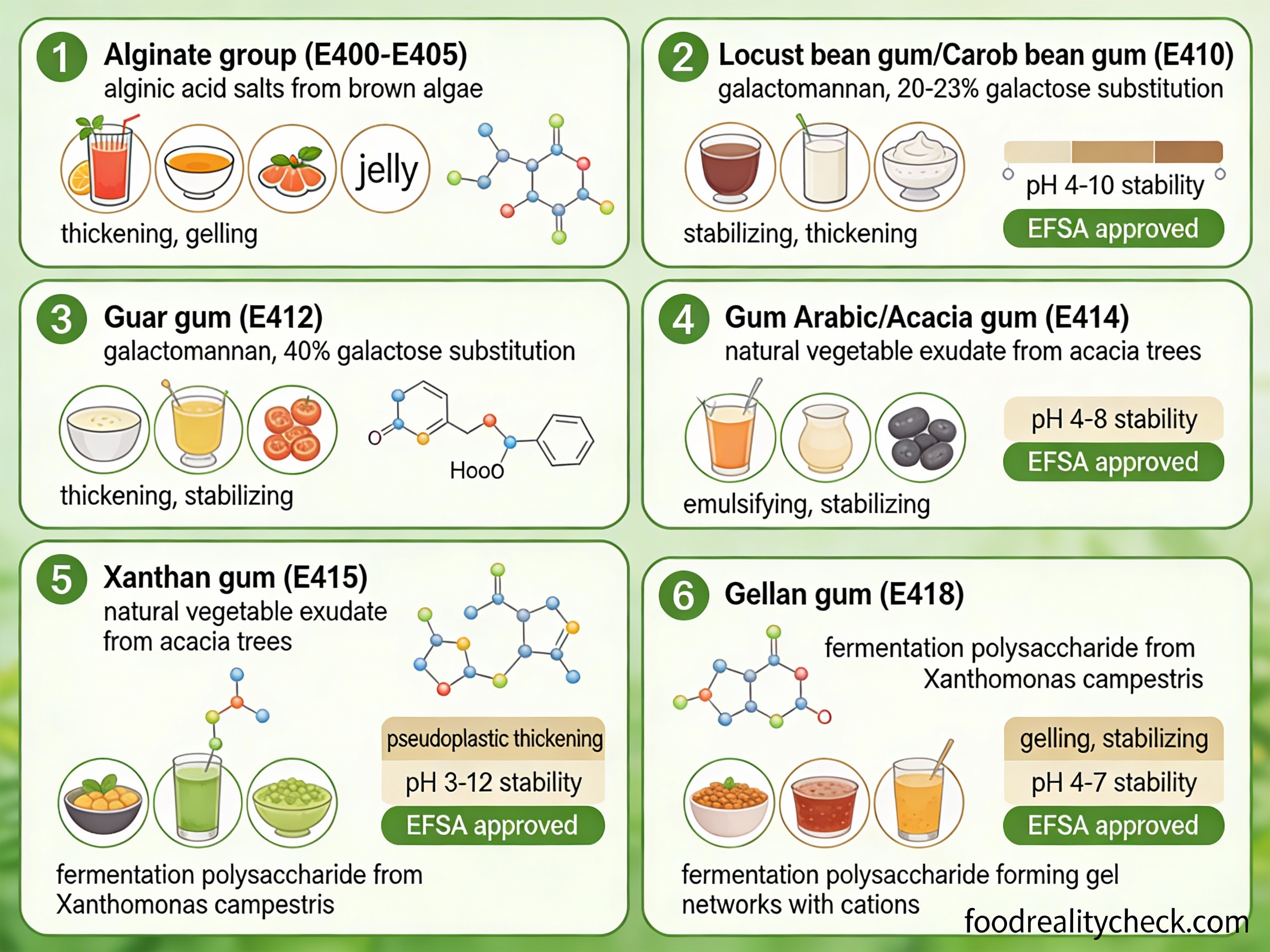
Want to avoid E403? Food companies sometimes use these alternatives:
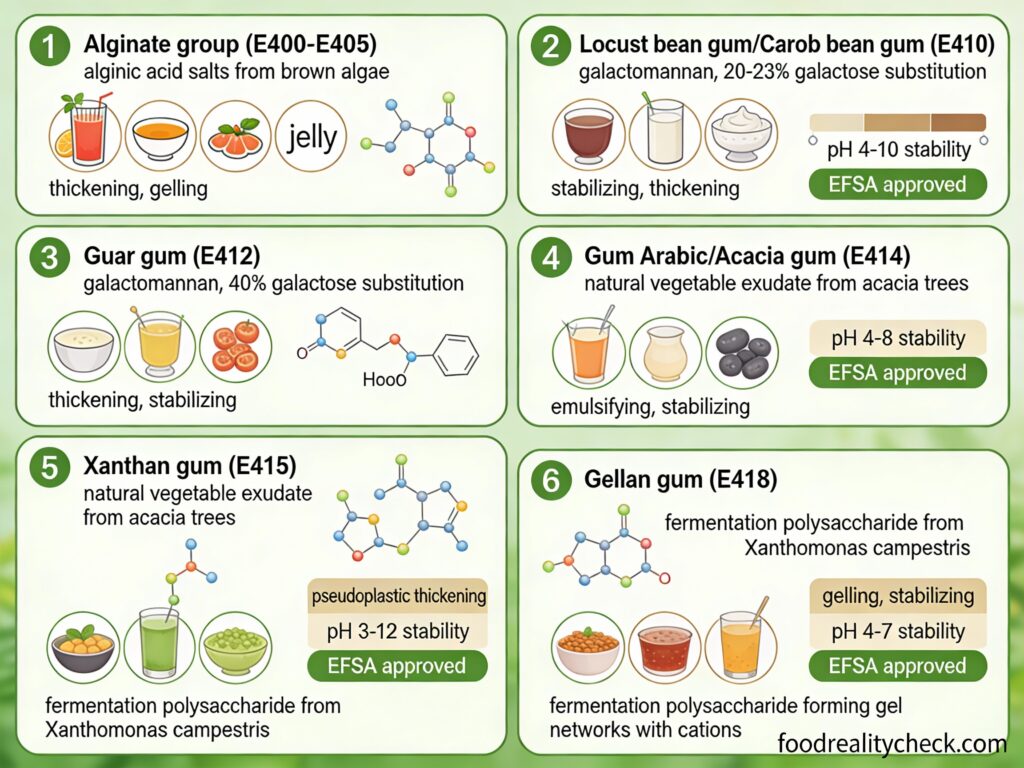
• E401 (Sodium alginate): Less restricted version, though less heat/acid resistant
• E402 (Potassium alginate): Low-sodium alternative with fewer restrictions
• Xanthan gum (E415): A natural polysaccharide produced by fermentation
• Locust bean gum (E410): Extracted from carob seeds
• Guar gum (E412): From guar bean seeds
• Gelatin or pectin: Traditional thickeners
• Starch or modified starch: Simple carbohydrate alternatives
These alternatives have similar thickening functions but may lack the specialized heat and acid resistance that makes E403 valuable in certain applications. E401 and E402 are the most similar alternatives since they’re also alginates.
The Bottom Line
E403 (ammonium alginate) is a safe, natural food additive derived directly from brown seaweed.
It’s been approved by all major regulatory agencies worldwide and has an excellent safety profile. Like other alginates, it poses no identified health risk for the general population. However, E403 has a unique restriction: it is NOT permitted in infant formulas or baby foods, distinguishing it from some other alginate salts. This restriction reflects abundance of caution for vulnerable infant digestive systems and ammonium ion metabolism.
Ammonium alginate is particularly valued for its superior performance in acidic and high-temperature food applications. It’s suitable for vegans and vegetarians, has no known religious dietary restrictions, and is being explored for sustainable food packaging applications. For adult and child populations (beyond infants), E403 is one of the safest food additives available. If you’re selecting foods for infants or young children, ensure that products use E401 (sodium alginate) rather than E403 if you prefer alginate-based additives.