What is E434?
Complete guide to understanding E434 (Polysorbate 40) in your food
The Quick Answer
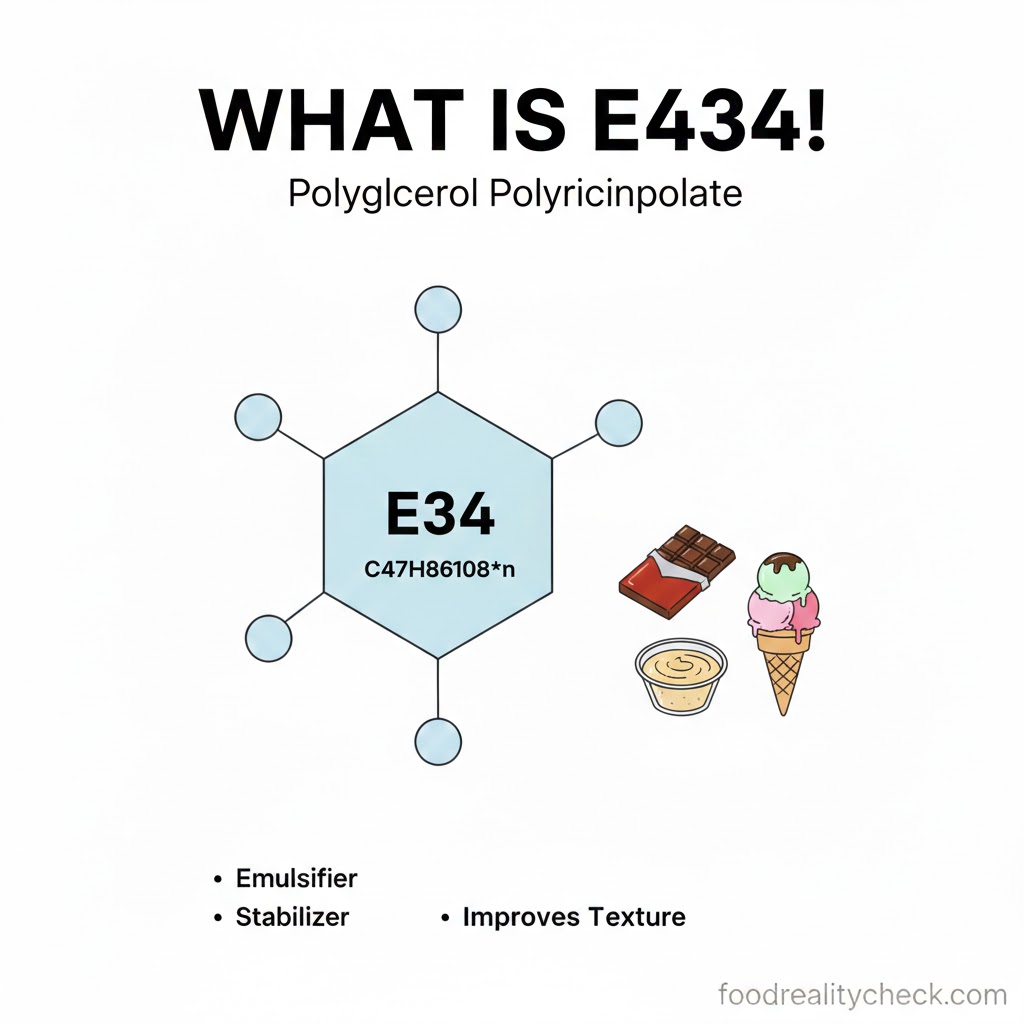
E434 is polysorbate 40 (also called polyoxyethylene sorbitan monopalmitate or Tween 40), a synthetic non-ionic emulsifier that prevents oil and water from separating in processed foods.
It’s used to stabilize emulsions, create creamy textures, and extend shelf life—appearing less frequently in food than related polysorbates, particularly because FDA approval is limited compared to other polysorbates.
Most people consume it occasionally in baked goods, ice cream, and processed foods, though E434 is used less extensively than E433 (polysorbate 80) or E432 (polysorbate 20).
📌 Quick Facts
- Category: Emulsifier, Non-ionic Surfactant, Stabilizer, Solubilizer, Wetting Agent, Antifoaming Agent
- Source: Synthetic—ethoxylated sorbitan monopalmitate (combination of sorbitol, ethylene oxide, and palmitic acid)
- Found in: Ice cream, baked goods, cakes, fine bakery products, frozen custards, edible fats, vegetable protein drinks
- Safety: FDA approved as INDIRECT emulsifier (not direct food additive); EFSA group ADI 0-25 mg/kg body weight per day; JECFA ADI 0-25 mg/kg
- Natural or Synthetic: Fully synthetic (no naturally occurring version)
- Vegan/Vegetarian: Can be if palmitic acid sourced from vegetable oils (coconut, palm, soy); check manufacturer
- Commercial Names: Tween 40, Alkest TW 40, Kolliphor PS 40
- Key Distinction: Less commonly used than other polysorbates; limited FDA direct food approval
What Exactly Is It?
E434 is polysorbate 40, a synthetic non-ionic surfactant created through the ethoxylation of sorbitan monopalmitate. The “40” refers to the average number of ethylene oxide (PEG) units attached (approximately 20 moles), though these are distributed across multiple chains creating a mixture of related chemical species.
Chemically, polysorbate 40 is formed by: (1) dehydrating sorbitol (a sugar alcohol) to create sorbitan, (2) esterifying the sorbitan with palmitic acid (a 16-carbon saturated fatty acid), and (3) ethoxylating the result with approximately 20 moles of ethylene oxide through controlled reactions.
The final product is a lemon to orange-colored oily liquid or semi-gel at room temperature. Unlike water-soluble polysorbate 80 (which is liquid), E434 has intermediate water solubility. The amphiphilic structure allows E434 to position itself at oil-water interfaces. E434 has an HLB (Hydrophilic-Lipophilic Balance) value of 15.6, making it suitable for oil-in-water emulsions.
E434 is fully synthetic—there is no naturally occurring version. All component parts are manufactured in industrial facilities.
Where You’ll Find It
E434 appears in select processed foods, though less frequently than other polysorbates:
• Ice cream, frozen custard, ice milk, fruit sherbet
• Baked goods (cakes, pastries, fine bakery products)
• Frozen non-standardized desserts
• Edible fats and oils for special dietary foods
• Shortening and edible oils for food use
• Vitamin-mineral preparations with calcium caseinate and fat-soluble vitamins
• Preserved vegetables (e.g., dill oil in canned spiced green beans)
• Vegetable protein drinks and milk analogues
• Yeast defoamer formulations
• Cosmetics and skin creams
• Pharmaceutical products
• Personal care products
E434 is notably less common in food compared to E433 (polysorbate 80) and E432 (polysorbate 20), primarily because FDA approval as a direct food additive is more limited than for other polysorbates.
FDA Approval Status: Less Approved Than Related Polysorbates
Important distinction from other polysorbates: E434 is approved by the FDA as an INDIRECT emulsifier (ingredient in another substance that then enters food) rather than a DIRECT food additive. This significantly limits its applications in the USA compared to E433 (polysorbate 80) or E432 (polysorbate 20), which are approved as direct food additives.
However, in Europe, E434 is approved as a direct food additive (E-number) and can be used in the same applications as other polysorbates. EFSA re-evaluated E434 in 2015 and established the group ADI for all polysorbates (E432-E436) at 0-25 mg/kg body weight per day.
Why Do Food Companies Use It?
E434 performs three critical functions:
1. Oil-water emulsification: E434’s amphiphilic structure stabilizes tiny oil droplets suspended in water, preventing separation during storage.
2. Texture improvement in baked goods and frozen desserts: In cakes and bakery products, E434 helps distribute fats uniformly, improving volume, grain uniformity, and texture. In ice cream, it helps create firm texture and prevents ice crystallization.
3. Solubilization of insoluble substances: E434 helps dissolve and distribute water-insoluble ingredients (essential oils, fat-soluble nutrients, lipophilic compounds) uniformly throughout water-based formulations.
Limited use considerations: The limited FDA approval for direct food use in the USA restricts E434’s applications compared to E433 and E432, which are fully approved as direct food additives. Manufacturers preferentially use the more-approved polysorbates when formulating for multiple markets.
Is It Safe?
E434 is officially approved but inherits the emerging research concerns of the broader polysorbate class.
Regulatory Status:
• FDA (USA): Approved as an INDIRECT emulsifier only (not direct food additive). Can be used in vitamin-mineral formulations and specific food applications.
• EFSA (Europe): Approved as direct food additive (E434). Part of polysorbate group (E432-E436) with group ADI 0-25 mg/kg body weight per day established in 2015.
• JECFA (WHO/FAO): ADI 0-25 mg/kg body weight established in 1973
⚠️ Emerging Research Concerns—Polysorbate Class Effect: E434, as part of the synthetic polysorbate class, inherits the emerging research concerns documented for E433 (polysorbate 80). While specific mechanistic research has focused primarily on E433 (polysorbate 80), regulatory agencies note that all polysorbates likely share similar biological activities.Key concerns include:
• Gut microbiota disruption: Research suggests polysorbates alter bacterial composition (documented most thoroughly for E433)
• Intestinal permeability increase: Potential for “leaky gut” effects allowing bacterial endotoxins to cross into bloodstream
• Inflammatory pathway activation: Evidence of promotion of intestinal inflammation and chronic inflammatory disease
• Metabolic dysfunction: Potential contribution to weight gain and metabolic syndrome through microbiota-mediated mechanisms
These effects are attributed to the shared polysorbate class structure rather than being specific to E433, suggesting E434 may share similar biological activity at sufficient doses, though clinical research specifically documenting E434’s effects at food levels is limited.
• 1,4-Dioxane: Classified as “possibly carcinogenic to humans” (Group 2B by IARC). Food-grade E434 contains less than 5 mg/kg 1,4-dioxane.Regulatory agencies consider residual levels safe given low use concentrations, though the presence of probable carcinogens as manufacturing byproducts remains a concern.
Documented effects and concerns:
• At food-use levels: Rare allergic reactions (cutaneous/skin reactions) in sensitive individuals
• Increased fat-soluble substance absorption: E434 may increase the absorption of fat-soluble contaminants and residues (pesticides, pharmaceutical residues in fats)
• Potential liver effects: Case reports in pharmaceutical contexts document liver enzyme elevation at cumulative daily doses of 35-40 mg/kg in adults; severe hepatotoxicity in neonates at doses >80 mg/kg/day (E-Ferol tragedy precedent)
• Class-effect concerns: Polysorbates may have liver effects requiring caution in individuals with pre-existing liver disease
Production and Chemistry
E434 is produced through multi-step chemical synthesis:
1. Sorbitol (a sugar alcohol from glucose, typically from maize or tapioca) is dehydrated to produce sorbitan
2. Palmitic acid (typically from coconut, palm, soy oils, or animal fats) is esterified to sorbitan through chemical reaction
3. The resulting sorbitan monopalmitate is ethoxylated by reacting with ethylene oxide (approximately 20 moles) under pressure and catalysis
4. The product is purified to remove unreacted materials and byproducts
5. The final product is dried and processed into its characteristic oily/semi-gel form
The entire process is synthetic—no step involves natural extraction.
Natural vs Synthetic Version
E434 is entirely synthetic—there is no natural version.
Polysorbate 40 only exists as a manufactured chemical. It doesn’t occur in nature and cannot be extracted from any natural source. The component parts (sorbitol, palmitic acid, ethylene oxide) can have natural or synthetic origins, but the final combined product is always synthetically manufactured.
Vegan and Vegetarian Status
E434 can be vegan or vegetarian if palmitic acid is sourced from vegetable oils—but this requires manufacturer verification.
Unlike many other polysorbates which are typically from animal fats, E434 can theoretically be sourced entirely from vegetable oils (coconut, palm, soy). However, the chemical origin of the fatty acid component cannot be determined from the label alone. Verification from the manufacturer is required to confirm vegetable sourcing. Some E434 products are produced from animal fats (including tallow), making them unsuitable for vegans and vegetarians.
Comparison with Related Polysorbates
E434 is one of the less-commonly-used polysorbates. The polysorbate family includes:
• E432 (Polysorbate 20): With lauric acid; similar emerging concerns; used more frequently than E434
• E433 (Polysorbate 80): With oleic acid; most commonly used; most extensively researched for adverse effects
• E435 (Polysorbate 60): With stearic acid; similar applications
• E436 (Polysorbate 65): With trioleic acid; less commonly used
E434’s lower frequency of use compared to E433 and E432 is partly due to its intermediate water solubility (makes it harder to work with in formulations) and partly due to more limited FDA approval as a direct food additive in the USA.
Historical Context: The E-Ferol Tragedy
The 1981-1982 E-Ferol tragedy (38 infant deaths from vitamin E formulation containing polysorbate 80 and polysorbate 20) demonstrates the hepatotoxic potential of polysorbates at high exposures. While this was a pharmaceutical incident at exceptional doses, it established that polysorbates can cause severe liver damage. Given that E434 shares the same basic chemistry as the polysorbates involved in that incident, similar risks exist at sufficient doses, particularly in vulnerable populations (infants, individuals with liver disease).
Environmental and Production Concerns
E434 production involves synthetic chemical processes with environmental impacts from ethylene oxide production. The manufacturing process generates carcinogenic byproducts (1,4-dioxane, ethylene oxide) requiring purification. Environmental footprint is moderate to high compared to natural extraction-based additives.
Natural Alternatives
Want to avoid E434? Food companies sometimes use these alternatives:
• Lecithin (E322): Natural emulsifier from soy or eggs
• Guar gum (E412) or Locust bean gum (E410): Plant-based stabilizers
• Mono- and diglycerides (E471): Simpler synthetic emulsifiers
• Xanthan gum (E415): Fermentation-derived (though facing emerging concerns)
• E433 (Polysorbate 80): More commonly used polysorbate (though with greater research concern)
• Agar or carrageenan: Seaweed-based stabilizers
• Modified starch: Plant-derived thickeners
The Bottom Line
E434 (polysorbate 40) is a fully synthetic emulsifier with limited FDA approval (indirect food additive only in USA) but EFSA approval as a direct food additive in Europe. It is part of the polysorbate class facing emerging research concerns about gut microbiota disruption and intestinal permeability.
E434 has traditional toxicological approval based on 1970s-1980s safety studies showing no acute toxicity or carcinogenicity. However, it inherits the emerging mechanistic concerns documented for related polysorbates (particularly E433), including potential for disruption of beneficial gut bacteria and increase in intestinal permeability at food-consumption levels.
E434 appears less frequently in foods than E433 or E432, partly due to its limited FDA approval status in the USA, which restricts its use to indirect food additive applications. When it does appear, it’s primarily in baked goods, ice cream, and frozen desserts.
E434 may be derived from vegetable or animal fats—manufacturer verification is required for dietary restriction compliance. The product may contain carcinogenic impurities (1,4-dioxane, ethylene oxide) from manufacturing, though present at levels regulatory agencies consider acceptable.
For consumers concerned about emerging evidence suggesting polysorbate class effects on gut health, reducing consumption of all polysorbates (E432, E433, E434-E436) is prudent pending further research and regulatory reassessment. E434’s more limited use compared to E433 makes it relatively easier to avoid, though other food additives and formulations may present similar biological risks.