What is E636?
Complete guide to understanding E636 (Maltol) in your food
The Quick Answer
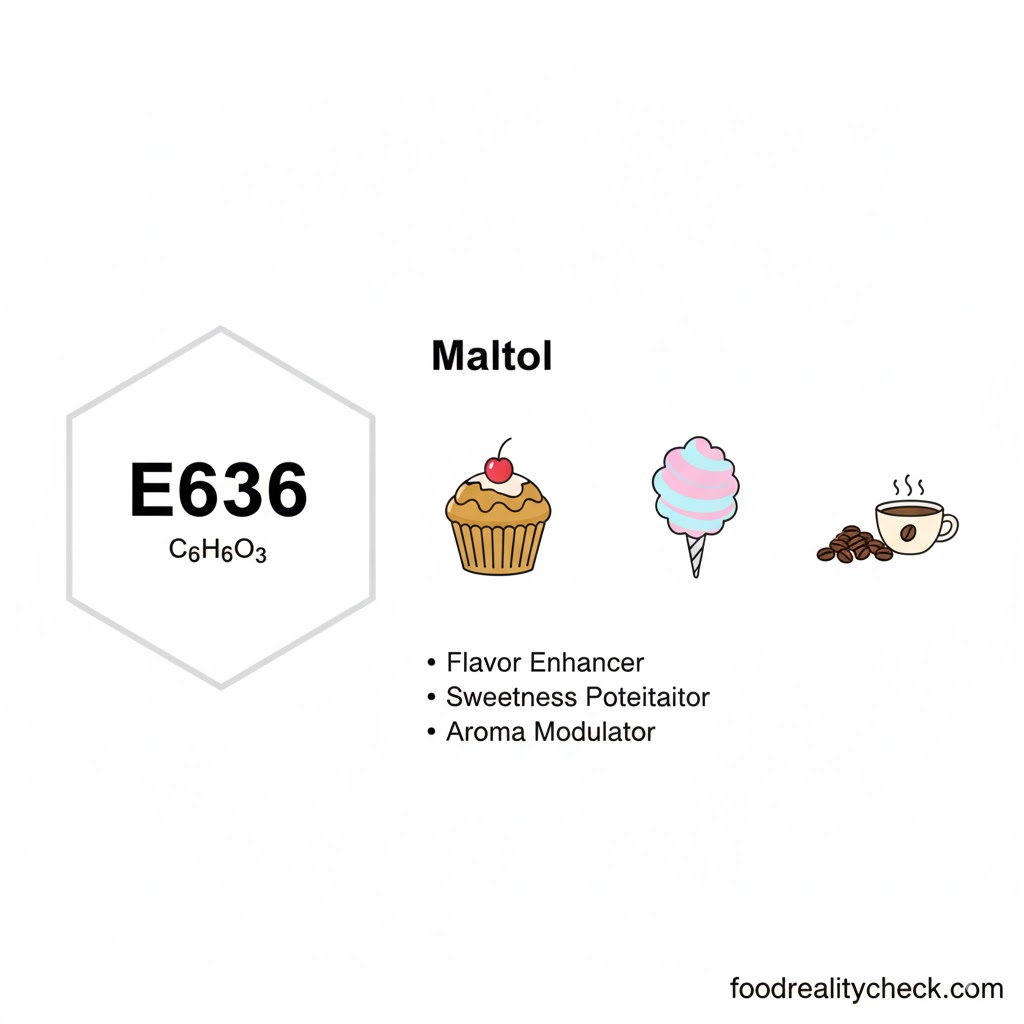
E636 is maltol, a naturally occurring flavor enhancer extracted from wood bark or roasted malt that imparts a sweet caramel-like aroma and taste to foods.
It’s used to enhance flavors, add sweetness without sugar, and improve the aroma of foods—particularly valuable in confectionery, bakery, and chocolate products.
Most people consume it occasionally in candies, baked goods, and chocolate products, though it remains one of the less commonly used flavor enhancers in food despite its natural origin and excellent safety profile.
📌 Quick Facts
- Category: Flavor Enhancer, Aromatic, Sweetening Agent, Fragrance Component
- Source: Natural—extracted from larch tree bark or roasted malt; also produced by heating lactose or maltose
- Found in: Confectionery, baked goods, chocolate, coffee, vanilla products, nutmeg, maple flavoring, cereals
- Safety: FDA approved; EFSA approved; ADI 1 mg/kg body weight (very low but safe at food levels)
- Natural or Synthetic: 100% natural—either extracted from nature or biologically produced through heating
- Vegan/Vegetarian: Usually yes (from wood bark or malt); check if lactose was used in production
- Key Advantage: Naturally occurring; excellent safety profile; reduces sugar needed in products
- Chemical Name: 2-methyl-3(2H)-furanone or 3-hydroxy-2-methyl-4H-pyran-4-one
What Exactly Is It?
E636 is maltol, a naturally occurring organic compound with the chemical formula C₆H₆O₃ and molecular weight of 126.11 g/mol. It appears as a white crystalline powder with a distinctive sweet, caramel-like odor and taste. The aroma is often described as reminiscent of freshly baked bread, caramelized sugar, or roasted malt.
Chemically, maltol is a 3-hydroxy-2-methyl-4H-pyran-4-one—a cyclic organic compound with a carbonyl group and hydroxyl group. This chemical structure gives maltol its distinctive properties: the ability to bind to metal centers (particularly iron, aluminum, and gallium), enhance flavors synergistically with other taste compounds, and impart sweet aroma without calories or sugar content.
Maltol is only slightly soluble in cold water (approximately 1%) but becomes increasingly soluble with heat. It is soluble in hot water, ethanol, and other polar solvents. The compound is stable during typical food processing but can degrade if exposed to very high temperatures or extreme pH conditions.
Maltol occurs naturally in the bark of larch trees and needles of pine trees. It is also produced during the roasting of malt (from barley, the origin of its name) and during the baking of bread. Additionally, maltol can be produced synthetically by heating sugars like lactose and maltose under controlled conditions.
Where You’ll Find It
E636 appears in a select range of products, primarily confectionery and bakery:
• Confectionery and hard candies
• Chocolate and chocolate products
• Baked goods (cakes, bread, pastries)
• Cereal products
• Coffee-flavored foods and beverages
• Vanilla-flavored products
• Nutmeg and nut-flavored products
• Maple-flavored foods
• Beverages (soft drinks, flavored drinks)
• Ice cream and frozen desserts
• Puddings and custards
• Biscuits and crackers
• Chewing gum and lozenges
• Toothpastes and mouth rinses (flavor)
• Fragrances and cosmetics (aromatic component)
• Pharmaceuticals (flavor masking in medicines)
E636 is used relatively sparingly in food applications compared to other flavor enhancers, partly because very small amounts (typically 1-20 ppm/mg per kg) are needed to achieve flavor enhancement effects.
Why Do Food Companies Use It?
E636 performs four critical functions:
1. Flavor enhancement and sweetness amplification: Maltol enhances the perception of sweetness in foods and synergistically improves flavors of chocolate, coffee, vanilla, nuts, and maple—allowing manufacturers to reduce actual sugar content while maintaining perceived sweetness.
2. Sugar reduction without flavor loss: By enhancing sweet perception, maltol allows manufacturers to reduce sucrose, high fructose corn syrup, and other sugars while maintaining consumer acceptability. In confectionery particularly, this enables reduced-sugar or sugar-free product formulation.
3. Aroma improvement and oxidative stability: The caramel-like aroma of maltol improves the sensory perception of products, particularly in chocolate and baked goods. Additionally, maltol’s metal-binding properties (particularly iron chelation) provide antioxidant benefits by preventing oxidative degradation.
4. Natural origin and clean label appeal: Maltol’s natural origin—extracted from wood bark or produced through heating sugars—appeals to consumers seeking “natural” flavor enhancement versus synthetic alternatives like vanillin.
Limited use considerations: Despite these advantages, maltol is used less frequently than synthetic flavor enhancers (vanillin, ethyl maltol) primarily due to cost and less aggressive flavor amplification per unit weight.
Is It Safe?
E636 is considered very safe with one of the most favorable safety profiles of any food additive.
Regulatory Approval:
• FDA (USA): Approved as a flavoring agent; designated as INS 636
• EFSA (Europe): Approved as direct food additive E636
• JECFA (WHO/FAO): ADI established at 1 mg/kg body weight—notably low, but applicable to actual food-use concentrations
Metal binding and mineral absorption: One unique property of maltol is its strong binding affinity for metal ions, particularly iron (Fe³⁺), aluminum (Al³⁺), and gallium (Ga³⁺). Research has documented that maltol increases the oral bioavailability of aluminum and iron—meaning it enhances absorption of these metals from the diet. For individuals with normal iron levels, this is not a concern. However, for people with iron overload conditions (hemochromatosis) or aluminum sensitivity, maltol consumption should be considered cautiously. Conversely, for people with iron deficiency, maltol may enhance iron absorption, potentially providing a health benefit.
Documented side effects and concerns:
• At food-use levels: No adverse effects documented. Extensive safety testing shows maltol is extremely well-tolerated.
• Metal bioavailability: Enhances absorption of iron and aluminum—beneficial for deficiency, potentially problematic for overload conditions
• At extreme doses (far exceeding food use): Animal studies at very high doses (100+ mg/kg body weight) show no serious toxicity, though some kidney or liver changes have been noted at extreme levels—far above realistic food exposure
• Vegan considerations: Some maltol is produced from lactose (milk-derived), making those products unsuitable for vegans—though wood bark-derived maltol is vegan
Production and Sources
E636 maltol is produced through multiple pathways:
1. Natural extraction from wood: Commercial maltol is primarily extracted from the bark of larch trees (Larix species) native to Russia and Eastern Europe. The bark contains naturally high concentrations of maltol, which is isolated through solvent extraction and purification.
2. Roasted malt production: Maltol is produced naturally during the roasting of malt (malted barley and other grains) for beverage and food production. This historical source explains the compound’s name.
3. Thermal synthesis: Maltol can be synthesized by heating lactose (milk-derived) or maltose (grain-derived) sugars under controlled temperature and time conditions. This produces maltol through pyrolysis and chemical transformation—still considered “natural” since no chemical reagents are added, only heat.
4. Fermentation (emerging): Some research indicates maltol may be produced through microbial fermentation, though this is not yet common in commercial food-grade production.
Natural vs Synthetic Version
E636 is entirely natural—there is no synthetic version required.
Since maltol is a naturally occurring organic compound, there is no separate “synthetic” version. All food-grade E636 is either directly extracted from nature (larch bark) or produced through natural processes (roasting or heating sugars) that do not require chemical synthesis. The different production methods all yield identical maltol molecules.
This contrasts with some flavor enhancers (vanillin, for example) which can be synthesized chemically or extracted from nature—E636 is purely natural regardless of production method.
Related Compounds
Maltol has related flavor compounds:
• Ethyl maltol: Synthetic ethyl ester of maltol; about 4-6 times more potent than maltol; more commonly used in some applications (E645 in Europe)
• Isomaltol: Isomer of maltol with similar properties but different flavor profile
• 5-Hydroxymaltol: Hydroxylated derivative of maltol
• Kojic acid: Related 3-hydroxy-4-pyrone compound with metal-binding properties
Among these, ethyl maltol (E645) is more potent and more commonly used in some food applications, particularly where stronger flavor amplification is desired per unit weight.
Historical Use and Natural Occurrence
Maltol has an ancient history of human consumption through natural food sources:
• Present naturally in bread crusts from Maillard reaction during baking
• Produced during roasting of grains and coffee
• Present in some ripe fruits and nuts
• Found in naturally occurring concentrations in wood bark used for flavoring drinks (historical use)
This millennia-long history of accidental consumption through roasted foods provides additional historical safety evidence beyond formal regulatory testing.
Unique Property: Iron Chelation and Bioavailability
Maltol’s metal-binding properties provide both benefits and considerations:
Beneficial effects: The iron-chelating property of maltol allows it to bind iron in food, potentially increasing iron bioavailability from plant-based sources (where iron is less bioavailable than animal sources). For iron-deficient populations, maltol may enhance iron absorption and help prevent anemia.
Potential concerns: In individuals with iron overload conditions (hemochromatosis, where excess dietary iron accumulates), enhanced iron absorption from maltol could theoretically worsen iron accumulation. Such individuals should monitor iron levels if consuming foods high in maltol.
Aluminum binding: Similarly, maltol binds aluminum and increases its oral bioavailability. For individuals with aluminum sensitivity or those attempting to minimize aluminum exposure, maltol consumption may be a consideration.
Environmental and Sustainability
Maltol sourced from larch bark is sustainable—larch trees are harvested and bark is used as a co-product without requiring specifically cultivated trees. Maltol produced from roasting malt is a byproduct of grain processing, making it sustainable. Heat-produced maltol from lactose or maltose uses agricultural byproducts or co-products, also sustainable. Overall, maltol has an excellent environmental profile compared to synthetic flavor enhancers.
Natural Alternatives
Want to avoid E636? Food companies sometimes use these alternatives:
• E645 (Ethyl maltol): Related compound; more potent but synthetic ester of maltol
• Vanillin: Natural or synthetic vanilla flavor; different flavor profile
• Natural vanilla extract: Whole vanilla pod extract; more expensive but fully natural
• Caramel coloring/flavoring: Provides caramel note without maltol
• Maple extract: For maple-flavored applications
• Nut extracts: For nut-flavored products
• Sugar itself: Direct sweetening rather than flavor amplification
Among these, ethyl maltol (E645) is actually more potent than maltol itself, making it preferred in some applications despite being technically synthetic (an ester modification of natural maltol).
Vegan and Dietary Considerations
Vegan status depends on production method:
• Larch bark-extracted maltol: 100% vegan and vegetarian
• Roasted malt-derived maltol: 100% vegan and vegetarian
• Heat-produced from maltose: 100% vegan and vegetarian
• Heat-produced from lactose: NOT vegan (contains milk-derived lactose); suitable for vegetarians only
Label checking alone cannot determine the source. Manufacturer verification is required for vegan certification. Most food-grade maltol is larch bark-derived, making it vegan.
The Bottom Line
E636 (maltol) is a naturally occurring flavor enhancer with one of the most favorable safety profiles of any food additive, an ADI of 1 mg/kg (very conservative), and thousands of years of safe human consumption through naturally-roasted foods.
Maltol functions as a sweet, caramel-like aromatic enhancer that allows manufacturers to reduce sugar content while maintaining perceived sweetness and flavor quality. It is 100% natural, extracted from wood bark or produced through heating sugars. EFSA, FDA, and JECFA all approve maltol with confidence, with no safety concerns identified at food-consumption levels.
E636 appears in confectionery, baked goods, chocolate, and other products at very low concentrations (typically 5-20 mg/kg). It is usually vegan and vegetarian unless derived from lactose. The compound has unique metal-binding properties that enhance iron and aluminum bioavailability—beneficial for iron-deficient populations but warranting consideration in those with iron overload.
Maltol is one of the safest and most thoroughly studied food additives available, with an excellent natural origin, no documented health concerns at food-use levels, and genuine functional advantages in enabling sugar reduction without flavor compromise. For consumers seeking naturally-derived flavor enhancers with exceptional safety profiles, E636 maltol represents an optimal choice.