What is E104?
Complete guide to understanding E104 (Quinoline Yellow) in your food
The Quick Answer
E104 is quinoline yellow, a synthetic yellow-green food colorant used primarily in Europe to color foods, despite being banned in the USA, Canada, Australia, Norway, and Japan.
It’s used to provide intense yellow coloring in beverages, confectionery, baked goods, and other foods—particularly those marketed to children.
Most people in Europe and other countries where it’s permitted consume it occasionally in soft drinks, candies, and baked goods, though it has become increasingly controversial due to evidence of potential behavioral effects and aluminum content concerns.
📌 Quick Facts
- Category: Synthetic Food Colorant, Non-azo Dye, Yellow-Green Dye
- Source: Fully synthetic; derived from quinoline chemical structure through chemical synthesis
- Found in: Soft drinks, energy drinks, confectionery, baked goods, ice cream, chewing gum, jam, beverages, soups, processed meats
- Safety: EFSA approved but with reduced ADI; JECFA approved; FDA banned (USA); banned in Australia, Norway, Canada, Japan
- Natural or Synthetic: Fully synthetic; no natural source
- Vegan/Vegetarian: Yes
- Key Concern: Potential behavioral effects in children; aluminum contamination risk
- Chemical Formula: C₁₈H₁₁NO₂; mixture of disulfonates, monosulfonates, trisulfonates
- EFSA ADI (2009): Reduced from 0-10 mg/kg to 0.5 mg/kg body weight per day
What Exactly Is It?
E104 is quinoline yellow, a synthetic non-azo quinoline-based dye with chemical formula C₁₈H₁₁NO₂. It is technically a mixture of disulfonated (primarily), monosulfonated, and trisulfonated forms of 2-(2-quinolyl)indan-1,3-dione—sodium salts of the quinoline dye.
The compound is created entirely through chemical synthesis from quinoline (a nitrogen-containing aromatic hydrocarbon) and has no natural source or equivalent. The sulfonate groups (-SO₃Na) on the molecule make it water-soluble, allowing use in beverages and aqueous food systems.
Physically, quinoline yellow appears as a yellow to yellowish-brown powder. It provides a greenish-yellow color in foods, particularly intense in acidic environments. The dye is notably stable against light and heat—characteristics making it valuable for products requiring color stability during processing and extended shelf life. Unlike some colorants that fade in acidic environments, quinoline yellow maintains its color even in fruit juices and other acidic products.
Quinoline yellow is often produced as an aluminum compound (aluminum lake form)—combining the dye with aluminum salts to enhance its properties and prevent fading. This aluminum incorporation is sometimes not explicitly listed on labels, creating hidden aluminum content in foods.
Where You’ll Find It
E104 appears in a wide range of foods in Europe and countries where it’s permitted:
• Soft drinks and energy drinks
• Non-alcoholic beverages (fruit drinks, squashes)
• Confectionery and hard candies
• Baked goods (particularly products marketed to children)
• Ice cream and frozen desserts
• Chewing gum
• Jams, jellies, and marmalades
• Soup bases and instant soups
• Seasoning mixes and flavor packets
• Processed meats and sausages
• Margarine and processed cheese
• Mayonnaise and salad dressings
• Pickled products
• Cake decorations and coatings
• Sports drinks and functional beverages
• Candy decorations (particularly on children’s products)
• Cosmetics (lipsticks, lotions, shampoos)
• Medicines and supplements
• Pet food and animal feed
Quinoline yellow is particularly prevalent in products marketed to children—candy, soft drinks, and brightly colored bakery items—despite regulatory concerns about behavioral effects.
Why Do Food Companies Use It?
E104 serves primarily one function:
Intense yellow-green coloring with exceptional stability: Quinoline yellow provides vibrant yellow coloring that remains stable during processing, storage, and exposure to light and heat. This stability is particularly valuable for beverages, confectionery, and products with extended shelf lives where natural colorants might fade. The intensity of color means very small amounts achieve desired coloring, reducing the total additive content needed.
Why it’s preferred despite concerns: The specific yellow-green color and exceptional stability made quinoline yellow historically preferred over alternatives. However, as evidence of behavioral concerns accumulated, many manufacturers shifted to alternatives (tartrazine E102, sunset yellow E110, or natural colorants like curcumin E100). The regulatory pressure and bans in major markets (USA, Australia, Canada) have limited its use predominantly to European markets where regulatory tolerance remains higher.
Is It Safe?
E104’s safety status is increasingly contested, with significant regulatory disagreement and evidence of potential concerns.
Regulatory Status—Conflicting Approvals:
• EFSA (Europe): Approved as food additive; ADI significantly reduced from 0-10 mg/kg (1984) to 0.5 mg/kg body weight per day (2009 re-evaluation)
• JECFA (WHO/FAO): Approved; concluded dietary exposure “does not present a health concern”
• FDA (USA): NOT permitted in food; restricted to pharmaceuticals and cosmetics
• Regulatory Bans: Banned in Australia, Norway, Canada, Japan
• EU Position: Permitted but controversial; requires warning labels in some contexts
⚠️ Critical Safety Concerns—Evidence of Potential Harm: E104 has accumulated evidence of potential harmful effects, particularly for children:• Behavioral effects in children: The 2007 Southampton study by McCann et al. documented that mixtures of food colorants including E104 resulted in increased hyperactivity in 8-9 year-old children. While regulatory agencies dispute attributing effects specifically to E104 (noting the mixture effect), the evidence is well-documented and peer-reviewed.
• Allergic reactions: EFSA documented sensitivity reactions including urticaria (hives), rhinitis, and bronchial asthma, especially when E104 is combined with other synthetic dyes.
• Aluminum content and contamination: When produced as aluminum lakes, E104 contains hidden aluminum that may not be labeled. Aluminum is suspected of promoting neurodegenerative diseases (Alzheimer’s, Parkinson’s) and can act as a xenoestrogen affecting sexual functions and contributing to obesity.
• Protein binding and cellular effects: Research indicates E104 can dock to various protein structures in the body, potentially impairing protein function and cellular processes in ways not yet fully understood.
• Synergistic toxicity: The Liverpool University study documented that mixtures of E104 with other additives (particularly E133 brilliant blue, E621 glutamate, E951 aspartame) showed multiplied harmful effects—not additive but exponential. For example, E133 + E621 together caused 46.1% cell growth reduction versus the expected 15.8%.
• Microbiota disruption: Evidence suggests E104 can alter gut bacterial composition, promoting inflammation and potentially contributing to irritable bowel syndrome.
• Mutagenic potential: In vitro (test tube) studies identified nerve-damaging and mutagenic effects in laboratory tests, though in vivo (in-organism) confirmation remains limited.
Documented toxicological findings:
• Genotoxicity: EFSA and JECFA both concluded E104 is negative in genotoxicity assays; animal studies show no carcinogenicity
• At regulatory ADI levels (0.5 mg/kg body weight): Refined intake estimates consistently exceed this ADI in actual consumption patterns, particularly in children consuming colored beverages and confectionery
• Behavioral threshold unclear: The Southampton study suggests effects in children but cannot definitively establish a no-observed-adverse-effect level (NOAEL) for behavioral endpoints
• Regular consumer concern: Notably, cumulative consumption from multiple foods containing E104 can easily exceed recommended daily intake—a major regulatory gap
Regulatory Disagreement and International Ban Disparity
The stark difference in regulatory approval by major food safety authorities is striking and meaningful:
The FDA (USA) banned E104 from food entirely, restricting it to pharmaceuticals and cosmetics—a position taken after review of the same scientific evidence that EFSA and JECFA evaluated. Australia, Norway, Canada, and Japan similarly prohibit E104 in food despite approving other synthetic colorants, suggesting specific concerns about this particular compound.
This regulatory disagreement reflects fundamental differences in risk tolerance: EFSA maintains approval with restrictions, while major developed-nation food safety authorities chose outright bans. For consumers, this disparity suggests E104 occupies a gray zone of contested safety—not definitively proven harmful, but concerning enough to warrant bans in major markets.
Production Process
E104 quinoline yellow is produced through complex chemical synthesis:
1. Quinoline base (a nitrogen-aromatic compound) is synthesized or sourced
2. The compound undergoes sulfonation to add sulfonate groups, creating water solubility
3. Indan-1,3-dione substitution creates the characteristic color-producing quinoline structure
4. The product is purified to remove unreacted materials
5. The final product is often combined with aluminum salts to create aluminum lakes enhancing color stability
6. The product is standardized and packaged as a mixture of disulfonates (primary), monosulfonates, and trisulfonates
The entire process is synthetic chemical creation—no natural material is extracted. Every step is intentionally designed to create the specific color and stability properties required for food applications.
Natural vs Synthetic Version
E104 is entirely synthetic—there is no natural version.
Quinoline yellow exists only as a laboratory-created compound. There is no natural source, no plant extract equivalent, and no historical use as a food ingredient. It is entirely a product of modern chemical synthesis created specifically for coloring applications.
Comparison with Other Yellow Colorants
E104 occupies a contested position among yellow food colorants:
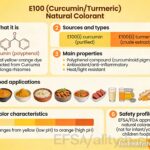
• E100 (Curcumin): Natural; documented antioxidant and anti-inflammatory benefits; no behavioral concerns; no aluminum content
• E101 (Riboflavin): Natural B-vitamin; less intense yellow color; uncontroversial safety
• E102 (Tartrazine): Synthetic azo dye; similar behavioral concerns; also linked to hyperactivity in children; more widely studied adverse effects
• E110 (Sunset Yellow): Synthetic azo dye; similar behavioral concerns; also linked to hyperactivity; FDA banned but EU approved
• E160a (Beta-carotene): Natural yellow-orange; less intense color; vitamin A activity; uncontroversial safety
• E160b (Annatto): Natural orange-yellow from seeds; limited approved applications; minimal controversy
Among these, E104 is unique in combining intense coloring with accumulated evidence of behavioral concerns and aluminum contamination risk—making it arguably the most contested yellow colorant despite ongoing regulatory approval in Europe.
Aluminum Content Concern—Hidden Metal in Food
A particularly significant concern with E104 is hidden aluminum content:
When E104 is produced as an aluminum lake (dye combined with aluminum salts to enhance color stability and prevent fading), the resulting product contains aluminum that may not be explicitly declared on food labels. This creates a situation where consumers unknowingly consume aluminum from E104-colored products without realizing aluminum is present.
Aluminum has been suspected of promoting neurodegenerative diseases (Alzheimer’s, Parkinson’s), acting as a xenoestrogen (mimicking female hormones), contributing to obesity, impairing intestinal function, and disrupting the gut microbiota. The hidden nature of E104’s aluminum content represents a particularly troubling oversight in food labeling regulation.
Environmental and Sustainability
E104 production involves petroleum-derived chemical precursors and complex chemical synthesis creating moderate to significant environmental footprint. The manufacturing process generates chemical byproducts requiring proper disposal. Unlike natural colorants derived from agricultural products, E104 offers no sustainability advantages and relies entirely on petroleum-based chemical industry.
Natural Alternatives
Want to avoid E104? Food companies can use these alternatives:
• E100 (Curcumin): Natural yellow; documented health benefits; no aluminum concerns; recommended alternative
• E101 (Riboflavin): Natural B-vitamin; yellow color; safe and controversial
• E160a (Beta-carotene): Natural yellow-orange; vitamin A source; safe alternative
• E160b (Annatto): Natural orange-yellow; limited approved uses; safe
• E102 (Tartrazine): Alternative synthetic dye; similar controversial concerns; not recommended
• E110 (Sunset Yellow): Alternative synthetic dye; similar behavioral concerns; not recommended
• Turmeric/Saffron: Natural spices; traditional yellow colorants; less intense but natural
E100 curcumin is the recommended alternative—natural, intensely yellow, documented antioxidant and anti-inflammatory benefits, and without aluminum or behavioral concerns.
The Bottom Line
E104 (quinoline yellow) is a fully synthetic yellow-green food colorant that is EFSA-approved (with significantly reduced ADI) but banned in the USA, Canada, Australia, Norway, and Japan—a regulatory disagreement reflecting accumulated evidence of potential safety concerns.
E104 is permitted in Europe primarily for intense color stability in beverages, confectionery, and baked goods, particularly products marketed to children. However, evidence has accumulated documenting potential behavioral effects in children (demonstrated in the 2007 Southampton study), allergic reactions in sensitive individuals, and hidden aluminum content when produced as aluminum lakes.
The EFSA reduced the ADI from 0-10 mg/kg (1984) to 0.5 mg/kg body weight per day (2009)—a significant downward revision reflecting new safety data. Critically, refined intake estimates indicate actual consumer exposure (particularly in children consuming colored beverages and candies) regularly exceeds this ADI, creating a regulatory gap between approved levels and real-world consumption.
The stark international regulatory disagreement—with major food safety authorities (FDA, Australian TGA, Health Canada) banning E104 while EFSA permits it—suggests E104 represents a compound of contested safety. For consumers seeking to minimize exposure to synthetic colorants with potential behavioral effects and hidden aluminum content, E104 avoidance is prudent. For those unable to avoid it, limiting consumption (particularly in children) remains advisable given the accumulated evidence.
E100 curcumin represents the superior alternative: natural, documented antioxidant and anti-inflammatory benefits, and without behavioral or aluminum concerns—a choice increasingly preferred by manufacturers responsive to consumer preferences for cleaner labels.