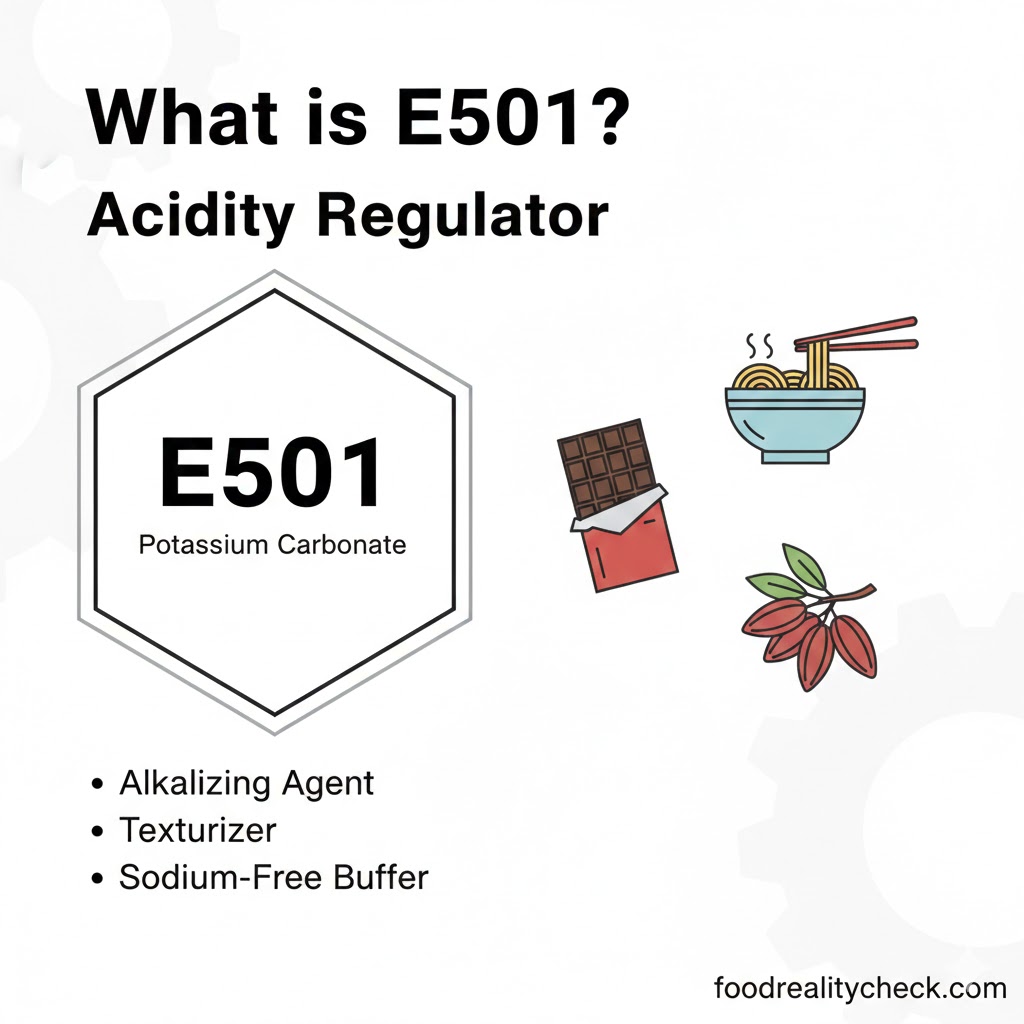
What is E501?
Complete guide to understanding E501 (Potassium Carbonates) in your food
The Quick Answer
E501 is potassium carbonates, a group of two related alkaline minerals used as acidity regulators, leavening agents, and stabilizers in foods—serving similar functions to sodium carbonates (E500) but providing potassium instead of sodium.
It’s used to regulate pH, create leavening in baked goods, alkalinize cocoa powder, and stabilize food texture—particularly valuable in low-sodium formulations where sodium reduction is desired.
Most people consuming cocoa products, low-sodium baked goods, processed foods, and ramen noodles occasionally encounter E501, though it remains largely invisible in products—functioning primarily to regulate acidity and create specific textures.
📌 Quick Facts
- Category: Mineral-derived additive; Acidity Regulator, Raising Agent, Leavening Agent, Stabilizer
- Two Main Forms: E501(i) potassium carbonate (K₂CO₃); E501(ii) potassium bicarbonate (KHCO₃)
- Source: Synthetic (from potassium hydroxide + carbon dioxide) or naturally derived
- Found in: Cocoa products, low-sodium baked goods, ramen noodles, wines, soda water, confectionery, effervescent tablets
- Safety: FDA GRAS approved; EFSA approved; JECFA ADI “not limited” (safe at any practical level)
- Natural or Synthetic: Mostly synthetic but mineral-derived (potassium compounds)
- Vegan/Vegetarian: Yes
- Key Advantage: Sodium-free alternative to sodium carbonate; provides potassium nutrient benefit
What Exactly Is It?
E501 is a group designation encompassing two related potassium carbonate compounds:
E501(i) – Potassium Carbonate (K₂CO₃): A white crystalline powder that is strongly alkaline (pH 11-12 in aqueous solution). It contains two potassium ions and one carbonate ion. Molecular weight is 138.3 g/mol. Potassium carbonate is highly soluble in water (113.5 g/100ml at 25°C—much more soluble than sodium carbonate). The compound is hygroscopic, readily absorbing moisture from air, appearing as a damp solid.
E501(ii) – Potassium Bicarbonate (KHCO₃): Also called potassium hydrogen carbonate. A white crystalline powder with a slightly salty, slightly alkaline taste (pH 8.3 in aqueous solution). Molecular weight is 100.1 g/mol. Less alkaline than potassium carbonate, similar to sodium bicarbonate.
Both forms are chemically similar to sodium carbonates (E500) with the fundamental difference being potassium replacing sodium as the cation. This substitution is meaningful in food applications where sodium reduction is desired but the same pH-regulating and leavening functions are needed.
Where You’ll Find It
E501 appears in a selective range of foods, particularly those targeting sodium reduction:
• Dutch-processed (alkalized) cocoa powder
• Low-sodium baked goods (bread, cakes, cookies)
• Ramen noodles and Asian noodle products (as kansui alkaline solution)
• Low-sodium/salt-free salt substitutes
• Wines and wine products
• Soda water and carbonated beverages
• Effervescent tablets and powders
• Confectionery and candies
• Processed foods marketed as “low sodium”
• Milk and cream powders
• Dried fruit (raisin production)
• Pharmaceuticals and supplements
• Infant foods (potassium-fortified)
• Dietary products (potassium supplementation)
E501 is less frequently used than E500 (sodium carbonates) because most food manufacturers default to sodium compounds. E501 is selected specifically when potassium provision or sodium reduction is a target.
Why Do Food Companies Use It?
E501 performs similar functions to E500, but with additional benefits:
1. Acidity regulation with sodium reduction: Both E501(i) and E501(ii) regulate pH like sodium carbonates (E500), but provide potassium instead of sodium—essential for low-sodium product formulations where sodium reduction is a marketing and health claim.
2. Cocoa alkalinization (Dutching process): E501(i) potassium carbonate is used in the Dutch-processing (Dutching) of cocoa powder to reduce acidity, darken color, and enhance aroma. This historic process (developed in 1828) creates “Dutch-processed” or “Dutched” cocoa with superior flavor compared to natural cocoa.
3. Leavening with potassium provision: E501(ii) potassium bicarbonate can substitute for sodium bicarbonate in baking, providing the same leavening function while delivering potassium nutrition—valuable in products marketed for potassium supplementation.
4. Ramen noodle texture (kansui): Potassium carbonate is a primary component of kansui (alkaline water) used in ramen and Asian noodle production to create characteristic chewiness and elasticity. Some manufacturers prefer potassium-based kansui over sodium-based versions.
Why it’s used selectively: E501 costs more than E500 (sodium carbonate), limiting use primarily to premium and specialty products where sodium reduction or potassium provision justifies the expense.
Is It Safe?
E501 is considered very safe with an exceptional regulatory approval record and minimal health concerns.
Regulatory Status:
• FDA (USA): Generally Recognized As Safe (GRAS) for food use at specified levels; approved as formulation aid, nutrient supplement, pH control agent
• EFSA (Europe): Approved as direct food additive (E501(i) and E501(ii)); categorized “Additives other than colours and sweeteners”
• JECFA (WHO/FAO): Approved; ADI “not limited” since 1965 (indicating safety at any practical consumption level)
Specific health considerations:
• At food-use levels (typically 0.3-3%): No documented adverse effects; safe for general population
• Potassium content benefit: Unlike sodium compounds, E501 contributes dietary potassium—supporting cardiovascular health, blood pressure regulation, and bone health; this is nutritionally beneficial
• Kidney disease consideration: Individuals with kidney disease or those on potassium-restricted diets must limit products containing E501 since the kidneys cannot properly regulate excess potassium; this is a medical rather than toxicological concern
• Hyperkalemia risk: Only in individuals with compromised potassium regulation; not a concern for healthy populations
• Alkalinity concerns: At food-use levels, no systemic alkalosis risk (only occurs with extreme overdose)
• Dermatitis potential: Contact with concentrated solutions can cause skin irritation; not a food-consumption concern at food-use concentrations
• Infant safety: Approved for use in infant foods; potassium provision is nutritionally beneficial for developing infants
Nutritional Difference from Sodium Compounds
A key distinction of E501 is nutritional benefit, not merely functional replacement:
While E500 (sodium carbonates) and E501 (potassium carbonates) perform identical pH-regulating and leavening functions, E501 provides potassium—a nutrient with documented health benefits including cardiovascular support, blood pressure regulation, and muscle/nerve function. For low-sodium product formulations, E501 represents not just sodium reduction but active potassium supplementation. This makes E501 nutritionally superior to E500 for most populations, with the exception of those with kidney disease or on potassium-restricted medical diets.
The Dutching Process—Historic Cocoa Application
E501(i) potassium carbonate is essential to the historic Dutch-processing (Dutching) of cocoa:
Developed in 1828 by Dutch chemist Coenraad Johannes van Houten, the Dutching process involves treating cocoa powder with potassium carbonate (or sodium carbonate). This process: (1) reduces the acidity of cocoa from pH 5.0-5.8 to pH 6.5-8.0, (2) darkens the color of cocoa from natural reddish-brown to deep brown-black, (3) smooths the flavor profile and reduces bitterness, (4) improves aroma and creates more nuanced chocolate flavor. Dutch-processed cocoa is more commonly used in premium chocolate and baking applications, while natural cocoa (without Dutching) is used in other applications. The visual difference is obvious: Dutch-processed cocoa appears significantly darker. The flavor difference is substantial: Dutch-processed creates richer, less acidic, more refined chocolate taste.
Production Methods
E501 potassium carbonates are produced through multiple pathways:
Industrial Synthesis: Potassium hydroxide (caustic potash) is reacted with carbon dioxide gas. The reaction produces potassium carbonate or potassium bicarbonate depending on the specific process conditions. The product is crystallized (forming potash hydrate), then may be heated above 200°C to produce anhydrous salt. Alternative synthesis: Potassium bicarbonate is produced by passing carbon dioxide through aqueous potassium carbonate solution.
Natural Extraction: Some potassium carbonate is extracted from natural brines or mineral deposits, though this is less common than synthetic production.
Both methods yield chemically identical products meeting the same purity specifications.
Natural vs Synthetic Version
E501 exists in both natural and synthetic forms, with chemically identical end products:
• Synthetic: Chemically created from potassium hydroxide and carbon dioxide; most cost-effective
• Naturally derived: Extracted from mineral deposits or natural brines; less common
• End product identity: Both methods yield chemically identical potassium carbonates
Comparison with E500 and Other Alkaline Additives
E501 occupies a position as the potassium alternative to E500:
• E500 (Sodium carbonates): Chemically identical acidity regulation; provides sodium; more economical; most commonly used
• E501 (Potassium carbonates): Functionally equivalent to E500; provides potassium instead of sodium; more expensive; selected for low-sodium and potassium-supplementation applications
• E503 (Ammonium carbonates): Different metal ion; provides nitrogen; different applications
• E504 (Magnesium carbonates): Different metal ion; provides magnesium; different applications
The choice between E500 and E501 is primarily economic (sodium is cheaper than potassium) and nutritional (potassium is beneficial vs. sodium reduction). Functionally they are interchangeable.
Kansui and Asian Noodle Applications
Kansui (alkaline water) is used in ramen and Chinese noodle production to create characteristic texture:
Traditional kansui contains sodium carbonate or potassium carbonate (often with some potassium phosphate). The alkaline solution: (1) raises dough pH, (2) causes proteins to network differently, creating characteristic chewiness (al dente bite), (3) increases alkalinity yellowing effect, creating the distinctive pale yellow noodle color, (4) improves elasticity and extensibility of noodles. Some manufacturers prefer potassium-based kansui, while others use sodium-based versions. The end result is essentially identical—the choice reflects supplier availability, cost, or minor preference for potassium provision over sodium.
Environmental and Sustainability
E501 production via potassium hydroxide and carbon dioxide is relatively sustainable. Natural extraction from mineral deposits follows similar sustainability principles as mineral mining for E500. Neither form poses significant environmental toxicity—the compounds are basic salts with no bioaccumulation concerns.
Natural Alternatives
E501 is the natural choice for low-sodium alkaline regulation. Other alternatives for specific applications include:
• E500 (Sodium carbonates): Functionally identical; provides sodium instead of potassium; more economical
• Yeast leavening: Natural fermentation for baked goods; slower, different character
• Other potassium compounds: Potassium phosphates, potassium chloride for different applications
• No alkalinization: Accept different product texture and color in cocoa or noodles
The Bottom Line
E501 (potassium carbonates) is an FDA GRAS approved, EFSA approved, and JECFA approved mineral-derived additive with a safety profile identical to E500 (sodium carbonates) but with the nutritional advantage of providing potassium instead of sodium.
E501 exists in two forms (potassium carbonate and potassium bicarbonate), used to regulate acidity, create leavening in baked goods, alkalinize cocoa powder (Dutching), create texture in ramen noodles, and stabilize food products. The compounds are chemically inert mineral salts, biologically benign, not absorbed systemically, and have regulatory approval with ADI “not limited” since 1965.
A critical distinction from E500 is nutritional benefit: E501 provides potassium—supporting cardiovascular health, blood pressure regulation, and bone health—making it nutritionally superior to sodium equivalents for most populations. This nutritional advantage explains its use in low-sodium product formulations and potassium-fortified products, despite higher cost than E500.
The historical Dutching of cocoa powder (since 1828) represents one of E501’s most significant applications, creating the darker color and refined flavor profile of premium Dutch-processed cocoa. Similarly, E501 in kansui solution creates the characteristic texture and color of authentic ramen noodles.
For consumers, E501 represents a superior choice compared to E500 in low-sodium applications—providing equivalent functionality while delivering beneficial potassium supplementation. Like E500, E501 is among the safest additives available, with no documented toxicity or health concerns at food-use levels. The only consideration is for individuals with kidney disease or those on medical potassium-restricted diets, for whom E501 consumption should be monitored.