What is E504?
Complete guide to understanding E504 (Magnesium Carbonates) in your food
The Quick Answer
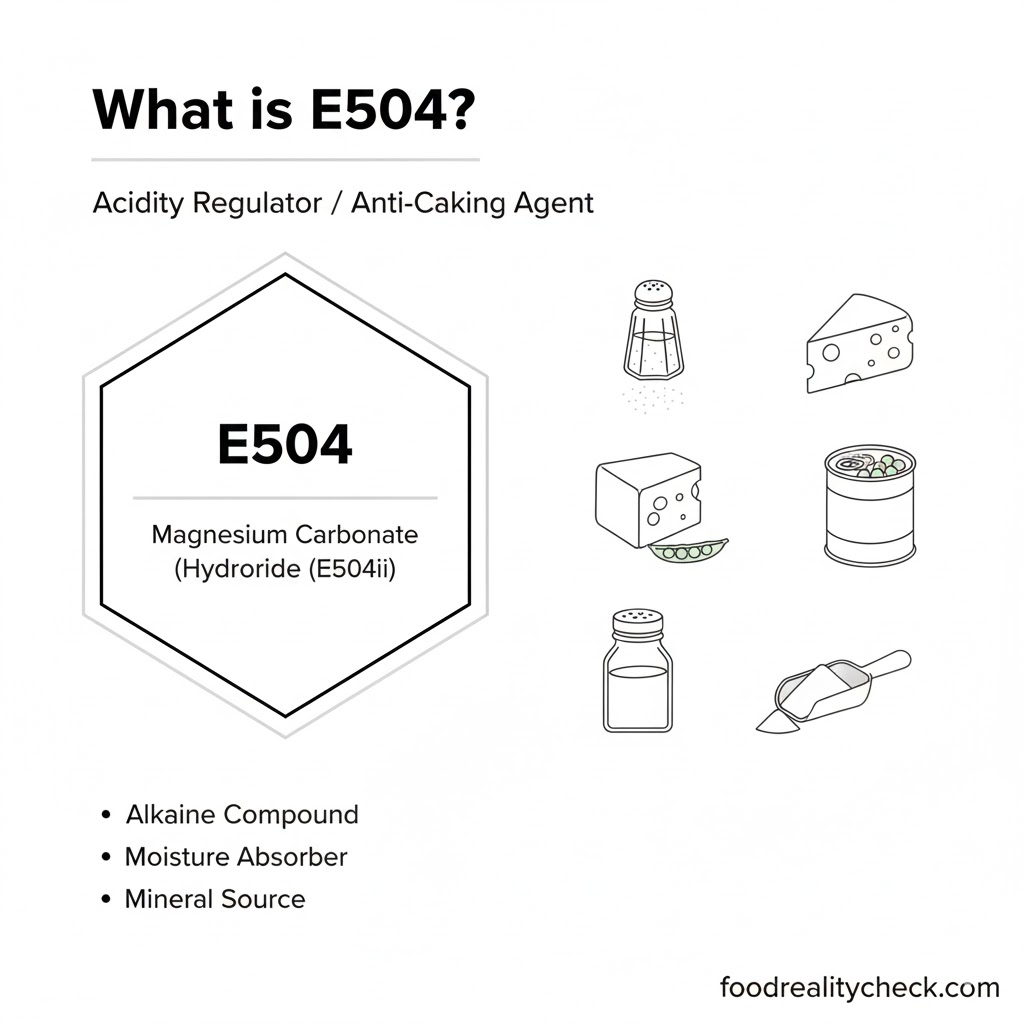
E504 is magnesium carbonates, a group of two related alkaline minerals used as acidity regulators, anti-caking agents, raising agents, and stabilizers in foods—serving similar functions to sodium and potassium carbonates but providing magnesium instead.
It’s used to regulate pH, prevent clumping, create leavening in baked goods, and stabilize food texture—particularly valuable as a laxative and nutritional magnesium source.
Most people consuming salt, baked goods, dairy products, and processed foods occasionally encounter E504, though it remains one of the least recognized carbonate additives despite significant food-industry use and documented laxative properties at higher doses.
📌 Quick Facts
- Category: Mineral-derived additive; Acidity Regulator, Anti-caking Agent, Raising Agent, Stabilizer, Laxative
- Two Main Forms: E504(i) magnesium carbonate (MgCO₃); E504(ii) magnesium bicarbonate (Mg(HCO₃)₂)
- Source: Naturally mined mineral (magnesite ore) or synthetic from magnesium hydroxide + CO₂
- Found in: Table salt, baked goods, dairy products, cheese, canned vegetables, sauces, flour treatment, confectionery
- Safety: FDA approved (no explicit ADI); EFSA approved; no ADI determined (safe at food levels)
- Natural or Synthetic: Mostly naturally mined, also synthetic
- Vegan/Vegetarian: Yes
- Key Properties: Provides magnesium nutrition; acts as laxative at higher doses; antacid properties
What Exactly Is It?
E504 is a group designation encompassing two related magnesium carbonate compounds:
E504(i) – Magnesium Carbonate (MgCO₃): A white, bulky crystalline powder that is very slightly soluble in water (approximately 0.18 g per 100 ml at 25°C, becoming more soluble in water containing carbon dioxide). Molecular weight is 84.3 g/mol. Magnesium carbonate is alkaline and easily loses CO₂ even with gentle heating. It occurs naturally as the mineral magnesite, an important ore for magnesium production. The compound is insoluble in acetone and ammonia.
E504(ii) – Magnesium Bicarbonate (Mg(HCO₃)₂): Also called magnesium hydrogen carbonate. A white crystalline powder that is more soluble in water than magnesium carbonate. Less commonly used than E504(i). Molecular weight approximately 146.4 g/mol.
Both forms are alkaline mineral salts derived from magnesium and carbonic acid. Unlike sodium and potassium carbonates (which are highly soluble), magnesium carbonate has very low water solubility—a characteristic that makes it particularly suitable for anti-caking applications and gives it distinct functional properties from its sodium and potassium counterparts.
Where You’ll Find It
E504 appears in a wide range of foods:
• Table salt and salt substitutes (anti-caking agent)
• Powdered sugar and powdered ingredients
• Baked goods (bread, cakes, pastries, flour)
• Dairy products (cheese, milk, ice cream, yogurt)
• Canned vegetables and fruits
• Sauces and gravies
• Sour cream and butter
• Processed meats and fish products
• Confectionery and candies
• Spice and seasoning mixes
• Soups and broths
• Salad dressings
• Beverages (soft drinks, alcoholic beverages)
• Food supplements and fortified foods (magnesium source)
• Pharmaceuticals (antacid, laxative)
• Cosmetics and personal care products
• Desiccants and drying agents in foods
E504’s prevalence in salt as an anti-caking agent makes it one of the most widely consumed carbonate additives, though often unnoticed due to small concentrations.
Why Do Food Companies Use It?
E504 performs multiple critical functions:
1. Anti-caking in salt (primary application): E504’s low water solubility makes it ideal for preventing moisture absorption and clumping in table salt. The compound absorbs moisture without dissolving, maintaining salt’s free-flowing properties. This is arguably E504’s most important food application.
2. Acidity regulation and alkalinization: Both E504(i) and E504(ii) neutralize acids and regulate pH in foods. Magnesium carbonate is used specifically in sour cream and butter to regulate acidity. In canned peas and other vegetables, it maintains pH and color.
3. Raising and leavening (less common): E504(ii) magnesium bicarbonate can function as a leavening agent in baking, though this application is less common than sodium/potassium equivalents.
4. Magnesium fortification and nutritional benefit: Unlike purely functional additives, E504 provides dietary magnesium—a mineral with documented health benefits for bones, muscles, cardiovascular function, and energy metabolism. This makes E504 a nutritional choice as well as functional additive.
5. Drying and color-retention agent: E504 absorbs moisture and helps retain color in processed foods, preventing oxidative browning and degradation.
Is It Safe?
E504 is considered very safe with strong regulatory approval and minimal health concerns, though with one important caveat: laxative effects at higher doses.
Regulatory Status:
• FDA (USA): Approved; no explicit ADI specified; classified as safe when used according to good manufacturing practices
• EFSA (Europe): Approved as direct food additive (E504(i) and E504(ii))
• JECFA (WHO/FAO): No ADI determined; approved for use in food
• No ADI specified: Unlike some additives with specific daily limits, no ADI was determined for E504, indicating regulatory confidence in safety at food-use levels
• Dose-response: At food-use levels (typically 0.5-5 g/kg in salt; <0.1% in most foods), laxative effects are minimal to absent. However, at therapeutic doses (1-4 g per dose), magnesium carbonate is marketed as a laxative.
• Food consumption context: Under normal consumption patterns, E504 food additive levels would not trigger laxative effects. However, combined consumption from multiple sources (salt + fortified foods + antacids) could theoretically approach laxative thresholds.
• Individual sensitivity: Some individuals have heightened sensitivity to magnesium’s laxative effects; for these people, E504 consumption may cause mild diarrhea or loose stools.
• Beneficial vs. concerning: For individuals with constipation, E504’s laxative properties can be beneficial. For others, undesired laxative effects should be recognized.
Other health considerations:
• At food-use levels (typically 0.5-5 g/kg): No documented adverse effects beyond potential minor laxative effects in sensitive individuals
• Magnesium content benefit: Unlike purely functional additives, E504 provides dietary magnesium—supporting cardiovascular health, bone density, muscle function, energy metabolism
• Kidney disease consideration: Individuals with severe kidney disease must limit magnesium compounds (similar to potassium restriction); this is medical rather than toxicological concern
• Hypermagnesemia risk: Only in individuals with severely compromised magnesium regulation; not a concern for healthy populations
• Antacid effect: Like medical antacids containing magnesium carbonate, food-use E504 has mild antacid properties—potentially beneficial for those with minor acid reflux
• Dermatitis potential: Contact with pure powder can cause skin irritation; not a food-consumption concern at normal use levels
Historical Use and Medical Applications
E504 magnesium carbonate has extensive historical use beyond food:
• Pharmaceutical history: Magnesium carbonate has been used medicinally for over a century as both antacid (for heartburn and indigestion) and laxative (for constipation)
• Culinary history: Particularly used in Asian cuisines and traditional European food preparation for centuries
• Industrial history: Key raw material for magnesium metal production; used in manufacturing refractory bricks, ceramics, and insulation materials
• Contemporary use: Continues as over-the-counter remedy for gastric discomfort and constipation, providing additional evidence of long-term safety
Production Methods
E504 magnesium carbonates are produced through multiple pathways:
Natural Mining (Primary Method): The natural mineral magnesite (MgCO₃) is mined from deposits, then crushed, purified, and processed into food-grade product. This method accounts for the majority of commercial E504 production.
Synthetic Production: Magnesium hydroxide (from sea water or brines) is reacted with carbon dioxide gas, forming magnesium carbonate. Alternative: Direct reaction of magnesium oxide with CO₂, or boiling a solution of magnesium bicarbonate.
Hydrated Forms: Various hydrated forms (di-, tri-, tetrahydrates, and basic forms) can be produced depending on specific process conditions and used for different applications.
All methods yield chemically identical products meeting identical purity specifications.
Natural vs Synthetic Version
E504 exists in both natural and synthetic forms, with chemically identical end products:
• Naturally mined: Extracted from magnesite ore deposits; most common source (~90% of production)
• Synthetic: Created from magnesium hydroxide + carbon dioxide; more controlled composition
• End product identity: Both methods yield chemically identical magnesium carbonate
Nutritional Benefit—Magnesium Provision
A significant distinction of E504 is provision of dietary magnesium:
Unlike purely functional additives, E504 provides bioavailable magnesium—a nutrient with documented health benefits including: cardiovascular support, blood pressure regulation, bone health, muscle function, energy metabolism, and stress management. While bioavailability from food-additive E504 is modest (compared to dedicated magnesium supplements), the cumulative provision from multiple sources can contribute meaningfully to daily magnesium intake. This nutritional aspect differentiates E504 from sodium/potassium carbonates which provide no nutritional benefit beyond their respective minerals (and where sodium reduction is actually desired).
Comparison with E500, E501, and Other Carbonates
E504 occupies a unique position among carbonate additives:
• E500 (Sodium carbonates): Highly water-soluble; provides sodium; more economical; most commonly used
• E501 (Potassium carbonates): Highly water-soluble; provides potassium; higher cost; selected for potassium provision
• E504 (Magnesium carbonates): Very low water solubility; provides magnesium; laxative properties; preferred for anti-caking (salt)
• E503 (Ammonium carbonates): Different application; provides nitrogen
The critical functional distinction is E504’s low water solubility—making it unique for anti-caking in salt applications where E500/E501 would dissolve into the product.
Environmental and Sustainability
Magnesite mining is sustainable with proper environmental management and land reclamation. Synthetic production from seawater or brines is environmentally favorable. Magnesium carbonate is non-toxic environmentally—no bioaccumulation concerns. Overall environmental impact is minimal compared to more complex synthetic additives.
Natural Alternatives
E504 magnesium carbonates are essentially irreplaceable for anti-caking in salt. Other alternatives for specific applications include:
• E500 (Sodium carbonates): Different functionality (would dissolve); not suitable replacement
• E551 (Silicon dioxide): Different anti-caking mechanism; alternative for some applications
• E535 (Sodium ferrocyanide): Different anti-caking agent; used specifically in salt
• Other magnesium compounds: Magnesium oxide, magnesium silicate for different applications
• No anti-caking agent: Accept clumping and recommend consumer action to separate salt
The Bottom Line
E504 (magnesium carbonates) is a naturally mined or synthetically produced mineral-derived additive with strong regulatory approval, excellent safety profile, and dual functionality as both food additive and nutritional magnesium source.
E504 exists in two forms (magnesium carbonate and magnesium bicarbonate), used primarily as anti-caking agent in salt, acidity regulator in dairy and canned products, and leavening agent in baked goods. The compound is biologically inert, not systemically absorbed, and has extensive historical use both in food and medicine (antacid/laxative), providing strong safety evidence.
No ADI was determined because no safety concerns were identified at food-use levels. No genotoxicity, carcinogenicity, reproductive toxicity, or developmental toxicity have been documented. The primary documented effect is laxative activity—well-recognized pharmacological property of magnesium compounds—which manifests primarily at therapeutic doses rather than food-additive levels.
A significant distinction of E504 is provision of dietary magnesium—a nutrient with documented health benefits. This makes E504 nutritionally superior to non-mineral additives, providing genuine health benefit while maintaining food-functional properties.
E504’s low water solubility makes it uniquely suited for anti-caking in salt—arguably its most important food application—where more soluble alternatives would dissolve. For consumers, E504 represents a safe, effective, and nutritionally beneficial additive with centuries of documented use and straightforward, well-understood mechanisms of action.