What is E230?
Complete guide to understanding E230 (Biphenyl) in your food
The Quick Answer
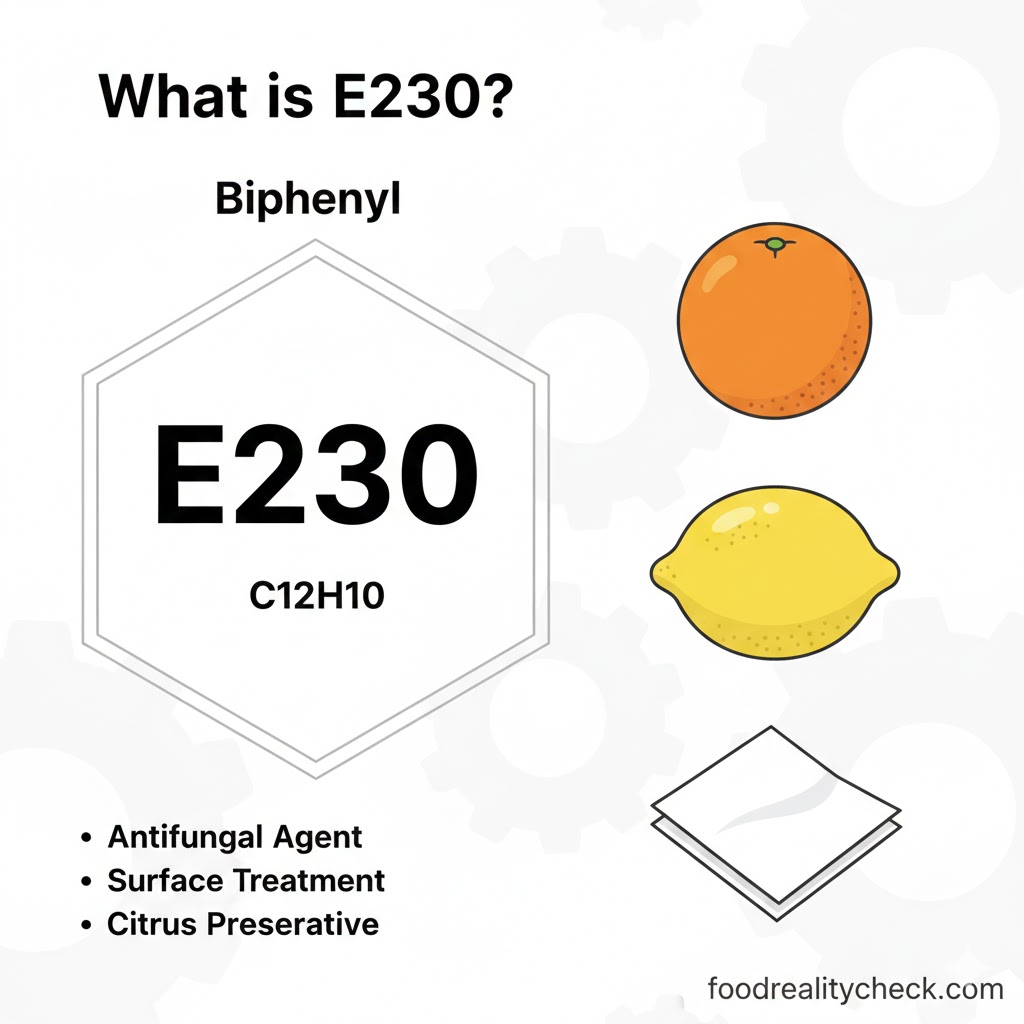
E230 is biphenyl (also called diphenyl), a synthetic organic compound used as a preservative to prevent mold and fungal growth on citrus fruits during storage and transportation.
It’s used exclusively on fruit surfaces—particularly oranges, lemons, and grapefruit—to extend shelf life and prevent spoilage during long shipping from production regions to consumer markets.
Most people consuming imported citrus fruits (oranges, lemons, grapefruit) may encounter E230 residues on fruit surfaces, though the compound is not absorbed into the fruit itself and can be removed by washing. E230 represents one of the most controversial food additives due to significant safety concerns and regulatory restrictions across major markets.
📌 Quick Facts
- Category: Synthetic Preservative, Antifungal Agent, Fungicide
- Source: Fully synthetic organic compound (petroleum-derived)
- Found in: Surface treatment of citrus fruits (oranges, lemons, grapefruit, tangerines)
- Safety: FDA approved; BANNED in European Union (no longer approved as food additive); JECFA approved
- Natural or Synthetic: Fully synthetic
- Vegan/Vegetarian: Yes
- Key Concern: Genotoxicity documented; potential carcinogenicity; bioaccumulation in tissues; aquatic toxicity; NOT approved in EU since restrictions
- Chemical Formula: C₁₂H₁₀; two connected phenyl rings
The Critical Context
E230 biphenyl is one of the most controversial food additives due to significant regulatory divergence: Approved in the USA (FDA) and by JECFA (WHO/FAO), but BANNED in the European Union where it is “no longer approved as a food additive.” This regulatory split is unusual and significant—reflecting that major regulatory bodies have reached different safety conclusions about the same compound.
What Exactly Is It?
E230 is biphenyl, an organic compound consisting of two connected phenyl rings (C₆H₅-C₆H₅) with the molecular formula C₁₂H₁₀ and molecular weight of 154.21 g/mol.
Biphenyl is a colorless to white crystalline solid at room temperature with a distinctively pleasant, aromatic smell (characteristic “sweet” odor). It is insoluble in water but highly soluble in typical organic solvents (alcohols, ethers, petroleum products). The compound is thermally stable, resistant to degradation at typical food storage temperatures.
Chemically, biphenyl is non-reactive due to lacking functional groups—the basis of its stability as a preservative. The two phenyl rings are rotatable around the central C-C bond, allowing different conformations. The compound is also notable as a precursor to polychlorinated biphenyls (PCBs)—historically used as dielectric fluids but now banned as environmental contaminants—though food-grade E230 biphenyl itself is not chlorinated.
Physically, biphenyl appears as white or nearly colorless powder or crystalline scales, with the characteristic pleasant aromatic odor being a key identifying feature.
Where You’ll Find It
E230 appears exclusively on citrus fruit surfaces:
• Oranges (the primary application)
• Lemons
• Grapefruit
• Tangerines
• Other citrus varieties during long-distance transport and storage
• Rarely in confectionery or processed foods containing citrus preservatives
• Fruit waxing formulations (historical use, largely discontinued)
E230 is applied directly to fruit skin as a surface treatment to prevent mold and fungal colonization during storage and shipping. The compound does not penetrate into the fruit flesh—it remains exclusively on the exterior surface.
Why Do Food Companies Use It?
E230 performs one critical function:
Mold and fungal prevention during transport and storage: E230 prevents growth of Penicillium fungi (particularly Penicillium digitatum causing “green mold”) on citrus fruit surfaces during long-distance shipping from production regions (Spain, citrus-growing regions, USA) to consumer markets globally. This prevents spoilage losses during 2-6 week shipping periods and storage. Without fungal preservation during transport, significant fruit losses occur—making preservation economically essential.
Why it’s being phased out: E230 is increasingly replaced by alternative fungicides (thiabendazole E233, imazalil) or alternative preservation methods (modified atmosphere packaging, waxing with alternative compounds) due to safety concerns and regulatory restrictions. The EU ban has driven much of this transition toward alternatives.
Is It Safe?
E230’s safety status is highly controversial, with major regulatory divergence and documented health concerns distinguishing it from most other approved additives.
Regulatory Status—Major Divergence:
• FDA (USA): Approved as food additive; no explicit ADI specified
• EFSA (Europe): BANNED—”no longer approved as a food additive” since EU regulatory restrictions; specific reasons for de-approval not detailed in simplified forms but concerns documented
• JECFA (WHO/FAO): Approved; ADI 1.5 mg/kg body weight
• Genotoxicity significance: Genotoxicity is a warning sign for potential carcinogenicity. Compounds demonstrating genotoxic effects are typically considered candidates for further carcinogenic scrutiny
• Dose-response: SCE induction was documented at concentrations tested (exact levels not universally specified in available abstracts)
• Regulatory interpretation: The documented genotoxicity appears to be a primary basis for EU de-approval, though not explicitly stated
• Contrast with regulatory approval: FDA approval persists despite known genotoxicity evidence—a significant regulatory divergence suggesting different risk tolerance or different assessment of evidence significance
• Aquatic toxicity: Classified as “Aquatic Acute 1” (H400) and “Aquatic Chronic” (H410)—meaning toxic to aquatic life even at low concentrations
• Environmental persistence: Suspected PBT (Persistent, Bioaccumulative, Toxic) substance; Sweden classified as “priority risk reduction substance”
• High aggregate tonnage: Noted as concern due to volume of production and use
• Carcinogenicity debate: While not conclusively carcinogenic in humans, genotoxicity and animal study findings create carcinogenicity concerns
• Low systemic toxicity at acute exposure: Traditional toxicology testing shows “mild toxicity” and ability to biodegrade; however, genotoxicity and bioaccumulation present different concerns than acute toxicity
Documented health effects:
• Genotoxicity: Sister chromatid exchange induction documented in vitro
• Potential carcinogenicity: Not conclusively proven in humans; animal studies at high doses showed tumor development, though human relevance questioned
• Bioaccumulation: Meets criteria for bioaccumulative substances; potential accumulation in fatty tissues
• Allergic potential: Some individuals may show sensitivity or allergic reactions
• Acute toxicity: Classified as “mildly toxic”; low acute toxicity at food-use levels
• Developmental effects: Limited data; no clear evidence of reproductive or developmental toxicity at food-use levels
Why the European Union Ban?
The EU explicitly removed E230 from approved food additives, though specific justifications were not detailed in simplified regulatory documents:
The documented genotoxicity, combined with bioaccumulation concerns and environmental persistence, appear to be primary factors. The EU’s precautionary principle—erring toward safety when evidence suggests concern—led to de-approval despite FDA continuing approval. This regulatory divergence suggests different risk-benefit calculations and different threshold for acceptable evidence of concern.
Actual Exposure and Residue Levels
A critical distinction for E230 is that it remains on fruit surface only—not penetrating into flesh:
E230 is applied as surface coating and does not migrate into the edible fruit flesh. Most E230 residue can be removed by washing fruit with soap and water. Typical residue levels on treated fruit are 0.5-3 mg/kg on fruit surface. Washing removes approximately 50-90% of surface residue depending on washing method. For consumers consuming fruit with skin (unlikely for citrus) or consuming residue on surface, exposure is limited. However, cumulative exposure from frequent imported citrus consumption could theoretically accumulate over time given E230’s bioaccumulative properties.
Production Method
E230 biphenyl is produced through chemical synthesis:
1. Toluene (methylbenzene from petroleum) undergoes dealkylation in the presence of benzene catalyst, producing biphenyl as a byproduct along with methane: C₆H₅CH₃ + C₆H₆ → C₆H₅-C₆H₅ + CH₄
2. Alternative synthesis: Aniline is converted to benzene diazonium chloride (using NaNO₂ + dilute HCl), then reacted with benzene to form biphenyl (Gomberg-Bachmann reaction)
3. The crude product is purified through distillation, crystallization, and further purification to meet food-grade specifications
4. Biphenyl is isolated from coal tar, crude oil, or natural gas via distillation as alternative source
All methods are fully synthetic—no natural sources exist. Food-grade biphenyl requires significant purification from industrial synthesis or extraction.
Natural vs Synthetic Version
E230 is entirely synthetic—there is no natural version.
Biphenyl is entirely a synthetic organic compound created through petroleum-derived chemical synthesis. While biphenyl occurs naturally in trace amounts in coal tar and crude oil, commercial E230 is entirely synthetically produced.
Comparison with Related Fungicide Preservatives
E230 is one of several fungicide preservatives used on citrus:
• E230 (Biphenyl/Diphenyl): Synthetic; genotoxicity documented; banned in EU; still FDA-approved; increasingly phased out
• E231 (Orthophenylphenol/2-Hydroxybiphenyl): Hydroxylated derivative of biphenyl; similar concerns; also restricted in EU
• E232 (Sodium orthophenylphenol): Sodium salt of E231; similar functionality; similarly restricted
• E233 (Thiabendazole): Synthetic benzimidazole fungicide; different chemical structure; increasingly used replacement for E230; FDA approved; EU approved
• Imazalil: Alternative synthetic fungicide; non-E-numbered; increasingly used as replacement
• Wax coatings with natural compounds: Alternative preservation without synthetic fungicides
• Modified atmosphere packaging: Non-chemical preservation method
The industry shift is clearly away from E230 and E231/E232 toward E233 (thiabendazole) or non-chemical alternatives.
Historical Context and Phase-Out
E230 biphenyl represents one of the oldest food preservatives now being phased out:
• Historical use: Used for decades as standard citrus preservative
• Global shift: EU ban (date not specified in simplified forms, but explicit de-approval) drove global reconsideration
• Alternative adoption: Thiabendazole (E233) and imazalil increasingly substitute for E230
• Technology evolution: Modern modified-atmosphere packaging and waxing alternatives reduce dependence on biphenyl
• Remaining use: Still permitted in some countries (USA, some Asian markets) but declining usage even where permitted
Environmental and Sustainability
E230 production through petroleum-derived synthesis carries environmental costs. More significantly, the compound’s bioaccumulation and aquatic toxicity make it environmentally problematic. The banned status in EU and “priority risk reduction substance” classification in Sweden reflect serious environmental concern. Environmental impact is substantially higher than most alternative fungicides.
Natural Alternatives
Want to avoid E230? Alternatives for citrus preservation include:
• E233 (Thiabendazole): Synthetic fungicide; less controversial than E230; increasingly used replacement
• Imazalil: Synthetic fungicide; used as E230 alternative
• Citral or essential oil coatings: Natural compound-based preservation
• Wax coatings: Physical barrier preservation without synthetic fungicides
• Modified atmosphere packaging: Reduced oxygen environment prevents mold growth
• Reduced-storage alternatives: Shorter distribution chains reducing preservation need
• Organic citrus: No synthetic fungicide treatment by definition
Consumer Actions to Minimize E230 Exposure
For consumers concerned about E230 exposure:
• Choose citrus from EU (guaranteed E230-free due to ban)
• Select “organic” citrus (no E230 treatment)
• Wash fruit surfaces thoroughly with soap and water before consumption
• Peel fruit completely, discarding all skin (E230 is surface-only; flesh is uncontaminated)
• Support producers using alternative preservation methods
• Reduce imported citrus consumption if concerned about cumulative residue exposure
The Bottom Line
E230 (biphenyl) is a synthetic preservative approved by FDA and JECFA but BANNED in the European Union—an unusual regulatory divergence reflecting serious safety concerns that distinguish this additive from typical approved food additives.
E230 is used exclusively as a surface treatment on citrus fruits to prevent mold growth during long-distance transport and storage. The compound does not penetrate into fruit flesh and can be largely removed by washing.
The critical safety concern is documented genotoxicity—E230 induces sister chromatid exchange in cultured cells, a marker of DNA damage and potential carcinogenicity. This genotoxicity finding, combined with bioaccumulation properties and aquatic toxicity classification, appears to be the basis for EU de-approval. The fact that genotoxicity is documented while FDA approval persists suggests divergent regulatory approaches to evidence of concern.
E230 is being phased out globally in favor of alternatives (E233 thiabendazole, imazalil) or non-chemical preservation methods, even in markets where it remains approved. This market-driven transition away from E230 reflects recognition of safety concerns and availability of superior alternatives.
For consumers, E230 represents one of the most controversial food additives with documented health concerns distinguishing it from most other approved additives. Geographic sourcing matters—EU-sourced citrus is guaranteed E230-free; North American citrus may contain residues. Surface washing can remove most residue. The regulatory split (approved USA/JECFA vs. banned EU) should alert consumers that this additive faces scientific concerns justifying caution.