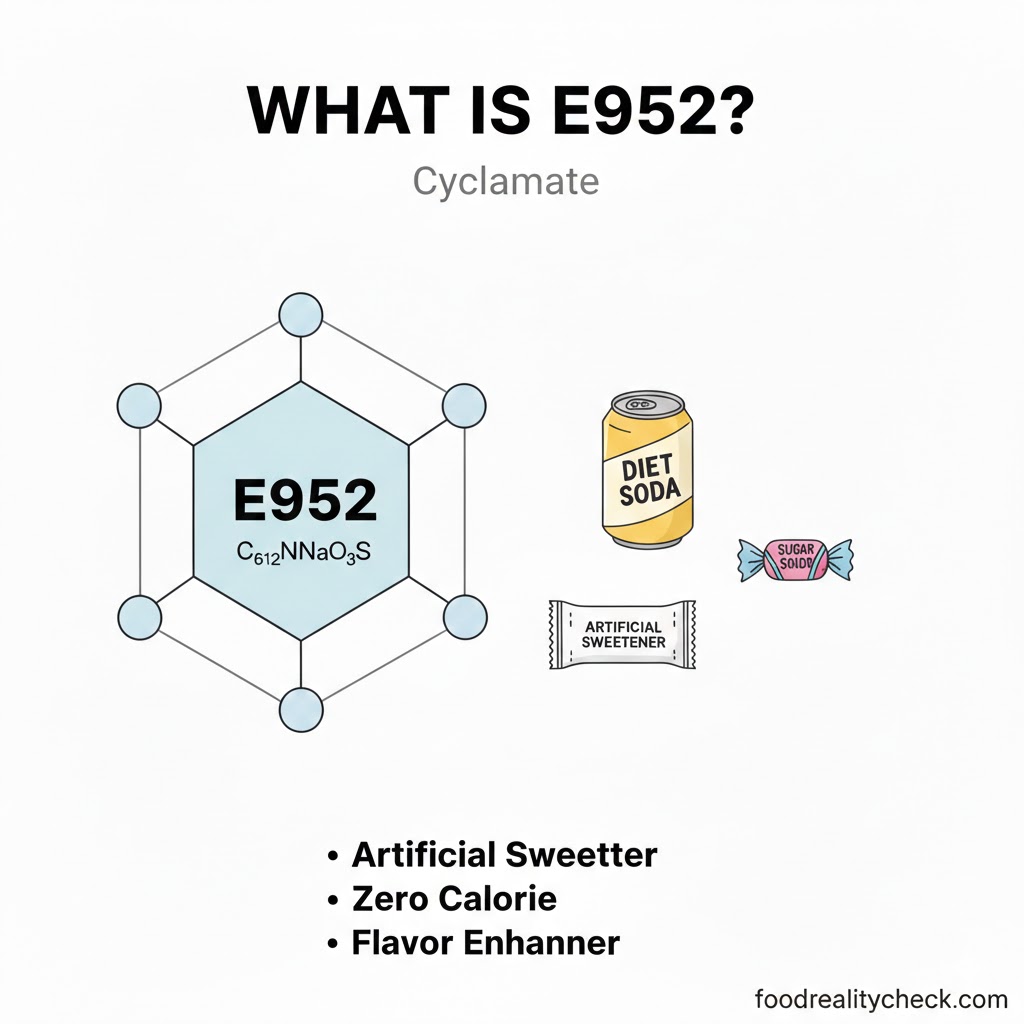
What is E952?
Complete guide to understanding E952 (Sodium Cyclamate) in your food
The Quick Answer
E952 is a synthetic artificial sweetener.
It’s used in food as a sugar substitute that contains zero calories.
It’s been one of the most debated food additives for over 50 years.
📌 Quick Facts
- Category: Synthetic non-nutritive sweetener
- Sweetness Level: 30–50 times sweeter than sugar
- Found in: Diet drinks, low-calorie desserts, chewing gum, sauces, toothpaste
- Safety: Approved in EU and 90+ countries; banned in USA, Canada, South Korea
- ADI (EFSA): 7 mg per kg of body weight per day
What Exactly Is It?
E952 is made from cyclohexylsulfamic acid and sodium salts.
Its chemical name is sodium cyclamate.
It was discovered accidentally in 1937 by Michael Sveda, a chemistry graduate student at the University of Illinois, who noticed a sweet taste after picking up a cigarette from his desk.
It’s a white crystalline powder with an intensely sweet taste, even in dilute solutions.
Where You’ll Find It
E952 appears primarily in:
• Diet carbonated drinks and soft drinks
• Sugar-free chewing gum
• Low-calorie desserts and ice cream
• Pickles and seasoning sauces
• Cakes, biscuits, and bread (reduced-sugar versions)
• Frozen treats and popsicles
• Toothpaste and mouthwash
• Dietary supplements and weight-loss products
• Medicines and syrups
It’s particularly common in Europe, Australia, and over 90 countries worldwide.
Why Do Food Companies Use It?
E952 does one main job: provide sweetness without adding calories or sugar.
It’s 30–50 times sweeter than sugar, so manufacturers use tiny amounts to achieve the desired sweetness.
Unlike sugar, it doesn’t contribute to tooth decay or blood sugar spikes, making it appealing for diet and diabetic-friendly products.
It’s also highly heat-stable (resistant to degradation up to 500°C) and pH-stable (stable between pH 2–10), so it works in processed foods, baked goods, and hot beverages.
Is It Safe?
E952’s safety is highly controversial and depends on where you live.
The European Food Safety Authority (EFSA) approved it with an ADI of 7 mg/kg body weight per day.
However, the FDA banned it in the United States in 1969 and it remains banned in the USA, Canada, South Korea, and Bangladesh.
Approval status varies: approved in the EU, Australia, New Zealand, and about 90 other countries.
What Are The Health Concerns?
The main health concern with E952 relates to metabolism. In most people, cyclamate passes through the body unchanged and is excreted in urine. However, a small percentage of people harbor specific gut bacteria that can metabolize cyclamate into cyclohexylamine, a compound that caused testicular damage in animal studies.
Key concerns include:
• Individual variation: Some people (high converters) may produce harmful metabolites
• Conflicting animal studies: 1960s-70s studies linked it to cancer; newer studies contradict this
• Lack of long-term human data: Limited epidemiological studies in humans
• Interaction with medications: May interfere with certain diabetes medications
Extensive recent studies in humans have found no evidence of carcinogenicity at approved consumption levels, but the historical controversy has kept it banned in several countries.
Natural vs Synthetic Version
E952 is always synthetic (made in a laboratory).
There is no natural version of sodium cyclamate.
It is chemically synthesized from cyclohexylamine compounds.
Natural Alternatives
Want to avoid E952?
Food companies sometimes use these natural sweetening options:
• Stevia (E960) – extracted from stevia plant leaves
• Monk fruit sweetener (Luo han guo) – from luo han guo fruit
• Sugar alcohols – including xylitol, sorbitol, maltitol
• Erythritol – a plant-derived sugar alcohol
These natural alternatives work similarly but often cost more and may have different taste profiles or digestive effects.
The Bottom Line
E952 is a synthetic artificial sweetener that’s been approved in much of the world, but banned in the USA, Canada, and a few other countries.
The EFSA considers it safe at approved levels, though a small subset of the population (high converters) may experience issues due to how their gut bacteria metabolize it.
If you’re in Europe or countries where it’s approved, it’s considered safe for most people at recommended intake levels. If you prefer natural sweeteners or are concerned about synthetic additives, natural alternatives are available.
The right choice depends on your personal preferences and local food safety regulations.