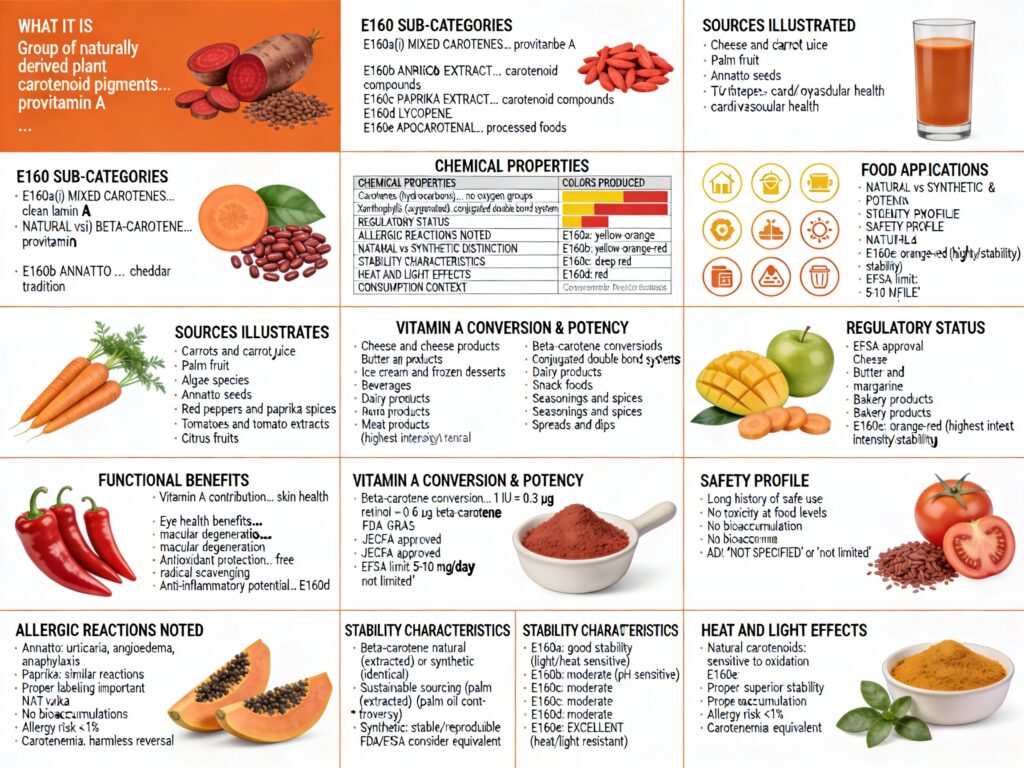
What is E160?
Complete guide to understanding E160 (Carotenoid Colors) in your food
The Quick Answer
E160 is a group of natural carotenoid food colorants derived from plants, fruits, and vegetables.
It’s used in food to provide yellow, orange, red, and deep red colors naturally.
It’s one of the safest food additives globally, with most forms conferring significant health benefits.
📌 Quick Facts
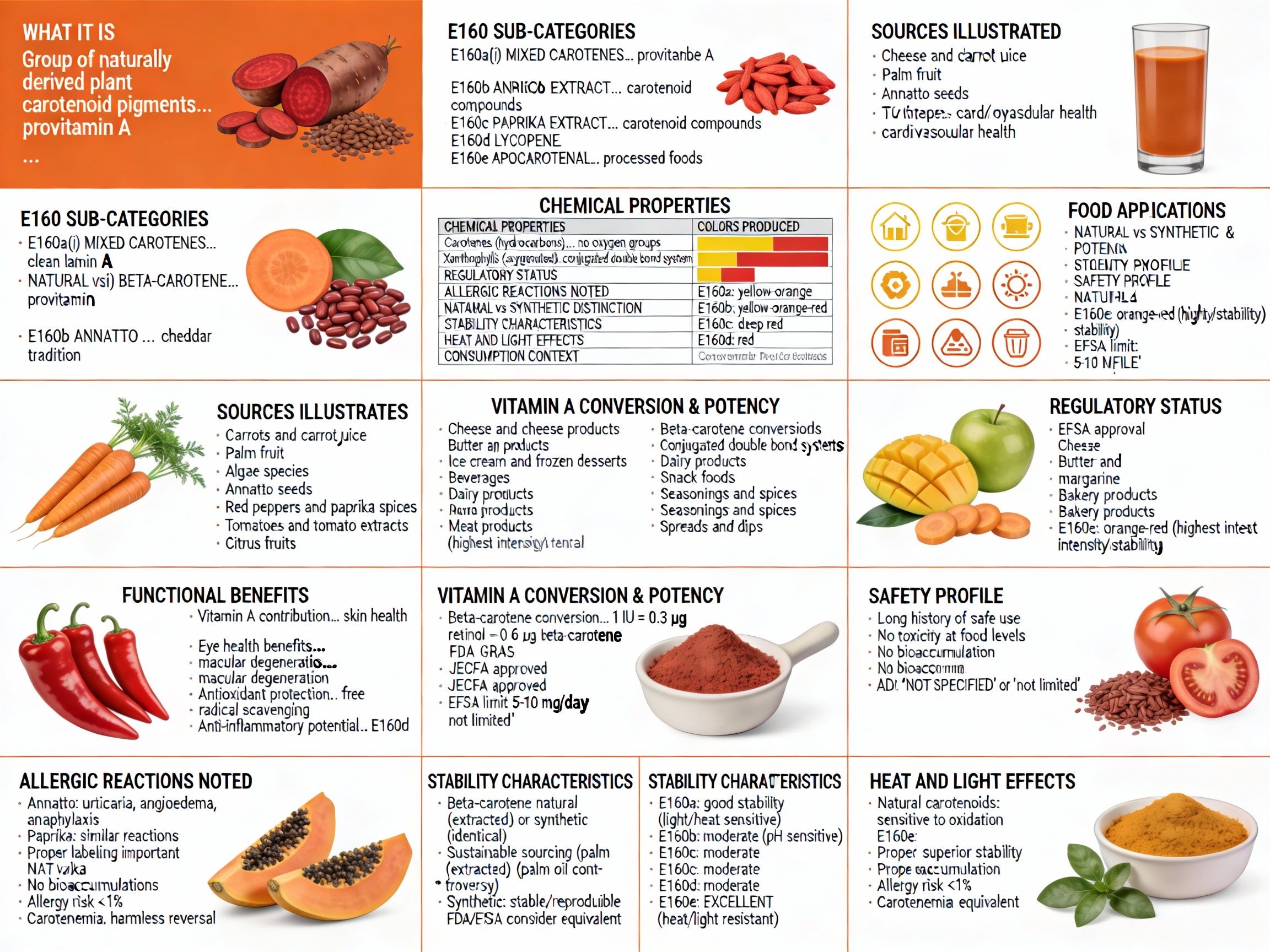
- Category: Natural food colorants (carotenoid group)
- Forms: E160a (carotenes/beta-carotene), E160b (annatto), E160c (paprika extract), E160d (lycopene), E160e (apocarotenal)
- Sources: Carrots, palm fruit, annatto seeds, paprika peppers, tomato, citrus fruits
- Found in: Cheese, butter, margarine, bakery products, ice cream, beverages, meat products
- Safety: Generally Recognized as Safe (GRAS); natural pigments with health benefits
- ADI Status: Most forms “Not Specified” or no limit needed; no numerical ADI required
What Exactly Is It?
E160 comprises five different natural carotenoid colorants, each from different plant sources:
| Form | Name | Source | Color |
|---|---|---|---|
| E160a(i) | Mixed Carotenes | Carrots, palm fruit, algae | Yellow to orange |
| E160a(ii) | Beta-Carotene | Carrots, palm fruit, algae | Yellow to orange |
| E160b | Annatto (Bixin, Norbixin) | Achiote tree seeds (Bixa orellana) | Yellow to orange-red |
| E160c | Paprika Extract (Capsanthin, Capsorubin) | Red bell peppers (Capsicum annuum) | Deep red |
| E160d | Lycopene | Tomatoes | Red |
| E160e | Apocarotenal (β-Apo-8′-Carotenal) | Synthetic modification of carotenoids | Orange to dark red |
All E160 forms are carotenoids—a large family of plant pigments responsible for yellow, orange, and red colors in nature.
Where You’ll Find It
E160 appears in many common foods:
• Cheese and cheddar (especially E160b for color)
• Butter and margarine
• Yogurt and dairy products
• Bakery products and bread
• Ice cream and frozen desserts
• Beverages (juices, soft drinks)
• Meat and sausage products
• Soup mixes and bouillon
• Confectionery and candy
• Poultry feed (to deepen egg yolk color)
• Condiments and seasonings
• Breakfast cereals
E160b (annatto) alone colors approximately 70% of all natural food colors globally.
Why Do Food Companies Use It?
E160 carotenoids serve multiple critical functions:
Natural color appeal: Consumers increasingly demand natural ingredients. E160 carotenoids provide vibrant colors without synthetic dyes, satisfying “clean label” preferences.
Enhanced visual appeal: Yellow and orange colors in butter, cheese, and margarine signal quality and richness, making products more appetizing.
Consumer recognition: Orange cheddar cheese colored with E160b has been the standard for 200+ years—consumers expect this color.
Nutritional benefit: Unlike synthetic dyes, carotenoids (especially beta-carotene and lycopene) provide actual health benefits as vitamin A precursors and antioxidants.
Stability advantages: E160e (apocarotenal) is highly heat- and light-stable, ideal for products that undergo heating or long-term storage.
Is It Safe?
Yes, E160 carotenoids are among the safest food additives available, with most forms conferring health benefits.
The FDA classifies all E160 forms as “Generally Recognized as Safe” (GRAS).
The EFSA and JECFA approved all E160 forms with no numerical ADI (Acceptable Daily Intake) limits needed for most forms—a designation reserved only for substances with minimal toxicological concern.
Beta-carotene is actually a nutritional precursor to vitamin A, meaning it’s a required nutrient for human health.
What Are The Health Concerns?
E160 carotenoids have virtually no documented health concerns and actual health benefits, though some considerations exist:
Beta-carotene supplement concern (different from E160 in food): High-dose beta-carotene supplements (not food amounts) in smokers showed increased lung cancer risk in a few studies. However, food-additive levels are far below supplemental doses and pose no risk.
Skin discoloration (cosmetic): Prolonged or frequent high-dose carotenoid exposure may cause temporary carotenemia (yellow-orange skin discoloration), which is harmless and reverses when intake stops.
Allergic reactions (rare): Annatto (E160b) and paprika extract (E160c) can cause allergic reactions in sensitive individuals—urticaria (hives), angioedema, or rarely anaphylaxis. However, true food allergies to these plant extracts are extremely uncommon.
Eye irritation (E160c with extreme exposure): Very high concentrations of paprika extract may irritate eyes; however, food amounts cause no risk.
Actual health benefits: Beta-carotene (E160a) is a vitamin A precursor essential for vision, immune function, and skin health. Lycopene (E160d) is an antioxidant linked to cardiovascular and prostate health benefits.
E160 carotenoids are genuinely beneficial food additives—rare substances that improve both product appeal AND consumer health.
Natural vs Synthetic Version
E160 forms are all naturally derived:
E160a: Extracted from carrots, palm fruit, or algae (natural) or synthetically manufactured to match natural beta-carotene (chemically identical).
E160b: Extracted from annatto tree seeds (completely natural).
E160c: Extracted from red bell peppers (completely natural).
E160d: Extracted from tomato (completely natural).
E160e: Chemically modified from natural carotenoids to enhance stability (semi-synthetic).
Natural Alternatives
E160 already ARE the natural alternatives to synthetic colorants.
For manufacturers seeking natural coloring without E160 specifically:
• Chlorophyll (E140) – green coloring from plants
• Beetroot (E162) – natural red/purple coloring
• Anthocyanins (E163) – red/purple from berries
• Turmeric/curcumin (E100) – yellow coloring
• Minimum processing – products without added colors
However, E160 carotenoids are preferred because they’re stable, effective, and provide nutritional benefits.
The Bottom Line
E160 is a group of naturally derived plant carotenoid colorants that are among the safest food additives available, with documented health benefits.
Unlike synthetic dyes, E160 forms provide actual nutritional value—beta-carotene (vitamin A precursor), lycopene (antioxidant), and other carotenoids with proven health properties.
Most forms have no numerical ADI limit, reflecting exceptionally low toxicological concern.
Regulatory bodies worldwide (FDA, EFSA, JECFA) classify all E160 forms as safe.
If you’re choosing between synthetic dyes and E160 carotenoid colors, E160 is unquestionably the superior choice for safety, effectiveness, and nutritional benefit.
For consumers seeking natural ingredients, E160 represents exactly what you want to see: natural plant pigments that are beneficial rather than merely inert.
I like this website so much, saved to favorites.