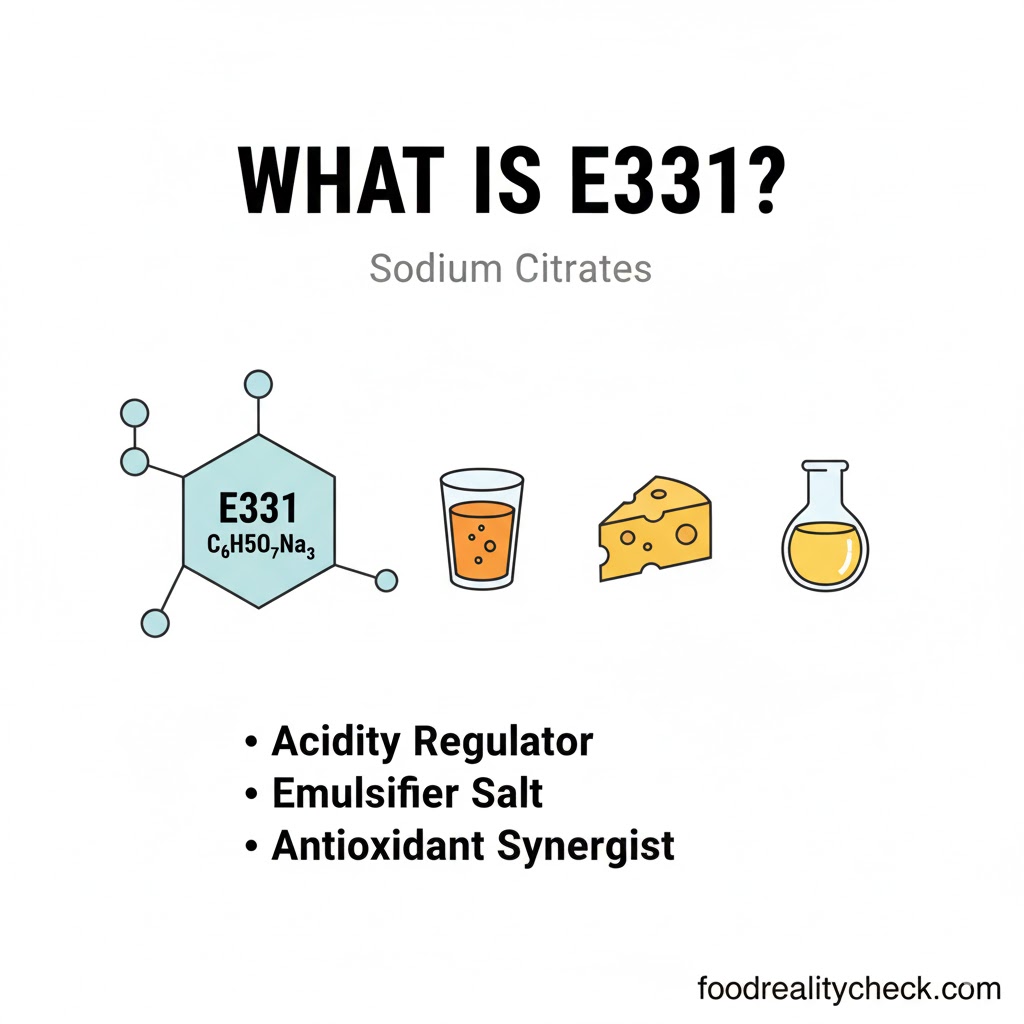
What is E331 (Sodium Citrate)?
Complete guide to this pH buffer and preservative with therapeutic health benefits and important sodium considerations
The Quick Answer
E331 is sodium citrate—the sodium salt of citric acid, available in three chemical forms (monosodium, disodium, and trisodium citrate). It’s used as an acidity regulator, pH buffer, preservative, and emulsifier in thousands of foods, particularly beverages, cheese, processed meats, and dairy products.
Unlike most food additives, sodium citrate is genuinely beneficial—it’s used medicinally to prevent kidney stones, treat gout, reduce metabolic acidosis, and even improve athletic performance. It’s approved by all major food authorities and is considered safe at food levels.
The main health consideration is sodium content: people with hypertension, heart disease, kidney disease, or on sodium-restricted diets should monitor total sodium intake, though E331 contributes relatively little to daily sodium levels in typical food consumption.
📌 Quick Facts
- Category: Acidity regulator, pH buffer, preservative, emulsifier, chelating agent
- Source: Sodium salt of citric acid (created by reacting citric acid with sodium hydroxide/carbonate)
- Found in: Soft drinks, beverages, processed cheeses, ice cream, yogurt, jams, processed meats, powdered drinks
- Safety Status: FDA GRAS approved, EFSA approved, ADI “Not Specified” (highest safety rating)
- Chemical Forms: E331(i) Monosodium, E331(ii) Disodium, E331(iii) Trisodium citrate
- Controversy Level: NONE—universally considered safe; therapeutic uses documented
- Health Benefits: Kidney stone prevention, gout treatment, athletic performance, metabolic acidosis management
- Main Concern: Sodium content for those on sodium-restricted diets
What Exactly Is Sodium Citrate?
Sodium citrate is the sodium salt of citric acid—created by neutralizing citric acid with sodium hydroxide, sodium carbonate, or sodium bicarbonate. The result is a white crystalline powder with a mildly salty, tart taste.
Chemical composition: The three forms differ in the number of sodium atoms bonded to the citrate molecule:
• Monosodium citrate (E331(i)): One sodium atom; Chemical formula C₆H₇NaO₇
• Disodium citrate (E331(ii)): Two sodium atoms; Chemical formula C₆H₆Na₂O₇
• Trisodium citrate (E331(iii)): Three sodium atoms; Chemical formula C₆H₅Na₃O₇ (most common form)
In simple terms: It’s similar to citric acid (E330), but the sodium atoms make it less acidic and give it buffering properties. When you add it to acidic foods, it neutralizes the acid and stabilizes pH.
Key properties:
• Alkaline: Has a pH of 7.5-9.0 in solution, making it basic (opposite of acidic)
• Mild base: Acts as a buffer, resisting pH changes
• Water soluble: Dissolves easily, making it ideal for beverages and liquid products
• Preservative: Helps prevent microbial growth by stabilizing pH
• Non-caking: Less prone to clumping than citric acid, useful in dry mixes
• Anticoagulant: Prevents blood clotting (used medically)
Where You’ll Find E331
Sodium citrate appears in a wide variety of foods and beverages:
• Carbonated beverages and soft drinks
• Powdered drink mixes and concentrates
• Fruit juices and juice drinks
• Processed cheeses and cheese spreads
• Dairy desserts (yogurt, ice cream)
• Jams, jellies, marmalades
• Processed meats and sausages
• Bratwurst and other prepared meats
• Canned vegetables and fruits
• Sauces and condiments
• Powdered beverage flavoring
• Wine and other beverages
• Butter chicken and curries
• Gelatin desserts
• Milk powder and reconstituted milk products
How Is Sodium Citrate Produced?
Sodium citrate production is a straightforward chemical process:
Step 1: Starting Material
High-purity citric acid (E330) is obtained, typically from fermentation of glucose or sucrose by Aspergillus niger fungus (same process described in the E330 article).
Step 2: Neutralization
The citric acid is neutralized with one of three sodium compounds depending on the desired final product:
• Sodium hydroxide (NaOH) → Trisodium citrate
• Sodium carbonate (Na₂CO₃) → Disodium or trisodium citrate (depending on ratios)
• Sodium bicarbonate (NaHCO₃) → Monosodium or disodium citrate
Step 3: Crystallization
The neutralized solution is crystallized to form solid sodium citrate crystals.
Step 4: Separation & Purification
The crystals are separated and purified to remove impurities.
Step 5: Drying
The product is dried to remove moisture, creating the final powder or granular form.
Step 6: Quality Control
Tested for purity, sodium content, and any contaminants before approval for food use.
Functions of E331 in Food
Sodium citrate serves multiple critical functions in food manufacturing:
As an acidity regulator: Neutralizes excessive acid in foods, allowing manufacturers to control pH. In beverages, prevents the sharp “acidic” taste while maintaining preservation.
As a pH buffer: Resists changes in pH, keeping foods stable. Critical in products where pH stability affects texture or shelf life (gelatin, cheese, yogurt).
As a preservative: By controlling pH to a range inhospitable to harmful bacteria (typically pH 3.5-3.8), it prevents microbial growth and extends shelf life.
As an emulsifier and stabilizer: In cheese production, sodium citrate prevents fat separation, allowing cheese to melt smoothly without becoming greasy. Essential in processed cheese manufacture.
As a chelating agent: Binds metal ions (calcium, magnesium) that might otherwise cause cloudiness or off-flavors in beverages.
As an anti-caking agent: In powdered products (drink mixes, powdered cheese), prevents clumping and moisture absorption.
Is E331 Safe?
Yes. Sodium citrate is approved as safe by all major regulatory authorities and has an excellent safety record.
Regulatory Approvals:
• FDA: Generally Recognized As Safe (GRAS) for use as a food additive
• EFSA (European Food Safety Authority): Approved as E331. All three forms (monosodium, disodium, trisodium) are approved for use as food additives.
• JECFA (Joint FAO/WHO Committee): Assigned an ADI of “Not Specified”—the highest possible safety rating, indicating no safety concern at typical use levels.
Why is the safety strong?
1. Natural origin: Derived from citric acid, which occurs naturally in all fruits and is metabolized by the body through normal biochemistry
2. Non-toxic: Extensive animal and human testing shows no toxic effects at food-level consumption
3. Therapeutic use: Used medically at higher doses to treat kidney stones and metabolic acidosis—proof of safety at elevated levels
4. No bioaccumulation: Doesn’t accumulate in tissues; completely metabolized and excreted
5. Low exposure from food: Typical food levels are minimal; most dietary sodium comes from salt, not food additives
Health Benefits of Sodium Citrate
🌟 Documented Medical & Athletic Benefits
- Kidney stone prevention: Increases urine pH and citrate excretion, reducing formation of calcium oxalate stones—the most common type of kidney stones. Used medically at 10-20g daily
- Gout treatment: Alkalizes urine, increasing uric acid excretion and reducing gout attack frequency and severity
- Metabolic acidosis management: Neutralizes excess acid in the body, helping correct metabolic imbalances, particularly in chronic kidney disease
- Athletic performance improvement: A 2003 study found 0.5g/kg body weight of sodium citrate improved 5km running performance by 30 seconds. Buffer effect may reduce muscle acid buildup during intense exercise
- UTI symptom relief: Alkalizing urine reduces discomfort in urinary tract infections like cystitis
- Muscle and nerve function: Helps balance electrolytes, supporting optimal muscle contractions and nerve signal transmission
- Anticoagulant effect: Prevents blood clotting—used medically in blood storage and transfusions, and in dialysis catheters
- Indigestion relief: Neutralizes excess stomach acid when taken medicinally (similar to antacids)
Side Effects & Sodium Considerations
At food levels, sodium citrate is very well tolerated. However, sodium content is the primary health consideration:
Gastrointestinal side effects (primarily from medicinal doses >5g):
• Nausea and vomiting
• Diarrhea (dose-dependent)
• Stomach cramps and discomfort
• Mild indigestion
These effects occur primarily with therapeutic/supplemental doses (5-20g), not from food-level consumption (<1g daily).
Critical: Sodium Content Concerns
Sodium citrate contains sodium, making it unsuitable for people on sodium-restricted diets:
Each form contributes sodium differently:
• Monosodium citrate: ~6% sodium by weight
• Disodium citrate: ~11% sodium by weight
• Trisodium citrate: ~15% sodium by weight
However, food levels are typically minimal: A typical beverage might contain 200-500mg of sodium citrate, contributing only 30-75mg of sodium—modest compared to the 2,300mg daily limit recommended by health authorities.
Caution for those with:
• Hypertension (high blood pressure)
• Heart failure or cardiovascular disease
• Chronic kidney disease (reduced sodium clearance)
• Edema (fluid retention conditions)
• On sodium-restricted medical diets
From Medicinal/High Doses (Not Food Levels):
Excessive sodium citrate supplementation can cause:
• Metabolic alkalosis (blood becomes too alkaline)
• Muscle weakness, cramps, or tetany
• Cardiac arrhythmias
• Confusion or altered mental status
• Electrolyte imbalances
These only occur with high supplemental doses (>5g daily), not from food consumption.
The Three Forms of E331 Compared
| Form | Chemical Formula | Sodium Content | pH Effect | Primary Use |
|---|---|---|---|---|
| E331(i) Monosodium | C₆H₇NaO₇ | ~6% sodium | Mild alkalinity; partial buffering | Less common; specialized buffering applications |
| E331(ii) Disodium | C₆H₆Na₂O₇ | ~11% sodium | Moderate alkalinity; medium buffering | Moderate pH adjustment; balanced buffering |
| E331(iii) Trisodium | C₆H₅Na₃O₇ | ~15% sodium | Strong alkalinity; powerful buffering | Most common; strong pH adjustment in beverages, cheese |
Sodium Citrate vs Citric Acid (E330): Key Differences
| Property | E330 (Citric Acid) | E331 (Sodium Citrate) |
|---|---|---|
| pH Effect | Acidic (pH 2-3) | Alkaline (pH 7.5-9.0) |
| Primary Function | Acidulant, flavor enhancer, antioxidant | pH buffer, acidity regulator, preservative |
| Taste | Sour, tart | Mildly salty, slightly tart |
| Sodium Content | No sodium | 6-15% sodium (depending on form) |
| Medical Uses | Mineral absorption, kidney stone prevention (citrate form) | Kidney stone prevention, gout, metabolic acidosis, athletic performance |
| Used Together? | Yes, frequently—citric acid provides tartness, sodium citrate provides pH buffering | |
Who Should Increase Sodium Citrate Intake?
Sodium citrate supplementation (not food levels) may benefit:
• Kidney stone formers: Medical use at 10-20g daily prevents recurrence
• Gout sufferers: Alkalizes urine to increase uric acid excretion
• Athletes: May improve endurance performance through buffering effects
• Those with metabolic acidosis: Medical management of acid-base imbalances
Important: These benefits require supplemental doses, not the minimal amounts in food.
The Bottom Line
E331 (sodium citrate) is a safe, approved food additive that’s one of the few additives with genuine documented health benefits beyond its food-functional purpose.
Key takeaways:
• Excellent safety: ADI “Not Specified”; approved by FDA, EFSA, JECFA with no controversy
• Therapeutic applications: Used medically to prevent kidney stones, treat gout, improve athletic performance, manage metabolic acidosis
• Natural origin: Derived from citric acid, which occurs naturally in all fruits
• Three forms available: Monosodium, disodium, trisodium with different alkalinity levels
• Minimal side effects at food levels: Safe for most people; medicinal side effects only occur at high supplemental doses
• Sodium consideration: Main concern is sodium content for those on sodium-restricted diets, though food-level amounts contribute minimal sodium
• Therapeutic benefits: When used medicinally, documented to improve kidney health, athletic performance, and gout management
Practical recommendation: Unlike many food additives that are purely functional, sodium citrate is genuinely beneficial when consumed as a food additive or supplement. For people without sodium restrictions, it’s an excellent additive with no health concerns. For those on sodium-restricted diets, food-level amounts are typically minimal and not a primary concern, but total sodium intake should be monitored. If you experience kidney stones, gout, or metabolic concerns, sodium citrate supplementation (under medical supervision) may be therapeutically beneficial.