What is E452?
Complete guide to understanding E452 (Polyphosphates) in your food
The Quick Answer
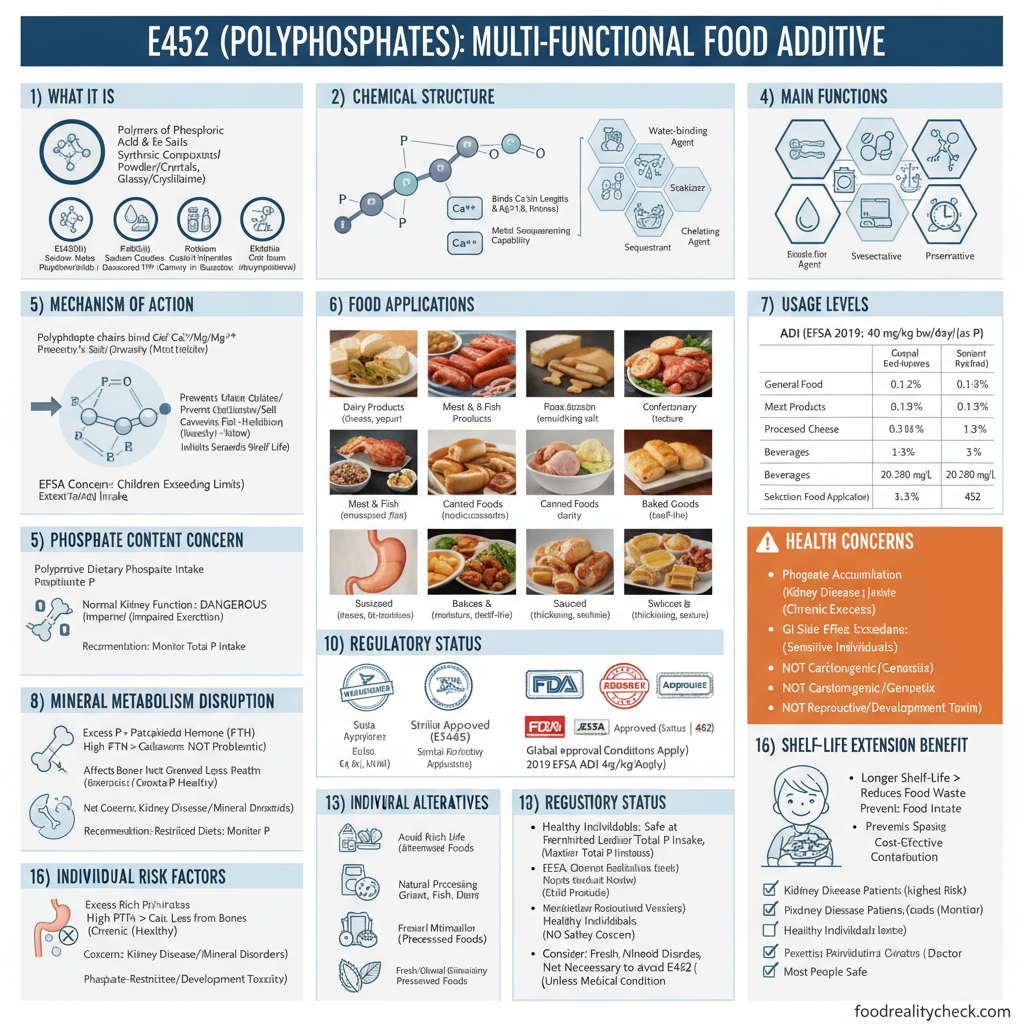
E452 is a group of polyphosphate salts used as stabilizers and emulsifiers.
It’s used in food to retain water, improve texture, and extend shelf-life in processed meats, dairy, and baked goods.
It’s one of the more controversial phosphate additives due to emerging health concerns.
📌 Quick Facts
- Category: Emulsifying salt and stabilizer (phosphate compound)
- Subtypes: E452(i) sodium, (ii) potassium, (iii) sodium-calcium, (iv) calcium, (v) ammonium, (vi) sodium-potassium polyphosphates
- Found in: Processed meat, cheese, dairy, baked goods, fish products, sauces
- Safety: Approved by EFSA and FDA; under re-evaluation for cardiovascular and kidney health concerns
- ADI (EFSA 2019): 40 mg/kg body weight per day (expressed as phosphorus)
What Exactly Is It?
E452 comprises six different polyphosphate salts, all made from phosphoric acid combined with sodium, potassium, calcium, or ammonium.
Polyphosphates are chains of phosphate units linked together (hence “poly-” meaning many).
All E452 subtypes are produced synthetically by reacting phosphoric acid with the respective metal carbonates or hydroxides.
They appear as white crystalline powders that dissolve readily in water.
Phosphates are naturally occurring compounds—your body contains phosphorus in bones, teeth, and soft tissues—but E452 is a processed, concentrated form.
Where You’ll Find It
E452 appears in many processed foods:
• Processed meats (ham, sausages, frankfurters, deli meats)
• Processed cheese and cheese products
• Dairy products (milk, yogurt, cream)
• Bakery and pastry products
• Biscuits and crackers
• Fish and seafood products (especially canned)
• Sauces, dressings, and condiments
• Frozen foods and ready-meals
• Jellies and aspics
• Canned vegetables
• Cola and soft drinks
• Beer and some alcoholic beverages
Food scientists frequently use E452 in combinations with other additives to maximize texture improvement and water retention.
Why Do Food Companies Use It?
E452 polyphosphates serve multiple critical functions in processed foods:
Water retention: Polyphosphates bind water molecules to meat and fish proteins, preventing moisture loss during cooking. This keeps products juicy and reduces weight loss in the pan, improving yield and consumer satisfaction.
Texture improvement: They stabilize protein structures, creating a more uniform texture and preventing the “mushy” appearance of some processed meats and dairy products.
Emulsification: Polyphosphates act as emulsifiers, keeping oil and water mixed in cheese sauces, dressings, and dairy products that would otherwise separate.
Chelation: They bind metal ions (calcium, magnesium, iron), preventing discoloration and off-flavors caused by metal oxidation, which extends shelf-life.
pH buffering: They regulate acidity, improving product stability.
Is It Safe?
E452 is approved but increasingly controversial.
The European Food Safety Authority (EFSA) re-evaluated phosphates (including E452) in 2019 and maintained approval with an ADI of 40 mg/kg body weight per day, expressed as phosphorus.
However, the EFSA also noted important caveats: current approved use levels may exceed the ADI for heavy consumers, particularly children and adolescents with high ultra-processed food consumption.
The ADI does not cover individuals with moderate to severe kidney function impairment.
What Are The Health Concerns?
E452 polyphosphates have raised several documented health concerns:
Cardiovascular risk: Recent epidemiological research indicates that high phosphate intake from food additives correlates with increased cardiovascular disease risk, as phosphates can deposit in arterial walls and promote calcification. This effect is especially pronounced in individuals with kidney disease.
Kidney function: The EFSA noted that individuals with chronic kidney disease may face greater risks because their kidneys struggle to excrete excess phosphate, leading to hyperphosphatemia (elevated blood phosphate).
Gut microbiota alterations: Experimental studies suggest food additive emulsifiers (including phosphate-based additives) may alter beneficial gut bacteria composition, increasing low-grade inflammation.
Artificial weight inflation: When combined with water addition, polyphosphates can artificially inflate product weight, meaning consumers pay for water rather than meat—a quality/fraud concern rather than a direct health issue.
High intake in children: The EFSA specifically flagged that heavy consumers of processed foods—particularly children—may exceed safe phosphate intake limits, raising long-term health concerns.
Natural vs Synthetic Version
E452 is always synthetically manufactured (made in a laboratory).
While phosphorus exists naturally in foods (meat, fish, dairy, nuts), the concentrated polyphosphate form in E452 is a processed chemical that doesn’t occur naturally in this concentrated form.
Your body does contain phosphate naturally, but E452 is a substantially different form at much higher concentrations.
Natural Alternatives
Want to avoid E452?
Food companies sometimes use natural alternatives:
• Native starches – natural thickeners from potatoes or corn
• Gelatin or collagen peptides – natural binders from animal protein
• Plant-based gums (guar gum, xanthan gum) – natural thickeners
• Citrus pectin – natural gelling agent
• Minimal processing – fresh meats and cheeses without additives
These alternatives often work less effectively and cost significantly more, so E452 remains the industry standard for processed meats and dairy despite the emerging health concerns.
The Bottom Line
E452 is a synthetically manufactured phosphate additive that’s approved for use but increasingly scrutinized for cardiovascular and kidney health concerns.
While regulatory bodies maintain approval, the EFSA’s 2019 re-evaluation flagged that heavy consumers (especially children eating lots of processed foods) may exceed safe phosphate intake limits.
Recent epidemiological studies link high phosphate additive intake to cardiovascular disease risk, particularly in people with kidney disease.
If you’re concerned about phosphate intake, reducing consumption of processed meats, cheese products, and ultra-processed foods is an effective strategy.
For healthy individuals with normal kidney function, occasional consumption of E452-containing foods is unlikely to cause harm, but high regular consumption may pose risks worth avoiding.