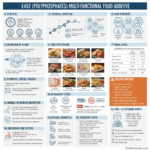
What is E236?
Complete guide to understanding E236 (Formic Acid) — a naturally-occurring preservative that was delisted from food use in 1995
The Quick Answer
E236 (Formic Acid) is the simplest organic acid — found naturally in ants, stinging nettles, and fruits.
What’s unusual about E236: it was once approved as a food preservative but was DELISTED in 1995 because of practical reasons (pungent smell, limited effectiveness), not safety issues. It’s still approved for animal feed and is used industrially, but you won’t find it as an approved food additive for human foods in the EU anymore.
E236 is safe — but it’s essentially a “retired” food additive. Better alternatives (sorbates, benzoates) replaced it.
📌 Quick Facts
- Chemical Name: Formic Acid (methanoic acid)
- Type: Organic acid; preservative; antimicrobial
- Chemical formula: HCOOH or H−C(=O)−O−H
- Origin: BOTH natural and synthetic
- Found naturally in: Ants, stinging nettles, pineapple, apple, kiwi, onion, honey
- EU Status: DELISTED in 1995 — no longer approved for human food
- Current approval: Limited; primarily animal feed use; processing aid only
- Safety status: Safe for consumption at use levels; corrosive as pure product
- Key property: Pungent smell (vinegar-like); fungicidal and bactericidal
- Why delisted: Pungent odor made food unpalatable; better alternatives available
What Exactly Is It?
E236 is formic acid (methanoic acid), the simplest carboxylic acid — chemically very simple but commercially produced and naturally occurring.
Chemical structure: H−C(=O)−O−H (the most basic organic acid)
Appearance: Colorless liquid; pungent, vinegar-like odor; miscible with water
Natural occurrence:
– Ants: Secreted for attack/defense (Latin “formica” = ant)
– Stinging nettles: Natural defense chemical
– Fruits: Pineapple (0.21 mg/100g), apple (2 mg/100g), kiwi (1 mg/100g)
– Vegetables: Onion (45 mg/100g), eggplant (1.34 mg/100g), cucumber (0.11 mg/100g)
– Honey: Natural component
– Forests: Emitted naturally from vegetation
– Fermented foods: Wine, fermented products
Key properties:
– Preservative: fungicidal and bactericidal
– Volatile: easily evaporates (pungent smell)
– Corrosive: can damage skin and eyes at high concentrations
– Simple structure: simplest carboxylic acid
– Naturally metabolized: body breaks down to CO₂ and water
– Effective: works better in low-pH (acidic) environments
Historical Use (Before 1995 Delisting)
E236 was once approved and used in various foods:
– Marinades
– Pickles
– Processed vegetables
– Smoked fish
– Fruit and vegetable purees
– Some beverages
– Some cheeses
– Winemaking (supporting fermentation)
Why it stopped being used: The pungent smell made food unappealing to consumers, and better preservatives (sorbates, benzoates) became available that worked without the smell problem.
The 1995 Delisting: What Happened?
In 1995, the EU removed E236 (and E237 sodium formate) from the approved food additives list.
Important: This was NOT a safety delisting. The EU simultaneously delisted E236 as a food additive but approved it as a “flavoring substance” and “processing aid” for specific uses. This distinction is crucial.
Why Was E236 Delisted?
Four main reasons (none related to safety):
1. Pungent smell: The vinegar-like odor is strong and unpleasant
– Makes food taste and smell strongly of formic acid
– Consumers reject foods with this strong smell
– Unacceptable sensory profile for most food applications
2. Limited effectiveness: Less effective than sorbates and benzoates as food preservative
3. Better alternatives available: Sorbates (E200-E203) and benzoates (E210-E213) superior in all respects
– More effective antimicrobial activity
– Better sensory profile (no pungent smell)
– Safer to handle
– Better accepted by industry and consumers
4. Regulatory streamlining: EU rationalized additive list; removed less practical options
Safety was NOT the reason: EFSA still recognizes formic acid as safe. The delisting was purely regulatory, based on practical limitations.
Current Status (2025)
E236 today is essentially a “retired” food additive.
| Region/Use | Status | Details |
|---|---|---|
| EU Food (Human) | DELISTED | No longer approved as E236 food additive for human consumption |
| EU Processing Aid | Limited Approval | Can be used as processing aid or flavoring in specific applications |
| Animal Feed | APPROVED | Approved and widely used (10,000-12,000 mg/kg permitted) |
| US FDA | Limited Approval | GRAS (Generally Recognized As Safe) for select uses; not common |
| Codex (International) | Listed but Restricted | Max 200 mg/kg sauces; 100 mg/kg flavored drinks |
| Actual human food use | EXTREMELY RARE | Essentially not used in modern consumer products |
Is E236 Safe? Absolutely
E236 is safe — delisting was never about safety.
Safety Assessment
| Safety Criterion | Finding | Conclusion |
|---|---|---|
| Acute Toxicity (at food use levels) | Safe; not toxic at approved concentrations | Safe |
| Chronic Toxicity | No adverse effects at food use levels | Safe |
| Genotoxicity | No concern identified | Safe |
| Carcinogenicity | No carcinogenic potential | Safe |
| Metabolic Fate | Broken down in liver; excreted; no bioaccumulation | Safe |
| ADI (Acceptable Daily Intake) | 0-3 mg/kg body weight (JECFA) | Safe at food levels |
| Natural occurrence | Found in fruits, vegetables, honey; naturally metabolized | Body handles naturally |
| Pure product hazard | Corrosive at high concentrations (H314 GHS) | Hazard in manufacturing only, not in food |
Key point: The pure product (85-98% formic acid) is corrosive and hazardous to handle. But at food use levels, it’s safe for consumption. The delisting was regulatory, not safety-based.
Comparison to Related Compounds
Formic acid is part of a family of organic acid preservatives:
| Compound | E-Number | Status | Odor/Taste | Effectiveness | Why Different |
|---|---|---|---|---|---|
| Formic acid | E236 | DELISTED | Strong vinegar smell | Moderate | Pungent; unpalatable |
| Acetic acid (Vinegar) | E260 | APPROVED | Vinegar taste acceptable | Good | Familiar flavor; acceptable |
| Sorbic acid | E200 | APPROVED | Minimal/neutral | Excellent | No smell; very effective |
| Benzoic acid | E210 | APPROVED | Minimal/neutral | Excellent | No smell; very effective |
The comparison reveals why E236 was delisted: Acetic acid (vinegar, E260) is chemically similar but has an acceptable flavor profile. Sorbates and benzoates are far more effective and odorless. Formic acid brought no advantage over these alternatives.
The Bottom Line
E236 (Formic Acid) is a safe, naturally-occurring preservative that was delisted from food use in 1995 due to practical limitations, not safety concerns.
What you should know:
- It was delisted in 1995: No longer approved for human food preservation in EU
- It’s safe: Delisting had nothing to do with safety; still recognized as safe
- It’s naturally occurring: Found in ants, fruits, vegetables, honey
- Reason for delisting: Pungent smell made food unpalatable; better alternatives available
- It’s still used in animal feed: Approved for livestock (10,000-12,000 mg/kg)
- You won’t encounter it: Essentially not used in modern consumer foods (EU)
- No health concerns: If you did encounter it, zero risk