What is E296?
Complete guide to understanding E296 (Malic Acid) in your food
The Quick Answer
E296 is a natural organic acid found in apples and other fruits.
It’s used in food as an acidity regulator, flavor enhancer, and preservative.
It’s one of the safest food additives—approved worldwide with no safety concerns documented.
📌 Quick Facts
- Category: Organic acid (acidity regulator, flavor enhancer)
- Chemical Name: 2-Hydroxybutanedioic acid (Malic acid)
- Forms: L-malic (natural), D-malic (synthetic), DL-malic (racemic mixture)
- Found in: Sour candies, juices, jams, beverages, wines, baked goods
- Safety: Generally Recognized as Safe (GRAS); no harmful effects documented
- ADI (JECFA): “Not Specified” – no numerical limit needed
What Exactly Is It?
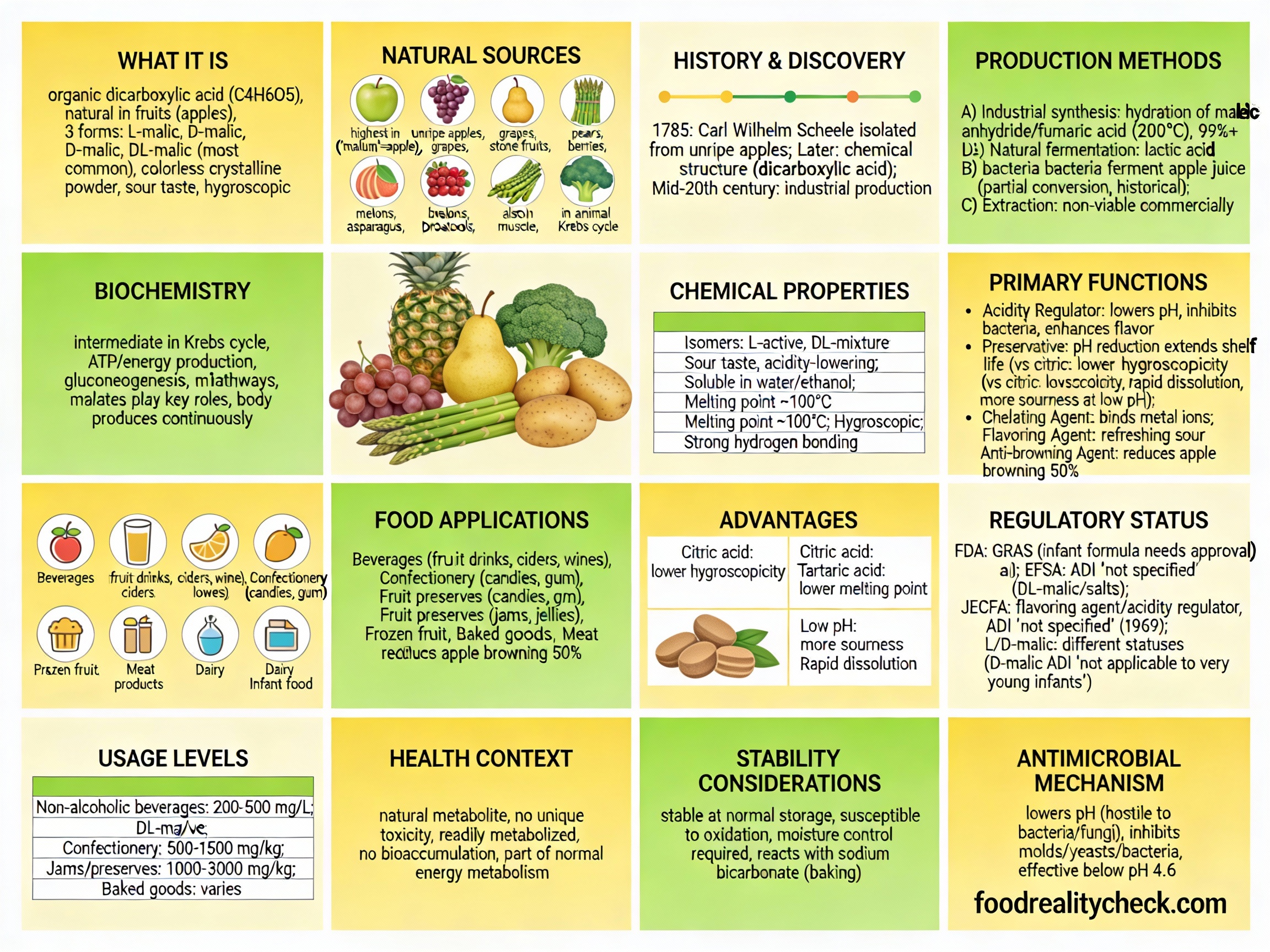
E296 is a naturally occurring organic acid found primarily in apples.
Its chemical formula is C₄H₆O₅, and it’s a dicarboxylic acid with both sour and sweet taste characteristics.
The name comes from the Latin word for apple—”mālum”—as malic acid was first isolated from apple juice by Swedish chemist Carl Wilhelm Scheele in 1785.
E296 exists in three forms: L-malic acid (naturally occurring in fruits), D-malic acid (synthetic), and DL-malic acid (a racemic mixture of both, most common in food additives).
It plays a crucial role in cellular energy production—malate is an intermediate in the Krebs cycle (citric acid cycle) that powers all living cells.
Where You’ll Find It
E296 appears in many common foods:
• Sour candies and “extreme candy” (high-tartness confectionery)
• Fruit juices (apple, grape, and mixed fruit)
• Jams, jellies, and fruit preserves
• Soft drinks and low-calorie beverages
• Wine and fermented beverages
• Baked goods and pastries
• Chewing gum
• Puddings, gelatins, and fillings
• Canned and frozen fruits
• Sports drinks and electrolyte beverages
• Breakfast cereals
• Sauces and condiments
It naturally occurs in high concentrations in unripe apples, grapes (up to 20 g/L before ripening), tomatoes, plums, currants, and bananas.
Why Do Food Companies Use It?
E296 serves multiple essential functions in food processing:
Acidity regulation: E296 lowers pH to preserve food, prevent bacterial growth, and extend shelf-life without refrigeration.
Flavor enhancement: Malic acid imparts a clean, tart, sour taste that enhances overall flavor perception and makes foods more appetizing. In sour candies, it’s the primary ingredient creating extreme tartness.
Color stabilization: In acidic foods, malic acid helps stabilize colors and prevent discoloration during storage.
Preservative effect: The acidic environment inhibits microbial growth, extending product shelf-life.
Flavor blending: Malic acid blends well with multiple food acids, sugars, and flavorings to create complex taste profiles—particularly in juices and beverages.
Wine production: In winemaking, malolactic fermentation converts the harsher malic acid to milder lactic acid, a natural aging process in quality wines.
Is It Safe?
Yes, E296 is considered extremely safe and is one of the safest food additives available.
The FDA classifies it as “Generally Recognized as Safe” (GRAS) for both L-malic acid and DL-malic acid (with the exception of use in baby food in excess of specific limits).
The EFSA approved E296 and its salts (sodium malate E350, potassium malate E351, calcium malate E352) with no numerical ADI limit.
The WHO Expert Committee (JECFA) assigned E296 an ADI of “Not Specified”—meaning no toxicological limit is necessary because it poses no health risk even at high levels.
The U.S. Environmental Protection Agency (EPA) awarded malic acid a “green circle” classification, indicating no safety concerns based on experimental data.
What Are The Health Concerns?
E296 has virtually no documented health concerns in food use, though a few minor considerations exist:
Mouth irritation from sour candies: Extreme sour candies containing high malic acid can irritate the mouth, lips, and tongue with repeated consumption. Some products are labeled with warnings. However, this is irritation from extreme sourness, not toxicity.
Skin and mucous membrane irritation (undiluted form): Undiluted or concentrated malic acid can irritate eyes, skin, and mucous membranes. However, the dilute amounts in food pose no risk.
Herpes simplex aggravation (theoretical): One source mentions malic acid may aggravate herpes simplex symptoms, though this is not well-documented in scientific literature.
Rare allergies: Some individuals allergic to apples or malic acid may experience headaches, diarrhea, or nausea, though this is extremely rare and affects only those with documented malic acid sensitivity.
Potential benefits: Malic acid is a precursor to citrate, which may help prevent kidney stone formation by increasing urine pH and citrate levels—the opposite of harm.
No documented toxicity, carcinogenicity, or genetic damage at any approved food levels.
Natural vs Synthetic Version
E296 exists in both natural and synthetic forms:
L-malic acid: The naturally occurring form found in fruits. Can be extracted from fruits or produced through microbial fermentation.
DL-malic acid: A synthetic racemic mixture (equal parts L- and D-malic) produced through chemical synthesis. This is the most common form in food additives.
D-malic acid: The non-natural synthetic form, less commonly used.
All three forms have identical acidity and flavor properties. Your body metabolizes all forms identically as part of the Krebs cycle.
Natural Alternatives
E296 is already derived from nature (apples and fruits).
For acidity regulation without E296, alternatives include:
• Citric acid (E330) – from citrus fruits, milder sour taste
• Fumaric acid (E297) – another natural fruit acid
• Tartaric acid (E334) – from grapes, milder than malic
• Vinegar or lemon juice – natural acidulants
• Fermentation – natural preservation via lactic acid bacteria
However, E296 is preferred for its clean taste profile and effectiveness, which is why it’s so widely used.
The Bottom Line
E296 is a naturally occurring organic acid from apples with an exceptional safety profile and zero documented health risks at approved food levels.
It’s one of the few additives that the WHO (JECFA) didn’t need to assign a numerical ADI limit to—a status reserved only for truly non-toxic substances.
Malic acid is not just safe; it’s a fundamental metabolite that your body produces and uses daily as part of cellular energy production.
The only realistic concern is mouth irritation from extreme sour candies, which is a sensory issue, not a toxicity issue.
For anyone avoiding synthetic additives, E296 offers a genuinely natural, historically safe option that’s been consumed in apples and fruits for millennia.