Here’s what the science actually says. Artificial sweeteners have been approved by the FDA, EFSA, and WHO for decades. But a major WHO recommendation in 2023 and recent cancer research have made this answer significantly more complicated than “completely safe.”
The Internet Myth
You’ve probably heard that artificial sweeteners cause cancer, brain damage, and weight gain.
You might have seen claims that aspartame is a neurotoxin that breaks down into formaldehyde.
Wellness sites warn that these chemicals are “unnatural poisons” that destroy your metabolism.
Health food stores prominently display “aspartame-free” and “sucralose-free” products.
But what does the actual evidence show?
What the Regulatory Experts Say (And Where They Disagree)
This is where things get genuinely interesting—regulatory bodies are not aligned on artificial sweeteners anymore.
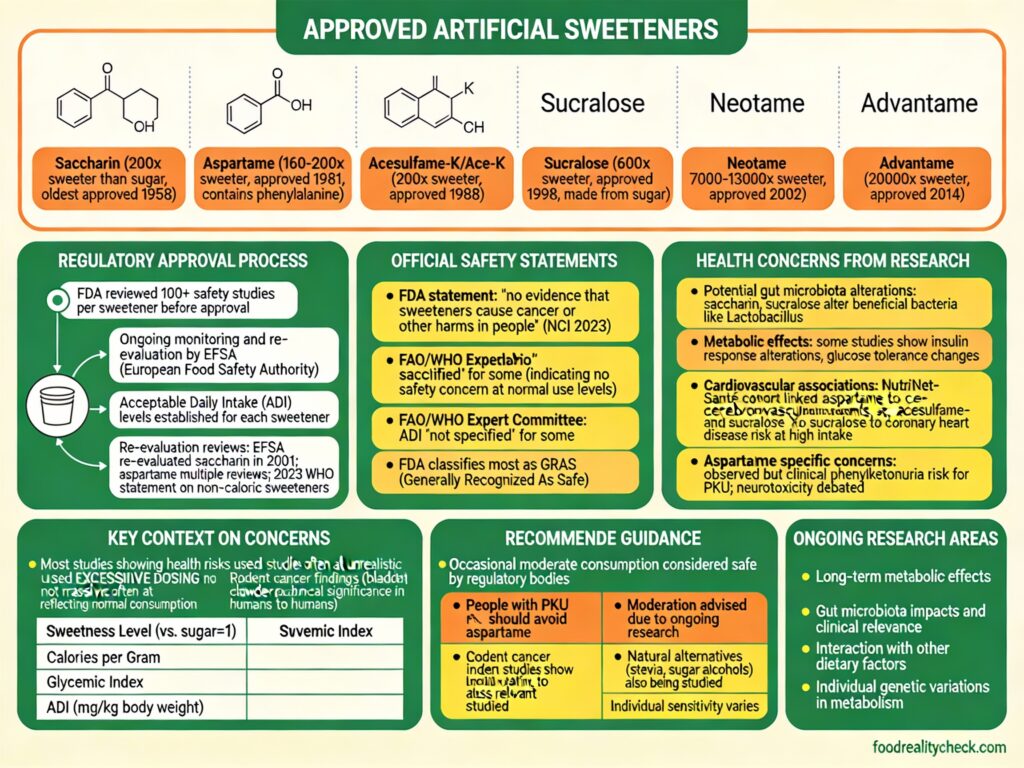
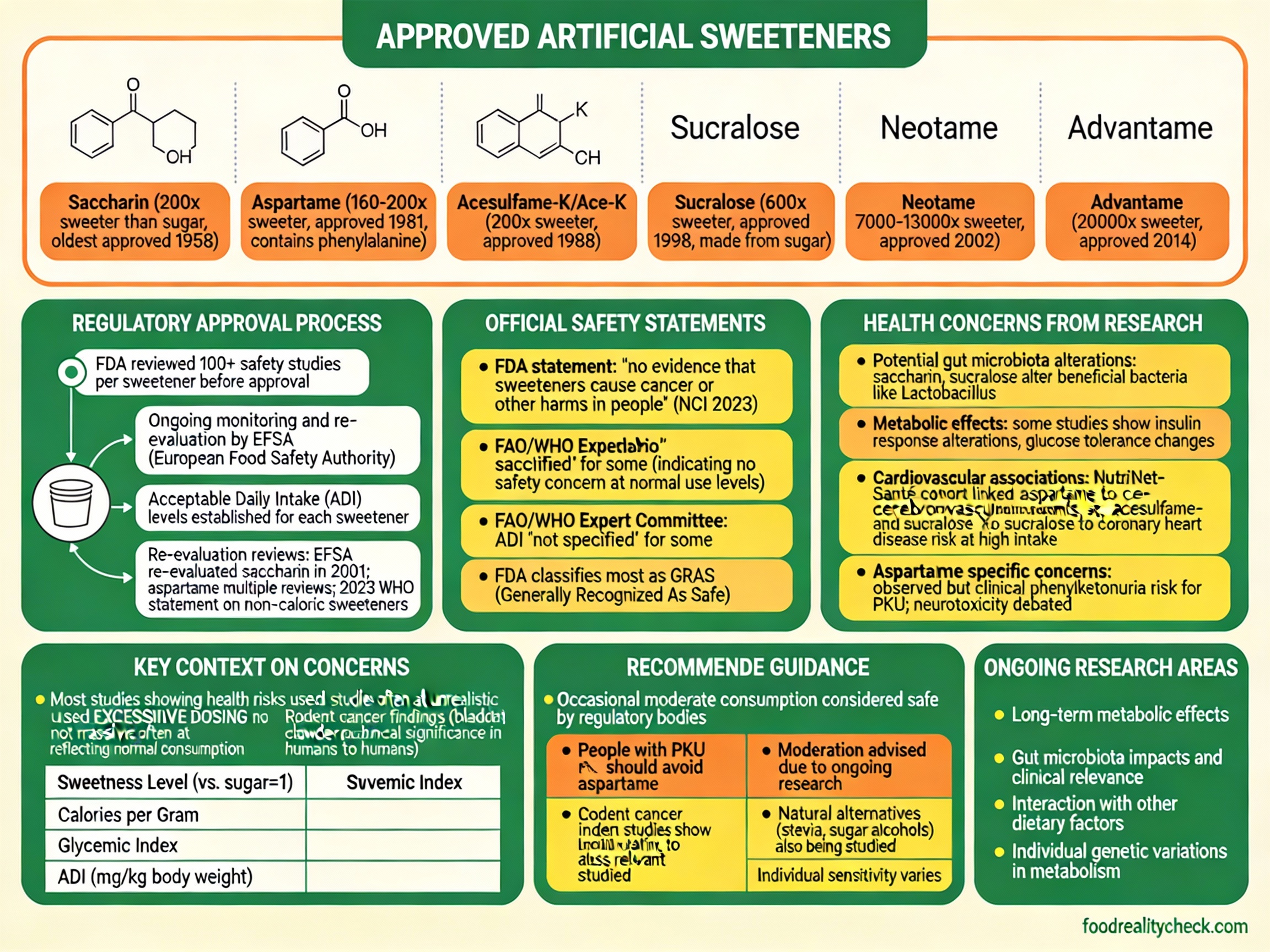
The FDA says: Approved artificial sweeteners are safe at current consumption levels. Before approving saccharin, aspartame, acesulfame-K, sucralose, neotame, and advantame, the FDA reviewed numerous safety studies. The agency continues to monitor new research.
The EFSA says: As of 2024-2025, revised Acceptable Daily Intake (ADI) limits for saccharin (increased from 5 to 9 mg/kg body weight) and acesulfame-K (increased to 15 mg/kg body weight) indicate these are safe. Aspartame ADI remains at 40 mg/kg body weight.
The WHO says: This is the outlier. In May 2023, the WHO recommended against using artificial sweeteners to control body weight, based on emerging evidence that they may contribute to weight gain and metabolic dysfunction. This was a significant shift from previous positions.
The IARC (International Agency for Research on Cancer) says: In June 2023, aspartame was classified as Group 2B—”possibly carcinogenic to humans.” But critically, JECFA (the joint WHO/FAO expert committee) reviewed the same evidence and concluded aspartame is safe and did not change its ADI of 40 mg/kg body weight.
Translation: Regulatory bodies are diverging, which means the evidence is genuinely uncertain and warranting more research.
What the Science Shows
The research divides into three critical questions: cancer risk, weight gain, and metabolic effects.
Do Artificial Sweeteners Cause Cancer?
The short answer: No clear evidence in humans, but recent cohort studies have raised concerns.
Early animal studies on saccharin showed bladder cancer in male rats at extremely high doses. However, mechanistic research proved this effect doesn’t apply to humans—saccharin was delisted as a carcinogen in 2000. The FDA notes that this animal data “is not predictive of cancer risk in humans.”
For aspartame, the 2023 IARC classification as “possibly carcinogenic” was based on limited evidence of liver cancer in humans and limited animal studies. However, this is crucial: the JECFA reviewed the identical evidence and reached the opposite conclusion—that aspartame is safe and no mechanism exists by which it could cause cancer. The FDA also disputed IARC’s methodology, stating it “identified significant shortcomings” in the studies.
The largest human cohort study (NutriNet-Santé, 102,865 French adults) found a slight increased cancer risk associated with higher artificial sweetener consumption overall (hazard ratio = 1.13). However, this was observational data—not proof of causation. People who drink more diet soda may also be more overweight, sedentary, or have other health differences that account for the increased risk.
Result: Regulatory agencies disagree. IARC flagged aspartame as possibly carcinogenic. JECFA and FDA said it’s safe. The evidence appears insufficient for either conclusion to be definitive.
Do Artificial Sweeteners Cause Weight Gain?
This is where the evidence is most concerning and contradictory.
Short-term randomized trials (the gold standard for safety assessment) show that artificial sweeteners reduce calorie intake compared to sugar and don’t consistently cause weight gain. In one study, people drinking aspartame-sweetened beverages gained less weight than those drinking sugar-sweetened drinks.
However, long-term observational studies tell a different story. A 2023 study by University of Minnesota researchers following people over 20 years found that habitual consumption of aspartame, saccharin, and diet beverages was linked to increased abdominal and muscle fat accumulation—even after controlling for diet quality and calories consumed. Notably, sucralose showed no such association.
Additionally, a 2008 Chinese study of 752 adults found that high MSG consumers had 2.1-2.75 times higher odds of being overweight, even after controlling for total calorie intake.
The WHO’s 2023 recommendation against artificial sweeteners for weight control was based on this emerging evidence that they may not help weight loss and might even promote weight gain through unknown metabolic mechanisms.
Result: Randomized trials show short-term benefit; long-term observational data suggest potential for weight gain. This discrepancy may indicate that mechanisms beyond calories—like altered appetite signaling or metabolic changes—are at play.
How Do Artificial Sweeteners Work In Your Body?
The mechanism matters because it reveals potential harms. Aspartame breaks down into aspartate, phenylalanine, and methanol. Each is found in common foods (phenylalanine is in all protein-containing foods; methanol is in fruit). The FDA notes this is not a concern at normal consumption levels.
However, several proposed mechanisms could explain the weight gain and metabolic concerns:
1. The “Reward System” Hypothesis: Sweet taste without calories may confuse the brain’s reward-satiety system, causing compensatory overeating elsewhere (though randomized trials haven’t consistently shown this).
2. Gut Microbiota Changes: Some sweeteners may alter your gut bacteria in ways that promote weight gain and inflammation—a mechanism observed in animal studies but not well-studied in humans.
3. Oxidative Stress: Some studies suggest aspartame induces oxidative stress (cellular damage). This could theoretically contribute to inflammation and cancer, though causation hasn’t been established.
Result: Proposed mechanisms exist, but human evidence is limited and inconsistent.
Why the Confusion?
Artificial sweeteners have been studied more thoroughly than almost any food additive—tens of thousands of studies exist. Yet the evidence remains conflicted because:
1. Short-term vs. long-term effects differ: Safe over a few weeks doesn’t necessarily mean safe over decades of consumption.
2. Observational data has limitations: People who drink more diet soda are often different from those who don’t in many ways (weight, health behaviors, underlying metabolic issues), making causation impossible to determine from observation alone.
3. Individual variation: Some people may be sensitive to specific sweeteners; others aren’t. Population-level averages may obscure important subgroup effects.
4. Different sweeteners, different risks: Aspartame, saccharin, sucralose, and acesulfame-K are chemically distinct and may have different effects. Many studies lump them together, which obscures differences.
Real Concerns
⚠️ Weight gain and metabolic dysfunction
Long-term consumption of aspartame and saccharin appears associated with increased body fat, particularly in the abdomen—even among people controlling for calorie intake. Whether this is causal or correlational remains unclear, but the WHO deemed it concerning enough to recommend against artificial sweeteners for weight management. If you’re trying to lose weight, these may undermine your efforts more than the “fewer calories” claim suggests.
⚠️ Cancer risk uncertainty
While regulatory agencies maintain that artificial sweeteners are safe, the IARC’s 2023 classification of aspartame as “possibly carcinogenic” and the NutriNet-Santé study’s finding of slightly increased cancer risk in high consumers represent genuine reasons for caution—not definitive proof of danger. If you consume very large amounts of aspartame daily (think 9+ diet sodas), this uncertainty may warrant reduction.
⚠️ Metabolic and immune effects in sensitive individuals
Some studies show that aspartame increases oxidative stress and may alter immune function in animal models. While human relevance is unclear, some individuals may be genetically predisposed to heightened sensitivity. If you experience symptoms like fatigue, headaches, or joint pain after high artificial sweetener consumption, these could be legitimate reactions in your body—even if population averages show safety.
Who Should Be More Cautious?
People with phenylketonuria (PKU): Aspartame breaks down into phenylalanine. This is dangerous for the rare genetic condition PKU. Aspartame packaging includes PKU warnings.
People trying to lose weight: Despite being calorie-free, artificial sweeteners may promote weight gain through metabolic changes, based on long-term observational data.
Pregnant women: Evidence is limited and conflicting, but some early studies suggested aspartame may affect fetal development. The safer approach during pregnancy is to avoid high consumption.
People with a family history of cancer or obesity: While not definitive, the emerging evidence on cancer and weight gain suggests these groups might benefit from minimizing consumption pending clearer research.
The Safe Amount
Regulatory bodies set ADI limits based on animal toxicity studies at extremely high doses:
Aspartame: 40 mg/kg body weight per day (JECFA). For a 70 kg person, this equals 2,800 mg daily. A single 12-ounce diet soda contains about 125-200 mg. You’d need to drink 14-22 cans daily to approach the regulatory limit.
Saccharin: 9 mg/kg body weight per day (EFSA, 2024—increased from 5). For a 70 kg person, this equals 630 mg daily.
Acesulfame-K: 15 mg/kg body weight per day (EFSA, 2024). For a 70 kg person, this equals 1,050 mg daily.
At typical consumption levels (1-2 diet beverages per day), you’re nowhere near these thresholds. However, the regulatory limits are set to prevent acute toxicity, not to prevent the weight gain and potential metabolic effects emerging from observational studies at much lower doses.
The Bottom Line
Artificial sweeteners are not acutely toxic at approved consumption levels—the FDA, EFSA, and JECFA are correct on this. The regulatory safety limits are scientifically sound.
However, the WHO’s recent recommendation against their use for weight control, combined with observational evidence of long-term weight gain and metabolic dysfunction, and IARC’s “possibly carcinogenic” classification of aspartame, suggests that “safe” and “beneficial” or even “neutral” are different questions.
The science says: Artificial sweeteners won’t poison you acutely. But they may subtly interfere with weight regulation and metabolism over years, and aspartame carries genuine uncertainty regarding cancer risk. If you consume them occasionally, the evidence suggests minimal risk. If you consume them daily as a major food source, the WHO’s caution is warranted.
The practical takeaway: You can feel safe using artificial sweeteners occasionally. But they’re not a free pass for weight management, and the long-term metabolic and cancer evidence is unsettled enough that minimizing consumption is reasonable, particularly if you struggle with weight or have cancer risk factors.