Blockchain in Food: How Technology Ensures Supply Chain Transparency
Understanding how distributed ledger technology transforms food traceability, prevents fraud, and builds consumer trust.
What Is Blockchain in Food Traceability?
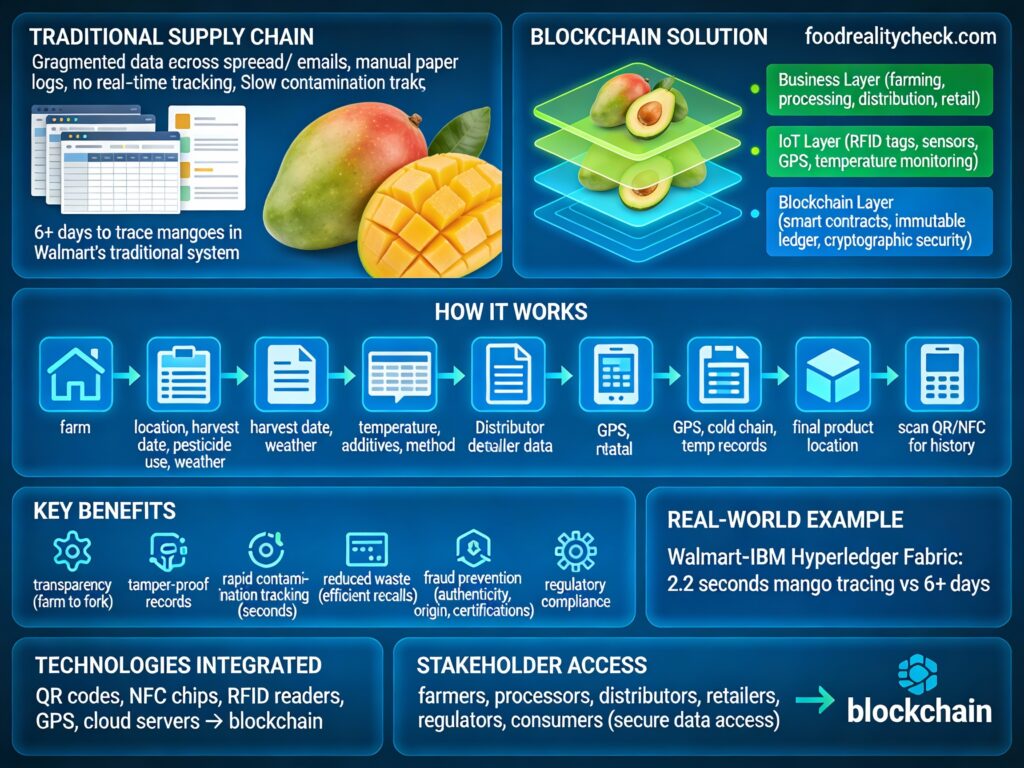
Blockchain food traceability is a digital ledger system that records every transaction, movement, and event in a food supply chain—from the moment a product is harvested at the farm through processing, distribution, retail, and delivery to the consumer. Rather than storing this information in separate databases controlled by individual companies, blockchain distributes the record across a network of computers, making it transparent, secure, and nearly impossible to tamper with.
The technology creates an immutable “paper trail” of food’s journey. When a product changes hands—from farmer to processor, processor to distributor, distributor to retailer—that transaction is recorded on the blockchain, timestamped, and linked to the previous transaction. This creates a continuous, verifiable chain of custody that anyone with appropriate permissions can access and audit.
The genius of blockchain is that it solves a fundamental problem in global food systems: traditional traceability relies on fragmented databases, paper records, spreadsheets, and phone calls. When food safety incidents occur, finding the contaminated product’s origin can take weeks. Blockchain collapses that timeframe to seconds.
🔑 Quick Facts About Blockchain in Food
- Technology Type: Distributed ledger (decentralized database)
- Key Feature: Immutable, timestamped records accessible to authorized parties
- Data Tracked: Product origin, batch numbers, handling conditions, certifications, transportation routes, storage temperatures
- Consumer Access: QR code scanning for farm-to-table transparency
- Speed Improvement: Traceability reduced from weeks/days to seconds (example: 6 days → 2.2 seconds)
- Market Size (2025): $3.04 billion globally
- Projected Market (2035): $52.2 billion (32.9% CAGR)
- Global Growth Leaders: China (44.4% growth), India (41.1% growth), Germany (37.8% growth)
How Does Blockchain Food Traceability Work?
Understanding blockchain in food requires grasping three core concepts: the distributed ledger, cryptographic security, and smart contracts.
The Core Process
- Data Entry at Source: A farmer harvests a batch of lettuce. Information is recorded: harvest date, location (GPS coordinates), weather conditions, pesticide use (if applicable), batch number. This data is entered into a blockchain application (web or mobile) and transmitted to the network.
- Cryptographic Hashing: The system creates a unique cryptographic fingerprint (hash) of this data. Any change to even one character in the original data would create a completely different hash. The blockchain permanently stores both the data and its hash.
- Block Creation: Multiple transactions (from different farms, different products, different timestamps) are bundled into a block. This block is timestamped, assigned a unique identifier, and cryptographically linked to the previous block. This creates an unbreakable chain—if someone attempts to alter a past transaction, the hash changes, breaking the chain and triggering an alert.
- Network Validation: Before a transaction is added to the blockchain, multiple nodes (computers) in the network validate it using a consensus protocol. This ensures no single actor can falsify data. Suppliers, auditors, and regulators might all validate the transaction before it’s finalized.
- Distributed Storage: Once validated, the record is copied and stored across multiple computers in the network. There’s no single point of failure. Even if one computer is hacked, the other thousands of copies remain intact and verifiable.
- Product Movement & Tracking: As the lettuce moves through the supply chain—to the processor, the distributor, the retailer—each handoff is recorded as a new transaction on the blockchain. Temperature sensors (IoT devices) can automatically log cold-chain conditions and trigger alerts if the lettuce gets too warm.
- Consumer Transparency: A QR code on the retail package is linked to the blockchain record. A consumer scans the code with their phone, and they instantly see where the lettuce was grown, how it was handled, what certifications it carries, and when it was harvested.
Smart Contracts: Automation & Enforcement
Smart contracts are self-executing agreements programmed into the blockchain. For example: “If a temperature sensor detects that produce has been exposed to temperatures above 5°C for more than 2 hours, automatically send an alert to the distributor and mark the shipment as non-compliant.” These contracts execute without human intervention, ensuring rules are enforced consistently and food quality is maintained automatically.
Problems Blockchain Solves in Food Supply Chains
1. Fragmented Data & Visibility Gaps
The Problem: Traditional food supply chains involve dozens of participants—farms, suppliers, processors, transporters, distributors, retailers, regulators. Each maintains their own databases in different formats. When a contamination incident occurs, piecing together what happened requires calling dozens of suppliers, waiting for responses, and hoping accurate records exist.
Blockchain Solution: All parties access the same, real-time ledger. A regulator investigating a food poisoning outbreak can instantly see every touchpoint: which farm supplied the ingredients, which processor handled them, which transporter delivered them, what temperatures they experienced. Investigation time collapses from weeks to hours.
2. Food Fraud & Counterfeit Products
The Problem: Food fraud costs the global economy billions annually. Products are mislabeled (non-organic products sold as organic), diluted (fake honey), or counterfeited (luxury champagne). Traditional certifications (organic, fair-trade, PDO) are paper-based and easy to forge.
Blockchain Solution: Every certified attribute is recorded immutably on the blockchain. A “PDO Parmigiano-Reggiano” cheese carries cryptographic proof of its origin, the specific dairy it came from, and the production process. Consumers scanning a QR code see verifiable data, not just a label claim. Counterfeiters can print fake labels, but they can’t create a matching blockchain record without access to the network.
3. Slow Recalls & Contamination Spread
The Problem: Food recall procedures are glacially slow. In a recent contamination incident, identifying all affected products and locations took six days. During those days, contaminated food continued to be sold and consumed, putting more people at risk.
Blockchain Solution: Once a contamination is identified in a specific batch, the system instantly identifies every location where that batch was shipped, every retail location that sold it, and can notify consumers via their purchase records. A 6-day recall window becomes a 2-second identification window.
4. Regulatory Compliance & Reporting
The Problem: Food companies face increasingly stringent regulations (FSMA 204 in the US, EUDR in Europe, CSRD reporting requirements). Compliance requires maintaining detailed traceability records and generating reports on demand. Many companies use outdated systems, making compliance expensive and error-prone.
Blockchain Solution: Compliance data is automatically recorded and timestamped. When a regulator requests records, companies can generate audit-ready reports in minutes. Smart contracts can automatically flag non-compliant suppliers or shipments, enabling proactive compliance management.
5. Sustainability & Ethical Sourcing Claims
The Problem: Brands claim products are “sustainable,” “ethical,” “organic,” or “cruelty-free,” but these claims often aren’t substantiated. Consumers want to trust these claims, but there’s no reliable way to verify them.
Blockchain Solution: Sustainability metrics—water use, carbon emissions, labor practices, deforestation risk—can be tracked and verified at each step of the supply chain. Brands can prove their environmental and ethical claims with data, not just marketing language.
Key Benefits of Blockchain in Food Traceability
Pinpoint contamination sources in seconds instead of days or weeks, dramatically reducing health risks and product recalls.
Cryptographic proof of authenticity makes counterfeiting and mislabeling nearly impossible, protecting brand reputation and consumers.
Smart contracts reduce manual paperwork by 80%, decrease processing times by 40-70%, and eliminate human error in compliance tracking.
Transparent, verifiable supply chain data builds brand loyalty and justifies premium pricing for ethically and sustainably sourced products.
Automatic audit trails and timestamped records simplify compliance with FSMA 204, EUDR, CSRD, and other regulations.
Real-time logistics visibility and predictive analytics minimize spoilage, optimize inventory, and reduce food waste by 25%+.
Regulatory Drivers Accelerating Blockchain Adoption
FSMA Rule 204 (United States)
The U.S. FDA’s Food Safety Modernization Act Rule 204 mandates that food companies establish comprehensive traceability plans and maintain electronic records that can be provided to the FDA within 24 hours. Blockchain platforms are the ideal solution—they automatically capture all required data elements (source, processing steps, batch codes, storage conditions) and generate FDA-ready reports instantly. Companies using blockchain for FSMA compliance report 40-70% reduction in processing times and 80% reduction in compliance-related fraud incidents.
EUDR (European Union Deforestation Regulation)
The EU’s deforestation regulation requires companies to prove that agricultural products (cocoa, coffee, cattle, soy) do not contribute to deforestation. This necessitates complete supply chain transparency—tracking land use, deforestation risk, and source verification. Blockchain-powered traceability systems are becoming the standard tool for EUDR compliance, particularly for suppliers in emerging markets where paper-based records are unreliable.
CSRD (Corporate Sustainability Reporting Directive)
The EU’s new corporate sustainability reporting requirements demand detailed data on supply chain environmental and social impacts. Blockchain systems that automatically record sustainability metrics at each step of the supply chain are becoming essential for large companies to meet these reporting obligations cost-effectively.
Market Impact of Regulations
Regulatory pressure is the primary driver of blockchain adoption. Regions with stricter food safety and sustainability regulations (Europe, developed parts of Asia, North America) are adopting blockchain fastest. Companies that implement blockchain now gain a competitive advantage—they’ll be compliant when stricter regulations roll out, while competitors scramble to catch up.
Challenges & Barriers to Adoption
⚠️ High Initial Costs
Implementing blockchain infrastructure is expensive. Companies must invest in software, IoT sensors, integration with existing systems, staff training, and ongoing maintenance. Small and medium-sized enterprises (SMEs) often lack the capital for these investments, limiting adoption to large corporations. For broader adoption, cost barriers need to fall—or vendors need to offer more affordable, modular solutions.
⚠️ Technology Complexity
Blockchain is complex. Food industry professionals—many from agricultural backgrounds—often don’t understand distributed ledgers, cryptography, or smart contracts. This knowledge gap creates resistance and makes implementation challenging. Companies adopting blockchain need significant training investments and typically hire external consultants.
⚠️ Scalability Limitations
Current blockchain systems process transactions relatively slowly. High volume—thousands of food companies, millions of products, billions of daily transactions—can create bottlenecks. New blockchain protocols (like Layer 2 solutions) are addressing this, but scalability remains a concern for truly global, real-time food tracing.
⚠️ Data Quality Issues
“Garbage in, garbage out.” Blockchain is only as reliable as the data entered into it. If a farmer falsifies harvest records, or a processor enters incorrect batch numbers, blockchain faithfully records the false data. Unlike humans, blockchain can’t detect obvious lies—it can only ensure that whatever data is recorded stays permanent and unaltered.
⚠️ Ecosystem Fragmentation
Multiple blockchain platforms exist (Hyperledger Fabric, VeChain, Ethereum, custom builds), but they don’t easily interoperate. A food company using one blockchain may struggle to share data with suppliers using a different system. Industry-wide standardization is still emerging, limiting the networks’ full potential.
⚠️ Regulatory Uncertainty
While regulations like FSMA 204 and EUDR accelerate blockchain adoption, unclear legal status in some jurisdictions creates hesitation. What happens if a blockchain record is hacked? Who’s legally responsible? These questions remain partially unanswered in many countries, creating legal risk for early adopters.
⚠️ Consumer Adoption Lag
Blockchain’s B2B benefits are clear, but consumer engagement is limited. Only 2-8% of consumers scan QR codes to verify supply chain data, even when it’s available. Building consumer demand for transparent food tracing requires significant education and cultural shift.
Leading Blockchain Food Traceability Companies
| Company | Platform/Focus | Key Clients/Partners |
|---|---|---|
| IBM Food Trust | Enterprise blockchain for food supply chain traceability using Hyperledger Fabric | Walmart, Carrefour, Unilever, Tyson Foods |
| TraceX Technologies | Blockchain platform for sustainability tracking and food traceability; focus on agricultural commodities | Spice processors, seed producers, global exporters |
| TE-FOOD | Blockchain-based food traceability system; consumer-facing transparency | Food producers, retailers in Asia, Europe |
| VeChain | Blockchain platform with IoT integration for supply chain visibility | Luxury brands, food companies, enterprise solutions |
| FoodLogiQ | Food safety and traceability platform integrated with blockchain | Large food manufacturers, retailers, distributors |
| Decapolis | Blockchain for food certifications (organic, fair-trade, PDO) and supply chain authentication | Food producers in MENA region, exporters |
| Provenance | Blockchain for supply chain transparency and ethical sourcing verification | Premium food brands, sustainability-focused companies |
| Wholechain | End-to-end food traceability and quality data coordination | Food producers, retailers, regulatory bodies |
The Bottom Line
Blockchain is transforming food supply chains from opaque, fragmented systems into transparent, auditable networks where every transaction is timestamped, cryptographically secured, and instantly traceable. The technology works—major retailers global brands have proven its value.
What blockchain does exceptionally well: Eliminates traceability delays (from days to seconds), prevents fraud through cryptographic proof, automates compliance documentation, and builds consumer trust through verifiable transparency. These benefits are worth the investment for large food companies and are increasingly required by regulations.
What blockchain cannot do: Blockchain cannot verify the honesty of data entered into it. It cannot prevent human corruption or false records at the source. It also cannot replace traditional food safety practices (hygiene, testing, inspection). Blockchain is a transparency tool, not a substitute for food safety fundamentals.
Where blockchain is headed: Expect exponential growth. The blockchain food traceability market is valued at $3.04 billion in 2025 and is projected to reach $52.2 billion by 2035—a 32.9% compound annual growth rate. Regulatory pressure (FSMA 204, EUDR, CSRD) will drive adoption. Costs will decline as the technology matures and competition increases. Interoperability standards will emerge, making it easier for companies to share data across blockchain platforms.
For businesses: Blockchain adoption is increasingly not a choice but a necessity. Suppliers will need blockchain traceability to sell to major retailers. Food companies will need it for regulatory compliance. Brands will use it for competitive advantage in transparency-conscious markets.
Blockchain in food isn’t a future technology—it’s becoming a present reality that will define the next decade of food supply chain management. The companies adopting it now are positioning themselves as industry leaders in transparency, safety, and sustainability.
Pingback: Blockchain Beyond Bitcoin: Revolutionizing Industries Far and Wide - Crypto Invest HQ