What Is BPA?
BPA stands for Bisphenol A, a synthetic chemical that has been widely used in food packaging since the 1960s. It’s a key ingredient in making polycarbonate plastics and epoxy resins—materials that are durable, clear, and heat-resistant.
The name comes from its chemical structure: a bisphenol compound with two phenol groups. BPA was discovered in 1891, but its usefulness in plastics wasn’t recognized until decades later.
Today, BPA is found in billions of consumer products worldwide, making it one of the most ubiquitous industrial chemicals on the planet. In fact, approximately 93% of Americans have detectable levels of BPA in their urine, indicating widespread exposure.
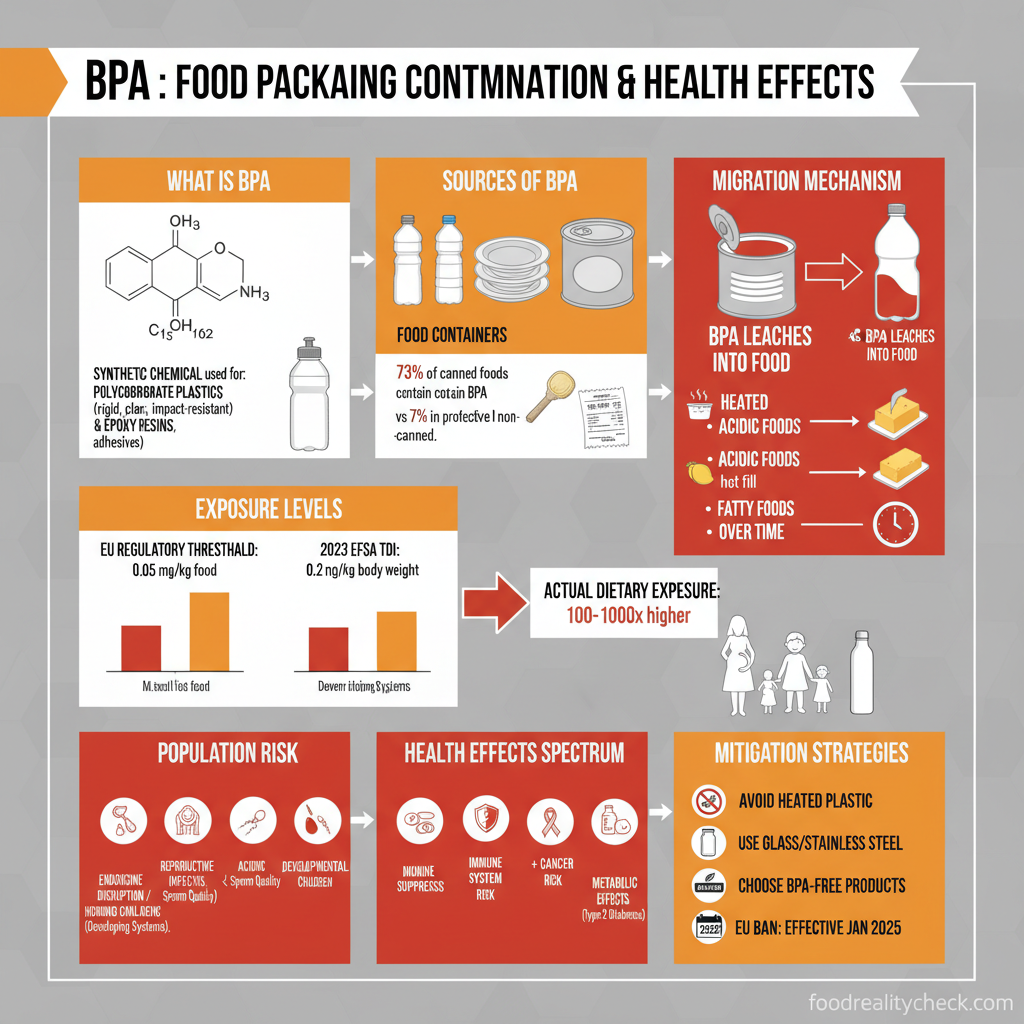
Quick Facts
- Type: Synthetic organic compound
- Made from: Phenol and acetone
- First synthesized: 1891
- Widely used in packaging: Since 1960s
- Key property: Endocrine disruptor
- Detection rate: 93% of Americans tested
Where You’ll Find BPA
BPA is in far more than you might realize. The primary exposure route is through food and beverages that have been in contact with BPA-containing materials:
| Product Category | BPA Presence | Risk Level |
|---|---|---|
| Canned vegetables | 73% of samples tested | High |
| Canned fruits | 73% of samples tested | High |
| Canned soups | High concentrations found | High |
| Canned beverages | Variable (some high levels) | Moderate |
| Polycarbonate plastic bottles | Leaches when heated | Moderate |
| Fresh or frozen foods | Only 7% of samples | Low |
| Glass-packaged foods | Minimal exposure | Very Low |
Beyond food and drink: BPA is also found in thermal paper receipts, some dental sealants, medical devices, electronics, and construction materials. However, dietary exposure from food contact materials remains the primary pathway for most people.
Why Do Food Companies Use BPA?
Manufacturers use BPA because it’s an extremely effective and inexpensive material with several valuable properties:
Durability: Polycarbonate plastics containing BPA are incredibly strong and long-lasting, making them ideal for reusable bottles and containers.
Heat resistance: BPA-based epoxy resins can withstand high temperatures without degrading, which is essential for hot-filling canning processes and microwave use.
Clarity: Products made with BPA remain transparent and clear, which consumers expect for beverages and certain foods.
Cost-effectiveness: BPA is far cheaper than most alternatives, keeping consumer prices low. This economic advantage has made it the industry standard for decades.
Food protection: The epoxy resin lining in cans prevents food from directly contacting the metal, which would cause corrosion and contamination.
Without BPA and similar compounds, food would spoil faster, packaging would be more fragile, and consumer prices would be significantly higher.
What Health Risks Does BPA Pose?
⚠️ Key Finding
BPA is classified as an endocrine disruptor. This means it can interfere with your body’s hormone systems, which regulate virtually every biological process.
Research has linked BPA exposure to numerous health concerns:
Reproductive & Developmental Effects
Studies show BPA can harm fertility in both men and women. In developing fetuses and young children, BPA exposure has been associated with abnormal development of reproductive organs, altered sex hormone levels, and reduced fertility in later life. Pregnant women are particularly vulnerable, as BPA can cross the placental barrier and affect fetal development.
Metabolic & Cardiovascular Effects
BPA exposure has been linked to increased risk of obesity, type 2 diabetes, and cardiovascular disease. It may interfere with insulin signaling and energy metabolism, contributing to metabolic syndrome.
Immune System Disruption
Recent research from the European Food Safety Authority (EFSA) found that BPA affects immune system cells even at very low doses. This can potentially increase susceptibility to infections and autoimmune diseases, and may trigger lung inflammation.
Neurological Effects
BPA exposure during critical developmental windows may impair cognitive development, learning, and behavior. Some studies suggest effects on attention span and social behavior, particularly in children.
Cancer Risk
BPA has been linked to increased risk of various cancers, including prostate and breast cancer. While the exact mechanisms in humans require further study, animal studies show clear carcinogenic potential at relevant exposure levels.
Other Concerns
Additional health effects under investigation include: eye damage, allergic skin reactions, respiratory tract irritation, and effects on bone health.
How Much BPA Are You Actually Consuming?
Real-World Exposure Data
A single canned food increases BPA levels by 24% in your body (measured in urine). Eating two or more canned foods in one day raises levels by 54%.
Certain canned foods are worse than others. Canned vegetables, fruits, and soups show the strongest associations with elevated BPA levels. One study found canned green beans containing up to 149 nanograms per gram, canned corn at 121 ng/g, and mixed vegetables at 80.6 ng/g.
Average American Exposure
Research estimates that the average American is exposed to approximately 200 nanograms of BPA per kilogram of body weight per day through diet. This means a 70 kg (154 lb) adult consumes roughly 14,000 nanograms of BPA daily from food alone—before accounting for exposure from receipts, air, dust, and other sources.
The critical issue: This exposure is far above levels that scientific research shows can cause health harm.
What Do Safety Standards Say?
The Regulatory Divide
Europe vs. United States: A 20,000-Fold Difference
In late 2023, the European Food Safety Authority (EFSA) drastically revised its safety assessment based on new scientific evidence. They lowered the tolerable daily intake (TDI) of BPA to 0.2 nanograms per kilogram of body weight per day. This is a 20,000-fold decrease from their previous 2015 standard.
In contrast, the U.S. FDA still maintains a safety level of 50 micrograms (50,000 nanograms) per kilogram per day—roughly 250,000 times higher than EFSA’s new standard.
This dramatic difference isn’t due to different scientific evidence—both agencies review the same studies. Rather, it reflects different regulatory philosophies and assessment methodologies.
FDA Position (United States)
The FDA continues to state that current BPA exposure levels are safe based on studies it deems acceptable. The agency argues that BPA is rapidly metabolized in the body and eliminated. However, the FDA’s approach has been criticized by leading independent scientists for relying on outdated assessment methods and ignoring thousands of recent studies on low-dose effects.
EFSA Position (European Union)
The EFSA conducted a comprehensive review using modern protocols for evaluating endocrine disruptors. They included more recent studies and paid specific attention to low-dose effects on the immune system—the most sensitive endpoint identified. Based on this analysis, EFSA concluded that the previous safety margin was inadequate and lowered the TDI by 20,000-fold.
Scientific Consensus
A coalition of prominent endocrine disruption researchers, including Dr. Frederick vom Saal and Dr. Shanna Swan, strongly support EFSA’s decision. They emphasize that the science on BPA’s effects is well-established and that the European standard is more protective of public health. These scientists point out that Americans are exposed to levels 5,000-20,000 times above the safe level under EFSA’s new standard.
How to Reduce Your BPA Exposure
Immediate Actions You Can Take
1. Choose Fresh Over Canned
This is the single most effective step. Fresh fruits, vegetables, and proteins contain minimal BPA (only 7% of fresh food samples test positive, compared to 73% of canned foods).
2. Eat Frozen Foods
Frozen vegetables and fruits are processed without prolonged contact with packaging, resulting in much lower BPA levels than canned alternatives. They’re also more affordable than fresh in many regions.
3. Avoid Microwaving Plastic Containers
Heat causes BPA to leach rapidly from polycarbonate plastics into food. Never microwave food in plastic containers—transfer to ceramic or glass instead.
4. Skip the Dishwasher for Plastic
High heat and harsh detergents accelerate BPA migration. Hand wash plastic containers with cool water when possible.
5. Reduce Canned Beverages
Some canned drinks contain higher BPA levels than others. Choose glass or aluminum bottles without BPA-based linings when possible.
6. Don’t Heat Food in Plastic
Fatty, salty, and acidic foods leach more BPA from plastic. These foods are especially problematic when heated.
7. Decline Thermal Paper Receipts
Most cash register receipts are printed on thermal paper coated with BPA. Ask for email receipts instead, or wash your hands after handling receipts.
8. Avoid Plastic Storage
Don’t store foods or liquids in plastic when alternatives exist. Plastic #3 (PVC) and #7 (polycarbonate) are most likely to contain BPA.
Safer Alternatives to BPA-Containing Packaging
Want to reduce your exposure? Several alternatives exist, though each has trade-offs:
| Material | Pros | Cons | Best For |
|---|---|---|---|
| Glass | No chemical leaching, reusable, dishwasher-safe, transparent | Heavy, fragile, more expensive | Food storage, beverages, cooking |
| Stainless Steel | Durable, hygienic, lightweight, long-lasting | Not transparent, can dent, more costly | Water bottles, travel containers, lunch boxes |
| Ceramic/Porcelain | No chemical migration, attractive, reusable | Fragile, can chip, variable quality | Food storage, serving, tableware |
| Bamboo/Wood | Natural, lightweight, renewable, attractive | Limited food contact uses, requires maintenance | Utensils, cutting boards, serving |
| Beeswax Wraps | Plastic-free, compostable, reusable | Not heat-safe, limited durability | Food wrapping, storage covers |
Important Note About “BPA-Free”
While BPA-free products are better than BPA-containing ones, they often contain alternative bisphenols like BPS, BPF, BPAF, or BPZ. Recent research shows these alternatives may have similar health effects to BPA. “BPA-free” does not necessarily mean safe. When possible, choose materials that don’t use bisphenols at all—glass, stainless steel, or ceramic.
The Bottom Line
BPA is a persistent endocrine disruptor found in food packaging worldwide. It can leach into food, especially when heated, and studies link it to reproductive, metabolic, immune, and developmental harm.
The regulatory debate is clear: European scientists, after comprehensive review, concluded that Americans are exposed to levels thousands of times above safe thresholds. While the U.S. FDA has not updated its standards, the scientific weight of evidence supports the precautionary approach taken by Europe and Canada.
You can reduce your exposure today by choosing fresh or frozen foods, avoiding canned products when possible, never microwaving plastic containers, and switching to glass, stainless steel, or ceramic for storage and beverages.
No single action will eliminate BPA from your life—it’s too ubiquitous. But meaningful reductions are absolutely possible through deliberate choices about food packaging and storage methods.