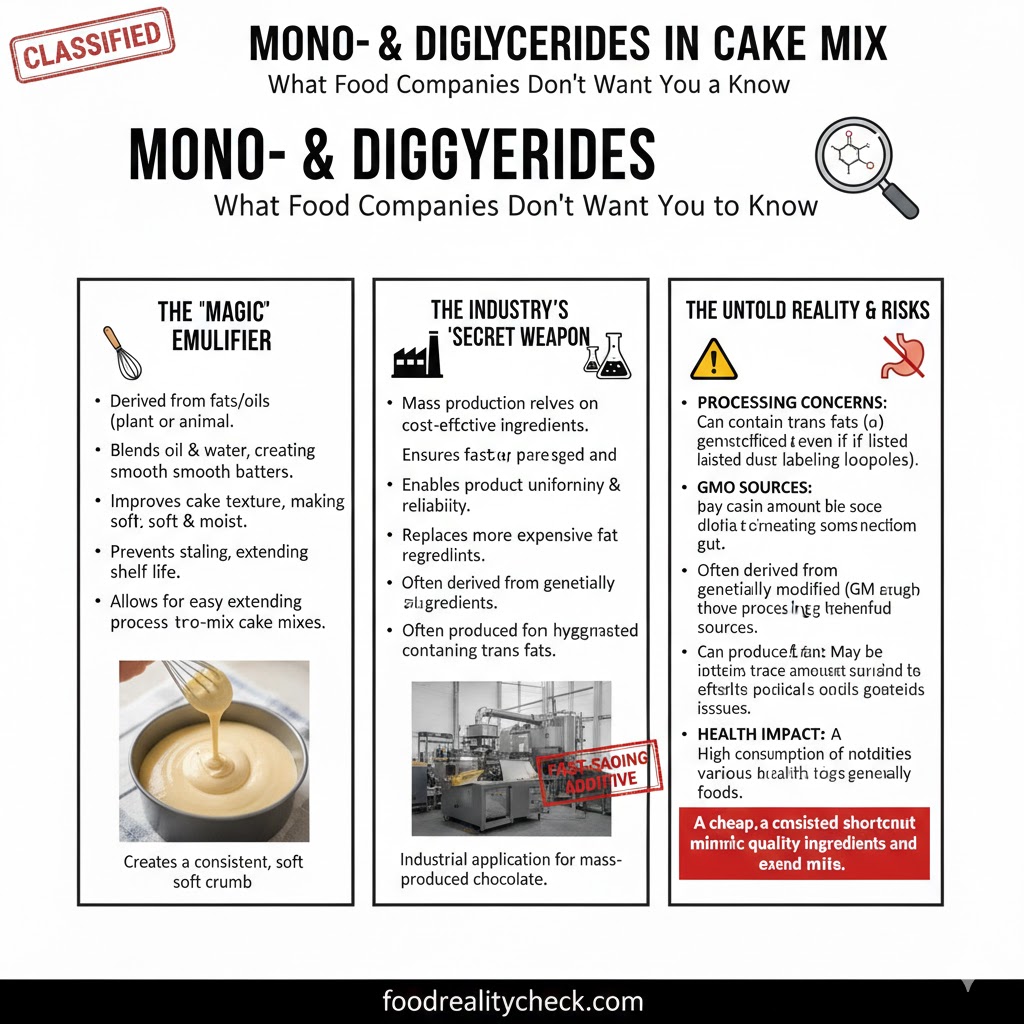
Mono- and diglycerides are emulsifiers derived from fats or oils, used in cake mixes to improve batter stability, increase volume, and create finer crumb structure. Understanding their emulsifying function explains why commercial cakes have better texture than some home-baked alternatives.
What Are Monoglycerides & Diglycerides
Glycerides are molecules formed from glycerol (a three-carbon alcohol) bonded to fatty acids. Triglycerides have three fatty acids attached, diglycerides have two, and monoglycerides have one. Monoglycerides and diglycerides are amphipathic—they have both hydrophobic (water-repelling, from the fatty acid) and hydrophilic (water-attracting, from the remaining glycerol) regions. This dual nature makes them excellent emulsifiers, allowing them to stabilize mixtures of oil and water.
The emulsifying power differs between mono- and diglycerides: monoglycerides are more amphipathic (greater difference between hydrophobic and hydrophilic regions), making them stronger emulsifiers. Commercial products often specify “mono- and diglycerides” because the mixture contains primarily monoglycerides with some diglycerides.
Production & Natural Sources
Monoglycerides and diglycerides can be produced by partial hydrolysis of triglycerides (fats) through acid or enzymatic treatment. This breaks some fatty acid bonds, leaving molecules with one or two fatty acids. The process is similar to natural fat digestion in the intestinal system, where lipase enzymes break triglycerides into monoglycerides and fatty acids for absorption.
They also occur naturally in small amounts in fats and oils, eggs, and some food sources. However, commercial products contain them in much higher concentrations than naturally occur. They’re GRAS (Generally Recognized as Safe) and widely used in baking, ice cream, and other processed foods.
Emulsification in Cake Batter
Cake batter is an emulsion: water (from liquid ingredients) and fat (from oil/butter) that don’t naturally mix. The emulsifier stabilizes tiny oil droplets dispersed throughout the water phase (or vice versa, depending on which phase is more abundant). Monoglycerides, positioned at oil-water interfaces with their hydrophobic tails in oil and hydrophilic heads in water, reduce interfacial tension and stabilize the emulsion.
This emulsification improves batter quality in multiple ways: (1) Better oil distribution throughout the batter, (2) Smaller fat droplets creating more uniform crumb, (3) Increased water retention during baking (monoglycerides improve dough’s water-holding capacity), (4) Better foam stability (important for cakes relying on air incorporation).
Texture & Volume Benefits
Cakes made with mono- and diglycerides have finer crumb (smaller, more uniform bubbles), greater volume (better foam stability allows more air to be retained), and more tender texture (finer crumb structure feels softer). These benefits are why commercial cake mixes include them—they consistently produce good cakes even with varying home-baking conditions and techniques.
The effects are measurable: cakes made with mono- and diglycerides typically rise 10-15% higher than equivalent recipes without them, producing visibly lighter crumb. Home bakers trying to replicate commercial cake texture often struggle because they lack this ingredient and must compensate through careful technique.
Why Cake Mix Contains Them
Commercial cake mixes depend on mono- and diglycerides because they standardize results across varying home conditions. Cake batter quality depends on fat distribution, water incorporation, and air retention. These all depend on emulsification. Including mono- and diglycerides ensures consistent quality regardless of whether the baker uses oil or butter, adds oil slowly or quickly, or uses varying water amounts. This is why commercial cake mixes often produce more consistent results than home recipes—the emulsifiers remove some of the technique dependency.
Additionally, mono- and diglycerides allow cakes to achieve greater volume with less fat—they improve emulsification efficiency, so slightly less total fat is needed. This reduces calories somewhat compared to traditional butter cakes while maintaining texture.
Typical Usage Amounts
Cake mixes typically contain 0.5-2% mono- and diglycerides (by weight). This amount is optimal for texture improvement—more provides minimal additional benefit and can create slightly unpleasant mouthfeel. The exact amount depends on other ingredients: cakes with higher water content need more emulsification, while cakes with adequate fat may need less.
Home bakers who want to replicate commercial cake texture without using mixes can add small amounts of mono- and diglycerides (available from baking supply companies), though most home cooks don’t bother. More practical solutions include using mayonnaise (contains egg emulsifier), whipping whole eggs thoroughly (incorporates air and provides natural emulsification), or simply accepting that home cakes will have slightly different crumb than commercial cakes.
Natural Alternatives in Home Baking
Eggs: Naturally contain lecithin (phospholipid emulsifier). Using whole eggs or egg whites provides emulsification. Thoroughly whipping eggs incorporates air while emulsifying fat and water. Mayonnaise: Combines oil and eggs, providing fat and emulsifier simultaneously. Butter: Contains natural mono- and diglycerides from partial fat breakdown during churning. Using high-quality butter provides some emulsification benefit.
These natural approaches work adequately for home baking but don’t provide the same level of optimization that commercial emulsifiers provide. Home bakers achieve good results through proper technique even without adding emulsifiers—using room-temperature ingredients, creaming thoroughly, and following recipes carefully compensates for lacking commercial emulsifiers.