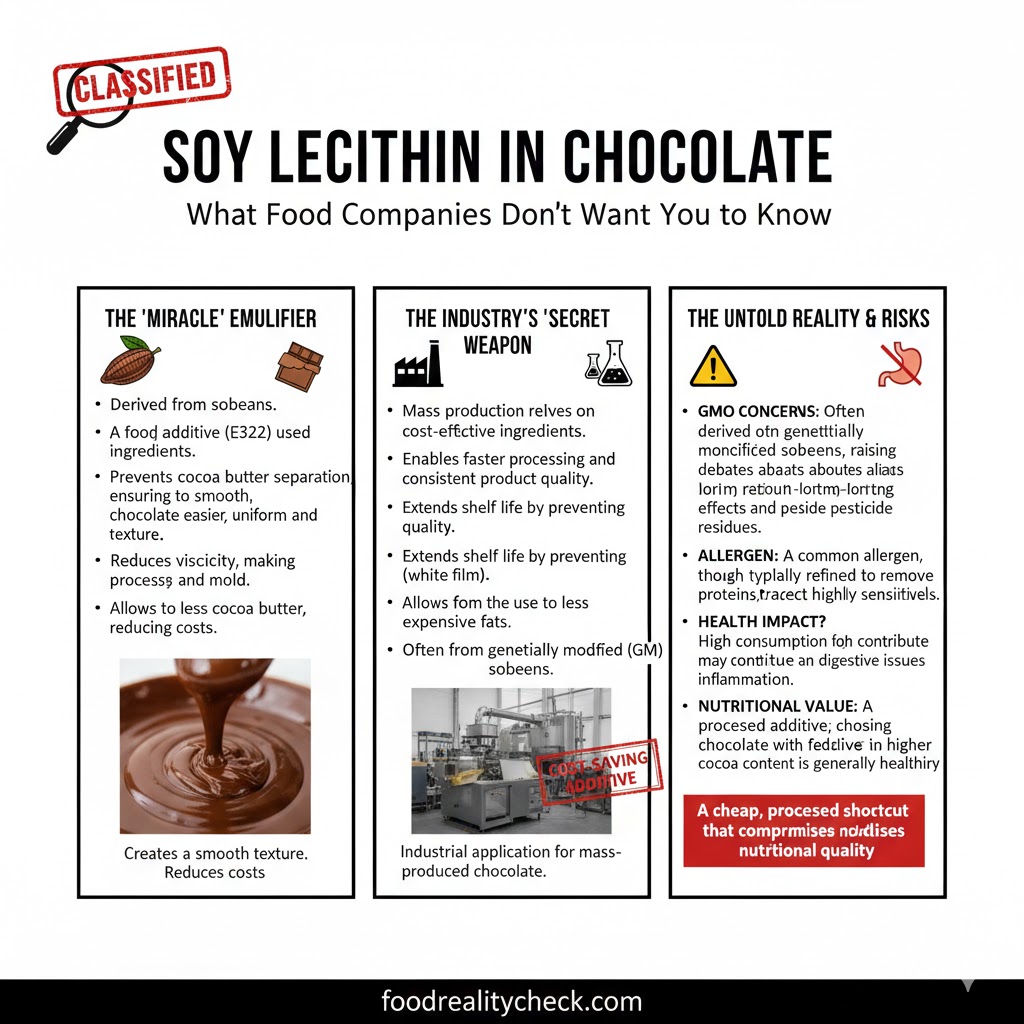
Soy lecithin—a natural emulsifier—reduces chocolate viscosity and improves flow properties without adding fat. Understanding lecithin’s emulsifying mechanism explains why it’s essential in commercial chocolate and why premium chocolates typically use more lecithin than budget products.
What Is Soy Lecithin
Lecithin is a phospholipid—a molecule with both hydrophobic (water-repelling) and hydrophilic (water-attracting) regions. In soy lecithin, these phospholipids are extracted from soybean oil through mechanical or chemical processing. The extraction produces a viscous amber liquid containing primarily phosphatidylcholine, phosphatidylethanolamine, and phosphatidylinositol. For chocolate application, soy lecithin is used because it’s inexpensive, effective, and generally recognized as safe.
Lecithin also occurs naturally in egg yolk (why egg yolks are natural emulsifiers), some seeds, and other sources. However, soy lecithin dominates commercial use due to cost and availability. Sunflower lecithin is an alternative for those avoiding soy, though it’s more expensive.
Emulsification Mechanism
Emulsification involves mixing two immiscible liquids (like oil and water) into a stable mixture. Lecithin’s bipolar structure—one end hydrophobic, one end hydrophilic—allows it to position itself at oil-water interfaces. The hydrophobic end embeds in oil, the hydrophilic end faces water. This reduces interfacial tension (the resistance to mixing), allowing the liquids to form smaller, more stable dispersions. In chocolate, lecithin similarly reduces the tendency of cocoa butter (fat) to separate from cocoa solids (particles).
The emulsifying action prevents component separation and improves flow. Chocolate without lecithin is thick and viscous (high particle-to-fat ratio causes friction). Lecithin, by stabilizing particle suspension, reduces apparent viscosity, allowing chocolate to flow more freely without additional fat.
Why Chocolate Needs Lecithin
Chocolate is a complex mixture: cocoa solids (particles), cocoa butter (liquid fat), and other ingredients (sugar, milk powder, etc.). The cocoa butter must coat the particles evenly. Without lecithin, the fat doesn’t coat particles smoothly, and they aggregate, increasing viscosity dramatically. Additionally, cocoa butter can partially separate from the mixture, creating grainy texture. Lecithin, by stabilizing particle suspension in fat, prevents these problems.
The amount of lecithin needed depends on cocoa solids content and desired flow properties. Dark chocolate (high cocoa solids) requires more lecithin than milk chocolate (lower cocoa solids, plus milk proteins that naturally have some emulsifying effect). The lecithin amount is typically 0.5-2% of chocolate weight.
Viscosity Reduction Function
Adding cocoa butter directly to chocolate increases flow but also increases calorie content. Lecithin achieves similar viscosity reduction without fat addition—a smaller amount of lecithin (by weight) reduces viscosity as much as additional cocoa butter would. This is economically valuable: using lecithin instead of additional cocoa butter reduces costs while maintaining proper flow. Premium chocolates use cocoa butter primarily for flavor; budget chocolates use lecithin to achieve flow efficiency.
Modern lecithin formulations include “super-lecithins” that are more effective than standard lecithin, requiring even smaller amounts. The goal is reducing lecithin amount (which some consumers perceive as an unwanted additive) while maintaining proper viscosity.
Typical Usage Amounts
Standard chocolate lecithin content ranges from 0.5-2%. Dark chocolate typically uses 1-2% (higher cocoa solids require more emulsification). Milk chocolate typically uses 0.5-1.5% (milk proteins provide some emulsification). White chocolate (no cocoa solids) uses minimal lecithin (0.3-0.5%). These amounts are standardized; exceeding them provides no additional benefit and can impart slightly soapy taste from lecithin excess.
Artisanal and premium chocolates often use less lecithin or none, compensating through additional cocoa butter and careful conching (grinding and mixing) to achieve proper particle suspension. This contributes to premium chocolate’s higher cost and smoother mouthfeel.
Alternatives & Substitutes
Sunflower lecithin: More expensive than soy but non-GMO alternative for those avoiding soy. Functionally similar. Rapeseed lecithin: Similar to soy lecithin, used in some European products. No emulsifier: Premium artisanal chocolates omit lecithin entirely, using additional cocoa butter and extended conching to achieve proper flow. Egg lecithin: Naturally occurring in egg yolk, occasionally used in small-scale production.
The choice reflects cost/quality balance: budget products use standard soy lecithin for cost efficiency, premium products use less lecithin or alternatives, acknowledging that some consumers perceive lecithin as an unwanted additive despite its necessity for proper chocolate production.
Impact on Final Product Quality
Proper lecithin use creates smooth, well-tempered chocolate with proper snap and mouthfeel. Insufficient lecithin creates thick, sluggish chocolate that’s difficult to mold properly. Excess lecithin creates slightly soapy taste and can impair temper stability. Well-executed lecithin formulation is invisible to the consumer—the chocolate simply flows properly and tastes good.
The lecithin amount interacts with cocoa butter content, particle size distribution, and conching duration. Achieving optimal quality requires balancing all these factors. Commercial chocolate manufacturers invest in precisely controlling these variables to achieve consistent quality batch after batch.


Nice post. I learn something totally new and challenging.