How Is Candy Made?
From sugar syrup to sweet treats through cooking, molding, and precise temperature control.
The Overview
Candy encompasses diverse confections—hard candy, chocolate, gummies, taffy—each made through different processes but all sharing one fundamental principle: controlling sugar crystallization and temperature to create the desired texture and taste.
The manufacturing process transforms simple ingredients (sugar, corn syrup, flavorings, colorants) into treats through precise cooking to exact temperatures, rapid cooling to control crystal formation, molding into shapes, and careful packaging to preserve freshness.
Here’s exactly how the major candy types go from raw ingredients to finished products through specialized techniques.
🥘 Main Ingredients (Varies by Candy Type)
• Sucrose (table sugar)
• Corn syrup or glucose syrup
• Water
• Flavoring agents (natural or artificial)
• Colorants (natural or synthetic)
• Gelatin or pectin (for gummies)
• Cocoa and cocoa butter (for chocolate)
• Salt and other minor ingredients
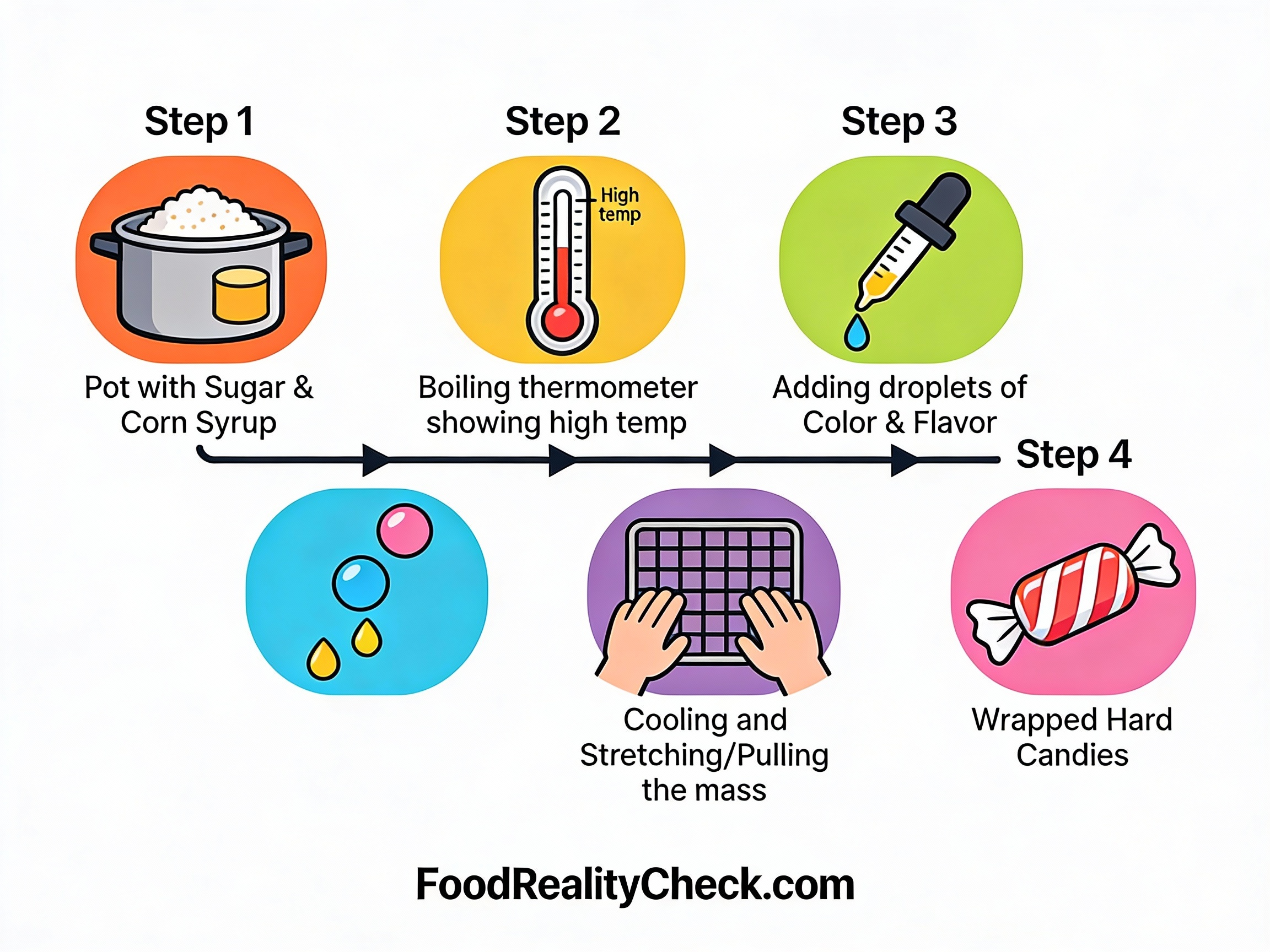
Hard Candy Production
Step 1: Raw Material Selection & Mixing
High-purity ingredients arrive at the factory: sucrose (table sugar), corn syrup, and glucose syrup—all tested for quality and consistency.
Measured quantities are combined in large mixing tanks at controlled temperature with water to create a uniform syrup base.
Precise ingredient ratios are critical—different ratios of sugar to corn syrup create different textures (harder, softer, brittler).
Step 2: High-Temperature Cooking (Hard-Crack Stage)
The syrup is transferred to large steam-jacketed kettles and heated to precise temperature—typically 149-154°C (300-310°F), known as the “hard-crack stage.”
At this temperature, the water content has boiled away and sugar molecules are perfectly positioned to form hard, brittle candy when cooled.
Temperature control is extreme—just 1-2°C difference changes the final texture from soft and chewy to hard and shattering.
Step 3: Color & Flavor Addition
When the syrup reaches target temperature, colorants and flavorings are rapidly added and stirred intensely for 30-60 seconds to ensure even distribution.
Timing is critical—adding color/flavor too early causes them to evaporate or degrade; too late and they won’t incorporate properly.
Many commercial operations use liquid flavoring and food-grade dyes specifically formulated to survive the high heat.
Step 4: Rapid Pouring & Cooling (Molding)
The hot syrup is poured into pre-prepared molds (metal or silicone) or onto cooled marble or stainless steel surfaces at extreme speed—sometimes 200+ pieces per minute.
Rapid cooling is essential—slow cooling allows sugar to crystallize into large, gritty crystals; rapid cooling produces tiny crystals, creating smooth, glassy texture.
Advanced machines pour precise quantities into individual cavities, then cool them in controlled temperature tunnels before demolding.
Step 5: Cooling & Setting
Molded candy passes through cooling tunnels maintained at 15-25°C with controlled humidity and airflow to solidify evenly.
Cooling takes 20-45 minutes depending on candy size—too fast and candy cracks; too slow and production slows dramatically.
Once solid, candy is removed from molds (demolded) and inspected for defects before moving to sorting and wrapping.
Chocolate & Tempering
Step 6: Chocolate Melting & Tempering
Chocolate is melted in large jacketed kettles to 45-50°C, then cooled to 27-28°C, then reheated to 31-32°C—a precise three-step temperature cycle called “tempering.”
Tempering controls cocoa butter crystallization, creating chocolate with a glossy finish, smooth snap when broken, and longer shelf-life.
Without tempering, chocolate becomes dull, grainy, and develops white “bloom” (fat separation) during storage.
Step 7: Molding or Enrobing
Tempered chocolate is either poured into molds for solid chocolate bars, or used in enrobing machines that coat candy centers (like nougat or caramel) in a chocolate shell.
Enrobing machines spray chocolate over centers moving on a conveyor, then the chocolate-covered pieces pass through cooling tunnels to solidify.
Multiple coatings can be applied for different flavor layers or textures.
Gummy Production
Step 8: Gummy Ingredient Mixing & Cooking
For gummies, gelatin (or pectin), sugar, corn syrup, glucose syrup, and other ingredients are combined in mixing tanks.
The mixture is heated to 120-150°C to fully dissolve gelling agents and create a homogeneous syrup.
Homogenization ensures even distribution of flavorings and colorants throughout the mixture.
Step 9: Vacuum Treatment & Degassing
Many modern gummy production systems use vacuum chambers to remove dissolved air and excess moisture from the hot syrup.
Removing air prevents bubbles in the final product and improves texture clarity.
This step also increases viscosity (thickness) for better shape definition during molding.
Step 10: Gummy Depositing & Molding
Hot gummy syrup is poured into starch molds or silicone trays using automated depositors that dispense precise volumes (typically 2-5 grams per gummy).
Modern multi-head depositors can create layered gummies (different colors/flavors in one piece) by depositing multiple syrup types sequentially into the same mold.
The molds cool on conveyors, and cooled gummies are automatically knocked out of molds (demolded) by vibration or air blast.
Step 11: Gummy Cooling & Drying
Gummies pass through cooling tunnels at 15-18°C for 30-60 minutes until they fully set and achieve the desired chewy texture.
Some products are then dried at low temperature (30-40°C) for a few hours to reduce surface stickiness while maintaining internal chewiness.
Proper cooling/drying balance is critical—too fast and gummies become brittle; too slow and they stick together.
Packaging & Distribution (All Candy Types)
Step 12: Quality Inspection & Sorting
Finished candies pass through vision inspection systems that scan for defects: cracks, discoloration, incorrect size, or missing pieces.
Defective candies are automatically rejected and diverted for reprocessing or disposal.
Weight checks ensure each candy meets specification (0-1% variation tolerance).
Step 13: Individual Wrapping
Acceptable candies are conveyed to high-speed wrapping machines that encase each piece in plastic, paper, or foil at rates of 300-800 pieces per minute.
Wrappers protect candy from moisture (which hardens hard candy and stickies gummies), light (which fades colors), and physical damage.
Some candies are wrapped in clear film to show the product; others use opaque wrappers for branding.
Step 14: Case Packing & Cartooning
Individually wrapped candies are robotically packed into small boxes or bags (typically 50-200g), which are then packed into larger cartons (24-48 bags per carton).
Cartons are sealed, labeled, and stacked on pallets for shipment.
Batch codes and expiration dates are printed on all packaging for traceability.
Step 15: Storage & Distribution
Packaged candy is stored in climate-controlled warehouses at 18-22°C with 35-45% relative humidity to prevent moisture absorption or loss.
Proper storage prevents sugar bloom (white coating on chocolate), prevents gummies from drying out, and keeps hard candy from absorbing moisture.
Candy is distributed to retailers via ambient temperature trucks—refrigeration is unnecessary and actually undesirable (condensation damages packaging).
Why This Process?
Precise temperature control during cooking determines final crystal size—rapid cooling produces tiny crystals (smooth, glossy texture); slow cooling produces larger crystals (grainy texture).
Corn syrup and glucose syrup interfere with sugar crystallization, preventing unwanted grittiness in hard candy and creating desired texture in other types.
Chocolate tempering controls cocoa butter crystal formation, creating snap, gloss, and longer shelf-life that untempered chocolate lacks.
Vacuum treatment removes air and excess moisture from gummies and other candies, improving transparency and preventing defects.
What About Additives?
Commercial candies typically contain:
• Corn syrup (prevents grittiness from sugar crystallization)
• Gelatin or pectin (creates gummy texture)
• Colorants (FD&C food dyes or natural alternatives)
• Flavorings (natural, artificial, or blended)
• Gum arabic (stabilizer and thickener)
• Lecithin (emulsifier for chocolate)
• Wax coating (on some hard candies for shine)
Premium artisanal candies may contain only sugar, corn syrup, colorants, and flavorings—minimal additives.
The ingredient list reveals production complexity—simple lists suggest simpler processing; long lists with chemical names suggest more additives and processing aids.
The Bottom Line
Candy production is a fascinating intersection of chemistry and precision engineering—controlling sugar crystallization through temperature, cooling rates, and ingredient selection to create vastly different textures from identical starting materials.
Whether hard candy, chocolate, or gummies, the fundamental principle remains: precise temperature control determines crystal formation, which determines final texture and mouthfeel.
Now you understand exactly how sugar transforms into the candies you enjoy—through carefully controlled cooking, rapid cooling, and modern manufacturing automation.