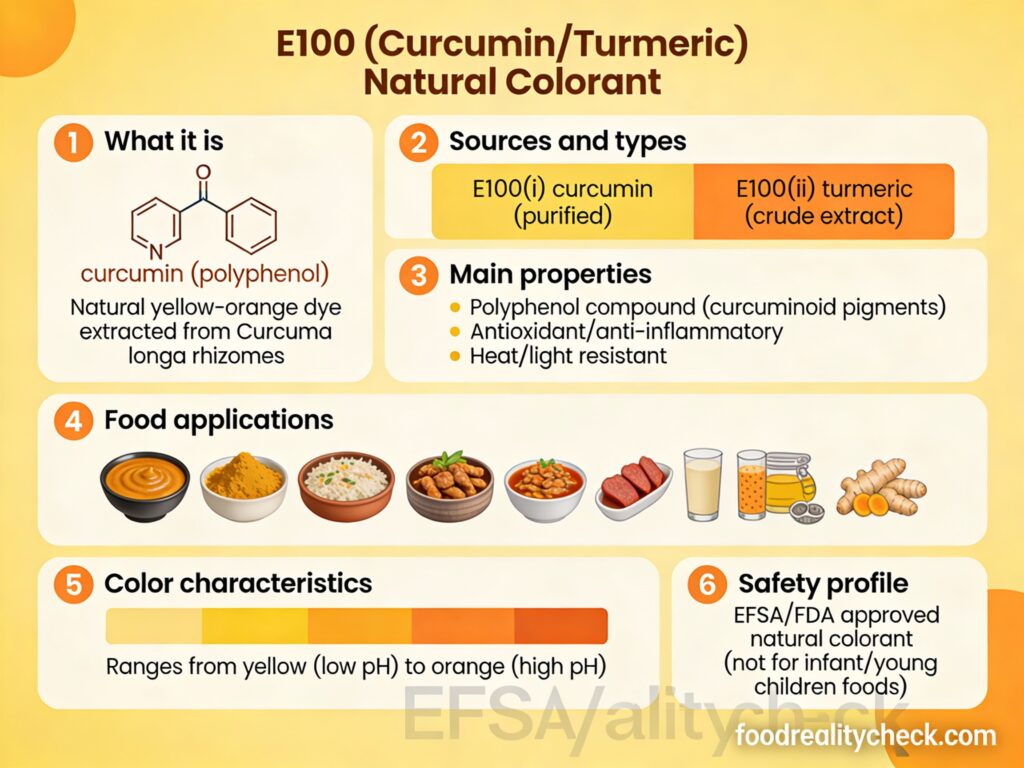
What is E100?
Complete guide to understanding E100 (Curcumin) in your food
The Quick Answer
E100 is curcumin, a natural yellow pigment extracted from turmeric (Curcuma longa) used as a food colorant with documented antioxidant, anti-inflammatory, and potential anticancer properties.
It’s used to color foods yellow to orange-brown, providing color stability while offering potential health benefits beyond mere visual appeal—unusual among food colorants.
Most people consuming turmeric-based foods, mustard, margarine, and curry products regularly encounter E100, though awareness of its presence is low because it’s perceived as a natural spice rather than an “additive.”
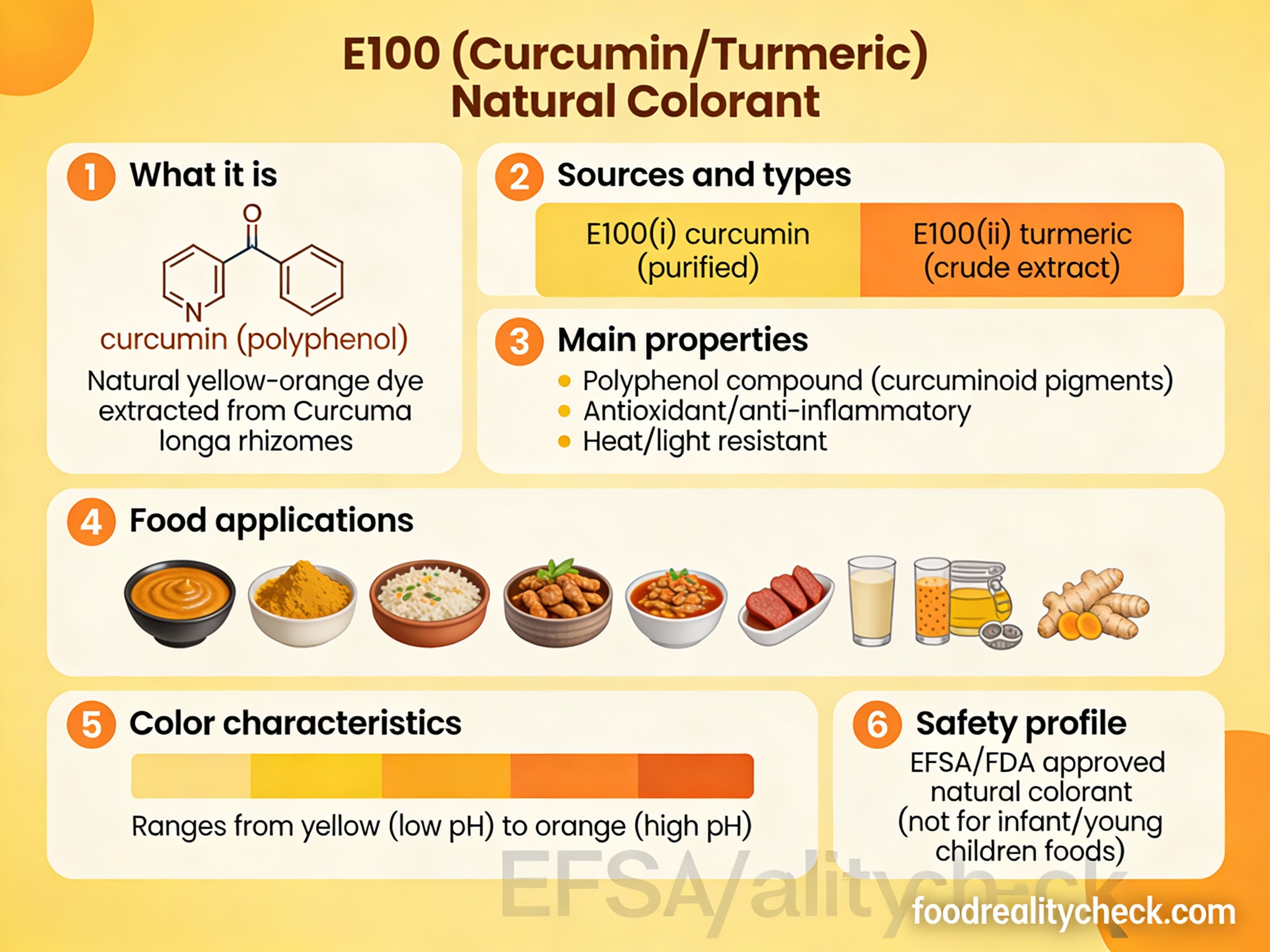
📌 Quick Facts
- Category: Natural Food Colorant, Antioxidant, Anti-inflammatory Agent, Nutraceutical
- Source: Turmeric rhizomes (Curcuma longa); also exists as turmeric extract (E100(ii))
- Found in: Mustard, margarine, dairy products, beverages, confectionery, sauces, preserved meats, curry products
- Safety: FDA approved; EFSA approved; JECFA ADI 0-3 mg/kg body weight (conservative due to low bioavailability)
- Natural or Synthetic: 100% natural—extracted from turmeric or derived as purified compound from turmeric extract
- Vegan/Vegetarian: Yes
- Key Advantage: Only food colorant with extensive research documenting antioxidant, anti-inflammatory, and potential anticancer properties
- Chemical Formula: C₂₁H₂₀O₆; Polyphenolic compound with diketone structure
What Exactly Is It?
E100 is curcumin, a polyphenolic compound that is the primary active constituent in turmeric (Curcuma longa), a rhizomatous plant from the ginger family native to South Asia. The chemical formula is C₂₁H₂₀O₆ with molecular weight of 368.38 g/mol.
Curcumin is a diketone polyphenol—a compound containing two ketone functional groups and multiple phenolic hydroxyl groups. This structure gives curcumin its distinctive properties: the yellow color (from the conjugated double-bond system), the antioxidant capacity (from the phenolic groups), and the anti-inflammatory activity (through multiple biochemical mechanisms including NF-κB pathway inhibition).
Physically, pure curcumin is a yellow-orange crystalline powder with a slightly bitter taste. It is poorly soluble in water (explaining its limited bioavailability) but readily soluble in organic solvents (ethanol, dimethyl sulfoxide, acetone). The melting point is 179-182°C, providing reasonable heat stability for food applications.
Curcumin’s color varies depending on pH: yellow in neutral and acidic solutions, reddish-brown in alkaline environments. This pH-dependent color shift has been used historically in applications as a pH indicator.
Two related forms exist in E100 classification: E100(i) is purified curcumin, while E100(ii) is turmeric, the crude extract containing curcumin plus other curcuminoids (demethoxycurcumin and bis-demethoxycurcumin) and components like volatile oils. Turmeric is the traditional spice form; curcumin is the concentrated pharmaceutical/food-additive form.
Where You’ll Find It
E100 appears in an extremely wide range of foods, often unrecognized as an “additive”:
• Mustard (primary application; yellow color, minor flavor contribution)
• Margarine and butter substitutes
• Cheese (natural orange-yellow color)
• Dairy products (yogurt, ice cream, custards)
• Beverages (soft drinks, particularly bitter sodas, wine-based drinks)
• Confectionery and candy
• Baked goods (biscuits, waffles, fine bakery products)
• Jams, jellies, marmalades, and fruit spreads
• Sausages, pâtés, and processed meats
• Fish and shellfish products (smoked fish, fish roe)
• Sauces and condiments
• Soups and broths
• Canned and preserved vegetables
• Curry spices and curry products
• Pickled products
• Snacks and ready-to-eat meals
• Breakfast cereals
• Dietary supplements and functional foods
• Pharmaceutical products and cosmetics
E100’s presence in foods is often unnoticed because turmeric-based colors are perceived as “natural spices” rather than “additives,” making curcumin one of the least controversial food colorants despite widespread use.
Why Do Food Companies Use It?
E100 performs three critical functions, with unique advantage over synthetic colorants:
1. Yellow-orange coloring with natural origin: Curcumin provides consistent yellow to orange-brown coloring depending on pH and concentration, with consumer perception as a “natural” ingredient due to its turmeric origin. This is psychologically valuable in the modern “clean label” market seeking natural additives.
2. Antioxidant and shelf-life enhancement: Unlike purely cosmetic colorants (which only add color), curcumin actively prevents oxidative degradation of food products, extending shelf life and reducing need for synthetic antioxidants (like BHA/BHT). This functional advantage means curcumin serves dual purposes: aesthetics and preservation.
3. Health benefits and marketing claims: The extensive research on curcumin’s antioxidant, anti-inflammatory, and potential anticancer properties allows manufacturers to market products containing E100 with health claims—”antioxidant-rich,” “anti-inflammatory,” or “turmeric-fortified.” No other synthetic food colorant offers this advantage, making curcumin unique in functional food formulation.
Advantages over synthetic colorants: Unlike azo dyes (tartrazine E102, sunset yellow E110) which have been linked to hyperactivity and allergic reactions in children, curcumin is documented to be beneficial with no adverse behavioral or allergic effects at food-use levels. This makes it the preferred colorant for health-conscious brands and products marketed to children.
Is It Safe?
E100 is considered very safe with extensive documentation of health benefits beyond basic safety.
Regulatory Status:
• FDA (USA): Approved as a food colorant and recognized as safe
• EFSA (Europe): Approved as direct food colorant (E100); 2010 re-evaluation concluded “not carcinogenic” and “not genotoxic”
• JECFA (WHO/FAO): ADI established at 0-3 mg/kg body weight (conservative due to low bioavailability); approved since 1982
Documented health benefits (unusual for a food additive):
• Antioxidant activity: Curcumin is a potent antioxidant, scavenging free radicals and increasing activity of antioxidant enzymes (superoxide dismutase, catalase)
• Anti-inflammatory effects: Inhibits the NF-κB pathway and modulates COX-2 and LOX enzymes—same mechanisms as some pharmaceutical anti-inflammatory drugs
• Anticancer properties: Research documents potential mechanisms including apoptosis induction, angiogenesis inhibition, and signaling pathway regulation—particularly promising in combination with chemotherapy
• Cardiovascular benefits: Documented in research to improve endothelial function and reduce atherosclerosis risk
• Neuroprotection: Potential protective effects against Alzheimer’s disease through amyloid-beta reduction and neuroinflammation inhibition
• Arthritis management: Used in traditional medicine for millennia; modern research supports efficacy comparable to some pharmaceutical treatments
Documented side effects and bioavailability limitations:
• At food-use levels (100-500 mg/kg): No adverse effects documented; well-tolerated
• At high supplemental doses (0.9-3.6 g/day for extended periods): Rare cases of nausea, diarrhea, and mild GI disturbance reported; increased liver enzymes (ALP, LDH) noted in some individuals but reversed upon discontinuation
• Poor bioavailability: Only 5-10% of ingested curcumin is absorbed—most passes through the GI tract unchanged. This low bioavailability explains the exceptional safety despite evidence of biological activity
• Mouth mucosa irritation: Rare cases of irritation reported with high-dose supplementation
• Interactions: May theoretically interact with anticoagulants or antiplatelet medications at high supplemental doses (not a concern at food levels)
Comparison with Synthetic Colorants
E100 curcumin is the only food colorant with documented health benefits and safety advantages over synthetic alternatives:
• E102 (Tartrazine): Synthetic azo dye; linked to hyperactivity in children; potential allergic reactions
• E110 (Sunset Yellow): Synthetic azo dye; similar behavioral concerns; allergenic potential
• E133 (Brilliant Blue FCF): Synthetic triphenylmethane dye; generally well-tolerated but lacks health benefits
• E102-E110 (Azo dyes in general): Linked to neurobehavioral effects and allergies in sensitive populations
• E100 (Curcumin): Natural colorant; documented antioxidant, anti-inflammatory, and potential anticancer properties; no behavioral or allergic effects; supported by extensive research
This unique positioning makes curcumin the recommended colorant choice for health-conscious brands, products marketed to children, and functional food formulations where health benefits matter.
Production and Extraction
E100 curcumin is produced through natural extraction:
1. Turmeric rhizomes (Curcuma longa) are harvested and dried
2. The dried material is ground into powder
3. The powder is treated with solvent extraction using ethanol, acetone, or other organic solvents to dissolve curcuminoids
4. The extract is filtered to remove insoluble material
5. Curcumin is precipitated from the solvent using selective crystallization or further purification
6. The purified curcumin is dried and milled into fine powder
7. The final product is standardized for curcumin content (minimum 90% for food-grade E100)
8. Optional: Extraction of turmeric oleoresin (volatile oils) produces turmeric extract (E100(ii)) which contains all active compounds
The entire process is extraction-based—no chemical synthesis. All curcumin originates directly from the turmeric plant.
Natural vs Synthetic Version
E100 is entirely natural—there is no synthetic version.
Curcumin only exists as a naturally occurring plant compound. While it can be extracted, purified, or formulated in various ways, all sources are ultimately botanical. There is no laboratory-created curcumin—all food-grade E100 is derived directly from turmeric plants through extraction and purification.
Health Applications Beyond Food Coloring
E100 curcumin has become a major focus of medical research and supplementation:
• Chronic inflammation management: Arthritis, inflammatory bowel disease, general inflammatory conditions
• Cancer adjunct therapy: Combined with chemotherapy; studied particularly for breast, colon, and prostate cancers
• Alzheimer’s and neurodegeneration: Potential neuroprotection and memory enhancement
• Cardiovascular disease prevention: Endothelial function improvement, atherosclerosis reduction
• Metabolic syndrome and diabetes: Glucose control and insulin sensitivity improvement
• Wound healing: Traditional use supported by modern research on tissue regeneration
• Liver health: Hepatoprotective properties; used in traditional medicine for liver conditions
While these applications require higher curcumin concentrations than food-use levels, the extensive research supports curcumin’s positioning as a nutraceutical—a compound with genuine health benefits rather than merely chemical functionality.
Historical and Traditional Use
Curcumin in turmeric has been used for millennia in traditional medicine:
• Ayurvedic medicine: Turmeric has been central to Ayurvedic practice for over 2,000 years, used for inflammation, wound healing, and general health
• Traditional Chinese medicine: Used for centuries to relieve abdominal pain and various conditions
• Indian traditional use: Treatment for cough, rheumatism, loss of appetite, and sprains
• Global culinary use: Turmeric and curcumin have been used as a food spice and colorant across cultures for thousands of years
This extensive historical use provides additional safety evidence beyond modern regulatory testing.
Environmental and Sustainability
Turmeric cultivation is sustainable—the plant grows in tropical climates, requires modest inputs, and can be cultivated organically. Global production meets growing demand for both culinary turmeric and curcumin extraction. Environmental impact is minimal compared to synthetic dye production (which involves petroleum-derived precursors and complex chemical synthesis). Turmeric farming provides livelihoods in turmeric-producing regions, supporting agricultural sustainability.
Natural Alternatives
Want to avoid E100? Food companies sometimes use these alternatives:
• E101 (Riboflavin): B-vitamin; yellow color; less intense than curcumin
• E110 (Sunset Yellow): Synthetic azo dye; similar color; linked to behavioral effects
• E102 (Tartrazine): Synthetic azo dye; yellow color; allergenic potential
• E140 (Chlorophyllins): Green-yellow natural colorants from plants
• E160a (Beta-carotene): Orange natural colorant; different color profile
• Annatto (E160b): Natural orange-yellow from seeds; limited to specific uses
• Natural turmeric spice: Whole turmeric powder; contains curcumin plus other components
For yellow-orange coloring with natural origin and health benefits, E100 curcumin remains essentially unmatched among alternatives, explaining its widespread use despite availability of other options.
The Bottom Line
E100 (curcumin) is a natural food colorant extracted from turmeric that is FDA-approved, EFSA-approved, JECFA-approved, and uniquely documented to provide health benefits beyond mere coloring.
Curcumin provides yellow to orange-brown coloring depending on pH, while functioning simultaneously as an antioxidant that extends shelf life and prevents oxidative degradation. Unlike purely cosmetic synthetic colorants, curcumin offers documented anti-inflammatory, antioxidant, and potential anticancer properties supported by extensive scientific research.
The safety profile is exceptional: no genotoxicity, no carcinogenicity, no reproductive toxicity documented. The compound is poorly absorbed (5-10% bioavailability), meaning most ingested curcumin passes through the GI tract unchanged at food-use levels. EFSA explicitly concluded that carcinogenicity and genotoxicity concerns are eliminated.
E100 curcumin is the recommended colorant choice for health-conscious brands, products marketed to children (where synthetic azo dyes like tartrazine are linked to hyperactivity), and functional food formulations. Its natural origin, documented health benefits, and safety advantages over synthetic alternatives make it the most defensible food colorant choice in the modern food additive landscape.
For consumers, E100 curcumin represents the intersection of food functionality, consumer safety, and documented health benefits—an unusual combination among food additives, making it one of the safest and most beneficial approved additives available.