What is E102?
Complete guide to understanding E102 (Tartrazine) in your food
The Quick Answer
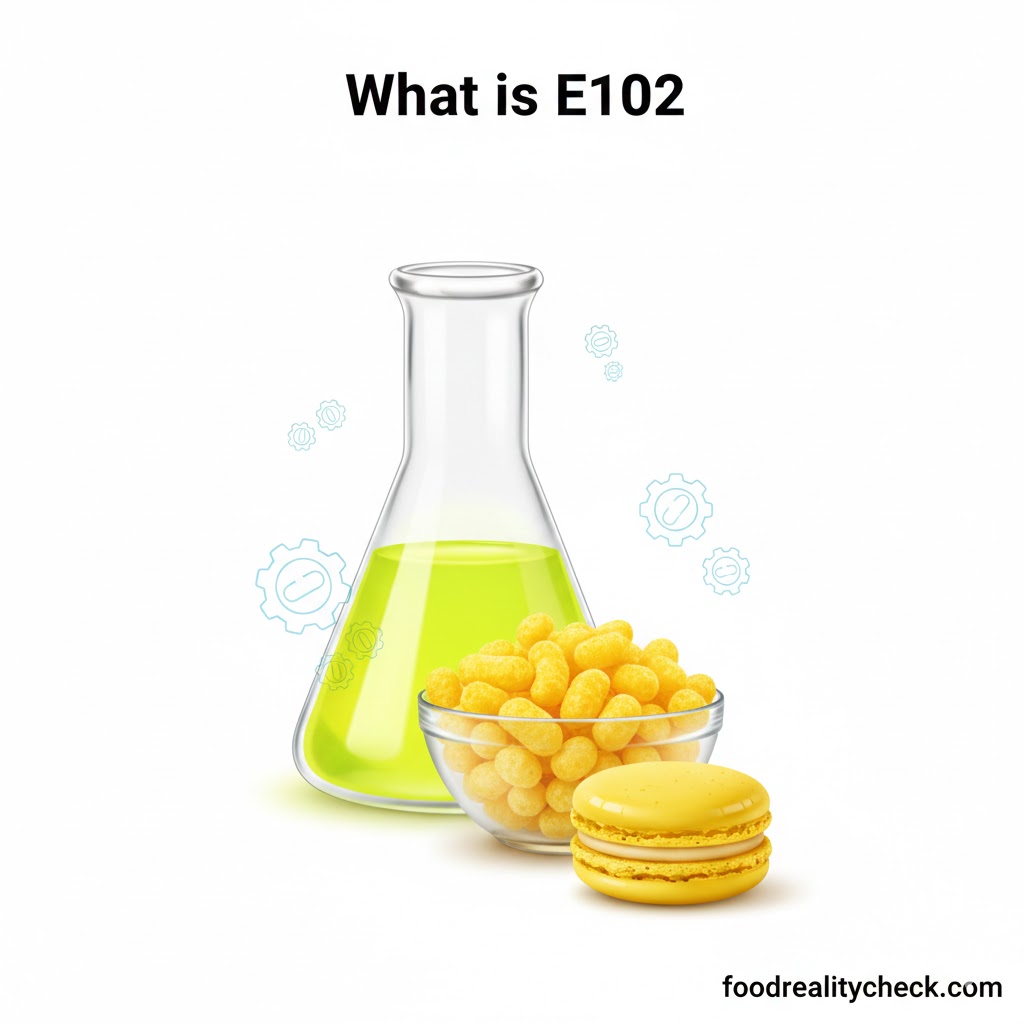
E102 is a synthetic yellow azo dye used to color foods bright yellow.
It’s used in soft drinks, candies, baked goods, and processed foods to make them more visually appealing.
It’s one of the most controversial and heavily scrutinized food colorants due to allergic reactions, hyperactivity in children, and emerging genotoxicity concerns.
📌 Quick Facts
- Category: Synthetic azo food colorant (yellow dye)
- Also Known As: FD&C Yellow No. 5, Acid Yellow 23, Food Yellow 4
- Made From: Coal tar derivatives and chemical synthesis
- Found in: Soft drinks, candies, baked goods, cereals, jams, cured meats, condiments
- Safety: Approved but restricted; requires warning labels in EU; FDA recently targeted for elimination (2025)
- ADI (EFSA): 7.5 mg/kg body weight per day
What Exactly Is It?
E102 is a synthetic azo dye chemically derived from coal tar compounds.
Its full chemical name is trisodium 1-(4-sulfonatophenyl)-4-(4-sulfonatophenylazo)-5-pyrazolone-3-carboxylate.
It’s a bright lemon yellow powder that dissolves readily in water to produce a golden yellow solution.
The azo structure (featuring the –N=N– double bond) is what gives E102 its color and stability—and also what causes health concerns.
E102 is entirely synthetically manufactured; there is no natural source of this specific dye.
Where You’ll Find It
E102 appears in many common foods:
• Soft drinks (lemonades, sports drinks, cordials)
• Candies and sweets (yellow candies, jelly beans)
• Baked goods (cakes, muffins, cookies, pastries)
• Cereals and breakfast products
• Jams, jellies, and preserves
• Yogurts and dairy desserts
• Ice cream and frozen treats
• Cured and processed meats
• Mustard and condiments
• Pickles and preserved vegetables
• Chewing gum
• Honey and honey products
• Some medications (particularly pediatric syrups)
E102 is one of the six “colors of concern” identified by the EU Food Safety Authority as potentially affecting behavior in children.
Why Do Food Companies Use It?
E102 serves one purpose: provide bright, stable yellow coloring to products.
It’s preferred by manufacturers because:
Cost-effective: Significantly cheaper than natural yellow dyes like annatto (E160b) or saffron.
Highly stable: Resists degradation from light, heat, and pH changes far better than natural colors, allowing long shelf-life without color fading.
Intense color: Provides bright, unmistakable yellow—more vibrant than natural alternatives.
Water-soluble: Easily dissolves in beverages and sauces without requiring special formulation.
Predictable: Manufactured under strict controls, ensuring color consistency across batches.
Is It Safe?
E102 is approved but controversial and increasingly restricted due to hyperactivity and genotoxicity concerns.
The FDA classifies it as acceptable with an ADI of 7.5 mg/kg body weight per day, though this has been questioned.
The EFSA also set an ADI of 7.5 mg/kg per day.
However, regulatory actions reflect serious concerns:
2007 Southampton Study & EU Response: Following research linking artificial food colors to hyperactivity in children, the EU declared six colors (including E102) unsafe and now require warning labels on all foods containing E102, yellow 6, quinoline yellow, carmoisine, red 40, or ponceau 4R.
FDA 2025 Action: In a groundbreaking move, the FDA announced it is working with the food industry to eliminate artificial food dyes (including E102/yellow 5) from the food supply—the first regulatory action of its kind in decades.
⚠️ Multiple Health Concerns – Why FDA Is Moving Toward Elimination:
1. Hyperactivity in Children: Multiple studies, most notably the 2007 Southampton study, found that tartrazine (often in mixtures with other dyes) increased hyperactivity and behavioral problems in children aged 3–9 years. The EFSA noted behavioral effects were “a cause for concern,” leading to mandatory warning labels in the EU. While regulatory agencies dispute causation, the evidence is strong enough that the FDA is now moving to eliminate the dye.
2. DNA Damage & Genotoxicity: A 2015 study found that yellow 5 damaged DNA in human white blood cells after just 3 hours of exposure, causing cell mutations at every concentration tested. Cells exposed to the highest concentration couldn’t repair the damage. A 2023 mouse model study found that yellow 5 at the allowed daily intake level altered genes increasing cancer likelihood and affecting brain function. These findings are driving FDA elimination efforts.
3. Zinc Wasting in Hyperactive Children: Multiple studies show tartrazine causes excessive urinary zinc excretion specifically in hyperactive children (possibly via chelation), which was associated with behavioral deterioration.
4. Allergic Reactions: E102 causes the most allergic and intolerance reactions of all azo dyes, particularly in asthmatics and aspirin-sensitive individuals—with reactions including bronchial asthma, hives, angioedema, migraines, and skin irritation.
What Are The Health Concerns?
E102 has multiple documented and serious health concerns, which is why regulatory action is accelerating:
Hyperactivity and neurobehavioral effects: The Southampton Study (2007) and multiple follow-up studies found tartrazine increased hyperactivity and behavioral problems in children. The EFSA acknowledged behavioral concerns were “a cause for concern.” This led to mandatory EU warning labels and is a primary reason the FDA is now moving to eliminate the dye.
DNA damage and genotoxicity: 2015 and 2023 studies showed tartrazine causes DNA damage in human cells, cell mutations, and altered gene expression increasing cancer risk—particularly in gastrointestinal cells. A 2023 mouse study found gene expression changes affecting cancer formation and brain function at permitted intake levels.
Zinc depletion: Studies show tartrazine causes excessive zinc excretion (zinc wasting) in hyperactive children, correlating with behavioral deterioration. This suggests tartrazine may chelate and remove essential minerals.
Allergic reactions and hypersensitivity: E102 causes more allergic reactions than any other azo dye. In asthmatics and aspirin-sensitive individuals, reactions include bronchial asthma, anaphylaxis, angioedema, urticaria (hives), rhinitis, and migraines. Studies show up to 20–40% of susceptible populations react.
Oxidative stress and cellular damage: 2024 research found that yellow 5 at environmentally acceptable concentrations triggers oxidative stress, cellular damage, and impaired neural development in zebrafish embryos.
Natural vs Synthetic Version
E102 is entirely synthetically manufactured—there is no natural form.
It’s produced through chemical synthesis from coal tar derivatives, not extracted from any natural source.
Natural Alternatives
Want to avoid E102?
Food companies can use natural yellow colorants:
• Annatto (E160b) – natural yellow/orange from achiote seeds
• Turmeric/Curcumin (E100) – natural yellow from turmeric spice
• Beta-carotene (E160a) – natural orange-yellow from carrots
• Caramel (E150) – brown yellow from heated sugar
• No coloring – accept naturally colored products
These natural alternatives are more expensive and less stable, but many brands now use them in response to FDA pressure and consumer concern.
The Bottom Line
E102 is a synthetic yellow azo dye with multiple documented health concerns including hyperactivity in children, DNA damage, allergic reactions, and mineral depletion.
Regulatory momentum is shifting: The FDA (2025) is now actively working to eliminate E102 and similar dyes from the food supply—the first major dye elimination action in decades. The EU requires warning labels. This regulatory action reflects genuine safety concerns backed by scientific evidence.
Strongest evidence: DNA damage at permitted intake levels and hyperactivity in children are the most robust findings. The 2007 Southampton Study and subsequent genotoxicity research have forced regulatory agencies to reconsider safety assumptions made decades ago.
If you want to minimize exposure: Avoid brightly colored yellow foods (soft drinks, candies, baked goods) and check ingredient labels for E102 or “FD&C Yellow No. 5.” Choose products with natural yellow colors (annatto, turmeric, beta-carotene) or uncolored alternatives.
For children particularly: The EU’s mandatory warning labels reflect medical consensus that tartrazine poses behavioral risks in sensitive children. Minimizing consumption is advisable, particularly for children with ADHD or aspirin sensitivity.