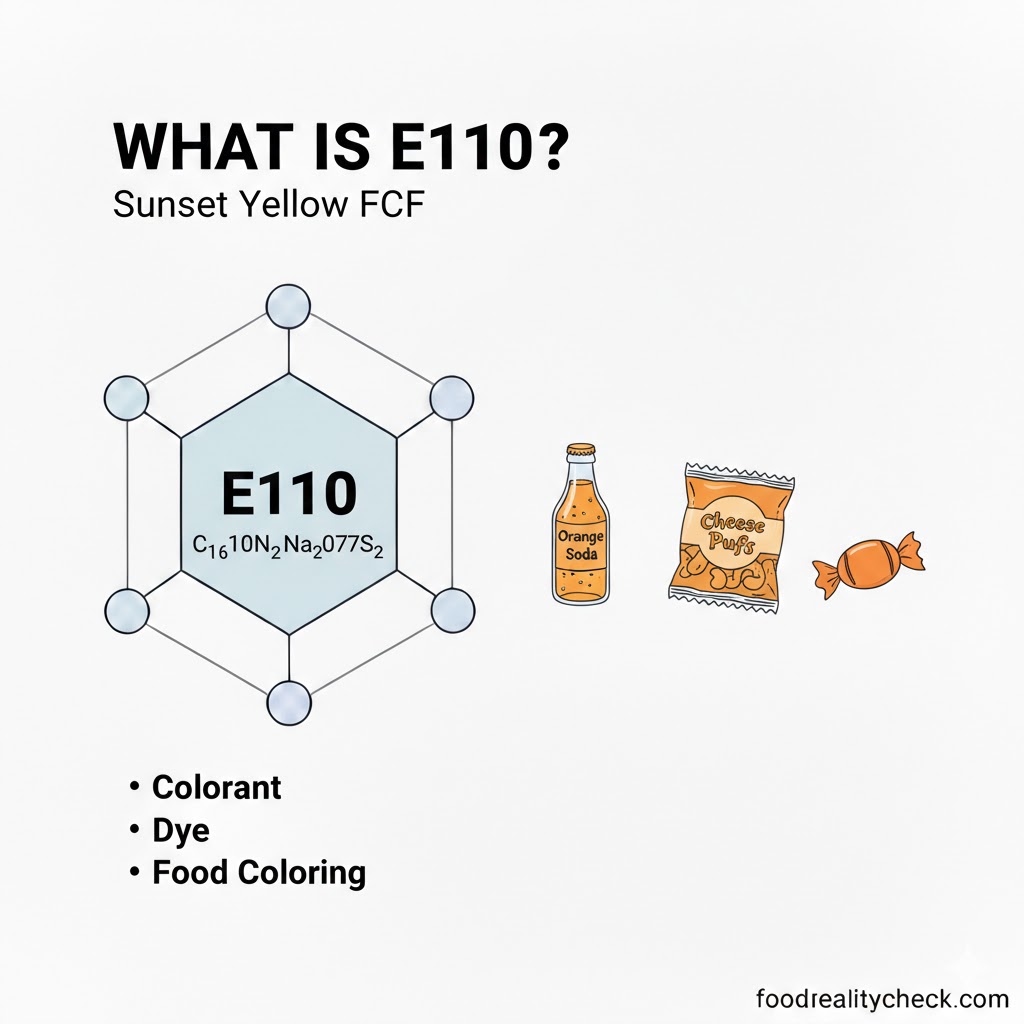
What is E110?
Complete guide to understanding E110 (Sunset Yellow FCF) in your food
The Quick Answer
E110 is a synthetic yellow-orange azo dye used to color foods bright orange-yellow.
It’s used in soft drinks, candies, baked goods, and processed foods to make them more visually appealing.
It’s one of the most controversial and scrutinized food colorants due to hyperactivity in children, allergic reactions, neurotoxicity, and potential reproductive/developmental concerns.
📌 Quick Facts
- Category: Synthetic azo food colorant (orange-yellow dye)
- Also Known As: FD&C Yellow No. 6 (USA), Sunset Yellow FCF, Orange Yellow S
- Made From: Petroleum derivatives via chemical synthesis
- Found in: Soft drinks, candies, baked goods, jams, cereals, cured meats, sauces
- Safety: Approved but restricted; EU warning labels required; FDA monitoring closely
- ADI (EFSA/FDA): 4 mg/kg (EFSA 2014); 3.75 mg/kg (FDA); down from 1 mg/kg (2009)
What Exactly Is It?
E110 is a synthetic azo dye chemically derived from petroleum.
Its chemical formula is C₁₆H₁₀N₂Na₂O₇S₂, commonly known as Sunset Yellow FCF or Orange Yellow S.
It’s a petroleum-derived orange azo dye with a bright orange-yellow color that’s pH-dependent (appearing yellower at lower pH, more orange at higher pH).
E110 is entirely synthetically manufactured; there is no natural source of this specific dye.
It belongs to the azo dye family—dyes containing the characteristic –N=N– (azo) double bond that creates color but also raises health concerns.
Where You’ll Find It
E110 appears in many common foods:
• Soft drinks and colas (particularly orange-flavored)
• Candies and sweets (orange candies, jelly beans, gummies)
• Baked goods (cakes, muffins, cookies, pastries with yellow/orange coloring)
• Cereals and breakfast products
• Jams, jellies, and preserves
• Yogurts and dairy desserts
• Ice cream and frozen treats
• Cured and processed meats (especially orange/yellow products)
• Mustard and condiments
• Pickles and preserved vegetables
• Chewing gum
• Some medications (pediatric syrups and tablets)
E110 is one of the six “colors of concern” identified by the EU Food Safety Authority as potentially affecting behavior in children.
Why Do Food Companies Use It?
E110 serves one purpose: provide bright, stable orange-yellow coloring to products.
It’s preferred by manufacturers because:
Cost-effective: Significantly cheaper than natural colorants like annatto or turmeric.
Highly stable: Resists degradation from light, heat, and pH changes, maintaining color throughout product shelf-life.
Intense color: Provides bright, unmistakable orange-yellow that’s more vibrant than natural alternatives.
Water-soluble: Easily dissolves in beverages without requiring special formulation.
Predictable: Manufactured under strict controls, ensuring color consistency across batches.
Is It Safe?
E110 is approved but highly controversial and increasingly restricted due to hyperactivity, allergies, neurotoxicity, and reproductive concerns.
The FDA currently approves E110 (Yellow 6) with an ADI of 3.75 mg/kg body weight per day.
The EFSA re-established an ADI of 4 mg/kg per day in 2014 (after lowering it to 1 mg/kg in 2009 based on safety concerns, then raising it again after further review).
However, regulatory actions reflect serious ongoing concerns:
EU Warning Labels Required: All products containing E110 in the EU must carry mandatory warning labels: “May impair attention and activity in children”—recognition of behavioral concerns.
⚠️ Multiple Health Concerns – Hyperactivity, Allergies, Neurotoxicity, Reproductive Effects:
1. Hyperactivity and ADHD-like Behavior: Multiple studies link E110 to hyperactivity and behavioral problems in children. The 2007 Southampton Study and follow-ups found synthetic food colors (including E110) increased ADHD-like symptoms. The EU mandated warning labels based on this evidence. While regulatory agencies dispute the magnitude of effect, the evidence is strong enough to require warnings.
2. Allergic Reactions and Hypersensitivity: E110 causes allergic reactions more frequently than many other dyes, particularly in asthmatics and sensitive individuals. Reactions include hives, rashes, angioedema (swelling), respiratory issues, asthma exacerbation, and gastrointestinal distress. Though regulatory agencies cite low prevalence rates, sensitive individuals should absolutely avoid this dye.
3. Intestinal Damage & Inflammation: A 2021 in vitro (test tube) study showed E110 damages the mucous membrane of the small intestine, potentially causing inflammation. The mechanism involves direct mucosal injury. While test tube studies don’t prove human harm, this suggests potential for gastrointestinal issues.
4. Neurotoxicity & Developmental Effects: Studies show E110 contains neurotoxic chemicals potentially linked to attention deficit, behavioral issues, and autism. The manufacturing process involves petroleum, formaldehyde, hydroxides, aniline, sulfuric acid—toxic precursors. Research shows synthetic food dyes may impair neurodevelopment.
5. Reproductive & Developmental Toxicity: The EFSA noted animal studies showing E110 may increase testicular and adrenal tumors at high doses, suggesting reproductive impairment. Developmental effects in animal studies raise concerns about impacts on children’s development.
6. Aluminum Content in Certain Formulations: Some batches of E110 may contain aluminum (as “aluminum lakes”), which is suspected of promoting dementia, hyperactivity, and endocrine disruption through estrogen-mimicking (metal estrogens). Aluminum can disrupt gut microbiota and impair immune function.
7. Cancer Risk & Benzidine Contamination: E110 contains benzidine, a cancer-causing substance, at permitted low levels. The FDA estimates cancer risk at 1 in 1 million from this contamination, but this is an unnecessary risk from an optional food additive.
What Are The Health Concerns?
E110 has multiple documented and serious health concerns:
Hyperactivity and behavioral effects: Multiple studies (Southampton 2007 and follow-ups) linked E110 to ADHD-like symptoms in children. The EFSA acknowledged behavioral concerns, leading to mandatory EU warning labels. Despite regulatory dispute over magnitude, the evidence is strong enough to warrant precaution.
Allergic reactions: E110 causes more allergic reactions than many other dyes—hives, rashes, angioedema, respiratory issues, asthma exacerbation, gastrointestinal distress. While regulatory agencies cite low overall prevalence, sensitive individuals are at significant risk.
Intestinal mucosal damage (2021 study): In vitro testing showed E110 damages small intestine mucous membrane, potentially causing inflammation and gastrointestinal issues.
Neurotoxicity: Manufacturing involves neurotoxic precursors; research shows impacts on attention, behavior, and potentially autism. The FDA does not require testing for developmental neurotoxicity.
Reproductive and developmental toxicity: Animal studies show potential testicular/adrenal tumors and developmental effects at high doses. The EFSA noted reproductive concerns in safety evaluations.
Aluminum content concerns: Some E110 batches contain aluminum (aluminum lakes), suspected of promoting dementia, ADHD, and hormone disruption through estrogen-mimicking effects. Aluminum alters gut microbiota.
Benzidine contamination (carcinogen): E110 contains low-level benzidine, a known carcinogen. FDA estimates 1 in 1 million cancer risk—an unnecessary risk from optional food coloring.
Natural vs Synthetic Version
E110 is entirely synthetically manufactured—there is no natural form.
It’s produced through chemical synthesis from petroleum derivatives, not extracted from any natural source.
Natural Alternatives
Want to avoid E110?
Food companies can use natural orange-yellow colorants:
• Annatto (E160b) – natural orange from achiote seeds
• Beta-carotene (E160a) – natural orange-yellow from carrots
• Turmeric/Curcumin (E100) – natural yellow from turmeric spice
• Caramel (E150) – brown-yellow from heated sugar
• No coloring – accept naturally colored products
These natural alternatives are more expensive and less stable, but many brands now use them in response to consumer concern and regulatory pressure.
The Bottom Line
E110 is a synthetic orange-yellow azo dye with multiple documented health concerns including hyperactivity in children, allergic reactions, intestinal damage, neurotoxicity, reproductive effects, and carcinogenic contaminants.
Regulatory actions reflect seriousness: The EU requires mandatory warning labels (“May impair attention and activity in children”)—an acknowledgment that behavioral risks are real enough to warn consumers. The EFSA changed the ADI from 1 mg/kg (2009) to 4 mg/kg (2014) after further review, but controversy persists.
Most robust evidence: Hyperactivity and allergic reactions are the most consistent findings. The 2007 Southampton Study and behavioral research showing ADHD-like effects drive regulatory caution.
If you want to minimize exposure: Avoid brightly colored orange-yellow foods (soft drinks, orange candies, orange-tinted baked goods) and check ingredient labels for E110 or “FD&C Yellow No. 6.” Choose products with natural colors (annatto, beta-carotene, turmeric) or uncolored alternatives.
For children particularly: The EU’s mandatory warning label reflects medical consensus that E110 poses behavioral risks in susceptible children. Minimizing consumption is advisable, especially for children with ADHD, asthma, or food sensitivities.
Recent trend: Like E102 (Yellow 5), E110 (Yellow 6) is under increasing scrutiny. Manufacturers are reformulating to use natural colors in response to FDA pressure and consumer concern—a clear sign of shifting regulatory direction.