What is E1200?
Complete guide to understanding E1200 (Polydextrose) – the soluble dietary fiber and sugar/fat replacer
The Quick Answer
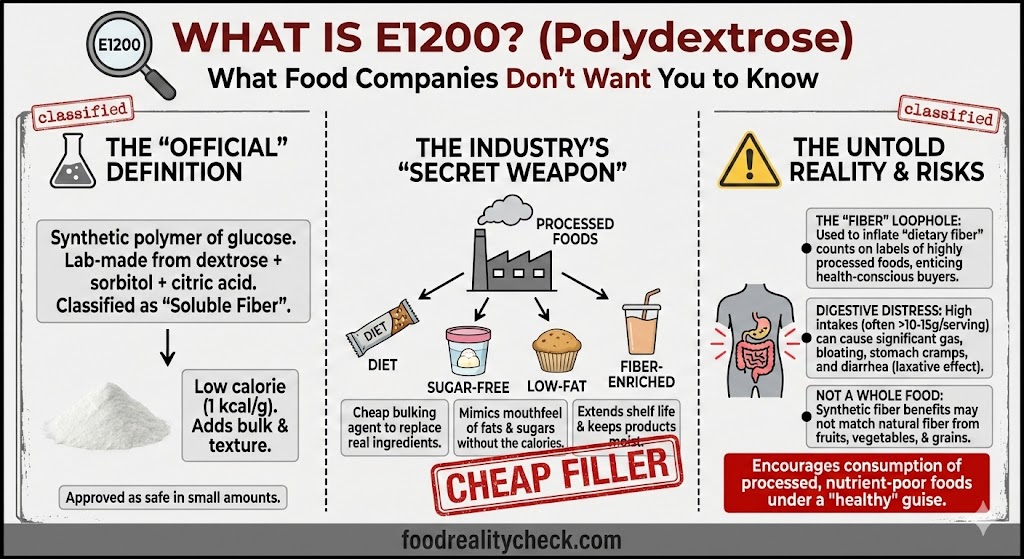
E1200 is polydextrose—a soluble dietary fiber synthesized from glucose (dextrose), sorbitol, and citric acid through a heating process. It is not a natural ingredient but a synthetic polymer created by chemically linking glucose molecules together. E1200 is primarily used as a low-calorie bulking agent and texturizer in reduced-sugar and reduced-fat foods, providing bulk and mouthfeel without significantly adding calories or affecting blood sugar levels.
E1200 is approved globally as a safe food additive by the FDA, EFSA, JECFA, and other regulatory authorities. The EFSA’s 2021 re-evaluation confirmed there is no safety concern for E1200 at reported use levels. However, at high intakes (over 50 grams as a single dose or 90 grams per day), E1200 exhibits a laxative effect—this is a known, manageable side effect rather than a toxicity concern. E1200 is recognized as a prebiotic fiber, meaning it selectively promotes the growth of beneficial gut bacteria.
E1200 is one of the most widely used functional food additives in the industry, found in thousands of products globally seeking to reduce sugar and calorie content while maintaining appealing texture and taste.
📌 Quick Facts
- Chemical: Polydextrose; synthetic polymer of glucose units linked together
- Also known as: Polydextrose, soluble fiber, dietary fiber
- Chemical formula: Polymer of C₆H₁₀O₅ units (glucose monomers) with varied linkages and modifications
- CAS number: 68424-04-4
- EC number: 232-559-2
- Molecular weight: Broad range (162–20,000); ~90% between 504–5,000
- Physical form: White to light tan powder; soluble in water
- Taste: Slightly sweet, clean taste; does not taste artificial
- Source: Synthetic polymer; made by chemical condensation of naturally occurring ingredients (glucose, sorbitol, citric acid from corn)
- Key properties: Soluble fiber, low-calorie, prebiotic, water-soluble, stable at varying pH and temperatures, bulking agent, humectant, thickener
- Caloric value: 1 kcal/gram (vs. 4 kcal/gram for sugar; vs. 9 kcal/gram for fat)
- Glycemic Index: Approximately 7 (very low; safe for diabetics)
- Primary functions: Sugar replacement (non-caloric bulking), fat replacement, calorie reduction, texture/mouthfeel in reduced-calorie foods
- Food uses: Baked goods, confectionery, dairy products, beverages, dietary supplements, frozen desserts
- Safety status: EU-approved; FDA-approved; EFSA confirmed safe (2021)
- ADI (Acceptable Daily Intake): “Not specified” – meaning no numerical limit needed; safe at all practical use levels
- Laxative threshold: 50 grams as single dose or 90 grams per day
- Health benefits: Prebiotic fiber (promotes beneficial bacteria growth), improves mineral absorption (calcium, magnesium, iron), produces short-chain fatty acids (butyrate), laxation at high doses
- Dietary restrictions: Vegan, vegetarian, kosher, halal, gluten-free approved
- Regulatory trajectory: Stable; approved in 80+ countries; no safety concerns identified
- Patent history: Patented 1973; FDA approval 1981; used for 45+ years
What Exactly Is It?
E1200 is a synthetic polymer created by chemically linking glucose molecules together through a heating and condensation process, with incorporation of sorbitol and citric acid as modifying agents. It is not extracted from nature but rather synthesized through chemical processing. However, all component ingredients are naturally occurring compounds derived from corn.
Think of polydextrose as a “molecular chain” made of glucose units (the same sugar found in table sugar and starch) that are linked together in complex, random patterns. This complex three-dimensional structure gives polydextrose its unique properties: it’s soluble in water (unlike starch), provides bulk without calories (unlike sugar), and behaves in foods like fat or sugar while providing only 1 calorie per gram.
Key characteristic: E1200 is a soluble fiber. Because it’s a polymer with random linkages, human digestive enzymes cannot break it down efficiently (only about 10-20% is digestible), meaning most of it passes to the colon intact where it ferments beneficially. This is fundamentally different from sugars or regular starches, which are rapidly absorbed.
Chemical identity:
• Primary component: Glucose polymers (~90% of composition)
• Sorbitol content: ~10% (provides sweetness and modifies polymer structure)
• Acid residues: ~1% citric acid or phosphoric acid (provides slight tartness and polymer stability)
• Linkage pattern: Primarily 1,6-glucosidic bonds; also α- and β-1,2, 1,3, 1,4 bonds in random pattern
• Molecular weight range: 162–20,000 g/mol (extraordinarily broad for single additive; ~90% between 504–5,000)
• Solubility: Highly soluble in water (~80 g/100 mL at 25°C); generates low-viscosity solutions
How it’s made:
E1200 is produced through chemical synthesis:
• Raw materials: Dextrose (glucose) from corn (~90%), sorbitol (~10%), citric acid or phosphoric acid (~1%)
• Heating process: Raw materials melted together under vacuum at high temperatures (200–300°C)
• Polycondensation: Molecules link together through condensation reactions, forming polymers with random linkage patterns
• Forms produced: Polydextrose-A (acid form), Polydextrose-N (neutralized form)
• Variants: Available as coarse powder, fine powder, and various specialty types (N, K, F)
• Purity specification: EU and FDA require ≥85% polydextrose content; remainder is water, sorbitol, and acid salts
Where You’ll Find It
E1200 appears extensively in foods where sugar/fat reduction and fiber enrichment are desired:
Primary Food Applications:
• Baked goods (PRIMARY USE) – bread, muffins, cakes, cookies, pastries; functions as humectant (moisture retention) and texture provider
• Confectionery (COMMON USE) – candy, chocolate, hard sweets; sugar replacer maintaining mouthfeel
• Dairy products (COMMON USE) – frozen desserts, ice cream, yogurt, puddings; fat/sugar substitute providing creaminess
• Beverages – nutritional drinks, energy drinks, carbonated beverages; provides body and mouthfeel
• Dietary supplements – protein bars, meal replacement products, supplement tablets; fiber enrichment
• Jams and spreads – sugar-free jams, reduced-sugar jams; provides bulk and texture
• Salad dressings and sauces – texture and body provision
• Table-top sweeteners – powder and tablet forms with other sweeteners
• Nutritional bars – protein bars, granola bars; texture and fiber source
Regulatory scope (widely approved): EU Authorization—E1200 approved at “quantum satis” (unlimited, as much as technically needed) in nearly all authorized food categories. FDA—Approved as GRAS (Generally Recognized As Safe) for direct food additive use in all foods except meat, poultry, baby food, and infant formula. Approved in 80+ countries globally.
Market prevalence: E1200 is one of the most widely used food additives. Thousands of reduced-sugar, reduced-fat, and fiber-enriched products globally contain E1200.
Why Do Food Companies Use It?
E1200’s primary functions are replacing sugar/calories while maintaining food texture and consumer acceptability.
Food manufacturers use polydextrose for:
• Sugar replacement: Reduces calorie content while maintaining bulk and sweetness perception
• Fat replacement: Mimics mouthfeel and texture of fats in reduced-fat products
• Calorie reduction: Provides only 1 kcal/gram vs. 4 kcal/gram for sugar; substantial calorie savings
• Fiber enrichment: Counts as dietary fiber; enables “high-fiber” or “good source of fiber” claims
• Texture preservation: Maintains desired mouthfeel when sugar/fat removed
• Moisture retention (humectant): Binds water; keeps bakery products fresh and tender longer
• Prebiotic benefit: Health benefit positioning; promotes beneficial gut bacteria
• pH stability: Stable in acidic and high-temperature processing; works in challenging applications
• Clean label appeal: Made from recognizable natural ingredients (glucose, sorbitol, citric acid); perceived as more natural than synthetic sweeteners
• Blood sugar impact: Low glycemic index (~7) makes it suitable for diabetic/health-conscious products
• Cost efficiency: More economical than some alternative fibers while providing superior functional properties
• Regulatory approval: Universally approved; no regulatory restrictions limiting use
Unique advantage: Polydextrose is uniquely effective at the combination of sugar replacement + fat replacement + fiber + texture maintenance. Few ingredients offer this multi-functional capability.
Is It Safe?
✓ YES — E1200 IS SAFE
The EFSA conducted a comprehensive re-evaluation of E1200 in 2021 and concluded: “There is no safety concern for the reported uses and use levels of polydextrose as a food additive.”
Regulatory approval status:
• FDA (USA): Approved as GRAS (Generally Recognized As Safe) since 1981; approved for use in all foods except meat, poultry, baby food, infant formula
• EU: Approved as E1200; EFSA 2021 re-evaluation confirmed safety
• JECFA (WHO/FAO): Evaluated and approved; ADI “not specified” (1987)
• EFSA 2021 verdict: “No safety concern for the reported uses and use levels”
• Global approval: Approved in 80+ countries; one of the most universally approved additives
Safety profile:
• No acute toxicity: Safe at all practical food use levels
• No chronic toxicity: Extensive long-term studies show no harm
• No carcinogenicity: No cancer-causing potential
• No genotoxicity: No evidence of genetic damage
• No reproductive/developmental effects: Safe for pregnant women and children
• Absorption limited: Only 10-20% absorbed in small intestine; remainder ferments in colon beneficially
• Bioaccumulation: Does not accumulate in body tissues
• ADI status: “Not specified” – regulatory determination that no numerical limit needed
• Prebiotic benefit: Fermented by beneficial bacteria (bifidobacteria, lactobacillus); suppresses harmful bacteria (clostridia)
• SCFA production: Fermentation produces beneficial short-chain fatty acids (butyrate, acetate, propionate)
• Mineral absorption: Improves absorption of calcium, magnesium, iron
• No allergenic potential: Not an allergen; suitable for all populations
• Long safety history: Used for 45+ years (patented 1973, FDA approved 1981) without documented safety issues
Known side effects (at high doses only):
• Laxative effect: At intakes >50 grams as single dose or >90 grams per day, polydextrose exhibits mild laxative effect (this is why it’s sometimes called “nature’s laxative”)
• Not a toxicity concern: Laxative effect is expected and harmless; actually beneficial in some contexts; easily managed by reducing intake
• Individual variation: Sensitive individuals may experience laxation at lower doses (30-50 grams)
• Adaptation: Regular consumers adapt; laxative effect diminishes with continued use as gut bacteria adjust
✓ Prebiotic Benefits (Health-Promoting Effects): Unlike many food additives evaluated purely for safety, polydextrose actually provides health benefits:
• Promotes growth of beneficial gut bacteria (bifidobacteria, lactobacillus)
• Suppresses pathogenic bacteria (Clostridium, E. coli)
• Produces short-chain fatty acids, especially butyrate (fuel for colon cells)
• Improves absorption of minerals (calcium, magnesium, iron)
• Contributes to satiety (helps with weight management)
• May improve lipid profiles
• Supports healthy immune function
This is distinctive: E1200 is a food additive that’s not just “safe” but actively beneficial.
Comparison: E1200 vs Alternative Fiber/Sugar Replacers
| Product | Source | Calories | Glycemic Index | Safety | Prebiotic |
|---|---|---|---|---|---|
| E1200 (Polydextrose) | Synthetic from corn glucose | 1 kcal/g | ~7 (very low) | Very safe; EFSA approved 2021 | Yes; beneficial |
| Sugar (Sucrose) | Natural (cane/beet) | 4 kcal/g | 68 (high) | Safe at normal intake | No |
| Sugar Alcohols (Sorbitol, Xylitol) | Derived from natural sources | 2-4 kcal/g | Low (~5-10) | Safe; laxative at high doses | Limited |
| Inulin (FOS) | Natural from chicory, onions | 1.5 kcal/g | ~6 | Safe; prebiotic | Yes; strong |
| Acesulfame-K | Synthetic sweetener | 0 kcal/g | 0 | Safe but some concerns | No |
The Bottom Line
E1200 (polydextrose) is a synthetic soluble dietary fiber that is safe, widely approved, and one of the most important ingredients enabling the production of reduced-sugar and reduced-fat foods without sacrificing texture and palatability. It is also a prebiotic—actively promoting beneficial gut health.
Key facts: E1200 is safe at all practical food use levels. EFSA 2021 re-evaluation confirmed no safety concerns. Low calorie (1 kcal/gram). Low glycemic index (~7). Prebiotic fiber (promotes beneficial bacteria). FDA-approved since 1981. Approved in 80+ countries. Only side effect is mild laxation at high doses (>50g single dose or >90g/day)—not a toxicity concern.
For consumers: E1200 is safe to consume. Products containing polydextrose are not health risks; in fact, they often have health benefits (reduced calories, added fiber, better blood sugar control, prebiotic support). E1200 is one of the few food additives where “safe” overlaps with “beneficial.” The mild laxative effect at high doses is manageable and actually desirable in some contexts (dietary fiber promotes healthy bowel function).
Regulatory confidence: The fact that EFSA determined ADI “not specified” (rather than assigning a numerical limit) reflects the highest level of regulatory confidence. This designation is used for substances where extensive data shows no safety concern even at high intakes. E1200 shares this status with only a handful of the safest approved additives.
Bottom recommendation: E1200 is one of the safest and most beneficial food additives. Its use in reduced-sugar and reduced-fat foods has been instrumental in making healthier food choices more accessible and palatable. No precautions necessary. Consume freely; only avoid excessive intakes if laxative effect is unwanted.