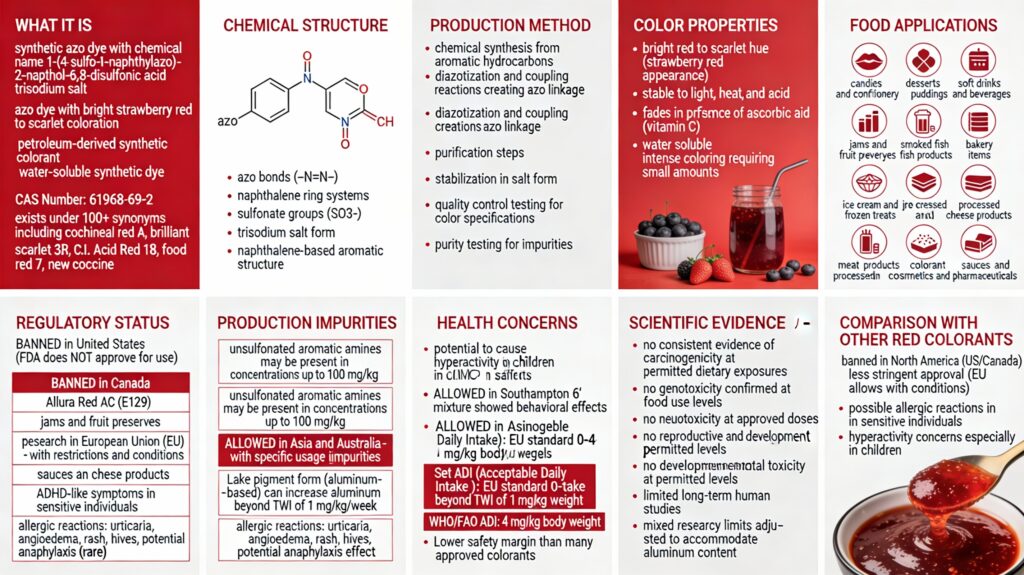
What is E124?
Complete guide to understanding E124 (Ponceau 4R) in your food
The Quick Answer
E124 is a synthetic red azo dye used to color foods bright red.
It’s used in foods like sausages, jams, and soft drinks to provide vibrant color.
It is banned in the USA and Canada, but approved in the EU with mandatory warning labels acknowledging it “May impair attention and activity in children.”
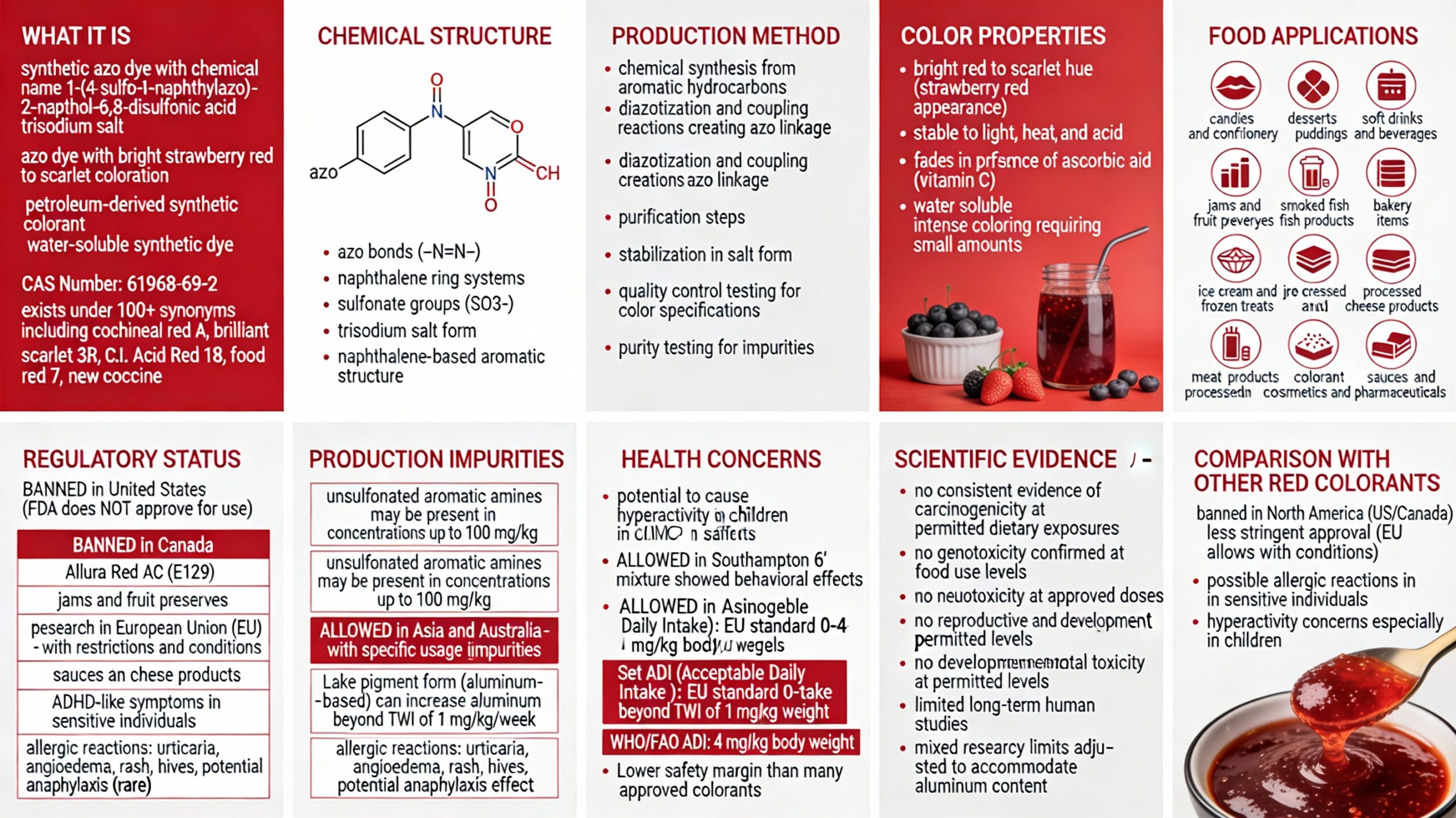
📌 Quick Facts
- Category: Synthetic azo food colorant (red dye)
- Also Known As: Ponceau 4R, Cochineal Red A, Food Red 7, New Coccine, FD&C Red No. 3 (different from E124)
- Made From: Petroleum/coal tar derivatives via chemical synthesis
- Found in (EU): Spanish sausages (chorizo, salchichón), jams, soft drinks, confectionery, salmon substitutes
- Status: BANNED in USA and Canada; EU approved with mandatory warning labels
- ADI (EFSA): 0–4 mg/kg body weight per day
- Safety Classification: RED – UNSAFE (due to hyperactivity, allergies, and regulatory bans)
What Exactly Is It?
E124 is a synthetic azo dye chemically derived from petroleum or coal tar.
Its chemical name is 1-(4-sulfo-1-naphthylazo)-2-naphthol-6,8-disulfonic acid, trisodium salt.
It’s also known by 100+ synonyms including Ponceau 4R, Cochineal Red A, Food Red 7, New Coccine, and Brilliant Scarlet 3R.
E124 is a bright strawberry-red azo dye that’s water-soluble and stable to heat, light, and acid (though it fades in the presence of vitamin C/ascorbic acid).
Like all azo dyes, it contains the –N=N– (azo) double bond structure that creates color but raises health concerns.
Where You’ll Find It (Geographic Differences)
In the European Union (where it’s approved but restricted):
• Spanish sausage specialties (chorizo, salchichón, sobrassada)
• Jams and jellies
• Soft drinks and beverages
• Confectionery and candies
• Salmon substitutes and processed fish products
• Some canned and processed foods
In the USA and Canada: NOT FOUND (banned)
Important: All EU foods containing E124 must carry a mandatory warning label stating: “May impair attention and activity in children”
Why Do Food Companies Use It?
E124 served/serves one purpose: provide bright, stable red coloring to products.
Manufacturers in the EU prefer it because:
Cost-effective: Cheaper alternative to natural carmine (E120) from cochineal insects.
Exceptional stability: Resistant to heat, light, and acid (though fades with vitamin C)—ideal for long shelf-life products.
Vibrant color: Produces bright strawberry-red color that appeals to consumers.
Regulatory approval (in EU): Approved in EU for specific food categories.
Is It Safe?
E124 is officially approved in the EU but is banned in the USA and Canada, with multiple documented health concerns including hyperactivity in children, allergic reactions, and possible genotoxicity.
The EFSA (European Food Safety Authority) sets an ADI of 0–4 mg/kg body weight per day.
However, the FDA never approved it, and its absence from the US food supply reflects FDA concerns about long-term safety.
⚠️ Critical Health Concerns – Why It’s Banned in USA & Restricted in EU:
1. Hyperactivity in Children (Strongest Evidence): The landmark 2007 “Southampton Study” published in The Lancet found that E124 combined with other synthetic dyes (Yellow 5/6, Red 40, Tartrazine) and sodium benzoate (E211) significantly increased hyperactivity and attention deficits in children ages 3–9 years. This is the primary reason the UK funded the research and why the EU now requires warning labels on all foods containing E124.
2. Allergic Reactions (Particularly in Aspirin-Sensitive Individuals): E124 causes allergic reactions in sensitive people: skin rashes, eczema, hives, shortness of breath, asthma-like attacks. Particularly problematic for asthmatics and individuals with salicylate intolerance.
3. Genotoxicity (DNA Damage): Laboratory and animal studies show mutagenic effects (DNA damage) at high doses. While not definitively carcinogenic in humans, the genotoxicity findings raise carcinogenic potential concerns.
4. Aluminum Content in Certain Formulations: When E124 is used as an “aluminum lake” (color bound to aluminum), it can increase aluminum intake beyond the safe tolerable weekly intake (TWI) of 1 mg/kg/week. Aluminum is suspected of promoting dementia, Alzheimer’s, Parkinson’s, hyperactivity, and ADHD.
5. Synergistic Effects with Other Additives: Studies show that E124 combined with other synthetic dyes and preservatives (sodium benzoate) produces synergistic (multiplied) behavioral effects—one plus one equals six, not two.
6. Neurotoxicity & Brain Effects: In combination with other additives, E124 shows neurotoxic effects that multiply when multiple additives are consumed together (typical in real-world diets).
What Are The Health Concerns?
E124 has multiple documented and serious health concerns:
Hyperactivity in children (PRIMARY CONCERN): The 2007 Southampton Study established a clear link between E124 combined with other synthetic dyes and hyperactivity in children. This is the most robust evidence and the reason the EU mandates warning labels. Despite regulatory approval, the EU acknowledges this concern sufficiently to warn consumers.
Allergic reactions: Well-documented cases of skin reactions (rashes, eczema, hives), respiratory symptoms (shortness of breath, asthma-like attacks), particularly in individuals with aspirin sensitivity, asthma, or salicylate intolerance.
Genotoxicity (DNA damage): Laboratory studies show mutagenic effects at high doses. While not proven carcinogenic in humans, the genotoxicity findings suggest potential cancer risk.
Aluminum lake concerns: When used as an aluminum lake formulation, E124 increases aluminum intake beyond safe limits. Aluminum is linked to dementia, Alzheimer’s, Parkinson’s, hyperactivity, and ADHD—and it mimics estrogen.
Synergistic effects: Combined with other dyes and sodium benzoate (E211), E124 produces multiplied behavioral and neurotoxic effects that exceed simple additive risk.
Regulatory divergence: The FDA’s non-approval and the USA/Canada bans reflect serious safety concerns despite EU approval. This regulatory disagreement signals genuine uncertainty about long-term safety.
Natural vs Synthetic Version
E124 is entirely synthetically manufactured—there is no natural form.
It’s produced through chemical synthesis from petroleum or coal tar derivatives.
E124 is actually marketed as a cheaper synthetic substitute for natural carmine (E120) derived from cochineal insects.
Natural Alternatives
Want to avoid E124?
Food companies use natural red colorants:
• Carmine/Cochineal (E120) – natural from insects (though has allergy concerns)
• Beetroot (E162) – natural red from beets
• Anthocyanins (E163) – natural red-purple from berries
• Allura Red (E129) – synthetic alternative (also under FDA elimination review)
• No coloring – accept naturally colored products
Natural alternatives are more expensive and may have different color/stability profiles, but they avoid the documented hyperactivity and allergy concerns.
The Bottom Line
E124 (Ponceau 4R) is a synthetic red azo dye that is banned in the USA and Canada but approved in the EU with mandatory warning labels acknowledging it “May impair attention and activity in children.”
Regulatory Red Flag: The difference in approval status between the USA (banned) and EU (approved with warnings) reflects genuine scientific disagreement and regulatory caution. The FDA’s non-approval suggests serious safety concerns.
Strongest Evidence: The 2007 Southampton Study linking E124 to hyperactivity in children is the most robust scientific finding. The EU’s response was to require warning labels—an acknowledgment that behavioral concerns are real enough to inform consumers.
Safety Classification: Classified RED – UNSAFE by food additive databases due to hyperactivity risk, allergic reactions, and regulatory bans in major markets.
If You Live in the EU: Check ingredient labels, particularly on Spanish sausages, jams, and soft drinks. Look for the warning label “May impair attention and activity in children.” If concerned, avoid E124 in favor of natural colorants.
If You Live in the USA/Canada: E124 is not present in your food supply—it’s banned. However, similar synthetic dyes (E129/Red 40, E110/Yellow 6, E102/Yellow 5) ARE permitted and have similar concerns, so the same caution applies.
For Children Particularly: Given documented hyperactivity links and the EU’s warning label, minimizing consumption of E124-colored foods is advisable, particularly for children with ADHD, asthma, or aspirin sensitivity.