What is E133?
Complete guide to understanding E133 (Brilliant Blue FCF) in your food
The Quick Answer
E133 is a synthetic bright blue triarylmethane dye used to color foods and beverages.
It’s used in soft drinks, desserts, confectionery, and baked goods to provide vibrant blue coloring.
It’s approved globally but has emerging health concerns including neurotoxicity, hyperactivity in children, allergic reactions, and potential organ damage that warrant caution and further research.
📌 Quick Facts
- Category: Synthetic triarylmethane food colorant (blue dye)
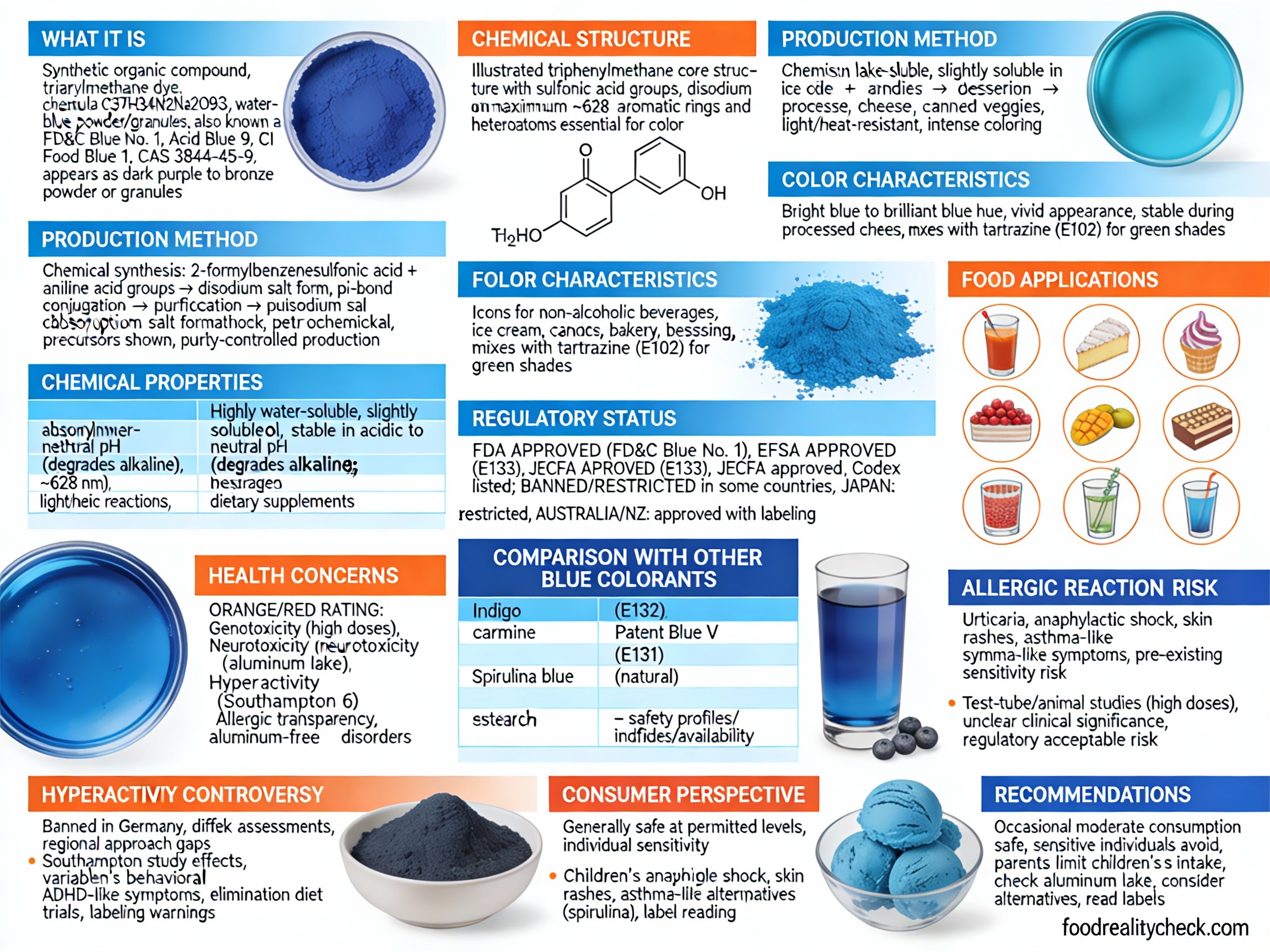
- Also Known As: FD&C Blue No. 1, Food Blue 2, Acid Blue 9, CI 42090
- Made From: Petroleum derivatives via chemical synthesis
- Found in: Soft drinks, desserts, confectionery, baked goods, dairy products, ice cream
- Safety: Approved but with emerging health concerns about neurotoxicity, hyperactivity, and genotoxicity
- ADI (EFSA/FDA): EFSA: 12.5 mg/kg body weight/day; FDA: 12 mg/kg/day
What Exactly Is It?
E133 is a synthetic triarylmethane dye chemically derived from petroleum.
Its chemical formula is C₃₇H₃₄N₂Na₂O₉S₂, commonly known as Brilliant Blue FCF, FD&C Blue No. 1, or Acid Blue 9.
It’s a bright blue powder that’s highly water-soluble, resistant to heat and light degradation, and stable across a wide pH range (works well from pH 3 to neutral/alkaline).
E133 is entirely synthetically manufactured; there is no natural source of this specific dye.
Where You’ll Find It
E133 appears in many common foods:
• Soft drinks and beverages (particularly sports drinks, energy drinks, juice drinks)
• Desserts and puddings
• Confectionery and candies (especially blue candies and lollipops)
• Baked goods (cookies, pastries, cakes with blue coloring)
• Ice cream and frozen treats
• Cereals and breakfast products
• Chewing gum
• Yogurts and dairy products
• Canned vegetables (in some jurisdictions)
• Cosmetics and medications (tablets, syrups)
• Vitamin jellies and supplements
E133 is one of the most commonly used blue dyes globally, particularly in beverages and confectionery targeting children and young adults.
Why Do Food Companies Use It?
E133 serves one purpose: provide vibrant, stable bright blue coloring to products.
Manufacturers prefer it because:
Intense color: Produces bright, unmistakable blue—more vibrant than natural alternatives.
Exceptional stability: Highly resistant to heat, light, and pH degradation, ideal for long shelf-life products.
Water soluble: Easily disperses in beverages and aqueous mixtures without special formulation.
Cost-effective: Cheaper than natural blue colorants (which are rare and limited).
Regulatory approval: Approved globally as safe, reducing manufacturer liability concerns.
No warning labels required: Unlike Yellow 5/6 (which require “may impair attention” warnings in EU), E133 has no mandatory warning labels despite similar concerns, making it attractive to manufacturers.
Is It Safe?
E133 is approved globally but has emerging health concerns about neurotoxicity, hyperactivity, genotoxicity, and organ damage that warrant caution.
The FDA approves E133 (Blue No. 1) with an ADI of 12 mg/kg body weight per day.
The EFSA set an ADI of 12.5 mg/kg per day.
However, approved ADI levels should not be interpreted as “completely safe”—they represent a regulatory threshold, not proven safety. Multiple emerging studies raise concerns:
⚠️ Emerging Health Concerns – Why Caution Is Warranted:
1. Neurotoxicity (Most Critical Concern): In vitro studies show E133 inhibits neurite growth and acts synergistically with glutamic acid, suggesting potential neurotoxic effects. This is particularly concerning for fetuses and infants under 6 months (underdeveloped blood-brain barrier) and children during critical neurodevelopmental windows.
2. Hyperactivity in Children (Disputed but Evidence-Based): Southampton studies and related research link synthetic food colors (including E133) to hyperactivity and behavioral problems in children. However, regulatory agencies dispute the magnitude of effect, and evidence is inconsistent. E133 is NOT required to carry the “may impair attention” warning that Yellow 5/6 require—despite similar concerns.
3. Genotoxicity & Cell Damage: Studies show E133 can cause genotoxic and cytotoxic effects in cell cultures at relevant exposure levels. It disrupts cell metabolism when entering the bloodstream.
4. Tumor Formation in Animal Studies (Inconsistent): While industry-sponsored studies found no carcinogenicity in rats/mice, an unpublished study suggested potential kidney tumors in mice. This discrepancy raises questions about study design and publication bias.
5. Purinergic Receptor Inhibition: E133 inhibits P2 purinergic receptors, which are critical for cell homeostasis, inflammation control, and apoptosis. Long-term inhibition could promote chronic inflammation and disease.
6. Allergic Reactions (Less Common Than Other Dyes But Documented): Rare but documented cases of skin rashes, hives, gastrointestinal discomfort, and bronchial constriction in sensitive individuals.
7. Degradation Products Unknown: E133 is not stable when consumed—degradation products have been identified in vitamin jellies and beverages. The health effects of these degradation products are largely unknown.
What Are The Health Concerns?
E133 has multiple emerging health concerns supported by research, despite FDA/EFSA approval:
Neurotoxicity (PRIMARY CONCERN): In vitro studies show E133 inhibits nerve cell growth and acts synergistically with glutamic acid. This is particularly concerning for developing brains (fetuses, infants, children) whose blood-brain barriers are incomplete. E133 can cross the blood-brain barrier.
Hyperactivity and ADHD-like behavior: Multiple studies (Southampton and others) link synthetic food colors to hyperactivity in children. While regulatory agencies dispute the magnitude, the evidence is compelling enough that Yellow 5/6 require warning labels—yet E133 does not, despite similar mechanisms.
Genotoxicity and cytotoxicity: Laboratory studies show E133 damages DNA and disrupts cell metabolism at relevant exposure concentrations. In test tubes at high doses, it damaged genes in rat cells.
Tumor formation in animals (conflicting evidence): An unpublished study suggested kidney tumors in mice; industry-sponsored studies found no carcinogenicity. This discrepancy raises publication bias and study design concerns.
Purinergic receptor inhibition: E133 inhibits P2 purinergic receptors critical for inflammation control and cell death (apoptosis). Long-term inhibition could promote chronic inflammation.
Allergic reactions: Documented cases of skin reactions, hives, gastrointestinal distress, and bronchial constriction in sensitive individuals.
Degradation products: E133 degrades during storage and consumption. Degradation products have been identified in vitamin jellies but their toxicity is unknown.
Synergistic effects with other additives: University of Liverpool study found that E133 combined with Yellow E104, glutamate (E621), and aspartame (E951) produced additive or synergistic neurobehavioral effects—suggesting safety assessments based on single additives may underestimate risk in real-world diets combining multiple dyes and additives.
Natural vs Synthetic Version
E133 is entirely synthetically manufactured—there is no natural version.
It’s produced through chemical synthesis from petroleum derivatives, not extracted from natural sources.
Natural Alternatives
Want to avoid E133?
Food companies can use natural blue colorants:
• Spirulina extract – natural blue-green algae (limited blue color)
• Butterfly pea flower (Clitoria ternatea) – natural bright blue from flowers
• Anthocyanins from berries – blue-purple natural pigments
• Indigo (E132) – natural indigo from plants (though also synthetic)
• No coloring – accept uncolored products
True natural blue colorants are rare and expensive, which is why synthetic E133 remains dominant. Butterfly pea flower is gaining use in premium/health-focused products.
The Bottom Line
E133 (Brilliant Blue FCF) is a synthetic blue dye with emerging health concerns about neurotoxicity, hyperactivity in children, genotoxicity, and organ damage that warrant caution despite regulatory approval.
Key Concern: Unlike Yellow 5 and Yellow 6 (which carry “may impair attention” warning labels in the EU due to behavioral concerns), E133 carries NO warning labels despite similar research linking it to hyperactivity and neurotoxicity. This is an inconsistency in regulatory approach that prioritizes industry interests over precaution.
Most Robust Evidence: Neurotoxicity in cell cultures (inhibits nerve growth), genotoxicity (DNA damage in cells), and hyperactivity linkage in children are the most well-supported findings. The blood-brain barrier penetration is particularly concerning for developing brains.
Publication Bias Concern: Industry-sponsored studies found no carcinogenicity; unpublished studies suggested tumors. This raises questions about selective publication and industry influence on safety assessments.
Synergistic Effects Unknown: E133’s effects are assumed independent, but combination with other dyes and additives (Yellow E104, glutamate, aspartame) produces additive or synergistic behavioral effects—meaning real-world risk may exceed assessments based on single additives.
If You Want to Minimize Exposure: Avoid blue-colored beverages (sports drinks, energy drinks), blue desserts, and blue candies—particularly for children. Choose products with natural colorants or uncolored alternatives.
For Children Particularly: Given underdeveloped blood-brain barriers and higher consumption rates relative to body weight, children are at higher risk from neurotoxic effects. The lack of warning labels (unlike Yellow 5/6) is a regulatory gap that leaves parents unaware of emerging concerns.
Regulatory Red Flag: E133’s approval without warning labels—despite evidence similar to dyes with warning labels—reflects inconsistent regulatory standards and suggests industry influence in safety assessment decisions. As FDA moves to eliminate Yellow 5 and Yellow 6, E133 should be re-evaluated with similar scrutiny.