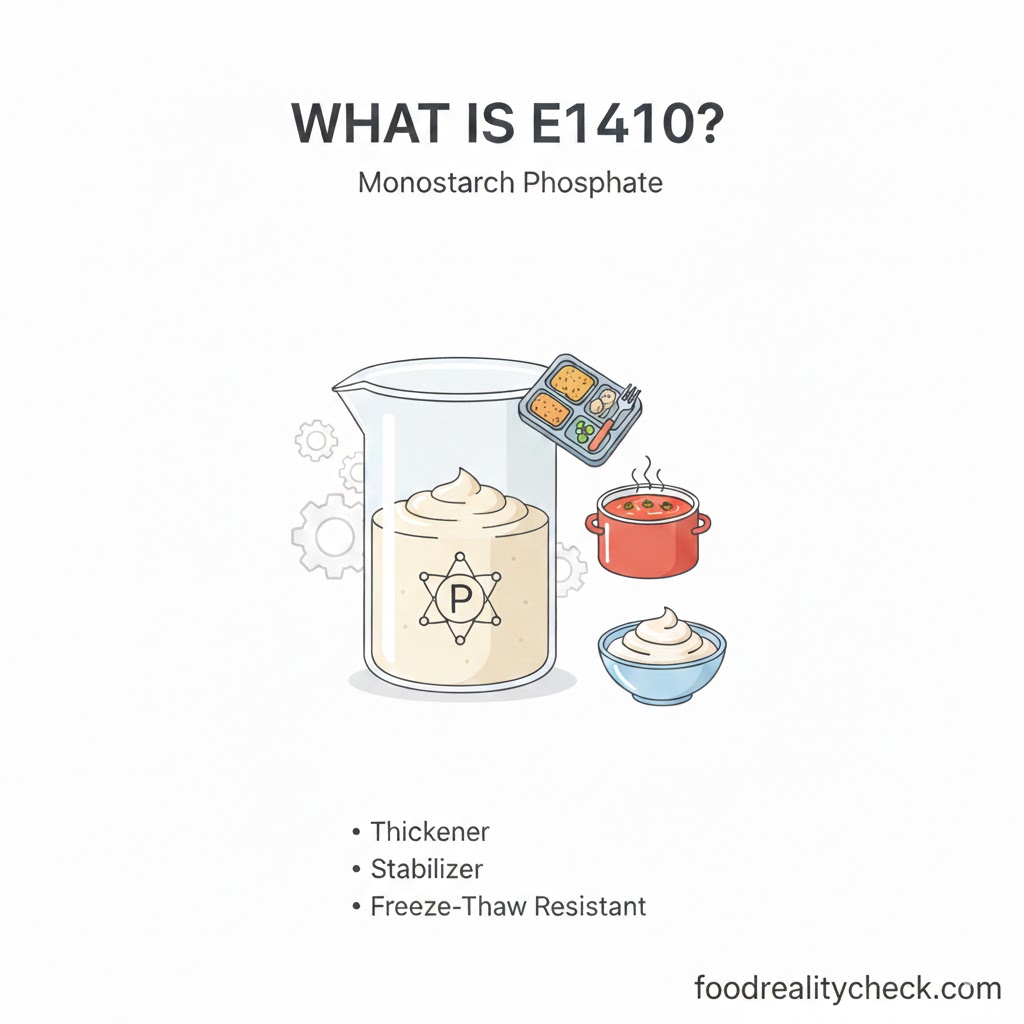
What is E1410?
Complete guide to understanding E1410 (Monostarch Phosphate) – the phosphorylated modified starch
The Quick Answer
E1410 is monostarch phosphate—a modified starch produced by esterifying native starch with phosphoric acid or phosphate salts (sodium phosphate, potassium phosphate, or sodium tripolyphosphate) to introduce phosphate groups onto starch molecules. It is derived from natural starch sources (corn, potato, wheat, tapioca) but undergoes chemical modification, making it a semi-synthetic or processed ingredient. E1410 functions as a thickener, stabilizer, emulsifier, and binder in food production, with superior water-binding capacity, improved freeze-thaw stability, and exceptional resistance to retrogradation (starch recrystallization) compared to native starch.
E1410 is approved globally as a safe food additive by JECFA, EFSA, FDA, and other regulatory authorities. The EFSA’s comprehensive 2017 re-evaluation of 12 modified starches (including E1410) confirmed safety with no need for a numerical ADI. E1410 is one of the most widely used phosphate-modified starches in the food industry, found in thousands of products where freeze-thaw stability, water-binding, or long-term storage are important (dairy products, sauces, gravies, ice cream, mayonnaise, baked goods). E1410 has approximately the same nutritional profile as native starch (providing 4 calories per gram) and similar blood sugar impact.
E1410 is part of the modified starch family (E1400-E1452), which represents some of the most extensively used food additives globally.
📌 Quick Facts
- Chemical: Monostarch phosphate; polymer of glucose units with phosphate groups esterified to hydroxyl groups
- Also known as: Monostarch phosphate, monosubstituted phosphate starch, INS 1410, E1410
- Chemical formula: Starch polymer with phosphate ester groups (-O-PO₃²⁻ or -O-PO₃H⁻)
- Esterifying agents: Orthophosphoric acid (H₃PO₄), sodium phosphate (Na₃PO₄), potassium phosphate (K₃PO₄), sodium tripolyphosphate (Na₅P₃O₁₀)
- CAS number: 9005-84-9
- INS number: 1410
- Physical form: White to off-white powder or granules; free-flowing
- Taste: Neutral; no taste
- Source: Derived from natural starch (corn, potato, wheat, tapioca); modified through phosphorylation
- Key properties: Superior water-binding, enhanced freeze-thaw stability, exceptional resistance to retrogradation, improved clarity, excellent viscosity stability
- Caloric value: 4 kcal/gram (same as starch and sugar)
- Glycemic Index: High (~70-80); similar to native starch
- Primary functions: Thickener, stabilizer, emulsifier, binder, antiretrograding agent
- Food uses: Dairy products, frozen desserts, sauces, gravies, mayonnaise, soups, baked goods, meat products
- Safety status: JECFA-approved; EFSA comprehensively re-evaluated (2017); FDA-approved; globally approved
- ADI (Acceptable Daily Intake): “Not specified” (JECFA, EFSA 2017)—no numerical limit needed; safe at all practical use levels
- Absorption: Not absorbed intact; hydrolyzed by intestinal enzymes and fermented by gut microbiota
- EFSA 2017 assessment: Comprehensive re-evaluation of 12 modified starches including E1410; concluded no safety concern
- Primary advantage: Superior retrogradation resistance; prevents starch “bleed-off” and water separation in stored foods
- Dietary restrictions: Vegan, vegetarian, kosher, halal-approved
- Regulatory trajectory: Stable; widely approved; no safety concerns
What Exactly Is It?
E1410 is produced by reacting native starch with orthophosphoric acid (H₃PO₄) or phosphate salts (sodium phosphate, potassium phosphate, or sodium tripolyphosphate) under controlled conditions, which esterifies phosphate groups onto the hydroxyl groups of starch molecules, creating monosubstituted phosphate ester linkages. This phosphorylation fundamentally changes the starch’s water-binding capacity, viscosity stability, and gel properties.
Think of monostarch phosphate as “phosphate-enriched starch”—the introduction of negatively-charged phosphate groups onto the starch polymer creates electrostatic repulsion between starch molecules, preventing them from clustering and gelling. This single chemical modification dramatically improves freeze-thaw stability, eliminates retrogradation, and enhances water-binding—making it ideal for products requiring long-term storage stability without separation or weeping.
Key characteristic: E1410’s most valuable property is exceptional resistance to retrogradation—the process where starch chains reassociate and crystallize during storage, causing weeping, texture degradation, and product separation. The phosphate groups introduce electrostatic repulsion that prevents this reassociation, allowing products to maintain perfect texture and water-holding for months.
Chemical identity:
• Primary component: Glucose polymers with phosphate ester groups covalently bonded to hydroxyl groups
• Substitution type: Monosubstituted (typically one phosphate group per several glucose units)
• Functional groups: Phosphate ester linkages (-O-PO₃²⁻ or -O-PO₃H⁻); negatively charged
• Linkage pattern: Primarily α-(1→4) and α-(1→6) glycosidic bonds (same as native starch)
• Degree of substitution: Typically 0.01-0.05 (1-5% of glucose units carry phosphate)
• Solubility: Water-dispersible or partially soluble, depending on substitution degree
• Viscosity: Enhanced viscosity stability compared to native starch
• Ionic character: Negatively charged due to phosphate groups; electrolyte-sensitive
• Color: White to off-white
How it’s made:
E1410 is produced from native starch through controlled esterification:
• Raw materials: Native starch (corn ~80%, potato, wheat, tapioca) suspended in water or slurry
• Esterifying agents: Orthophosphoric acid (H₃PO₄), sodium phosphate (Na₃PO₄), potassium phosphate (K₃PO₄), or sodium tripolyphosphate (Na₅P₃O₁₀)
• Esterification process: Phosphate reagent reacted with starch under controlled conditions (temperature, pH, duration)
• Mechanism: Phosphate groups bond covalently to hydroxyl (-OH) groups on glucose units, forming phosphate ester linkages
• Some depolymerization: Process typically causes some starch hydrolysis, reducing average chain length
• pH and temperature control: Carefully controlled to achieve desired degree of substitution
• Neutralization: Excess phosphate reagent removed or neutralized
• Optional additional treatments: May undergo acid, alkali, enzyme, or bleaching treatment per GMP
• Washing and drying: Product washed to remove excess chemicals, then dried
• Purity specification: EU and international standards require specific starch content and phosphorus limits (typically 0.4-1.0% phosphorus)
Where You’ll Find It
E1410 appears extensively in foods requiring superior water-binding, freeze-thaw stability, and retrogradation resistance:
Primary Food Applications:
• Dairy products (PRIMARY USE) – yogurt, puddings, custards, ice cream; stabilizer and thickener
• Frozen desserts (PRIMARY USE) – ice cream, sorbet, frozen puddings; prevents texture degradation and water separation
• Sauces and gravies (COMMON USE) – improved water retention, prevents separation and weeping
• Mayonnaise and emulsions – stabilizer; prevents oil separation
• Soups and broths – thickener; maintains consistency over storage
• Baked goods – moisture retention; improves texture and extends shelf life
• Meat products – binder; water-holding capacity; texture improvement
• Prepared/convenience foods – comprehensive stabilization through long storage
• Canned foods – prevents separation and syneresis during shelf storage
• Puddings and desserts – texture stability; prevents separation
Regulatory scope (widely approved): JECFA—Approved as INS 1410; listed in Codex GSFA Table 3; permitted per GMP in certain food categories. EU—E1410 approved; EFSA confirmed safe (2017). FDA—Approved as phosphorylated starch. Approved globally in virtually all countries.
Market prevalence: E1410 is one of the most widely used phosphate-modified starches. The ability to prevent retrogradation and maintain perfect texture during long storage makes it standard in premium dairy products, frozen foods, and shelf-stable prepared meals.
Why Do Food Companies Use It?
E1410’s primary advantage is exceptional retrogradation resistance and superior freeze-thaw stability, combined with excellent water-binding and viscosity stability.
Food manufacturers use monostarch phosphate for:
• Retrogradation prevention: Prevents starch reassociation and crystallization during storage; maintains perfect texture
• Freeze-thaw stability: Exceptional resistance to texture degradation during repeated freeze-thaw cycles
• Water-binding (humectant): Superior moisture retention; prevents weeping and separation; extends shelf life
• Syneresis prevention: Prevents water separation in gels, puddings, and emulsions
• Viscosity stability: Maintains consistent viscosity over storage time and temperature fluctuations
• Emulsion stabilization: Prevents oil separation in mayonnaise, dressings, sauces
• Gel stability: Improved gel formation and texture consistency
• Shelf-life extension: Maintains product quality for extended periods without separation or degradation
• Acid stability: Maintains viscosity and texture across pH ranges
• Texture improvement: Creates desired mouthfeel and consistency
• Cost efficiency: Economical way to achieve properties requiring otherwise expensive ingredients (eggs, gums)
• Regulatory approval: Universally approved; no restrictions on use levels
Key advantage: E1410 enables production of shelf-stable products with perfect texture maintenance—crucial for frozen foods, prepared meals, and dairy products requiring weeks or months of storage without separation or texture degradation.
Is It Safe?
✓ YES — E1410 IS SAFE
The EFSA’s 2017 comprehensive re-evaluation of 12 modified starches (including E1410) concluded: “There is no safety concern for the use of modified starches as food additives at the reported uses and use levels for the general population and that there is no need for a numerical ADI.”
Regulatory approval status:
• JECFA (WHO/FAO): Approved as INS 1410; ADI “not specified” (indicating highest confidence)
• Codex Alimentarius: Listed as INS 1410 in GSFA Table 3; permitted per GMP
• EU: Approved as E1410; EFSA comprehensively re-evaluated in 2017 (E1410 among 12 starches evaluated)
• FDA (USA): Approved as phosphorylated starch; classified as GRAS (Generally Recognized As Safe)
• Global approval: Approved in virtually all countries
Safety profile (EFSA 2017 assessment):
• No acute toxicity: Safe at all practical food use levels
• No chronic toxicity: Extensive short- and long-term toxicity studies show no harm
• No carcinogenicity: No cancer-causing potential; adequate carcinogenicity data reviewed
• No genotoxicity: No evidence of genetic damage; in silico analyses support this
• No reproductive/developmental effects: Safe for pregnant women, children, all populations
• Metabolic fate: Not absorbed intact; significantly hydrolyzed by intestinal enzymes; phosphate groups removed during digestion; glucose absorbed; remaining material fermented by gut microbiota
• Phosphorus residue: Phosphate groups are released during digestion; phosphorus is essential nutrient; no concern at food use levels
• No bioaccumulation: Fully metabolized to glucose and phosphate; completely eliminated
• ADI status: “Not specified” (both JECFA and EFSA 2017)—highest regulatory confidence
• Human tolerance: Modified starches (e.g., E1450) well-tolerated in humans up to single doses of 25,000 mg
• Exposure assessment: EFSA evaluated combined exposure to E1404-E1451 at 95th percentile: up to 3,053 mg/kg body weight/day; no safety concern
• No allergen potential: Not an allergen; suitable for all populations (though may contain trace gluten if wheat-derived)
• Long safety history: Used for decades without documented safety issues
• EFSA conclusion: “There is no need for a numerical ADI”
Important nutritional note:
• High glycemic index: E1410 has glycemic index (~70-80) similar to native starch
• Metabolically similar to starch: Although chemically modified, nutritional behavior is starch-like after digestion
• Calorie content: Provides 4 kcal/gram, same as native starch and sugar
• Blood glucose impact: Raises blood glucose similarly to refined carbohydrates
• Phosphorus source: Introduces small amount of phosphorus; not a concern at food use levels
• Not prebiotic: Unlike soluble fibers, does not selectively promote beneficial bacteria growth
✓ EFSA 2017 VERDICT ON MODIFIED STARCHES:
“Following the conceptual framework for the risk assessment of certain food additives, the Panel concluded that there is no safety concern for the use of modified starches as food additives at the reported uses and use levels for the general population and that there is no need for a numerical ADI.”
This statement applies to E1410 and 11 other modified starches. The determination of “no ADI needed” reflects the highest level of regulatory confidence based on comprehensive safety review.
Comparison: Phosphate-modified Starches
| E-Number | Type | Modification | Key Property | Primary Advantage |
|---|---|---|---|---|
| E1410 | Monostarch phosphate | Single phosphate groups on starch | Retrogradation resistance | Prevents texture degradation during storage |
| E1412 | Distarch phosphate | Cross-linked with phosphate; dual substitution | Cross-linked structure | Stronger gel; improved texture under stress |
| E1413 | Phosphated distarch phosphate | Cross-linked + single substitution combined | Dual properties | Both gel strength and retrogradation resistance |
| E1414 | Acetylated distarch phosphate | Cross-linked phosphate + acetylation | Multiple modifications | Enhanced thermal stability + gel strength |
The Bottom Line
E1410 (monostarch phosphate) is a safe, widely-approved modified starch that provides exceptional retrogradation resistance and freeze-thaw stability, making it essential for shelf-stable dairy products, frozen foods, and convenience meals requiring long-term storage without texture degradation. The EFSA’s 2017 comprehensive re-evaluation confirmed safety with no need for a numerical ADI limit.
Key facts: E1410 is safe at all practical food use levels. ADI “not specified” (EFSA 2017) indicating highest regulatory confidence. Approved globally in virtually all countries. Comprehensively evaluated by EFSA in 2017 along with 11 other modified starches; all concluded safe. Not absorbed intact; hydrolyzed and fermented; completely eliminated. No bioaccumulation.
Primary function: E1410’s main value is preventing retrogradation—the natural tendency of starch to crystallize and lose texture during storage. This allows frozen desserts to maintain perfect, creamy texture for months and allows shelf-stable products to avoid separation and weeping.
For consumers: E1410 is safe to consume. Products containing monostarch phosphate are not health risks. Nutritionally E1410 behaves like starch (not reduced-calorie, high glycemic impact), so it’s not suitable for low-sugar or low-GI diets. But it’s a well-established, thoroughly safety-evaluated stabilizer with exceptional regulatory confidence reflected in the 2017 EFSA determination of “no ADI needed.”
Important distinction: E1410 is fundamentally different from native starch in stability and functionality. The phosphate groups create electrostatic repulsion preventing retrogradation—a problem that plagues native starch products. This functional advantage is why E1410 is preferred for premium frozen desserts and long-shelf-life dairy products.
Bottom recommendation: E1410 is one of the safest and most thoroughly evaluated food additives. The 2017 EFSA re-evaluation representing comprehensive safety assessment of 12 modified starches is among the most rigorous food additive evaluations conducted. No precautions necessary. Consume freely. Not suitable for those restricting sugar/carbohydrates or managing blood glucose, but safe for general population. Essential for maintaining product quality in frozen foods and shelf-stable products.