What is E142?
Complete guide to understanding E142 (Green S) in your food
The Quick Answer
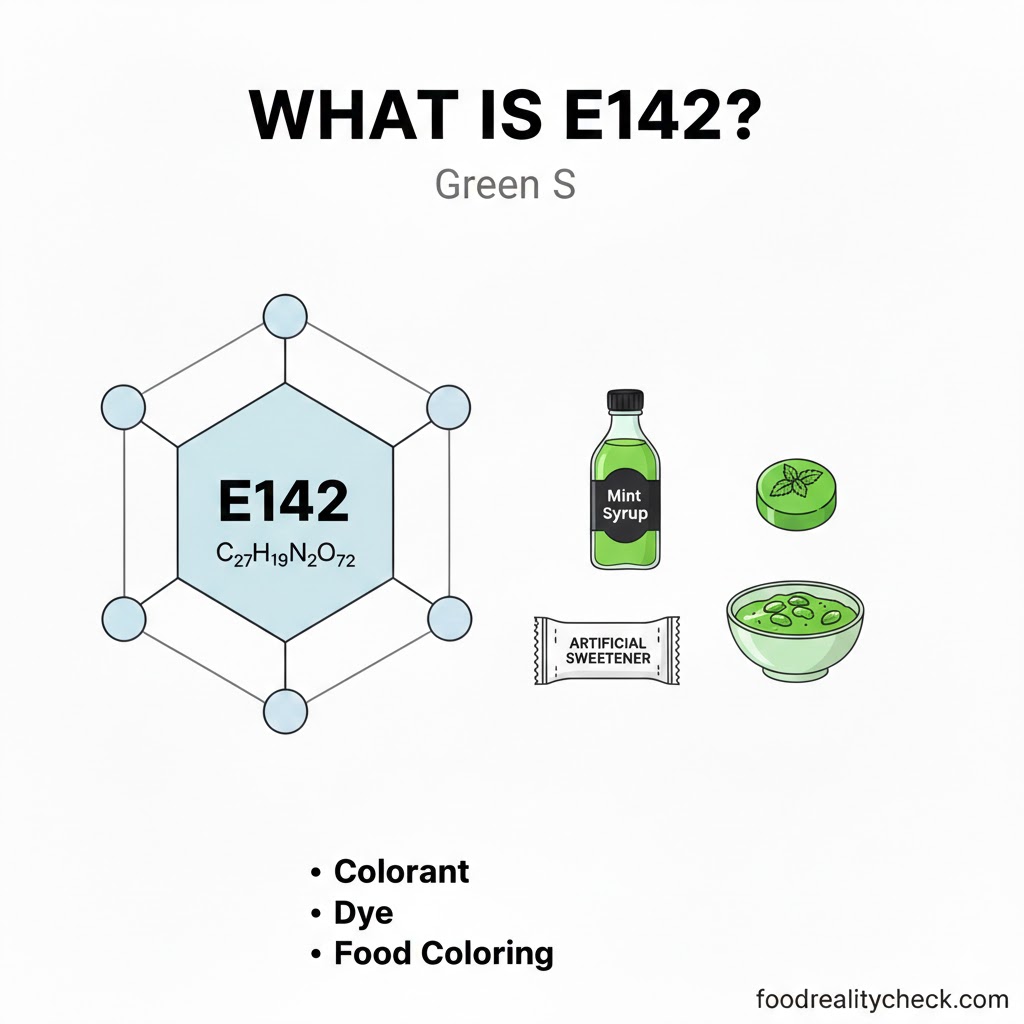
E142 is a synthetic green food dye.
It’s used in food to give products a bright green color.
It’s more common in Europe than in North America.
📌 Quick Facts
- Category: Synthetic food colorant (triarylmethane dye)
- Found in: Canned vegetables, sweets, mint sauces, desserts, and syrups
- Safety: Controversial – banned in some countries, approved in EU with restrictions
- Approved by: EFSA (Europe), but banned by FDA (USA), Health Canada, and Japan
What Exactly Is It?
E142 is made from synthetic coal tar derivatives.
Its chemical name is Green S (also called Acid Green 50 or CI Food Green 4).
The molecular formula is C27H25N2O7S2Na.
It’s a bright green water-soluble dye that remains stable during cooking and freezing.
Where You’ll Find It
E142 appears primarily in:
• Canned peas and green beans
• Mint sauces and candy
• Dessert toppings and syrups
• Ice creams and sorbets
• Powdered drink mixes
• Bakery products with green coloring
• Some pharmaceutical tablets and syrups
It’s most common in Europe and Australia but banned in the United States and Canada.
Why Do Food Companies Use It?
E142 does one main job: create an appealing bright green color.
This makes food look more appetizing and fresh.
It’s stable under heat and light, so the color doesn’t fade during cooking, storage, or freezing.
Food companies prefer it because it’s inexpensive and produces consistent color.
Is It Safe?
E142’s safety is highly debated and varies by country.
In the European Union, it’s approved with an ADI (Acceptable Daily Intake) of 5 mg/kg body weight per day.
However, the FDA banned it in the United States, Canada, and Japan due to inadequate long-term safety data and reports of allergic reactions.
What Are The Health Concerns?
E142 can potentially break down into aromatic amine compounds that raise toxicological concerns. Specific concerns include:
Allergic reactions: Reported cases of hives and asthma attacks
Behavioral effects: Possible link to hyperactivity in children
Organ accumulation: Studies suggest it may accumulate in liver and kidney tissue
Limited long-term data: Chronic safety studies are sparse
Natural vs Synthetic Version
E142 is always synthetic (made in a laboratory from coal tar derivatives).
There is no “natural” version of this specific dye.
It is chemically designed in a factory to achieve its bright green color.
Natural Alternatives
Want to avoid E142?
Food companies sometimes use these natural green colorants:
• Chlorophyll (E140) – extracted from plants
• Spirulina extract – from algae
• Spinach juice – natural plant extract
These natural alternatives work similarly but cost more.
So they’re used mainly in premium or health-focused products.
The Bottom Line
E142 is a synthetic green food dye that’s controversial and banned in many countries.
Although approved in the EU with safety limits, the FDA and health authorities in Canada and Japan have banned it.
If you have sensitivities to artificial dyes or concerns about long-term safety, natural alternatives are available.
The choice is yours – you have the right to know what’s in your food and make informed decisions.