What is E150?
Complete guide to understanding E150 (Caramel Color) in your food
The Quick Answer
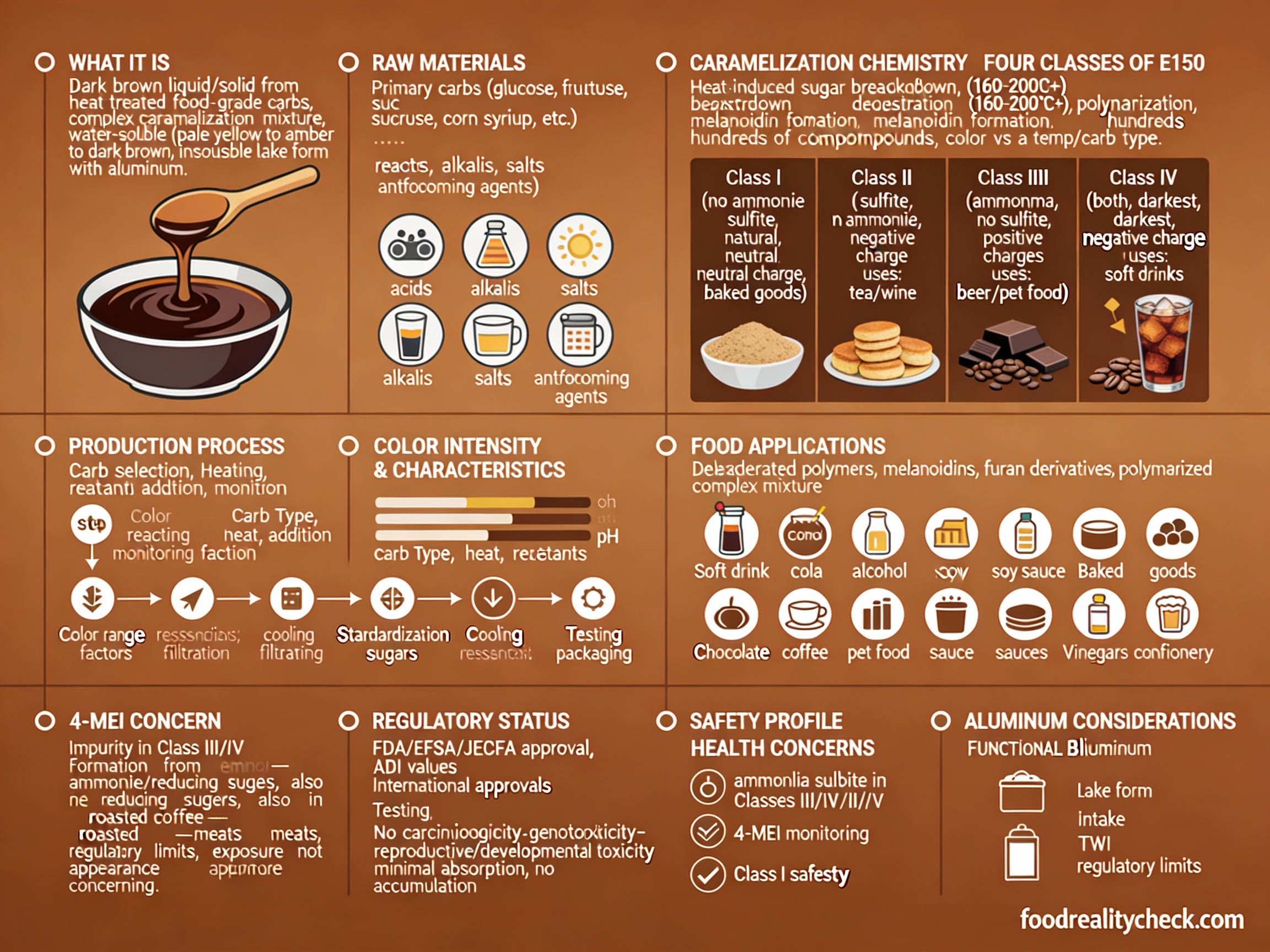
E150 is a group of four caramel-colored food dyes made by heating sugars.
It’s used in food to provide brown coloring, particularly in colas, sauces, and confectionery.
It’s one of the most controversial and debated food additives due to carcinogenic byproducts in certain types.
📌 Quick Facts
- Category: Synthetic caramel-based food colorant (four classes)
- Types: E150a (Plain), E150b (Sulfite), E150c (Ammonia), E150d (Sulfite Ammonia)
- Made From: Heated sugars (glucose, sucrose) with chemical reactants
- Found in: Colas, sauces, balsamic vinegar, confectionery, baked goods, spirits
- Safety: Approved but controversial; contains carcinogenic byproduct 4-MeI
- ADI (EFSA 2011): 300 mg/kg for E150a/b/d; 100 mg/kg for E150c (due to immunotoxicity)
What Exactly Is It?
E150 comprises four different caramel colors created by heating sugars under controlled conditions with different chemical reactants:
| Type | Name | Production Method | Color Range |
|---|---|---|---|
| E150a | Plain Caramel (Caustic Process) | Heated sugar only; no ammonium or sulfite | Pale yellow to dark brown |
| E150b | Sulfite Caramel (Caustic Sulfite) | Heated sugar with sulfite compounds (no ammonia) | Pale yellow to dark brown |
| E150c | Ammonia Caramel (Ammonia Process) | Heated sugar with ammonia compounds (no sulfite) | Pale yellow to dark brown |
| E150d | Sulfite Ammonia Caramel (Ammonia Sulfite Process) | Heated sugar with both ammonia and sulfite compounds | Pale yellow to dark brown (darkest of all) |
All E150 types are produced by incompletely decomposing, dehydrating, and polymerizing carbohydrates at high temperatures (160–200°C+)—a complex process that produces hundreds of chemical compounds in a mixture.
Where You’ll Find It
E150 appears in many common foods:
• Cola and dark soft drinks
• Soy sauce and sauces
• Balsamic vinegar
• Bread and bakery products (especially brown/dark products)
• Chocolate and confectionery
• Spirits and alcoholic beverages (brandy, whisky, rum)
• Beer
• Soy and tamari sauces
• Gravy and meat sauces
• Cough syrups and medicines
• Flavor extracts
• Some breakfast cereals
• Pickles and canned vegetables
Caramel color is one of the most widely used food colorants globally—it appears in thousands of products, particularly beverages.
Why Do Food Companies Use It?
E150 serves one essential function: provide brown coloring to foods.
E150 is the most economical and stable caramel color available. It’s:
Cost-effective: Made from inexpensive sugar, making it the cheapest color additive for brown shades.
Highly stable: Different types resist heat, acidity, and light differently, allowing manufacturers to choose the right type for their product’s processing conditions.
Naturally derived appearance: Caramel is a natural process (it occurs when you burn sugar when cooking), so consumers accept it as “natural.”
Globally available: It’s approved in nearly every country and has been used for 150+ years.
Is It Safe?
E150 is approved but highly controversial due to carcinogenic byproducts, particularly in ammonia-process types (E150c and E150d).
The FDA permits caramel color in food, considering it safe for consumption at approved levels.
The EFSA re-evaluated E150 in 2011 and established a group ADI of 300 mg/kg body weight per day for E150a/b/d, with a lower individual ADI of 100 mg/kg for E150c due to immunotoxicity concerns.
However, the contentious issue is 4-MeI (4-methylimidazole) and THI (2-acetyl-4(5)-tetrahydroxybutylimidazole)—byproducts created during the caramelization process, especially with ammonia and sulfite reactants.
What Are The Health Concerns?
E150 has several documented and controversial health concerns:
4-MeI (4-methylimidazole) carcinogenicity: The National Toxicology Program (NTP) reported “clear evidence of carcinogenic activity” in mice (lung tumors) in 2007. California listed it as a possible carcinogen under Prop 65. However, the FDA and EFSA argue the effect is thresholded (dose-dependent) and not relevant to human food exposure levels. Debate continues.
THI immunotoxicity: Studies showed that THI (another byproduct) may impair immune function in animal models. This led EFSA to set a lower individual ADI for E150c (Ammonia Caramel) of 100 mg/kg (instead of 300 mg/kg).
Gastrointestinal effects: Animal studies reported gastrointestinal issues at high doses, though human data are limited.
Risk-reduction by California and manufacturers: California mandated lower limits for 4-MeI in caramel color (150 µg/L), leading manufacturers to change production processes to reduce 4-MeI content in recent years.
Regulatory disagreement: The FDA maintains that caramel color is safe and poses no cancer risk at current use levels. The EFSA also approved it but with specific ADI limits. This disagreement between health authorities reflects genuine scientific uncertainty about human risk.
Natural vs Synthetic Version
E150 is synthetically manufactured (though from natural sugar).
While the starting material (sugar) is natural, the caramel color itself is created through an industrial chemical process involving high heat and chemical reactants (ammonia, sulfite, alkalis, acids)—it is not simply burned sugar.
E150 does not occur naturally in this form; it is entirely a factory product.
Natural Alternatives
Want to avoid E150?
Food companies sometimes use natural brown/dark colorants:
• Molasses or blackstrap molasses – natural brown color and flavor
• Cocoa powder – natural brown coloring
• Carob powder – natural brown alternative to cocoa
• Vegetable carbon (E153) – natural black color from wood ash
• No coloring – accept lighter colored products
• Food from whole ingredients – minimal processing without added colors
However, these alternatives are more expensive, impart flavor, or are less stable, so E150 remains the industry standard.
The Bottom Line
E150 is a synthetically manufactured caramel colorant that’s approved globally but controversially contains byproducts (4-MeI and THI) flagged as potentially carcinogenic in animal studies.
Regulatory divergence: The FDA considers it safe; California requires warning labels under Prop 65 for high 4-MeI content; the EFSA approved it with ADI limits but acknowledged immunotoxicity concerns for E150c.
What the science shows: Mouse studies (NTP) found clear carcinogenic activity, but these were at high doses. The relevance to human consumption at food-approved levels remains disputed.
Recent improvements: Manufacturers have reformulated caramel color since 2011 to reduce 4-MeI content, responding to California’s restrictions and consumer concern.
If you’re cautious: Minimizing consumption of heavily colored beverages (colas, dark sauces) is a prudent approach. Choosing lighter-colored alternatives or products with alternative colorants (E162 from beets, E160 carotenoids) avoids the controversy entirely.
For regulatory compliance: E150 is approved, but the presence of carcinogenic byproducts warrants close monitoring and potential further restrictions.