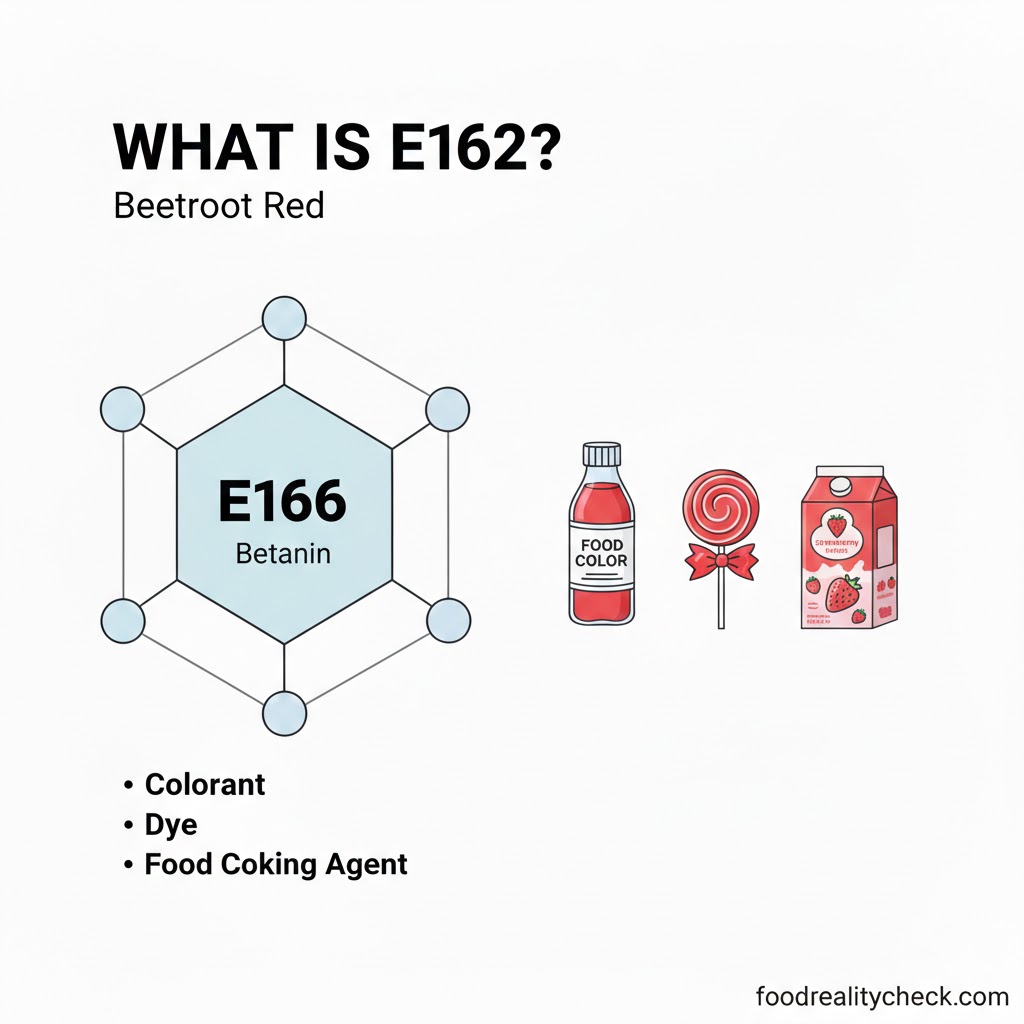
What is E162?
Complete guide to understanding E162 (Beetroot Red) in your food
The Quick Answer
E162 is a natural red food dye extracted from beetroot.
It’s used in food to provide vibrant red to purple colors without synthetic chemicals.
It’s one of the safest and most natural food colorants available.
📌 Quick Facts
- Category: Natural food colorant (betalain pigment)
- Common Name: Beetroot Red or Betanin
- Chemical Name: Betanidin-5-O-beta-glucoside
- Found in: Ice cream, yogurt, frozen desserts, soft drinks, confectionery, sauces
- Safety: Generally Recognized as Safe; no ADI limit established
- Approval Status: Approved by FDA, EFSA, and worldwide
What Exactly Is It?
E162 is made from the roots of red beetroot (Beta vulgaris).
The primary coloring compound is betanin, a type of betalain pigment—a unique class of nitrogen-containing plant pigments.
It’s extracted by pressing or aqueous extraction of shredded beet roots.
The extract contains betanin (the main red pigment), plus naturally occurring sugars, proteins, minerals, and other plant compounds from the beet.
The color intensity and shade depend on pH: between pH 4–5 it’s bright bluish-red, becoming blue-violet at higher pH levels.
Where You’ll Find It
E162 appears in many common foods:
• Ice cream and frozen desserts
• Yogurt and dairy products
• Soft drinks and powdered beverages
• Sugar confectionery and candy
• Fruit jellies, jams, and marmalades
• Meat and sausage products
• Soups and broths
• Sauces and dressings
• Cakes, muffins, and pastries
• Biscuits and cookie fillings
• Powdered drink mixes
It’s particularly popular in frozen products because of its stability in cold temperatures.
Why Do Food Companies Use It?
E162 serves one primary purpose: provide natural red to purple coloring.
It’s a premium choice among food manufacturers because it’s:
Naturally derived: From actual beetroot, giving a “clean label” appeal to consumers seeking natural ingredients.
Safe and approved: No documented health concerns, approved by major regulatory bodies worldwide.
Visually appealing: Creates vibrant red to purple hues that make products more attractive and appetizing.
pH-responsive: Changes color based on acidity (blue-red in acidic foods, blue-violet in neutral), providing versatility.
Companies use E162 instead of synthetic dyes (like Red No. 40) to appeal to health-conscious consumers and meet “natural” product claims.
Is It Safe?
Yes, E162 is considered extremely safe by all major regulatory bodies.
The FDA permits it as a color additive exempt from certification.
The European Food Safety Authority (EFSA) re-evaluated it and found no safety concerns.
No Acceptable Daily Intake (ADI) limit has been established—a designation reserved for substances with extremely low toxicological concern.
Research shows betanin is poorly absorbed, rapidly metabolized, and quickly excreted from the body, meaning it doesn’t accumulate.
What Are The Health Concerns?
E162 has virtually no documented health concerns.
Non-absorption and excretion: Betanin is only partially absorbed in the intestines and is rapidly metabolized and excreted, resulting in low systemic exposure.
No allergies: Clinical food allergy cases linked to E162 as a colorant are essentially non-existent.
Antimicrobial activity: Studies actually show that betanin may have natural antimicrobial properties, potentially offering preservation benefits.
Rare individual sensitivity: Although extremely rare, some individuals may show sensitivity to beetroot itself, though this is unrelated to the pigment E162 specifically.
Nitrate content: Some beet extracts may contain naturally occurring nitrates (common in beets), which health authorities recommend limiting in infants and very young children—but E162 levels in typical foods pose no risk.
E162 is essentially free of documented toxicological concerns in the scientific literature.
Natural vs Synthetic Version
E162 is completely natural—it’s extracted directly from beetroot.
There’s no synthetic version of E162; all sources are plant-based extraction from red beets.
The only processing involves pressing or aqueous extraction; the pigment itself is not chemically synthesized.
This makes it fundamentally different from synthetic dyes like Tartrazine (E110) or Allura Red (E129).
Natural Alternatives
E162 already IS the natural alternative.
If you want to avoid any food colorants (including natural ones), you can:
• Choose uncolored versions – many plain yogurts, ice creams, and products without added color
• Use whole beets – cook or juice fresh beets for color and nutrition
• Try other natural pigments – anthocyanins (E163) from fruits, or caramel color (E150)
• Eat “white label” products – foods marketed without any colorants
But for manufacturers seeking a safe, natural red colorant, E162 is already the optimal choice.
The Bottom Line
E162 is a naturally derived, plant-based food colorant extracted from beetroot with an excellent safety profile.
It’s one of the few E-numbered additives that is genuinely natural, safe, and offers no documented health concerns.
Regulatory bodies worldwide approve it without safety limits—a status reserved only for truly non-toxic substances.
If you’re choosing between synthetic dyes and E162 (betanin), E162 is unquestionably the safer, more natural option.
For consumers seeking “clean label” products with natural ingredients, E162 represents exactly what they’re looking for: a color additive derived from a whole food.